
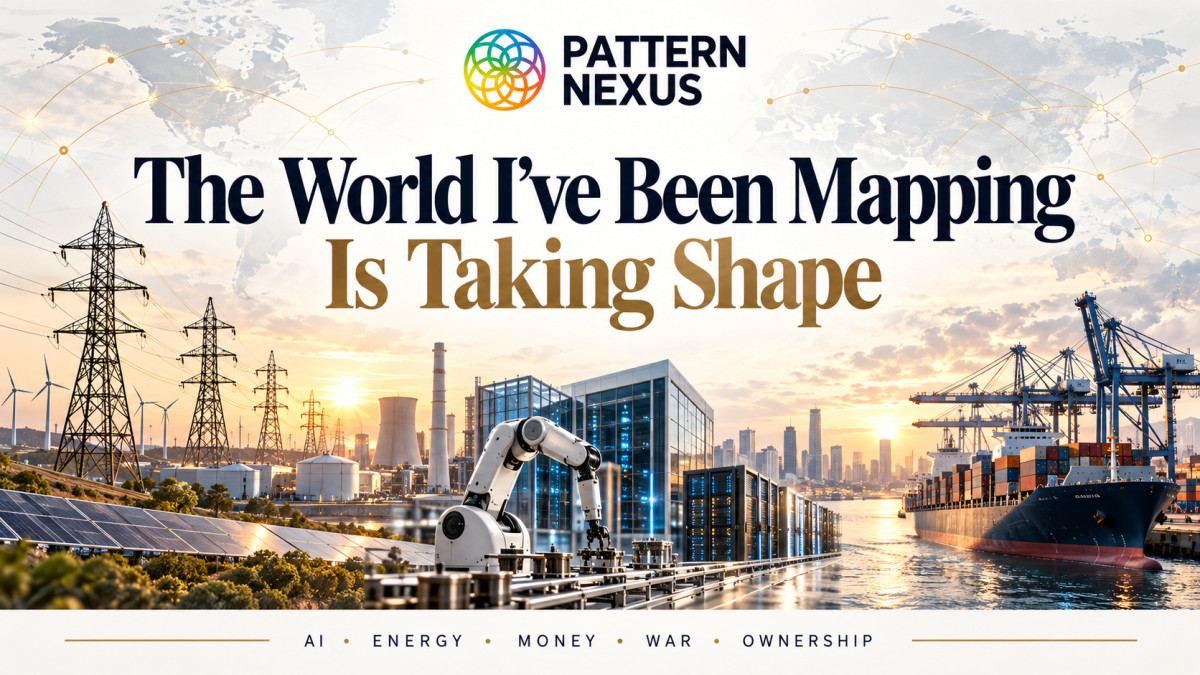
The World I’ve Been Mapping Is Taking Shape
I connect the developments now taking shape across AI infrastructure, private power, critical minerals, the Iran energy shock, digital dollars, machine commerce, robotics and productive ownership. The article explains the mechanisms for readers joining the discussion now, carries the research into September and October, and connects the later housing, Greenland, space, neural-computing and polar-vortex work. Includes links to 46 earlier Pattern Nexus articles, 53 numbered external sources, a practical watch list and six reader questions.
- AI is acquiring an industrial base. Power delivery, private generation, grids, materials and permission to build are becoming part of the competitive system.
- The energy shock travels through buffers and bottlenecks. Inventories, refining, diesel and fertilizer explain why the damage can arrive unevenly and with a delay.
- Digital dollars and AI operators are becoming connected. Banks are developing settlement infrastructure while payment networks build authorization around machine transactions.
- Robotics makes ownership more consequential. Producing more with machines does not automatically give everyone the income to buy what those machines produce.
- Practical control is expanding through access. Operating agreements, standards, software, identity and infrastructure can matter as much as formal ownership.
- The later research belongs in the picture. Housing, Greenland, space, neural computing and the polar-vortex sequence all add specific developments to the broader map.
For months, I have been writing about a world that was being reorganized underneath the headlines. AI was becoming an industrial buildout. Energy was becoming a source of economic and strategic control. Money was moving toward continuous digital settlement. Automation was turning ownership into an even more important dividing line.
Those subjects kept appearing in different articles because they are connected. A data center needs electricity and copper. A robot needs compute, machinery and financing. An AI operator needs permission to act and a way to pay. A household needs income to buy the output. A war can interrupt the fuel, shipping and financial conditions that hold the whole arrangement together.
We can now see more of that arrangement in actual contracts, physical infrastructure, banking products, military systems and household data. September and the first days of October have added important pieces.
If you have not been following every article, I want to bring you through the chain from the beginning. I will link the earlier work as we go, explain what is happening now, and identify the points where the next outcome still depends on decisions or conditions that have not arrived.
Capacity
The ability to build, power and operate the productive system.
Access
The rights, money and infrastructure needed to use that capacity.
Distribution
Who receives the returns, and who pays the cost of the transition.
01 · The framework
Start with the dependencies
A useful way to understand this period is to follow what each system needs in order to keep functioning.
The digital economy depends on physical power. Power infrastructure depends on equipment, fuel, minerals, land and financing. Finance depends on settlement, collateral and confidence. Households depend on wages, savings, credit and the prices of essentials. Strategic power comes partly from controlling the points where those dependencies meet.
That is the connection running through The World Is Not Normal Anymore, the AI industrial flywheel, and The Permission Stack. The system can expand its productive capacity while becoming more concentrated, more expensive to enter, and more sensitive to failures at a few important junctions.
Think about a cloud service you use every day. It may look like an application on a screen. Behind it are buildings, substations, cooling, network routes, insurance, financing and contracts. The service works because those layers keep working. Once you follow them, technology, geopolitics and household economics stop looking like separate subjects.
The question I keep returning to: Who owns the capacity, who controls access to it, and who absorbs the cost when a dependency becomes scarce?
02 · Compute and electricity
AI is becoming an industrial power system
When I wrote the industrial-flywheel article in November, the point was that AI demand could create a recurring cycle of physical investment. More compute requires more power, cooling, networking and construction. That investment supports more deployment, which can generate another round of demand.
The geography follows the electricity. In America’s New Map of Power and the Midwest and mega-region follow-up, I examined why locations with viable power connections, industrial land and room to expand become strategically important.
Meta’s January nuclear agreements point toward future capacity of up to 6.6 gigawatts. PJM, a regional U.S. electricity-grid operator, is working on the conditions under which major new demand can enter without undermining grid adequacy. Both show how far the AI competition reaches into the power system. Much of the contracted or proposed capacity still has to be delivered. [1] [2]
A chip can be manufactured and still sit behind a delayed power connection. A campus can be announced and still wait on transmission or generation. This is why I watch operating capacity, connection dates and reliability alongside model releases. The practical limit increasingly sits between the machine and the electricity it needs.
The buildout can therefore create real demand for equipment and construction even while individual projects have poor economics. Expansion across an industry does not make every investment sound. The financing has to survive long enough for the productive capacity to become useful.
03 · Capacity and permission
Private power is becoming a competitive asset
GW Ranch took that argument a step further: when the public grid cannot deliver power on the required schedule, large operators have an incentive to assemble more of the power system themselves.
Vertiv’s September 2 agreement to acquire UtilityInnovation Group is a direct commercial example. The proposed purchase adds capabilities around microgrid controls, onsite generation, storage and behind-the-meter design. The announced upfront price is approximately $1.45 billion, with possible additional consideration. It remains an acquisition agreement, with closing and execution ahead. [3]
Behind the meter means that part of the power arrangement sits on the customer’s side of the utility connection. An operator can coordinate its own generation, batteries and demand. That can improve its ability to start operating and manage interruptions, although fuel supply, permits and maintenance still matter.
The scarce asset becomes dependable time to power. Two companies can have access to similar processors and very different abilities to run them. One has a completed power arrangement; the other has a place in a queue.
The cost-sharing issue is becoming explicit too. A September 30 Senate proposal includes provisions assigning associated transmission costs to data centers. On October 2, Amazon announced more than $1 billion in additional community investment over five years alongside its data-center commitments. The legislation is proposed, and the spending is a future commitment. Both put local costs and political acceptance into the business model. [4] [5]
This is the terrain I examined in War, Backlash and Build-Out. Electricity bills, water, construction disruption and local consent can determine whether a technically possible project becomes an operating one.
04 · The upstream limit
The mineral constraint connects technology to geopolitics
The next dependency is upstream. Data centers and grids require copper. Motors and industrial equipment require metals. Semiconductors and solar manufacturing depend on specialized materials and processing.
In Copper in the AI-Industrial Era, I treated copper as a limit on the scale of the electrical buildout. The IEA’s 2026 outlook projects a potential copper supply gap of roughly 25% by 2035 under the announced-project pipeline. That is a conditional projection, but it identifies a serious mismatch between planned supply and demand. [6]
A higher commodity price can encourage investment. It cannot instantly produce a mine, a skilled workforce, refining capacity or a transmission line. Those processes take time. Rapid downstream expansion can therefore meet much slower upstream supply.
The Quiet War for Critical Minerals and The Quartz Chokepoint followed the strategic consequences. The Treasury’s January critical-minerals ministerial is one institutional example of governments treating access and supply-chain resilience as economic-security questions. [7]
There is another connection here that is easy to miss: mineral production can depend on chemicals and transport routes exposed to the same energy conflict affecting agriculture. Sulfuric-acid supply, for example, links parts of the mining and fertilizer systems. A disruption can move through several industries before it appears in the final product price. [6]
This is why I look beyond the apparent abundance of a resource. The relevant question is whether the required grade can be extracted, processed, financed and delivered where it is needed.
05 · Physical exposure
War can reach you through the cloud
The infrastructure connection becomes especially clear when physical damage interrupts digital services.
AWS’s March 2 service record described direct drone strikes on two facilities in the United Arab Emirates and physical impacts from a nearby strike at a Bahrain facility. Buildings and power were damaged, and cloud services were disrupted. Amazon later advised affected Bahrain customers to migrate workloads to other regions. [8] [9]
That gives us a concrete chain: a strike affects a facility; the facility loses part of its operating capability; applications hosted there become unreliable; customers have to relocate workloads. Distance from the conflict does not remove a business’s dependence on infrastructure inside it.
My energy-control essay and permission-stack framework explain the dependency. The May data-center report then examined the strikes and the wider strategic exposure after they occurred.
Redundancy helps, but it has a price. Extra regions, backup power, replication and recovery procedures all require resources. As more economic activity moves into cloud and AI systems, continuity becomes a strategic capability that somebody has to build and pay for.
06 · The energy clock
Hormuz works through access, inventories and time
My energy-war analysis has repeatedly focused on usable access. A shipping corridor can remain physically navigable while commercial throughput deteriorates because insurers, crews, owners or customers judge the risk unacceptable.
The February 28 escalation brief immediately connected the Iran conflict to shipping, oil, inflation and financial stress. The March 5 control-valve analysis followed how partial disruption could persist. The Clock Starts at Hormuz explained the time dimension: stored supplies can keep systems operating while their cushion is being consumed.
That cushion has been drawn down. The IEA’s September oil report put cumulative inventory draws since February at 507 million barrels, including a 95-million-barrel draw in August. Stocks absorb a mismatch between supply and use, but repeated draws reduce the buffer available for the next disruption. [10]
The June oil-cushion warning centered on that mechanism. A functioning market can be living off stored resilience. The visible shortage may arrive later than the original shock.
The latest export figures also matter. Reuters reported on October 5 that a seven-day moving average through September 30 had reached 18.3 million barrels a day, above the prewar average, even as tanker attacks increased. Improved exports show that the system can adapt and recover throughput while remaining exposed. [11]
For readers, the useful distinction is between a flow and a buffer. Exports measure a flow over a period. Inventories measure what remains in reserve. A stronger week of exports does not, by itself, tell us whether inventories, downstream supply and commercial confidence have recovered.
07 · The delayed household cost
The shock reaches trucks, farms and the next harvest
Crude oil is only the beginning of the transmission chain. The economy needs the right refined products in the right places. Refining capacity, product yields, shipping and regional stocks determine whether crude becomes affordable diesel or other usable fuel.
The EIA reported U.S. retail diesel at $6.29 a gallon on September 14, a nominal record in its series beginning in 1994. The inflation-adjusted 2022 peak was higher. The current nominal cost still matters to the trucker or farmer paying the bill today. [12]
The October 2 G7 declaration addressed energy security, including coordinated product measures. Its reference to 100 million barrels over four months implements the earlier March commitment; it should not be counted as an entirely new additional release. The attention to diesel and coordination shows why headline crude supply is an incomplete guide to downstream stress. [13]
Agriculture introduces another delay. Fertilizer must be affordable and available when planting decisions are made. Farmers can respond to expensive or delayed inputs by reducing application, changing crops or cutting planted area. The resulting production effect appears later.
FAO’s September 24 statement reported prices for DAP—diammonium phosphate, a widely used fertilizer—up 26% and delays affecting roughly 1.5–3 million tonnes of monthly fertilizer trade. Those are input conditions with consequences for later crop cycles. They do not establish the size of a future harvest loss today. [14]
This is the chain developed in The Fertilizer Strait. The 2027 risk depends on how fertilizer access interacts with weather, inventories, currencies and the ability of importing countries to finance purchases. A country can face severe food-access stress even while the world continues producing substantial quantities of food.
The same connected view runs through the global oil-war report. Fuel, shipping and agricultural inputs link strategic decisions to household costs. The bill can arrive months after the original event.
08 · The revised macro path
The Iran conflict changed the monetary sequence
A forecast has conditions. When a major energy conflict changes those conditions, the next forecast has to use the new world.
Before the Iran escalation, the expected interest-rate path rested on a different energy and inflation environment. After February 28, my framework moved through the consequences of constrained energy access: higher costs, pressure on inflation, tighter financing, then the possibility of weaker demand and later intervention.
The March system essay, July cut-trade analysis and September CPI and hike-option report belong to that sequence. The September report assigned a combined 80% probability to branches involving a hike at the September meeting. The Fed raised its target range to 3.75–4% on September 16. [15]
My phase-two duration-control thesis looks further ahead. It concerns the possibility that financing stress eventually forces intervention in longer-term government debt. That remains a conditional scenario over the next six to twelve months, into 2027.
The earlier plumbing transition has already happened: balance-sheet runoff ended December 1, and Treasury-bill reserve-management purchases began in December. Supporting short-term reserves and intervening to control longer-term financing costs are different operations, with different triggers. [16] [17]
Gold belongs in this monetary picture too. My October 2025 gold article discussed a conditional $5,000–$6,000 zone. Gold reached $5,594.82 on January 29. The market entered that zone; the move does not establish a permanent floor. [18]
The continuing question is how long inflation pressure, financing costs and economic weakness can coexist before the policy balance changes again.
09 · Money and settlement
The dollar is moving into a new settlement structure
In The Tokenized Reserve Era and Stablecoins, Treasuries, and the Synthetic Liquidity Engine, I connected digital settlement with the institutions and reserve assets behind the dollar.
A stablecoin is a privately issued claim intended to hold a stable value. A tokenized bank deposit is a bank deposit represented on a digital ledger. They have different legal and balance-sheet structures. Both can be used to make money transferable within systems designed for continuous settlement.
On September 1, 21 financial institutions announced plans for a stablecoin enterprise, with an initial dollar product targeted for the first half of 2027, subject to approvals. Wells Fargo separately announced tokenized deposits for corporate and commercial clients, beginning with a limited rollout and planned expansion. [19] [20]
The Federal Reserve’s September 24 proposals address reserves and supervision for payment-stablecoin issuers it oversees. The December SEC staff action concerning the Depository Trust Company, a central part of U.S. securities settlement, provides another example: a voluntary permissioned tokenization pilot inside established market infrastructure. [21] [22]
The CFTC’s September staff guidance updates add another part of the institutional framework around crypto and blockchain activity. Guidance, proposals and pilots are different stages of adoption; the common thread is that digital-market infrastructure is being addressed inside established institutions. [53]
The direction is institutional. Existing banks, regulators and market operators are incorporating digital rails into the financial system. Issuers need reliable reserve assets. Users need confidence that the digital claim can be redeemed. Settlement needs a legal framework.
Moving a dollar claim onto a new rail does not automatically create new net purchasing power. What changes is how it can circulate, when settlement can occur, and which applications can interact with it. Those operational changes become more important as automated systems begin buying services and executing transactions.
10 · From answers to action
AI operators are acquiring the ability to transact
A machine that can identify a useful service still needs a way to obtain it. That means an account, funds, authorization and settlement.
Coinbase’s September 22 release gives agents access to paid data or model services through x402, a protocol for software payments on the web, and to equity trading within user-defined limits. Mastercard launched Agent Pay for Machines in June and added new trust and intelligence services in September. Anthropic’s Project Swap studied agents negotiating for people in a controlled market. [23] [24] [25] [26]
These are early operating pieces of the Universal Intelligence Economy. An agent can be given a task, obtain an input, pay for it, and continue. A business can potentially delegate part of a purchasing or execution process to software.
The immediate change is in the cost and speed of coordination. Some transactions that previously required a person to compare options, approve a purchase and move information between systems can become part of an automated workflow.
The authority remains important. Spending limits, permitted assets, identity and revocation determine what the agent can do on somebody’s behalf. A payment-enabled agent is still operating inside an arrangement built and authorized by people and institutions.
Watch the connection among payment, identity and execution. A model answering a question and an operator authorized to spend money have very different economic roles.
11 · Authority and access
Permission becomes part of the transaction
The permission-stack framework follows the layers that decide whether an action can proceed: identity, account status, standards, access rights and continuity.
Mastercard’s September trust-services announcement brings identity, intent, behavioral signals and fraud information into agent-led authorization. That is an operational example of permission being attached to execution. The system has to determine who authorized an action and whether the action fits the authority granted. [25]
For readers, imagine an AI operator buying a service for your business. The technical ability to make the purchase is only one requirement. The account must be accepted. The transaction must fit your limits. The provider must trust the payment. The network must permit it. Each layer has rules and an operator.
In What’s Happening to Our World?, I followed how these access systems can accumulate across finance, infrastructure and administration. They can make services safer and more efficient while also concentrating decisions about eligibility.
The European digital-identity wallet framework is another existing part of that picture, with wallets expected by the end of 2026. Its legal framework was already in place. The point is how identity systems become part of the practical route into services, and what rights accompany their use. [52]
How that power is used will depend on law, competition, institutional design and public choices. I am watching who can change the rules, how a person can challenge a denial, and whether practical alternatives remain available. Access is valuable precisely because losing it can stop an otherwise capable person or business from acting.
12 · Embodied production
Robotics is moving through real industrial tasks
The humanoid-robot article asks what changes when intelligence becomes productive physical labor. A general-purpose body could eventually operate in places built for people, but commercial usefulness still has to be established task by task.
BMW’s September update describes a new AEON pilot at Leipzig and an earlier Figure 02 trial at Spartanburg. In the earlier trial, the robots assisted production of more than 30,000 X3 vehicles, handled about 90,000 components and accumulated roughly 1,250 operating hours. That earlier experience predates my August report; the new pilot extends the industrial learning process. [27]
The economic test is dependable productive time. How many useful hours can the robot deliver? How much supervision does it need? What happens when it fails? What do maintenance, power, insurance and financing cost?
Anthropic’s September 30 research makes that distinction concrete. It estimates wide technical exposure to robotic capabilities but finds far narrower current cost competitiveness under its assumptions. Capability creates a possible substitution. Reliability and economics determine whether a company actually makes it. [28]
Defense manufacturing is following a related path. Anduril and Voyager’s September partnership covers advanced weapons and propulsion, with an existing pipeline exceeding $60 million and a stated route toward high-rate production. Anduril also reports large-scale production of a modular weapon built for standardized interfaces. [29] [30]
My Port Alpha and autonomous-shipbuilding article examined how software, autonomy and manufacturing could be organized together. Standardized interfaces can make suppliers and production more interchangeable. Scaling then becomes an industrial and procurement problem as well as a software problem.
13 · Hiring and adjustment
The labor change can begin before unemployment shows it
One of the distinctions in the August universal-intelligence report is between labor-equivalent capability and measured unemployment. A machine becoming able to perform a task does not mean a worker is immediately dismissed.
A company can reduce new hiring, leave vacancies unfilled, reorganize tasks or ask existing staff to produce more. An established worker and a graduate seeking a first job can therefore experience the same transition differently.
Anthropic’s March labor study found suggestive slowing in younger-worker hiring in exposed occupations without a systematic unemployment increase. September graduate research examines exposure-related employment and earnings difficulties, while a separate NBER comparison does not find a broad summer unemployment spike. The findings remain mixed and depend on the population and measure. [31] [32] [33]
That is why I watch hiring, entry routes, compensation and task redesign alongside the headline unemployment rate. A weaker ladder into work can matter long before it produces a clear national unemployment signal.
The larger 2030–2035 scenarios in my report remain scenarios. They depend on deployment speed, cost, institutional response and demand. The near-term question is whether firms turn capability into sustained productive use and whether the resulting gains reach workers, customers and owners in different proportions.
14 · Who receives the return
More output does not guarantee broad purchasing power
This is the distribution problem running through The Two-Tier Future. If machines do more productive work, income increasingly depends on how the returns from those machines are allocated.
A person who owns productive infrastructure can benefit from output, fees or capital gains. A person relying on wages may face weaker bargaining power in some tasks while still paying for housing, energy and access to services. The economy can become more capable without making entry into that economy easier.
The unstable-barbell report describes the coexistence of a strong capital-investment economy and strained household financing. An AI campus under construction and a household cutting discretionary spending can belong to the same economic expansion.
The IMF’s current AI assessment also emphasizes uneven gains and financing risks. The distribution question is already present, even though the eventual employment and asset-price outcomes remain uncertain. [34]
There are several possible paths. Broad ownership, competition and falling prices could spread a productivity dividend. Concentrated ownership and expensive access could create a sharper divide. Public policy can affect both the ownership of assets and the channels through which income reaches households.
The distinction matters because productive capacity and purchasing power have to meet. Machines can make more goods and services; somebody still needs the means to obtain them. The design of that connection will shape the social consequences of automation.
15 · Assets and affordability
Housing already shows the split between owners and entrants
Housing is a familiar example of how aggregate wealth and practical access can diverge.
The Great Housing Plateau focused on a market where existing asset values can stay high while the ladder becomes harder to climb. The September 30 housing study updated that argument with prices, inventory, financing and buyer-payment data.
The September 29 Case-Shiller release reported approximately 1.9% annual nominal national price growth for July, against 3.4% consumer inflation. It described fourteen consecutive months of real annual home-price declines. A nominally higher index can therefore coexist with erosion in purchasing-power terms. [35]
Even that does not settle affordability. A new buyer has to finance today’s price at today’s rate. An established owner may have an older fixed-rate loan and equity accumulated over years. The same neighborhood can be financially comfortable for one household and inaccessible to another.
Inventory measures also need context. More months of supply can reflect slower sales as well as more homes. A rental vacancy, an occupied property and a home offered for sale are different parts of the housing system.
The connection to my wider work is access. An asset can continue supporting an owner’s wealth while providing a weaker route into ownership for the next buyer. That is one way an economy develops a division between people already inside and people paying current entry costs.
16 · Access and escalation
Strategic control often arrives through operating rights
In Greenland as a Control Plane, I focused on practical strategic rights: access, basing, routes and the ability to operate. Those can change without a country changing its flag.
The September defense agreement expands the relevant arrangements while retaining Danish sovereignty and Greenlandic self-determination. It is a concrete example of the mechanism: strategic access changes through an agreement. It is neither annexation nor a literal Compact of Free Association. [36]
The same attention to mechanisms runs through my Venezuela escalation article and December flashpoint analysis. They examined movement from pressure toward direct confrontation. The January 3 capture of Maduro brought that confrontation into the open. [37]
The January Iran decision-window article and retaliation and escalation indicators followed force posture, airspace, embassy movements and regional exposure. February 28 then brought the confrontation and immediate shipping suspensions. [38]
I follow those indicators because they affect the range of possible next actions. An airspace change can alter operational freedom. A basing agreement can alter reach. Shipping risk can raise the economic cost of confrontation. The consequence is larger than the isolated diplomatic or military announcement.
The connected oil-war report brings the theaters together through energy routes, sanctions, replacement demand and financing. Different governments can pursue different objectives while their actions interact through shared markets and infrastructure.
Cuba remains an open watch. On September 26, I put possible military action in a roughly 90–120-day window, extending into January 2027. September reporting describes fuel shortages, blackouts, pressure and negotiation. Those are current conditions; the military-action scenario is still ahead of us. [51]
17 · Interfaces and dependence
Software and standards determine which machines can run
Power is also exercised through interfaces. A company can possess hardware and still depend on another ecosystem’s software, developer tools or intellectual property.
DeepSeek’s September Ascend release adds a concrete compute-library example to the U.S.–China competition. A usable library helps developers move workloads within an ecosystem. That is meaningful progress, but it does not establish a complete replacement for CUDA, NVIDIA’s GPU-computing software platform, or the removal of all compatibility constraints. [39]
Huawei’s October 5 announcement of a broad patent agreement with Qualcomm covers important areas of connectivity and computing, subject to regulatory approvals. It also shows continuing interdependence between firms operating inside a strategic rivalry. [40]
A standard can determine whether components communicate. A license can determine whether a manufacturer can sell a product. A library can determine whether developers can use a processor efficiently. These are practical control points below the headline level.
This is another application of The Permission Stack. I watch the layers that determine whether a system can operate, because access to the visible product does not always include freedom from the dependencies underneath it.
18 · Beyond terrestrial infrastructure
Space is becoming an operating environment
My Project Suncatcher article examined the implications of moving compute beyond terrestrial campuses. The later space-infrastructure report connected orbital computing with communications, launch, servicing and strategic security.
Google’s October 1 update advances Suncatcher through a prototype stage. It does not mean a commercial gigawatt orbital data center is already operating. The Space Force’s September acknowledgment of on-orbit space-control weapons provides a separate security development without publicly resolving every detail of the capability. [41] [42]
The system question is straightforward. A satellite network needs launch, tracking, communication and continued operation. Orbital compute needs a way to move useful information to and from users. Assets require protection or resilience if they become economically or militarily valuable.
As those capabilities accumulate, space becomes infrastructure on which terrestrial systems depend. Failure or denial in orbit can affect services on the ground. The operating environment therefore includes commercial capacity, security, standards and access, much as it does on Earth.
19 · Structure, models and embodiment
Neural computing is advancing along distinct paths
The mind-uploading roadmap laid out a sequence of problems: map a nervous system, model its dynamics, connect it to inputs and outputs, and determine what has actually been preserved.
Google’s September connectomics work reports a complete mapping of the male fruit-fly central nervous system. A connectome maps neural connections, improving the structural information available for modeling. An independent Minecraft implementation connects a derivative of a fly connectome to a closed-loop environment, with disclosed engineered reflexes and other manual elements. [43] [44]
My fly-brain article examined why that pipeline matters. Structure can become a model; a model can receive input, produce action and receive feedback. A behaviorally useful model still has to be distinguished from a faithful preservation of an individual organism’s learned state.
Singapore’s living-neuron computing work follows a different branch. NUS and its partners announced a biological-computing prototype using living neurons. It explores biological material as a computational substrate. It is not an uploaded human mind. [45]
These developments give us working pieces to examine. Human-scale mapping, learned-state preservation and personal continuity remain much harder questions. The progress is in building and testing parts of the process, with the next experiment becoming more concrete than the last.
20 · The actual atmospheric sequence
The polar-vortex watch followed a sequence
The atmospheric research follows a different physical system, but the method is the same: identify the variables, follow their development, and test the next stage.
My early September watch separated circulation geometry from wind strength. Unusual organization did not mean that every strength metric was equally extreme. The next question was whether the organization, strength and depth would persist over the following one to two weeks.
The September 18 update then addressed a new stage. Date-matched wind records had been exceeded, while the forecast showed the positive anomaly fading and wave forcing increasing. I did not forecast uninterrupted strengthening.
The daily series used here shows the sequence continuing through October 2: record-level date-matched winds in mid-September, followed by a fade relative to climatology. On September 20 the analyzed 60°N, 10-hPa wind was 14.62 m/s, above the prior date-matched maximum of 13.84 m/s. By October 2 it was 13.03 m/s against a 14.77 m/s mean. [46]
Those comparisons are relative to the time of year. A seasonal mean can rise while the observed wind fluctuates. The question is how unusual the wind is for that date, rather than whether it increases every day.
The solar relationship still requires attribution work. Wave forcing and other atmospheric drivers can affect the same outcome. A matching sequence does not isolate one cause, and September behavior does not determine the full 2026–27 winter. The next test is how the vortex develops as the season progresses.
21 · Evidence and interpretation
New observations sharpen the historical and physical questions
The same distinction between observation and interpretation applies to the other research threads.
The Göbekli Tepe article follows new evidence concerning intact burials, human remains and domestic uses at the site. The underlying study adds specific observations to the discussion of how the site functioned. It cannot settle every larger claim about prehistoric civilization on its own. [47]
The Higgs-entanglement discussion connects my theoretical interests with experimental work from ATLAS. The experiment has to be understood on its own terms. Establishing an entanglement result within that analysis does not independently validate my entire field framework. [48]
For readers, the important habit is to keep the measured result attached to the question it can answer. A new discovery can change the range of plausible explanations without proving the largest interpretation available.
22 · Institutions and interaction
AI’s institutional role makes accountability practical
The questions in my 2022 AI ethics paper, republished this summer become more immediate when AI systems affect transactions, hiring or access. Bias, responsibility and trust have to be handled inside operating institutions.
The September 29 AI accord describes internal controls, monitoring, outside evaluations and board oversight. It is a governance arrangement, with possible later legal codification. Alongside agent-payment authorization, it shows accountability being translated into procedures that organizations can implement. [49]
There is also a human side to the operating system. In The AI Is the Same. The System Isn’t, I explain how shared vocabulary, accumulated context and working methods change a sustained human–AI interaction.
A March EACL study documents linguistic accommodation by language models to users’ conversational styles. That research is relevant to the interaction mechanism, rather than a later event forecast. A system can respond differently because the available context is richer without the underlying model weights being retrained. [50]
That distinction matters as people delegate more consequential work. A familiar interaction can become more useful, but familiarity does not remove the need to check authority, reasoning and results. Trust has to rest on what the system can reliably do in the role it has been given.
23 · The next stage
What I am watching from here
The pieces are becoming easier to see together. AI is acquiring power and industrial infrastructure. Money is acquiring continuous digital rails. Operators are acquiring the ability to transact. Robotics is extending automation into physical tasks. Strategic control is being exercised through access, agreements and interfaces.
The next stage depends on conversion: promises into operating capacity, technical capability into profitable deployment, and productive gains into income people can use.
| Connection | The next practical test |
|---|---|
| AI and power | Generation and grid connections delivered on schedule; dependable operating capacity; the allocation of local costs. |
| War and essentials | Inventories rebuilt, reliable refined-product supply, fertilizer delivered before planting, and financing available to importers. |
| Digital money and agents | Approved launches, redemption and settlement reliability, usable authorization, and accountability when an automated transaction fails. |
| Robotics and labor | Repeatable productive hours, competitive total cost, hiring changes, and the route by which people share in the return. |
| Assets and households | Real purchasing power, current entry costs, household cash flow and access to ownership. |
| Research frontiers | The next measured result: atmospheric development, orbital performance, neural-model validation or a discriminating physical experiment. |
Some of those tests are close. Others extend into 2027 or the 2030s. Keeping the timing attached to the mechanism is essential. A new banking announcement, a robot pilot and a future harvest risk are all consequential, but they occupy different points in their respective sequences.
What I have been mapping is increasingly present in the working structure of the world. The task now is to follow who can turn that structure into durable productive capacity, who retains access, and how the returns and costs are distributed.
24 · The reading chain
The earlier articles, connected
The earlier articles below develop the individual links in this chain. Start with the system framework, then follow the subject you want to understand in more detail. The later reports carry the argument into September and October.
The system and its control points
- The World Is Not Normal Anymore
- AI Isn’t a Bubble — It’s a Monetary-Industrial Engine
- The Permission Stack: Narrative, Rails, Standards, Identity, and Continuity in the Age of Control Systems
- What’s Happening to Our World? AI, Agenda 2030 & Control
AI’s power and material base
- America’s New Map of Power: Data Centers, Grid Shortfall, and the AI Industrial Build-Out
- America’s New Map of Power: Mega-Regions, AI Data Centers, and the Re-Industrialization of the Midwest
- GW Ranch: Texas Builds Private Grids for the AI Flywheel
- War, Backlash and Build-Out: The 2026 AI Data Center Report
- Copper in the AI-Industrial Era: Why the World Is Running Out of the Metal That Powers Everything
- The Quiet War for Critical Minerals: How Resource Control Defines the Next Century
- The Quartz Chokepoint: Silica, Semiconductors, Solar, and the Quiet Resource That Runs the Modern Machine
Energy, buffers and the food cycle
- Energy Control- Grid Interdependence, Fuel Corridors, and Blackout Leverage
- The Clock Starts at Hormuz: Oil Corridors, Timed Failure, and the Real Architecture of Dependency
- The Oil Cushion Is Breaking: Hormuz, Inventories, and the Global Economy
- Iran, Ukraine and the Global Oil War
- The Fertilizer Strait: 2027 Global Food-Shock Risk
The monetary sequence
- Israel Strikes Iran: Escalation Ladder
- Mar 5, 2026 Market Wrap (8:40 PM): VIX Won’t Relax, Gold Leads, and the Hormuz “Control Valve” Stays Partially Closed
- Fed Minutes and the Broken Cut Trade
- August CPI Activates the Fed’s Hike Option
- QE 2026 Phase Two: Fed Duration Control Probability
- Gold at $4,300+: This Isn’t a Bull Run — It’s a System Reset
Money, machines and ownership
- Tokenized Reserve Era: AI Industrial Dominance and the New Operating System of the World Economy (1980–2040)
- Stablecoins, Treasuries, and the Synthetic Liquidity Engine
- The Universal Intelligence Economy
- The Real Reason They Are Building Humanoid Robots
- Port Alpha vs the Shipyard Graveyard: How a Three-Year-Old Startup Is Trying to Rebuild the U.S. Navy With Autonomous Warships
- Two Economies, One Balance Sheet
- The Two-Tier Future: War, Demand Destruction and AI Ownership
Housing and the entry cost
- The Great Housing Plateau: Why the American Dream Is No Longer a Ladder
- Housing in 2026: Case-Shiller, Inventory and Buyer Payments
Strategic access and escalation
- Greenland as a Control Plane: COFA Talk, Arctic Basing, and the Real Levers
- Venezuela on the Brink — From Quiet War to Open Confrontation
- The Venezuela Flashpoint: Why the U.S. Just Locked Down Airspace and Shifted the Caribbean Chessboard
- The Iran Decision Window: What the CBS Briefing Actually Signals
- Iran’s Decision Window: Blackout, Embassy Pullbacks, Airspace Closures, and the Retaliation Math (Jan 14, 2026)
Space and neural computing
- Google’s Space-Based AI Data Center Gambit: Project Suncatcher and the New Compute Frontier
- Space Infrastructure 2026: Orbital AI, Weapons & Networks
- Toward Mind Uploading in an Era of Exponential AI Acceleration: A Detailed Roadmap and Prospects for 2025–2050 and Beyond
- Fly Brain in Minecraft: The Mind-Uploading Pipeline Is Starting to Exist
- Human Neurons in a Data Center: Singapore’s CL1 Rack
Atmosphere, archaeology and physics
- Polar Vortex Watch 2026–27: Solar Quieting, a 10 hPa Record, and the Next Test
- Göbekli Tepe Human Burials 2026: 10,000-Year-Old Remains & New Evidence
- Higgs Entanglement and the ESFD Field Test
AI accountability and sustained interaction
25 · FAQ
Questions readers may have
These are the questions that connect the individual developments back to the larger argument.
What is the main connection among these developments?
AI and automation depend on physical infrastructure, financial settlement and permission to act. Their social effect depends on ownership and purchasing power. Following those dependencies connects technology, energy, war and household economics.
Has the entire future described in the earlier articles already arrived?
Several operating pieces are now concrete, including power agreements, digital-money initiatives, agent-payment capabilities and industrial robot trials. Larger outcomes—such as the 2027 food cycle, widespread profitable robotics and the 2030s labor scenarios—still depend on future conditions.
Why did the interest-rate outlook change after the Iran conflict?
The conflict changed the energy, inflation and financing conditions. My later analysis used that changed environment, moving through energy pressure, tighter financing and the possibility of later economic weakness and intervention.
Does stronger oil throughput mean the energy shock has ended?
Higher exports are a meaningful improvement. They must be read alongside inventories, refining, product availability, transport risk and import financing. Different parts of the supply system can recover at different speeds.
Why can investment expand while households remain under pressure?
Investment and household income can follow different paths. Owners may benefit from productive assets while new buyers and wage-dependent households face current financing and living costs. The distribution of returns determines how much additional capacity becomes broadly usable purchasing power.
Did the polar-vortex watch predict continued strengthening?
No. It followed early organization and date-matched records, then a forecast fade in the positive anomaly with increasing wave forcing. The later daily series showed that fade. Solar attribution and the full winter remain further questions.
Sources and notes
Earlier Pattern Nexus work is linked in the article and reading chain. Numbered references below identify the underlying announcements, data releases and research used for the current developments.
- [1] Meta, nuclear-energy projects supporting American AI infrastructure, January 9, 2026
- [2] PJM, large-load integration and system-adequacy work
- [3] Vertiv, agreement to acquire UtilityInnovation Group, September 2, 2026
- [4] U.S. Senate Environment and Public Works Committee, American Affordability and Jobs Act introduction, September 30, 2026
- [5] Amazon, Built Together data-center community commitments, October 2, 2026
- [6] IEA, Global Critical Minerals Outlook 2026, executive summary
- [7] U.S. Treasury, critical-minerals ministerial, January 12, 2026
- [8] AWS, service-health record of Gulf infrastructure impacts, March 2026
- [9] Amazon, Bahrain-region response to the Middle East conflict, March 24, 2026
- [10] IEA, Oil Market Report, September 2026
- [11] Reuters, Middle East exports above prewar levels amid increased tanker attacks, October 5, 2026
- [12] U.S. EIA, September 2026 retail-diesel price record, September 18, 2026
- [13] G7, declaration on global energy security and market stability, October 2, 2026
- [14] FAO, fertilizer access and food-security statement, September 24, 2026
- [15] Federal Reserve, monetary-policy decision, September 16, 2026
- [16] Federal Reserve, policy-normalization record
- [17] Federal Reserve Bank of New York, Treasury-bill reserve-management purchase announcement, December 10, 2025
- [18] Reuters, gold’s January 2026 record-price move
- [19] Wells Fargo, 21-institution stablecoin-enterprise announcement, September 1, 2026
- [20] Wells Fargo, tokenized-deposit rollout announcement, August 4, 2026
- [21] Federal Reserve, proposed payment-stablecoin reserve and supervisory requirements, September 24, 2026
- [22] SEC, statement concerning the DTC tokenization pilot, December 11, 2025
- [23] Coinbase Developer Platform, agent access to equities and x402 services, September 22, 2026
- [24] Mastercard, Agent Pay for Machines, June 10, 2026
- [25] Mastercard, agentic-commerce trust and intelligence services, September 30, 2026
- [26] Anthropic, Project Swap controlled agent-market experiment, September 24, 2026
- [27] BMW Group, humanoid-robot pilot at Leipzig and earlier factory experience, September 21, 2026
- [28] Anthropic, What Work Can Robots Do?, September 30, 2026
- [29] Anduril and Voyager, advanced-weapons and propulsion partnership, September 29, 2026
- [30] Anduril, modular WOSA-compliant weapons production
- [31] Anthropic, labor-market impacts of AI, March 5, 2026
- [32] U.S. Census Bureau, graduate employment and AI exposure working paper, CES-WP-26-56
- [33] NBER, graduate labor-market comparison, working paper 35796
- [34] IMF, AI Deployment and Disruption, Annual Report 2026
- [35] S&P Dow Jones Indices, July 2026 Case-Shiller results, released September 29, 2026
- [36] U.S.–Denmark–Greenland agreement amending defense arrangements, September 2026
- [37] Reuters, U.S. capture of Venezuela’s president, January 3, 2026
- [38] Reuters, shipping suspensions following the February 28 Iran escalation
- [39] DeepSeek, DeepGEMM-Ascend primary repository
- [40] Huawei, broad patent agreement with Qualcomm, October 5, 2026
- [41] Google Research, Project Suncatcher prototype update, October 1, 2026
- [42] U.S. Space Force, on-orbit space-control weapons announcement, September 14, 2026
- [43] Google Research, complete male fruit-fly central nervous system connectome, September 3, 2026
- [44] Fly Brain in Minecraft, implementation and validation documentation
- [45] NUS Medicine, DayOne and Cortical Labs biological-computing prototype, August 17, 2026
- [46] NASA Ozone Watch, 2026 MERRA-2 60°N, 10-hPa wind series; values used through October 2
- [47] PLOS ONE, Göbekli Tepe burials and settlement evidence, September 2026
- [48] ATLAS, Run 3 Higgs four-lepton analysis, June 2026
- [49] White House Accord on Super-Intelligence, September 29, 2026
- [50] EACL 2026, linguistic convergence in human–AI interaction
- [51] Reuters, Cuba pressure and the U.S. call for a different path, September 29, 2026
- [52] European Commission, digital-identity wallet questions and answers
- [53] CFTC, updated staff guidance on crypto and blockchain activities, September 24, 2026
Current developments are described as of October 5, 2026. Dates refer to the cited announcements or releases; economic releases can measure earlier periods. The polar-vortex comparisons use the daily series through October 2, with later forecast values kept separate from observations.
Power, money, productive capacity and access belong in the same picture. That is the picture I will keep following.
What's Your Reaction?
 Like
0
Like
0
 Dislike
0
Dislike
0
 Love
0
Love
0
 Funny
0
Funny
0
 Wow
0
Wow
0
 Sad
0
Sad
0
 Angry
0
Angry
0

Founder of Pattern Nexus. I research markets, macro, geopolitics, AI, history, ancient systems, and the patterns most people overlook. I’m also building Market Radar, a trading scanner designed to read pressure, risk, confirmation, and setup quality before chasing a move. Pattern Nexus is where I connect the dots between data, history, technology, and the bigger system playing out around us.

Comments (0)