

Accountability Over Immaturity: Budapest, History, and How Leaders Should Answer Fair Questions
Budapest isn’t just a backdrop. It symbolizes a promise — one where Ukraine gave up nuclear weapons in exchange for security assurances that were later broken. A journalist asked a fair question about that history, and instead of professionalism, we got immaturity. Here’s why acknowledging history still matters. A…
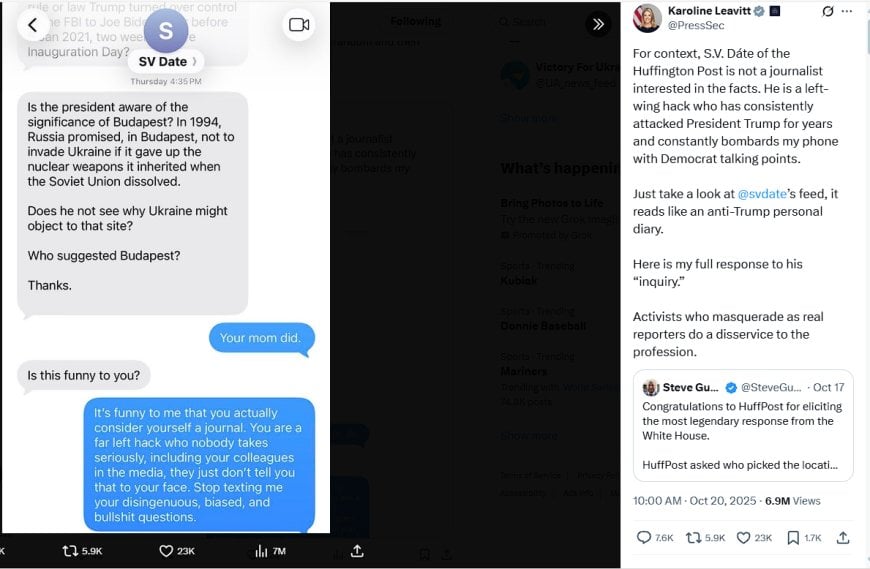
Budapest isn’t just a backdrop. It symbolizes a promise — one where Ukraine gave up nuclear weapons in exchange for security assurances that were later broken. A journalist asked a fair question about that history, and instead of professionalism, we got immaturity. Here’s why acknowledging history still matters. A…
Jump to a section
Accountability Over Immaturity: Budapest, History, and How Leaders Should Answer Fair Questions
I try to stay away from this kind of commentary, but this one deserves a real response. A journalist asked a straightforward, relevant question: does the administration recognize the historical significance of Budapest as a meeting site? That is not “gotcha” politics—it’s context. And context matters.
Why? Because “Budapest” evokes a concrete moment in the post–Cold War order. In December 1994, Ukraine acceded to the Nuclear Non-Proliferation Treaty as a non-nuclear state and received security assurances in the Budapest Memorandum (see also the UN filing S/1994/1399), signed by the United States, the United Kingdom, and Russia (with parallel statements from France and China). Those assurances included respect for Ukraine’s independence, sovereignty, and existing borders, and a commitment to refrain from the threat or use of force except in line with the U.N. Charter.
That historical backdrop is inseparable from today’s diplomacy. Ukraine surrendered what was then the world’s third-largest nuclear arsenal—roughly 1,900 strategic warheads, plus ICBMs and strategic bombers—transferring the remaining warheads to Russia by 1996 as part of the denuclearization process (Arms Control Association; Brookings—The Trilateral Process).
Given that history, a professional answer was available. Something like: “Yes, we’re aware of the historical precedent, but we’re focused on building a durable way forward. The meeting location doesn’t determine the progress we aim to make.” That acknowledges the past without letting symbolism derail substance.
Instead, the public saw a needlessly hostile reply. That’s a mistake on two levels. First, it signals insecurity when leaders dismiss fair questions with insult. Second, it forfeits a chance to put today’s choices in the wider arc of policy, which is how serious people communicate about war, peace, and security guarantees.
There’s also a deeper layer the public deserves to hear. Debates about NATO enlargement and “assurances” to Moscow have simmered for decades. In early 1990, U.S. officials—famously Secretary of State James Baker—floated phrases like “not one inch eastward” during talks with Mikhail Gorbachev about German unification. Scholars and archives note those were political statements made in a specific context, not a binding treaty limitation on future NATO policy; nonetheless, they shaped Russian expectations and later grievances (National Security Archive; PolitiFact analysis via NSA PDF).
Pointing that out is not “taking a side.” It’s recognizing that today’s chessboard is built on yesterday’s moves—and on ambiguities left unresolved. Likewise, acknowledging that the Clinton-era U.S. diplomacy helped both enable Ukraine’s nuclear disarmament and set the stage for NATO’s “open-door” approach gives the public a truer picture of how we got here (Wilson Center—New Sources from the Clinton Library).
So, no: this isn’t about Trump vs. Biden, or left vs. right. It’s about accountability and the standard of communication we should expect from people in power. Adults can disagree, concede valid context, and still argue for the policy they believe is right. That’s how you model leadership.
Where does that leave Budapest today? As a symbol, it cuts both ways. For Ukrainians—and for nonproliferation advocates worldwide—it represents a bargain: give up nuclear arms in exchange for security assurances. Russia’s subsequent violations of Ukraine’s territorial integrity turned “assurances” into a cautionary tale, one that Kyiv’s leaders regularly cite when arguing for legally binding guarantees or stronger forms of deterrence (Wilson Center Issue Brief; Harvard Belfer Center).
Leaders don’t have to fear that context. They should own it. Acknowledge the history. Explain how today’s approach is meant to correct failures of the past. Then make the case for the policy on the table. That’s the opposite of name-calling—and it’s the minimum the public should expect.
Bottom Line
Budapest is not just a city on a calendar invite. It’s a reminder of promises made, arsenals dismantled, and the costs of ambiguity. If we want a better future, start by treating fair questions fairly—and by answering with the dignity the subject deserves.
Key Sources & Further Reading
• United Nations Treaty Collection: Budapest Memorandum
• UN Filing S/1994/1399 (full text PDF)
• Arms Control Association: Ukraine & Security Assurances (at a glance)
• Brookings: The Trilateral Process (PDF)
• National Security Archive: NATO Expansion—What Gorbachev Heard
• PolitiFact analysis (via National Security Archive PDF)
• Wilson Center: New Sources on NATO Enlargement
What's Your Reaction?
 Like
0
Like
0
 Dislike
0
Dislike
0
 Love
0
Love
0
 Funny
0
Funny
0
 Wow
0
Wow
0
 Sad
0
Sad
0
 Angry
0
Angry
0

Nexus (Christopher)
Founder of Pattern Nexus. I research markets, macro, geopolitics, AI, history, ancient systems, and the patterns most people overlook. I’m also building Market Radar, a trading scanner designed to read pressure, risk, confirmation, and setup quality before ch…
Related research
Trump Orders Immediate Resumption of U.S. Nuclear Weapons Testing — I Didn’t See This Coming
President Donald Trump has directed the Pentagon to immediately resume U.S. nuclear weapons testing, citing Russia and China. What happened…
2 shared topics, 1 shared asset, same research avenue.
Berlin Turns €1.3B Ukraine Aid Into a Drone-and-Winter-Energy Deterrence Stack
German Chancellor Friedrich Merz used an Oct. 4, 2026 visit to Kyiv to announce more than €1.3 billion in new support for Ukraine. The pack…
2 shared topics, same research avenue.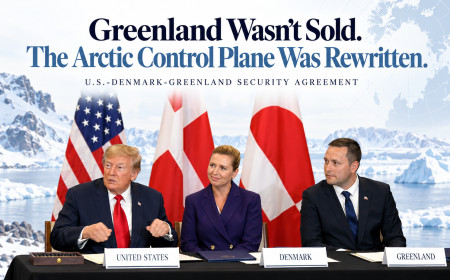
Greenland Wasn't Sold. The Arctic Control Plane Was Rewritten.
Greenland wasn't sold or annexed. The September 22, 2026 U.S.–Denmark–Greenland security agreement expands Pituffik, provides for defense a…
2 shared topics, same research avenue.
One System, Many Flags: Ukraine, Iran, North Korea and the Illusion of Separate Wars
The United States can arm Ukraine while temporarily easing pressure on Russian oil, convert stockpile transfers into new procurement, court…
2 shared topics, same research avenue.
Iran Turns America’s Missile Stockpile Into a Two-Theater Deterrence Gap
Fresh reporting and defense analysis point to a widening U.S. magazine-depth problem. The Iran war has drawn heavily on long-range strike w…
2 shared topics, same research avenue.
The Surveillance State: Does Humanity Need a Nanny?
A Pattern Nexus article on the surveillance state after AI, asking whether humanity’s old fear of Orwellian control changes once artificial…
1 shared asset.
Comments (0)
Security Check
Please complete the captcha to verify you are human.