
How the Fed Quietly Stole 30% of Your Future (And How They’ll Use Stablecoins to Do It Again)
From 2020 to 2022, the Federal Reserve silently transferred 30–40% of your future purchasing power to asset owners via balance-sheet expansion, housing inflation, and the Cantillon effect. The next round of this game will run through stablecoins, CBDCs, and the Argentina playbook—bypassing governments and locking entire generations into asset feudalism.
How the Fed Quietly Stole 30% of Your Future (And How They’ll Use Stablecoins to Do It Again)
By Chris Grenke • Pattern Nexus
In 2020 you could buy a normal middle-class house for $300,000. In a lot of markets today, that same house is $450,000. That’s not “you missed the cycle.” That’s the Fed quietly moving the finish line on you.
What most people feel as “everything got stupidly expensive after COVID” is not some random accident of history. It’s not a natural disaster. It’s not even just “corporate greed.” It’s a weaponized Cantillon effect wrapped in polite Federal Reserve language.
This wasn’t an “oops, inflation.” It was a policy choice to save the asset system at the direct expense of anyone who lives on wages and savings. And it’s the same template they’re going to run again with CBDCs, stablecoins, and AI-era liquidity—just with more control and better branding.
What actually happened between 2020–2022
COVID hits. The economy locks up. Markets nuke roughly 35% in a month. The Fed is sitting on a balance sheet of a little over $4 trillion going into March 2020. By early 2022, that balance sheet is pushing close to $9 trillion.
That gap—about $4.5 trillion—is the part nobody fully groks.
- It wasn’t “taxes.”
- It wasn’t Congress passing a normal budget.
- It was a handful of unelected technocrats pressing “buy” on Treasuries and mortgage securities with money they literally conjured out of nothing.
On the surface, it sounds sterile and technical:
“We expanded the balance sheet to support market functioning.”
In real life, that sentence means:
- They created around $4.5 trillion out of thin air.
- That new money went first to large banks and financial institutions in exchange for their bonds and mortgage-backed securities.
- Those institutions turned around and bought more assets with it.
The order of operations is everything.

Source: FRED: WALCL
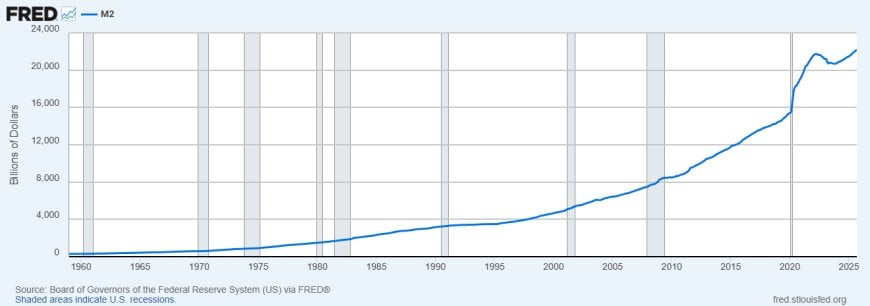
Source: FRED: M2SL
These two charts are the “before and after” of the monetary bomb. You don’t need a PhD to read them: flat-ish line for a decade, then a near-vertical wall. That’s the context for everything else in this article. Whatever you want to call it—stimulus, liquidity support, QE—this is the part where they fundamentally changed the denominator under all your future work.
M2 and the Fed’s total assets are not “inflation” by themselves, but they are the fuse. What you feel as inflation, housing insanity, and grocery shock shows up downstream from these moves, in the stuff you actually buy and the assets you’re trying to access.
The house you were saving for is where the theft shows up
Housing is the cleanest place to see what happened because it’s not abstract. You can’t gaslight someone who watches their rent and home prices every year.
From early 2020 into 2022, U.S. home prices jumped on the order of 30–40% depending on the index and the market. Meanwhile:
- Wages did not go up 30–40%.
- Median household income crept up in single digits.
If you already owned a house in 2019–2020, you “made” 30–40% on an asset you were already living in. You didn’t work more hours; the Fed just bid up the denominator under you.
If you were saving for a house, you got ambushed. Example:
- In 2019:
- House is $300,000.
- 20% down = $60,000.
- You’ve saved $30,000. You’re halfway there.
- You grind for a few years, doing everything “right,” expecting to hit that target.
- By 2022:
- Same house is now $450,000.
- 20% down = $90,000.
- Maybe you’ve got $50,000 saved now.
Your savings went from $30k to $50k. The target moved from $60k to $90k. Your position *worsened* in percentage terms.
On paper, you “have more money” ($50k vs $30k). In reality, you’re further from the thing you’re saving for.
That distance between what your dollars used to buy and what they buy after the Fed detonates a few trillion over the asset complex—that gap is the extraction.
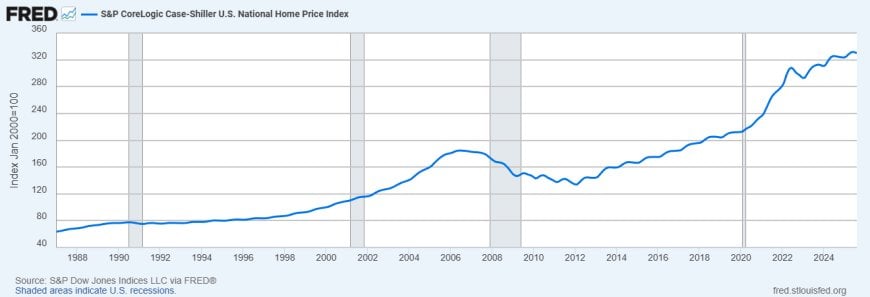
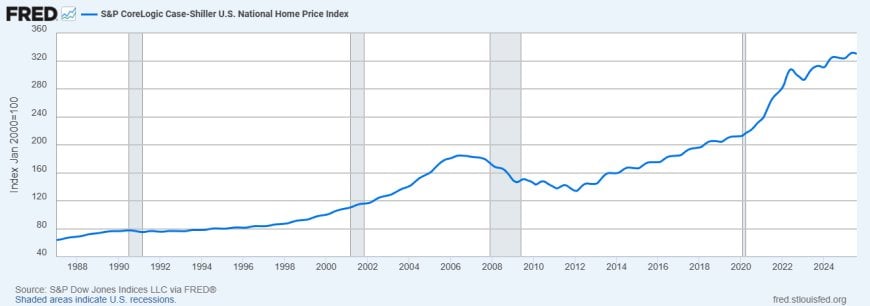
Source: FRED: CSUSHPINSA
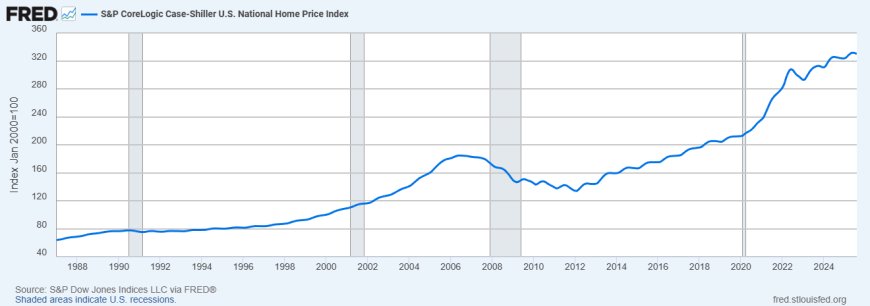
Source: FRED: USSTHPI
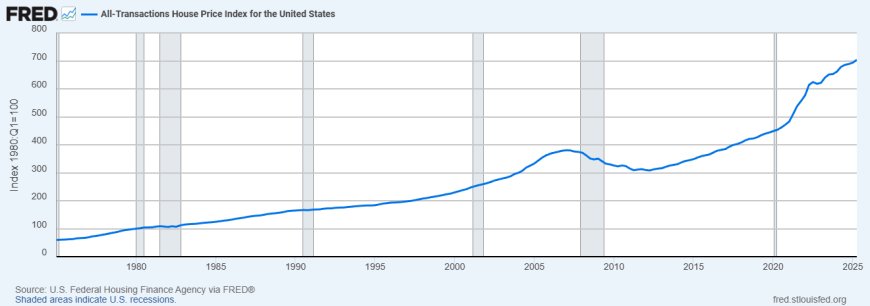
Those charts do something very simple: they take your “it feels like houses went insane” intuition and anchor it with hard data. It wasn’t your imagination. The national indices really do show a once-in-a-generation vertical repricing. And once those levels are established, they rarely go back down in nominal terms. The system prefers to hold prices high and let time, wages, and new buyers slowly suffer their way into the new normal.
This is just the Cantillon effect wearing a tie
Economists have had a name for this for 300 years: the Cantillon effect.
Richard Cantillon’s basic observation was simple and brutal:
Where new money enters the system determines who benefits. People closest to the source of new money get to spend it before prices adjust. Everyone else gets the higher prices later.
In the 2020 playbook, the “closest to the spigot” were:
- Primary dealers
- Large banks
- Big asset managers
- Large corporates with pristine collateral
The furthest from the spigot were:
- You
- Your paycheck
- Your rent
- Your grocery bill
The sequence looked like this:
- The Fed creates reserves and buys Treasuries and mortgage-backed securities from big financial institutions.
- Those institutions now sit on piles of cheap liquidity in an environment where rates are basically zero and the Fed is promising “whatever it takes.”
- They do not run out and extend a flood of 2% loans to fragile small businesses. They:
- Buy more stocks
- Buy more bonds
- Buy more real estate
- Fund corporate buybacks
- Extend low-rate margin loans and credit to already-wealthy clients
- Asset prices rip higher on this wall of money.
- Far downstream, wage earners get:
- A few rounds of stimulus checks
- A cost-of-living raise that lags what’s happening to housing, food, energy, and insurance
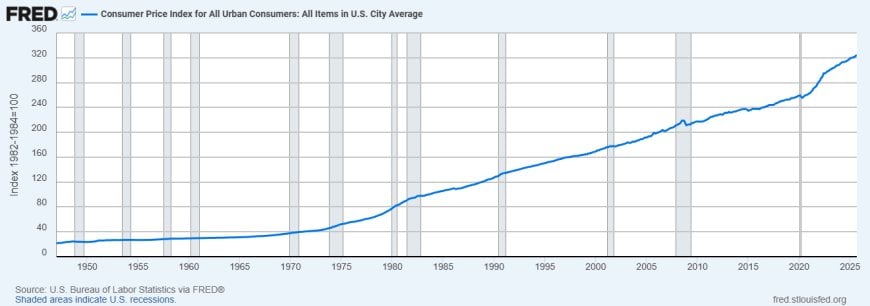
By the time any of that newly created money shows up in your world, the S&P has already ripped off the lows, houses have repriced, and the everyday stuff you actually buy has silently moved 20–40% higher.
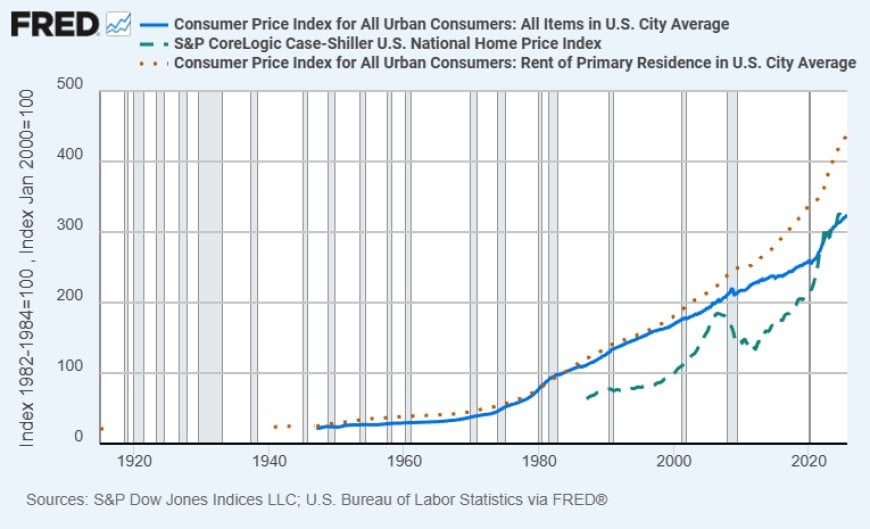
Official CPI comes in around the high-teens for that window, and they tell you inflation is “transitory.” Your lived experience is closer to 30–40% on the things that matter.
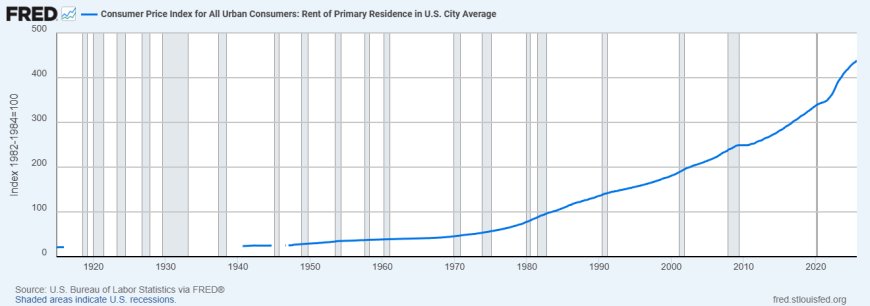
Source: FRED: CUUR0000SEHA
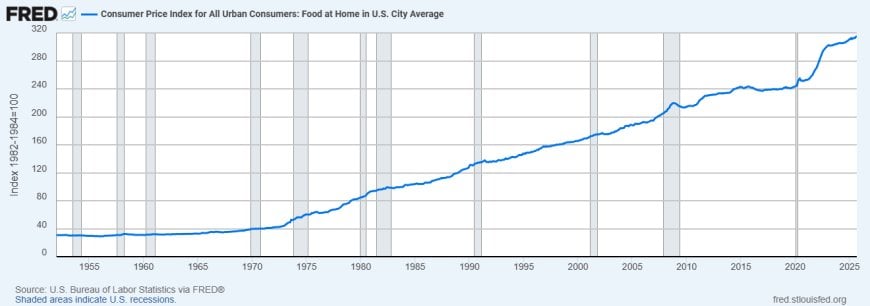
Source: FRED: CUUR0000SAF11
This is why arguing over the headline CPI print misses the point. Life-cost inflation is what hits you: rent, housing, food, energy, insurance. Those categories don’t just “go up a bit” and then come back down. They ratchet higher and stay there. The Cantillon effect isn’t theory in this period—it’s your landlord, your grocery bill, and the shrinking amount of slack left in your checking account each month.
The Fed’s own numbers give the game away
You don’t have to believe any conspiracies to see this. Just look at the Fed’s own data.
Between 2020 and 2022:
- The Fed’s balance sheet jumps by roughly $4.5 trillion.
- The top wealth brackets in the U.S. add trillions in net worth, heavily concentrated in stocks and real estate gains.
- The bottom 50% also “gain” a little on paper, mostly via transfer payments and tiny asset exposure—but their share of the total pie barely moves.
The top 10% captured a massive share of the post-COVID wealth increase while being a minority of the population. The bottom half of the country got a smaller total boost despite being the majority.
That’s exactly what you’d expect from a system where:
- The central bank doubles its balance sheet via asset purchases.
- Those purchases directly support the collateral base and asset markets first.
- Real wages downstream are left to “catch up” after prices have already adjusted higher.
The machine did what it’s built to do:
- Preserve collateral.
- Preserve the banking system.
- Push asset prices higher to generate a “wealth effect.”
It just didn’t preserve your purchasing power.
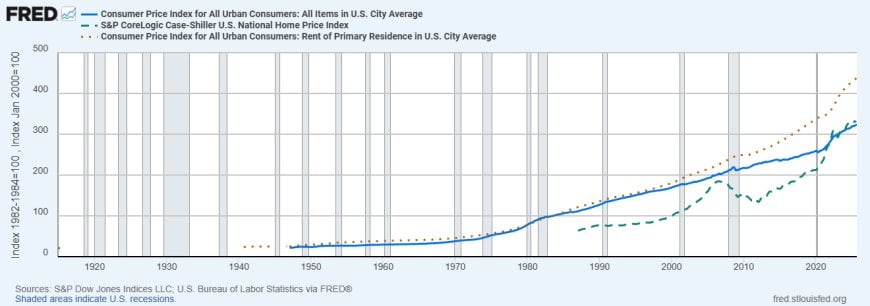
Source: FRED composite graph (CPIAUCSL, CSUSHPINSA, CUUR0000SEHA)
The composite graph is the truth serum. One line is what they tell you inflation is. The other lines—home prices and rent—are what your life has to price in. The gap between them is where the narrative breaks and the anger starts. That’s also where the wealth transfer hides in plain sight.
The “rigged” part isn’t hidden—it’s the mandate
Structurally, the Fed is wired to care about two big things:
- Stability of the financial system (banks, bond markets, collateral chains).
- Its dual mandate (inflation + employment)—as long as dealing with that doesn’t blow up #1.
Look at who sits at the table and where they go afterward:
- Regional Fed banks are owned by member banks.
- Officials rotate between Wall Street, hedge funds, academia, and government.
- The career upside is not becoming the central banker who decides to vaporize asset prices by 60% for the sake of generational housing affordability.
So in every crisis, the instinctive sequence is the same:
Save the collateral. Save the banks. Save asset prices. We’ll deal with the social fallout later.
That “later” is what you feel as a 20–40% stealth tax on your future.
Why they couldn’t let prices truly reset
The video version of this story frames 2020 as a simple choice: let markets clear and suffer a deeper recession, or print and reflate everything.
In reality, that choice barely exists anymore without blowing up the global plumbing.
The modern system sits on:
- Trillions in dollar-denominated debt that must be rolled and refinanced.
- Collateral chains that assume U.S. Treasuries and “safe” securitized assets keep trading, keep pricing, and keep being used as funding fuel.
- Pension funds, insurers, and sovereigns whose solvency depends on asset values not collapsing and staying collapsed.
Letting asset prices fall 40–60% and stay there would mean:
- Blowing up pension systems.
- Blowing up parts of the shadow banking system.
- Blowing up government funding trajectories.
From the system’s perspective, letting you buy a house at a sane multiple is less important than keeping a 50-year leverage stack from collapsing in on itself.
They chose system survival over generational affordability. And they’ll choose that again.
Why the trap is now permanent for a lot of people
Fast-forward to the present environment:
- Home prices are still massively above 2019 levels.
- Mortgage rates are in the 6–7% range instead of 2–3%.
- The median age of first-time buyers has drifted higher, and their share of all buyers has been squeezed.
Practically, that means the entry ramp into ownership has been pushed so far out that an entire cohort is getting stuck as permanent renters.
On the other side of the trade:
- Corporate landlords and institutional buyers locked in cheap funding during the zero-rate window.
- They bought houses, build-to-rent subdivisions, and portfolios of single-family homes at yesterday’s costs.
- They now rent those units to you at today’s pricing.
The extraction mechanism looks like this now:
- Round one: the Fed prints, asset prices inflate, your future down payment gets priced away.
- Round two: the Fed hikes to fight the inflation it created; prices plateau at a higher level, but your cost of capital explodes.
- Result: triple-priced houses plus double or triple mortgage rates equals an affordability black hole.
So you’re now staring at yesterday’s prices with today’s interest rates — the worst of both worlds.
If you bought pre-2020 on a fixed low rate, you’re inside the fortress. If you didn’t, the bridge they pulled up behind them is what you’re staring at.
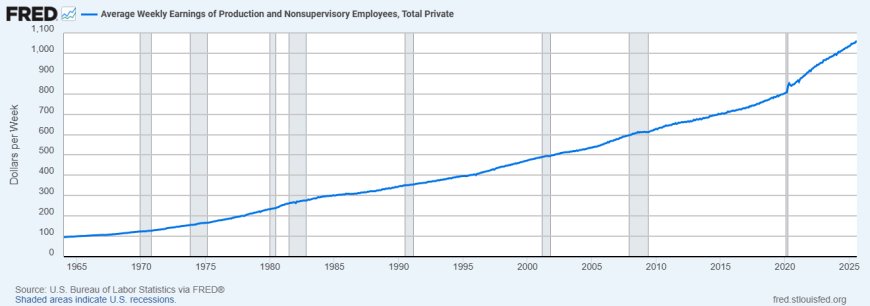
Source: FRED: CES0500000030
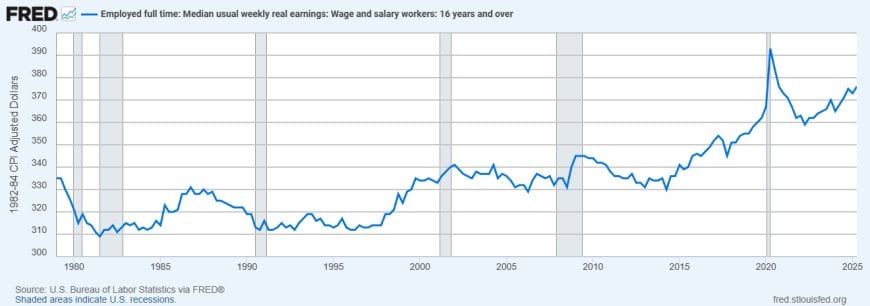
Source: FRED: LES1252881600Q
Lay those wage series next to the housing and rent charts and you don’t need anyone’s opinion. The lines tell the story: the cost of access to stability and ownership is accelerating away from the thing you’re paid in. That’s what it means to be trapped in the system as a permanent renter, even if your paycheck in nominal dollars looks “higher” than it was five years ago.
This isn’t capitalism—it’s administered asset feudalism
This is where I diverge from the usual “doom tomorrow” crowd.
Most macro commentary stops at: “The system is rigged, therefore it must collapse.”
My view:
- Yes, it’s rigged.
- No, that doesn’t automatically mean a sudden, cinematic collapse.
- It means managed feudalism is the base case unless something forces a restructuring.
The core pattern is simple:
- The asset side of the system gets whatever liquidity it needs.
- The liability side—wages, small savers, renters—gets the bill via:
- Inflation
- Higher entry prices
- Structurally higher rents
- Slower real wage growth
The hidden tax isn’t just “CPI went up.” It’s that your entire future path into ownership got repriced up by 30–60% while your income path moved in slow motion.
That is theft, but it’s also infrastructure. It’s how they maintain a collateral base big enough to support U.S. Treasury funding, global dollar usage, and the next round of industrial build-out: AI, grid upgrades, defense, and eventually CBDC rails.
Once you see it as infrastructure, the question stops being ‘Will they stop?’ and becomes ‘What are they building on top of it?’
They’re not going to stop doing this voluntarily. Mechanically, they can’t.
Where my macro narrative diverges from pure doom
If you zoom out, 2020–2022 wasn’t a one-off. It was an iteration:
- 2008–2014 was the beta test for quantitative easing and asset-only rescue.
- 2020–2022 was QE: live-fire, scaled-up, with social media watching.
- The next crisis will be QE plus digital rails:
- Tokenized Treasuries
- Stablecoins and CBDCs
- AI systems sitting in the loop managing liquidity and risk
The pattern will rhyme:
- System stress hits.
- “Emergency” interventions are announced.
- New money enters through the same privileged pipes.
- Assets are saved first; people are helped later, partially, and unevenly.
The only realistic way not to be wrecked by the next round is to accept that inflation is a policy tool, not a natural disaster, and that proximity to the point where new money enters the system is the whole game. You either get yourself on the asset side of the ledger before the next round, or you become the funding source for someone else’s rescue.
From stealth theft to digital rails
Everything above is the analog version of the scam. The next version is going to be digital and real-time.
In the old model:
- The Fed runs QE.
- Banks and large institutions move the liquidity around through legacy pipes.
- The Cantillon effect plays out with a lag as prices slowly adjust.
In the new model:
- Dollar claims increasingly live on programmable rails:
- Tokenized Treasuries
- Regulated stablecoins
- CBDC-style settlement layers
- Liquidity can be pointed like a firehose into specific geographies, sectors, and cohorts.
- Access can be conditioned:
- Which users?
- Which jurisdictions?
- Which behaviors?
The hidden tax doesn’t go away. It just gets wrapped in a nicer user interface. The story becomes:
“We’re democratizing access to dollars and safe assets through digital innovation.”
Underneath that story, the same thing is happening: new dollar claims are created near the core and pushed outward. The people closest to the spigot get the advantage. Everyone else gets the price adjustment later.
The crucial twist is geopolitical: now they can run the Cantillon effect across borders in a much more targeted way.
The Argentina stablecoin playbook: bypass the government, own the people
This is where Argentina comes in as the live pilot project.
When a country has hyperinflation or chronic currency collapse, people will do anything to escape the local unit. They already dollarize informally. They hoard physical dollars. They use shadow FX markets. They wire money out of the country if they can.
Now overlay this with stablecoins and digital dollar rails:
- Local currency is melting down. Trust in the domestic unit is gone.
- Stablecoin issuers and dollar-linked fintechs roll in as “solutions.”
- People start transacting, saving, and even paying salaries in dollar stablecoins instead of the local currency.
- The population voluntarily migrates their economic life onto a dollar-linked ledger that the local government does not control.
At that point, the critical thing is this:
If you can get a nation to run its daily life on your stablecoin, their domestic government stops being the real monetary center of power.
…stops being the real monetary center of power for that population’s savings and transactions.
For the issuer and its backing institutions:
- Every dollar of stablecoin in circulation is:
- A dollar, T-bill, or short Treasury in reserve somewhere.
- More structural demand for U.S. government paper.
- The rails create direct retail demand for Treasuries that bypasses the local sovereign entirely.
So while the viral narrative online is, “Stablecoins and crypto will free people from central banking,” the base case I see is almost the opposite:
- They free people from weak local central banks.
- They plug those people directly into the strongest central bank and debt system on Earth.
Argentina is the test bed:
- A population desperate for a stable unit.
- Local currency credibility destroyed.
- High crypto and stablecoin literacy on the street.
If you can normalize the idea that “real money lives on your phone as a dollar-linked token,” then politically and economically, you’ve just run the Cantillon effect straight through the front door of another sovereign’s population.
The local government becomes a tax authority and police force. The real monetary power shifts to whoever controls the dominant rails and their backing collateral.
CBDCs as the next layer of control, not liberation
Zoom out again. Stablecoins are the messy, semi-private middle step. The endpoint central planners really want is a unified set of digital rails with:
- Real-time visibility
- Programmability
- Direct policy transmission
That’s the CBDC layer.
Combine what we already know works for them:
- Balance sheet expansion to inflate assets when needed.
- Rate hikes and regulatory pressure to cool things off.
- Now add:
- Programmable wallets
- Whitelisting and blacklisting
- Geo-fenced or time-limited “stimulus”
The old-world theft was blunt:
- Print trillions, let inflation show up, shrug.
The new-world theft is selective and targeted:
- Turn on extra purchasing power for favored sectors and cohorts.
- Throttle or tax others in real time.
- Use foreign populations’ demand for “digitized dollars” to cement external Treasury demand.
The Cantillon effect goes from being a side effect to being a design feature you can aim.
QE 2020 was them pulling a fire alarm with a garden hose; CBDCs are them wiring the sprinklers into every room and putting the valves behind a locked door.
What this means for you (developed world)
If you’re a millennial or Gen Z in the U.S. or another developed country, here’s the uncomfortable translation of all this:
- The 2020–2022 period permanently reset your baseline. The “old normal” home-price-to-income ratios are not coming back in any clean way.
- Future crises will be met with the same playbook—printing and asset support—but delivered over more efficient, more controlled rails.
- If you stay purely on the wage side of the equation, every new round of “support” will leave you relatively further behind, not ahead.
So the question stops being, “Is this fair?” (it’s not), and becomes:
How do I shift myself—however uncomfortably—from the bleeding side of these policies to the side that at least participates in the upside?
That doesn’t mean becoming some cartoon villain or cheerleader for the system. It means recognizing:
- Asset ownership is no longer optional if you want to keep your head above the waterline.
- The timing of when you get exposure matters—being early to the next wave of liquidity matters more than debating its morality.
- You are not going to vote this away. The plumbing is too deep and the incentives are too locked in.
What this means for them (Argentina and every “Argentina-in-waiting”)
For countries like Argentina, the game is even harsher.
Local elites and average citizens both want out of the domestic currency. The political system usually can’t deliver real reform fast enough. That’s the opening. Stablecoin and digital dollar adoption looks like salvation in the short term, and in many ways it is—compared to 50%+ annual inflation in a local unit.
But step back and look at the second-order effects:
- The more people adopt dollar stablecoins as their real unit of account, the more demand there is for the collateral behind those tokens, usually Treasuries.
- The local state’s ability to devalue, restructure, or default its way into a reset gets weaker because daily life is drifting off its balance sheet.
- The institutions that control the rails and reserves gain an informal veto over the local system’s options.
So while the citizen thinks they’re “escaping” a rigged game, in reality they’re switching tables—from a rigged local game to a bigger, more sophisticated one run from somewhere else.
How to respond so you’re not the liquidity exit
This is the part nobody likes, because it forces a mental shift from moral outrage to cold strategy.
The system as it exists today is not built to maximize your affordability, your savings power, or your social mobility. It’s built to keep the dollar-based asset machine functioning across cycles, at almost any cost.
You cannot “fix” that by yelling at it. You can only:
- Understand how the balance sheet and Cantillon games work.
- Recognize that inflation is a recurring, engineered outcome, not a random storm.
- Position yourself so that when the next $4–5 trillion gets conjured and pushed into the system, you’re not the person watching the same house jump another 30% while your wages crawl.
That means:
- Owning productive or scarce assets if you can, even in small amounts.
- Understanding the rails—how stablecoins, tokenized assets, and future CBDCs will actually move value—and not confusing slick UX with freedom.
- Seeing Argentina and similar cases not as isolated tragedies, but as the forward test nets for how this machinery will be rolled out globally.
The Fed didn’t steal 30% of your future through an income-tax vote. They did it by engineering a balance-sheet shock that repriced the world under your feet. The next rounds will look different on the surface—more apps, more tokens, more “innovation”—but the core mechanism will rhyme.
If you don’t understand how the theft happened the first time, you can’t protect yourself from the next one. If you do understand it, you at least have a shot at stepping out of the line of fire—and maybe, finally, getting on the side of the ledger that gets paid instead of drained.
How I Personally Navigate This System (and Why Real Estate Is My Hedge)
Everything above sounds abstract until you’re living through it in real time.
I’m not speaking about real estate from the outside—I’m inside this system every single day. My world is built around cash-flowing properties, leverage, refinances, repairs, tenants, and the grind that comes with scaling an actual portfolio. And here’s the part most people miss:
The same monetary system that punishes savers is the exact system that rewards asset owners—especially those with leverageable cash-flowing real estate.
That’s why I’ve spent the last few years pushing my portfolio as fast as I sustainably can. Not because I think housing is “cheap,” not because I’m chasing hype, but because the entire QE/Cantillon architecture we’ve just walked through structurally advantages anyone who owns productive assets.
Here’s the real mechanism:
**• When the Fed prints, assets inflate.
• When the Fed hikes, rent stays sticky.
• When the Fed pivots again, leveraged assets compound.**
If you’re sitting on a property that generates cash flow, the bank will always treat that as a productive machine—something they can safely lend against. Even in choppy credit conditions, cash flow is king, and that’s where DSCR (Debt Service Coverage Ratio) lending comes into play.
DSCR Loans: The Quiet Key to This Whole Game
A DSCR loan doesn’t care about your W-2, your personal income, or your tax gymnastics.
It cares about one number:
Does the property generate enough income to cover the debt?
If yes, the system opens the door for you.
If not, it slams shut.
That’s the entire trick.
In a world where savings melt and wages lag inflation by miles, ownership of even one or two cash-flowing properties flips your relationship with the monetary system upside-down. Suddenly you’re not the liquidity exit—you’re the collateral owner. You’re in the group the Fed quietly protects every cycle.
Why This Is the Play for Normal People Too
You don’t need 20 properties.
You don’t need a trust fund.
You don’t need perfect credit.
You just need an entry point into the asset side of the system.
A single DSCR-eligible rental can function like:
- A hedge against inflation
- A future refinancing engine (when rates eventually cycle back down)
- A leveraged position in a world built on balance-sheet expansion
- A productive asset that throws off income even in economic turbulence
While the system extracts from wage earners, it inflates the value of productive assets.
That’s the part I learned the hard way in real time—and it’s why real estate remains my personal hedge against everything I described in this article.
A Tool I Actually Use: Kiavi
If you’re going this route, you need lenders that understand cash-flowing assets, not W-2 box-checking.
Kiavi has been one of the cleanest solutions I’ve used for scaling:
- Fast DSCR approvals
- Investor-focused underwriting
- No W-2 required
- No personal-income hoops
- Designed for real-estate operators, not traditional mortgage shoppers
It’s not a magic button, but if you’re trying to get to the asset side of the system, this is one of the few on-ramps that actually works in the real world.
The bottom line
The system isn’t fair.
It isn’t designed to be.
But if you understand how liquidity cycles work, how Cantillon dynamics shape every crisis response, and how cash-flowing assets interact with leverage—you can position yourself on the side that gets lifted instead of the side that gets drained.
For me, that means real estate.
For you, it might start with one property.
But the principle is the same:
Own productive assets or be priced out by the next round of liquidity.
Sources & Data
- Federal Reserve balance sheet – Total Assets (WALCL), FRED: https://fred.stlouisfed.org/series/WALCL
- U.S. House Price Index – All Transactions (FHFA, USSTHPI), FRED: https://fred.stlouisfed.org/series/USSTHPI
- Consumer Price Index for All Urban Consumers (CPIAUCSL), FRED: https://fred.stlouisfed.org/series/CPIAUCSL
- Median Household Income in the United States (MEHOINUSA672N), FRED: https://fred.stlouisfed.org/series/MEHOINUSA672N
- M2 Money Stock (M2SL), FRED: https://fred.stlouisfed.org/series/M2SL
- Distribution of Household Wealth in the U.S. – Distributional Financial Accounts, Federal Reserve: https://www.federalreserve.gov/releases/z1/dataviz/dfa
- U.S. housing market pricing & inventory – Zillow Research: https://www.zillow.com/research/data/
- Stablecoin overview & regulatory context – BIS & global reports (via Wikipedia stablecoin entry): https://en.wikipedia.org/wiki/Stablecoin
- Argentina stablecoin usage and dollarization trend – Chainalysis report summary (Decrypt): https://decrypt.co/285491/argentina-stablecoin-use-booms-inflation
Related Pattern Nexus Reading
- The Lock-In Economy: Why America’s Housing Market Remains Frozen
- The Great Housing Plateau: The American Dream Is No Longer a Ladder
- The 1% Down Payment Trap
- Debt Without a Cliff: U.S. Debt, GDP, and CBDC Rails
- The Dollar Isn’t Collapsing – It’s Evolving
- The Tokenized Reserve Era & the New Operating System of the World Economy
- Digital Sovereignty and the Global Race for Central Bank Digital Currencies
- Gold, CBDCs, and the Digital Return to “Real” Money
- The Reverse Repo Trap: How the Fed Controls Liquidity
- QT Is Over: The System Just Crossed Its Reserve Floor
আপনার প্রতিক্রিয়া কি?
 পছন্দ করুন
0
পছন্দ করুন
0
 অপছন্দ
0
অপছন্দ
0
 ভালোবাসা
0
ভালোবাসা
0
 মজার
0
মজার
0
 বাহ!
0
বাহ!
0
 দুঃখজনক
0
দুঃখজনক
0
 গোস্বামী
0
গোস্বামী
0

Founder of Pattern Nexus. I research markets, macro, geopolitics, AI, history, ancient systems, and the patterns most people overlook. I’m also building Market Radar, a trading scanner designed to read pressure, risk, confirmation, and setup quality before chasing a move. Pattern Nexus is where I connect the dots between data, history, technology, and the bigger system playing out around us.



















মন্তব্যসমূহ (0)