
The Iran Decision Window: What the CBS Briefing Actually Signals
CBS reports Trump was briefed on military, cyber, and psychological options for Iran. That single line matters: it marks the opening of a decision window, changes the risk profile, and reshapes what to watch next.

“Briefed on options” is the internal switch from talking to planning. It means packages are built, sequencing is mapped, and the constraint becomes political choice, not military feasibility.
The next phase is where misinformation spikes. Every aircraft photo becomes “war,” every rumor becomes “confirmed.” If action is coming, it will be preceded by a small set of repeatable indicators, not viral posts.
The center of gravity is not “Iran vs U.S.” The center of gravity is regime stability under blackout conditions, and whether external pressure accelerates cracks or hardens retaliation logic across the region.
If you want “real data,” stop arguing about vibes. The real data is the footprint: the Gulf air hubs, the Combined Air Operations Center, the naval headquarters in Bahrain, and the long-range staging options. Everything else is noise layered on top of that reality.
What CBS Just Confirmed
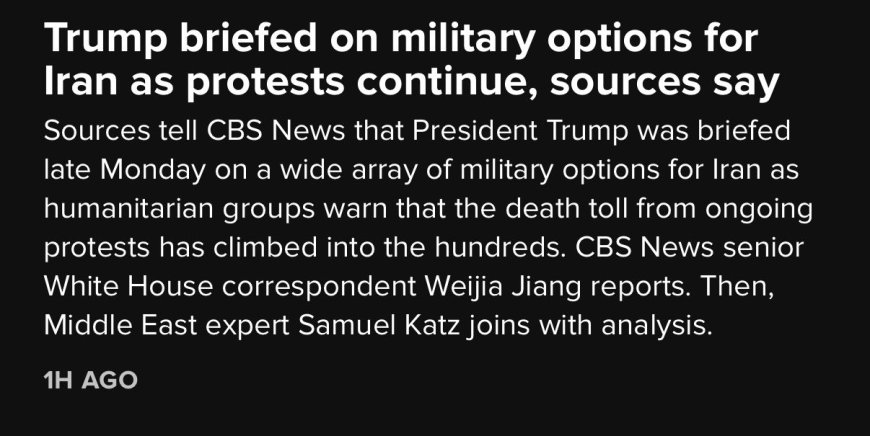
CBS reporting that Trump was briefed on military options for Iran isn’t random television filler. It’s a procedural tell. When a president is briefed on a “wide array” of options and the list explicitly includes military, cyber, and psychological lines of effort, that means the machine has moved beyond public warnings and into structured decision support.
Translation: the menu exists, the sequencing exists, and the timeline can compress quickly if the White House decides the conditions are met.
This is not the same thing as “strikes are imminent.” It is the stage where “imminent” becomes possible without further bureaucratic buildup. That distinction matters, because Twitter/X tends to skip the middle and jump straight from “rumor” to “war.”
This isn’t just bombs. It is a layered toolkit: disruption of regime communications, amplification of internal fractures, restoration of outside connectivity, intimidation signaling, selective kinetic strikes, and the narrative wrapper that justifies any of it. The inclusion of “psychological” is a clue that the information layer is being treated as operational terrain, not commentary.
The Escalation Ladder and Why “Options” Is a Threshold
Most people talk about escalation like it’s binary: peace or war. Real systems don’t work that way. They move in steps, and every step changes the probability distribution even if nothing explodes that day.
Here is the ladder in plain language. Not theory, not vibes, but the typical sequencing that shows up across modern U.S. crisis responses.
- Stage 1: Rhetorical signaling. Warnings, threats, public red lines. Mostly politics.
- Stage 2: Policy pressure. Sanctions, tariffs, diplomatic isolation, ally alignment, and information posture.
- Stage 3: Options brief (the CBS stage). Packages are built. Timelines and contingencies are mapped. “Can we” becomes “will we.”
- Stage 4: Posture adjustment. Assets reposition, alert status changes, corridors are planned, embassies and dependents get reviewed.
- Stage 5: Non-kinetic first strike. Cyber, EW, comms disruption, narrative operations, and selective exposure of intelligence.
- Stage 6: Limited kinetic. One-off or short-burst strikes with a narrow target set, often aimed at deterrence and shaping.
- Stage 7: Sustained strike campaign. Multi-day operations, layered suppression, and repetition until desired effects are achieved.
- Stage 8: Regime-change war. Rare, high-cost, and typically avoided unless a broader coalition and legal wrapper exist.
The reason Stage 3 matters is simple: it opens a decision window. Once options are briefed, events on the ground can rapidly become “the justification” rather than “the reason.” A shocking clip, a major casualty event, a confirmed massacre, a regional proxy attack, or a direct threat to U.S. assets can become the catalyst that moves the system from prepared to executed.
Major outlets don’t publish “sources say he was briefed” unless someone with access wanted it out. That can be deterrence messaging to Tehran, alliance reassurance, domestic positioning, or pre-justification if things escalate. Either way, it signals pressure, not passivity.
What To Watch Next
The hardest part right now is that Iran is operating under an internet shutdown, and the information domain becomes polluted. That creates two simultaneous realities: real violence can be hidden, and fake narratives can be manufactured. Both can be used to shape external intervention decisions.
So the correct approach is not “trust nothing.” The correct approach is “watch the few indicators that consistently precede action.”
If kinetic action is approaching, expect some combination of: structured White House language about “protecting civilians,” credible confirmation of mass-casualty events, posture shifts at regional bases, formal warnings about retaliation risk to U.S. assets, and information operations meant to pierce the blackout or isolate regime command-and-control.
Now apply that to the current Iran environment.
- Domestic pressure: Protests are widespread and the reported death toll has reached the hundreds, with arrests in the thousands. This creates a tightening clock inside Tehran. The longer unrest persists, the more violent the regime must become to reassert control, and the more visible the “intervention justification” becomes internationally.
- Connectivity warfare: Human rights organizations are explicitly framing the internet shutdown as a mechanism to conceal abuses. That is not only a moral argument; it is a narrative foundation for coercive actions, including restoring connectivity through satellite services and cyber operations.
- Retaliation logic: Iran has explicitly warned that U.S. bases in the region and Israel would be legitimate targets if the U.S. strikes. That is the cost side of the ledger. Any U.S. action has to price regional escalation risk, not just Iran’s internal situation.
- Diplomatic signaling: Multiple reports indicate Tehran is simultaneously threatening retaliation while also keeping some channel open for negotiation through intermediaries. This is classic crisis behavior: “we are ready for war” publicly, “what do you actually want” privately.
One more point that has to be said out loud: U.S. power projection in this theater is not a mystery. It is a known architecture. If you want “real,” you focus on the architecture, then you watch for deviations from baseline.
When X says “troops moving,” ask one question: does it connect to the known footprint and change the operating tempo of that footprint? If not, it’s entertainment.
The Real Footprint: Bases and Assets Around Iran
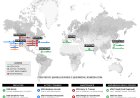
This section is the “real data” layer. These are the publicly documented hubs and force layers that define what the U.S. can do in this theater. This is not a claim about what is newly deployed today. It is the operating geometry that makes certain options feasible and other options fantasy.
Listing a base is not “targeting.” These locations are widely published and routinely discussed in mainstream reporting. The value here is understanding which nodes matter, which missions they support, and what “posture changes” actually look like when you have a baseline mental model.
Air hub layer (where sorties are generated and sustained)
- Al Udeid Air Base (Qatar): A central node for U.S. operations in the region that has been reported as a forward headquarters and a critical airpower nerve center. It is closely associated with the Combined Air Operations Center function that coordinates air activity across the theater.
- Al Dhafra Air Base (UAE): A key UAE-based hub that has long been associated in open reporting with U.S. air operations and ISR-heavy missions across the region.
- Ali Al Salem Air Base / Ahmad al-Jaber Air Base (Kuwait): Kuwait is a core logistics and air mobility platform in the Gulf architecture; these bases are repeatedly cited in public overviews of regional U.S. facilities.
- Muwaffaq Salti Air Base (Jordan): A smaller but strategically positioned operating node that appears in open reporting and base summaries tied to coalition operations and contingency access.
- Prince Sultan Air Base (Saudi Arabia): A Saudi-based node that shows up in public discussions of U.S. regional posture, often framed as a contingency location for air operations and missile defense integration.
Naval layer (the maritime control system)
- Naval Support Activity Bahrain: Headquarters and operational backbone for U.S. Naval Forces Central Command / U.S. Fifth Fleet, the naval command responsible for the Gulf, Red Sea, Arabian Sea, and surrounding waters.
- Maritime task force ecosystem: The naval layer is not just “ships.” It is sustained patrol coverage, mine countermeasure capability, maritime domain awareness, and rapid response across chokepoints and trade routes.
Long-range staging layer (when you want reach without telegraphing everything)
- Diego Garcia (British Indian Ocean Territory): A strategic base repeatedly described in public reporting as critical for U.S.-UK security and long-range operations. It functions as a deep staging and support node in the broader region.
What “assets” actually means in practical terms
When people say “assets,” they usually mean a mixed stack of capabilities, not one platform. In real operations, this becomes a layered system:
- Air mobility and refueling: The unsexy reality that makes sustained operations possible: tankers, transports, and the logistics tail that keeps tempo high.
- ISR saturation: Persistent intelligence, surveillance, and reconnaissance through a blend of aircraft, drones, and space-based coverage. If a strike option is real, ISR is already shaping it.
- Air and missile defense integration: Gulf basing is tied into layered defense concepts with U.S. and partner systems designed to manage missile and drone threats.
- Command and control: The CAOC-style command function and the naval headquarters function. These are the brains. Platform talk is mostly noise without understanding the brain layer.
What That Footprint Enables: The Real Packages
If the White House is being briefed on a “wide array” of options, those options fall into recognizable packages that map to the footprint above. This is where fantasy collapses into what is operationally plausible.
Package A: Connectivity-first pressure (the non-kinetic opener)
This is the pathway where the U.S. tries to change the internal trajectory without immediately firing the first shot. It stacks cyber, communications restoration, and psychological operations meant to fracture regime cohesion and reduce the regime’s ability to conceal events under blackout conditions.
Package B: Deterrence strike (limited kinetic, heavy messaging)
Selective, narrow target sets designed to signal capability and resolve. The objective is not occupation. The objective is to force a change in regime behavior and raise the perceived cost of continued repression or external retaliation.
Package C: C2 degradation (cut the brain, not the population)
Operations that prioritize command, control, and communications nodes, paired with psychological messaging. The theory is to reduce coordination of repression and reduce the regime’s ability to respond coherently under stress.
Package D: Maritime coercion and interdiction (pressure through sea lanes)
The naval layer becomes a control instrument. In this pathway, the center of gravity is shipping risk, chokepoint management, and the credibility of retaliation threats across the Gulf and beyond.
Package E: Retaliation management (the part the internet never talks about)
Any Iran scenario has to price retaliation: regional bases, partner infrastructure, and Israel. This is why missile defense posture, force protection measures, and public warnings about retaliation matter as indicators. If you see an unusual burst of force protection language and defensive deployments, the system is actively pricing the second-order effects.
This is a layered chessboard: air hub + naval headquarters + long-range staging + ISR + missile defense. When people argue online about “will we strike,” they’re usually not watching the only thing that matters: whether those layers are being reconfigured beyond baseline.
Pattern Nexus Lens
This is a control-systems moment, not a conventional “country A vs country B” story. The core mechanism is regime control under internal stress, and the external environment that decides whether to tighten the screws, cut a deal, or break the system.
Three layers are operating at once.
Layer 1: The population layer. Economic collapse stress becomes political revolt. Revolt becomes an existential threat. The regime responds with repression, and repression escalates because half-measures fail when legitimacy is breaking.
Layer 2: The connectivity layer. When the internet is shut down, truth becomes scarce, coordination becomes harder, and the regime buys time. But the shutdown also creates international narrative fuel: it looks like concealment, and concealment invites external pressure.
Layer 3: The deterrence layer. The U.S. is not just weighing “how to stop repression.” It is weighing “how to act without triggering regional escalation.” Iran’s threats to strike U.S. bases and Israel are not side notes. They are the constraint that forces the U.S. to think in packages, not impulses.
When a president is briefed on military, cyber, and psychological options, the system is treating information control and regime stability as operational targets. The question is no longer “is escalation possible,” but “what trigger makes escalation politically inevitable,” and “how do we manage retaliation across the footprint.”
FAQ
Does this confirm the U.S. is about to strike Iran?
No. It confirms the U.S. has advanced into formal option selection. That is a threshold shift. Strikes still require a decision, and that decision typically follows either a trigger event, a deadline, or a perceived closing window where waiting becomes riskier than acting.
Where would the U.S. actually operate from?
From the established regional footprint: the Gulf air hubs (with a theater-level command-and-control function centered around Al Udeid in public reporting), partner-base access in neighboring states, the naval headquarters in Bahrain, and long-range staging options such as Diego Garcia. The exact mix depends on which “package” is chosen and how much retaliation risk is being priced.
Why does “cyber and psychological options” matter?
Because it signals the approach is not limited to kinetic force. It implies an intent to shape Iran’s internal environment, pierce or exploit the blackout, disrupt regime coordination, and influence the perceptions of both Iranian security forces and external stakeholders. That is escalation without necessarily dropping bombs first.
What is the most likely form of action if the U.S. acts?
The highest-probability path is layered and limited: non-kinetic measures first, then selective strikes if necessary, with heavy attention to deterrence messaging and retaliation management. Large-scale sustained campaigns are structurally more costly and create higher regional blowback risk.
Sources
These sources support the reporting on the CBS options briefing, Iran’s protest crackdown and internet shutdown, and publicly documented U.S. regional basing and command footprint (air hubs, NAVCENT/Fifth Fleet, and long-range staging).
- CBS News: Trump briefed on military, cyber, psychological options for Iran, sources say (Jan 12, 2026)
- CBS News: Iran protests latest; U.S. posture and Iran response (Jan 12, 2026)
- Reuters: Trump weighs response to Iran crackdown; Tehran says communications open (Jan 12, 2026)
- Reuters: Iran warns it will retaliate; threatens U.S. bases and Israel (Jan 11, 2026)
- Reuters: What are the main U.S. military bases in the Middle East? (Jun 22, 2025)
- Financial Times: Al Udeid as a nerve center of U.S. air power in the Gulf (Jun 2025)
- U.S. Naval Forces Central Command (NAVCENT) official site
- AP: Diego Garcia base secured under UK-Mauritius Chagos agreement (May 2025)
- Amnesty International: Internet shutdown and human rights concerns in Iran (Jan 2026)
- Institute for the Study of War: Iran Update (Jan 11, 2026)
- Congressional Research Service: U.S. Overseas Basing (Background and Issues)
Qual é a sua reação?
 Curtir
0
Curtir
0
 Não Gostar
0
Não Gostar
0
 Amor
0
Amor
0
 Engraçado
0
Engraçado
0
 Uau
0
Uau
0
 Triste
0
Triste
0
 Bravo
0
Bravo
0

Founder of Pattern Nexus. I research markets, macro, geopolitics, AI, history, ancient systems, and the patterns most people overlook. I’m also building Market Radar, a trading scanner designed to read pressure, risk, confirmation, and setup quality before chasing a move. Pattern Nexus is where I connect the dots between data, history, technology, and the bigger system playing out around us.











Comentários (0)