
The Middle East Fragmentation Regime: Red Sea Chokepoints, Iran Stress, and the Multi-Front Escalation Machine
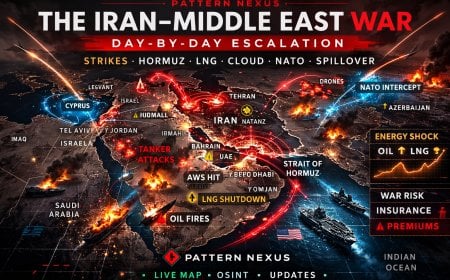
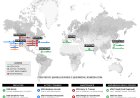
Over the last month, the Middle East has shifted into a fragmentation regime: Red Sea disruption remains a global trade lever, Iran is under acute internal stress, Israel’s conflict geometry stays multi-front, and Gulf alignment is no longer bloc-discipline. This Pattern Nexus framework maps the interacting theaters, the country-specific incentives, and the next 30–90 day escalation triggers.
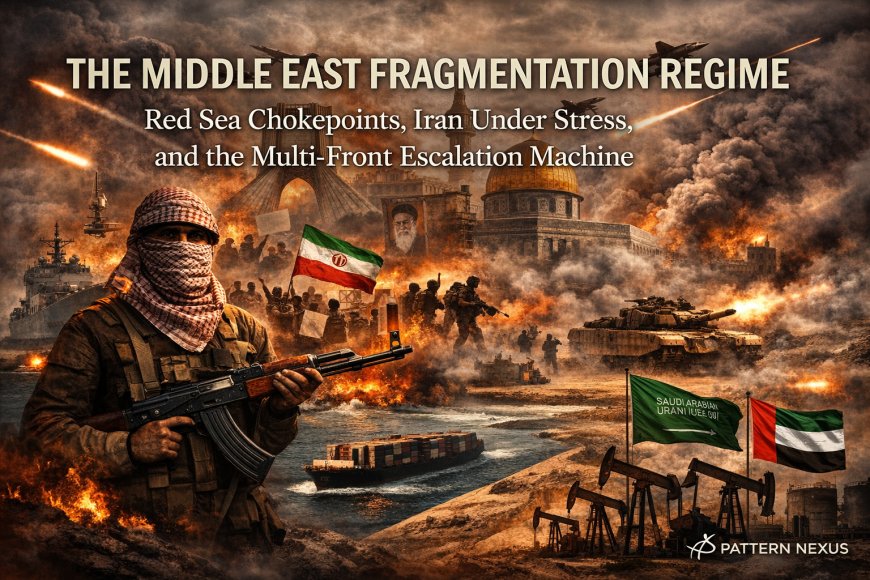
This is no longer “one war.” Over the last month, the region has consolidated into an interlocking escalation machine: Red Sea pressure persists as a global trade lever, Iran is showing visible internal stress, Israel’s operational footprint remains multi-front, and Gulf alignment is shifting from coalition discipline to competitive autonomy. If you are still analyzing this as isolated headlines, you are missing the operating system.
The Regime Shift: From Conflicts to Coupled Systems
The common analytical failure is treating each event as a discrete episode: a strike here, a protest there, a ceasefire headline somewhere else. That approach collapses the real structure of the moment. The Middle East has moved into a fragmentation regime where every theater is now mechanically coupled to at least one other theater through chokepoints, proxies, trade routes, domestic legitimacy, and alliance incentives.
The key point is this: escalation does not need a single “decision” anymore. It can emerge from the interaction of separate systems that are each rational in isolation but unstable in combination. Red Sea disruption raises trade and insurance costs and pressures regional economies. Domestic Iranian stress reduces regime bandwidth and increases the temptation for external signaling. Israel’s multi-front posture remains active because the strategic geometry never fully resolves. Gulf states pursue autonomy and competitive positioning rather than bloc coherence. Those are not separate stories. They are the same story at different layers.
PN Core Claim: The dominant driver is not “who is winning.” The driver is that the region is operating as a coupled system where shocks propagate across theaters faster than diplomacy can compartmentalize them.
Yemen and the Red Sea: Chokepoint Economics + Coalition Fracture
Yemen is still the most efficient place on earth to apply pressure to global trade at low cost. The Red Sea lane is not merely “regional.” It is a pricing mechanism for shipping, insurance, and rerouting decisions. Even when the tempo of attacks fluctuates, the risk premium persists because the vulnerability is structural: a narrow maritime corridor, high cargo density, and the ability of a non-state actor to generate outsized disruption.
That is why the U.S. and partners have treated Houthi capabilities as a recurring target set for years. The strategic intent of these operations is consistent: degrade launch infrastructure, disrupt command and logistics, and reduce the reliability of attacks that force global rerouting. The real shift over the last month is not simply “more strikes.” It is that the anti-Houthi political architecture is visibly weakening at the same time Red Sea insecurity remains a global constraint.
PN Translation: Even if you crater launch sites, you do not solve the problem if the coalition that is supposed to stabilize the map fractures and begins competing inside the same battlespace.
Saudi–UAE Divergence: The Anti-Houthi Architecture Is Breaking
The most consequential Yemen development in late December was not a battlefield win. It was an alliance rupture. Saudi Arabia struck the Yemeni port city of Mukalla over an alleged UAE-linked shipment connected to the Southern Transitional Council (STC), and the UAE announced it would pull its remaining forces from Yemen. This is not noise. This is a regime-level signal that the Gulf coalition is no longer functioning as a unified structure inside Yemen.
The STC is not a minor variable. It is a force that can seize territory, control key nodes, and create a second civil-war axis inside the broader Yemen conflict. When Riyadh and Abu Dhabi diverge on STC support and end-state geometry, Yemen stops being “Saudi vs Houthis” and becomes “multiple competing state-backed projects on one map.” That fragmentation does not reduce conflict. It extends it, because it creates more veto points and more armed stakeholders with incompatible end states.
The immediate implication is logistical: border closures, port controls, and flight disruptions become tools of leverage between nominal partners. The deeper implication is strategic: a fractured coalition increases the probability that the Houthis benefit indirectly, even if they are tactically pressured, because their opponents are consuming bandwidth fighting over control of the rear.
Why This Matters for the U.S.: Maritime security is not just a strike package problem. It is a coalition integrity problem. If Gulf alignment fractures, U.S. deterrence becomes more expensive because partners are no longer pulling in the same direction.
Iran: Internal Stress, Crackdowns, and External Miscalculation Risk
Iran is showing visible signs of internal stress that are now spilling into sustained unrest: protests tied to inflation, currency collapse dynamics, and worsening living conditions, accompanied by aggressive security response and reported deaths. The precise tactical details will always be contested in real time, but the macro signal is clear: internal legitimacy and economic stability are under acute strain.
The geopolitical implication is not that the regime is “about to fall.” That is a low-quality way to read the situation. The higher-quality read is bandwidth. When the state is forced to allocate attention and coercive resources inward, it has less flexibility outward and becomes more prone to performative deterrence signaling to project control. That is how miscalculation risk rises across the network: Iraq militia dynamics, Syria corridor interdictions, Hezbollah pressure calibration, and Red Sea proxy signaling can all become “external posture” instruments in periods of domestic stress.
Internal stress also increases the risk of policy lurches that are economically rational in the short term but politically destabilizing over time: heavier market controls, harsher enforcement, higher repression, and propaganda escalation. Those actions can suppress near-term unrest while deepening longer-run legitimacy decay.
PN Core Claim: Iran under stress does not automatically mean Iran is weaker. It often means Iran is less predictable, because the regime’s survival logic compresses decision space and rewards signaling over stabilization.
Israel–Palestine Continuity: Multi-Front Optionality, Not Closure
The Israel–Palestine conflict remains the central gravity well. Even when ceasefire language appears, the regional reality continues to behave like a multi-front system. The operational footprint and strike geography in 2025 underscored that Israel has been willing to operate across a wider set of theaters than typical single-front conflicts, and that footprint has downstream effects: it shapes proxy activation, domestic politics across the region, and the incentives of regional states managing internal stability.
Gaza remains the humanitarian and political pressure engine. Restrictions, aid disputes, and operational decisions become not only moral flashpoints but also strategic accelerants: they intensify regional anger, strengthen recruitment narratives for militant actors, and increase the probability of spillover events that force secondary theaters to react. Meanwhile, the West Bank remains structurally unstable because its dynamics are not solved by a Gaza “phase” headline.
The core point is optionality. Israel’s posture is not designed for closure. It is designed for threat suppression across multiple vectors. That posture can be tactically effective while still producing strategic instability if it perpetuates the conditions for recurring escalation.
PN Translation: “Ceasefire” headlines do not equal regime change. They often equal phase shifting. The machine keeps running; it just changes which gears are engaged.
Lebanon, Syria, Iraq: The Corridor Battlefield
If Yemen is the trade chokepoint theater, the Levant corridor is the escalation corridor theater. Lebanon, Syria, and Iraq form a connected operational space where deterrence signaling, interdiction logic, militia networks, and state weakness interact.
In Lebanon, ceasefire frameworks have not eliminated strike dynamics or political coercion. Reports and negotiations have centered on ceasefire administration, verification, and alleged violations, with continued fear that pressure campaigns could expand to force accelerated disarmament outcomes. The practical implication is that Lebanon remains a high-sensitivity escalation surface: a single incident can cascade into broader engagement because credibility is the currency on both sides.
Syria remains a corridor and a trigger zone. Its airspace and border regions are repeatedly implicated in the logic of preventing weapons transfers, degrading networks, and denying adversarial entrenchment. Regardless of the week-to-week tempo, the structural function persists: Syria is where deterrence and interdiction meet deniable escalation.
Iraq remains the hinge where U.S. posture, state sovereignty politics, and militia ecosystems collide. It is the classic vulnerability: formal governance exists, but coercive capacity is fragmented. That creates a persistent environment where external actors can compete without needing to declare conventional war, and where domestic political shifts can suddenly reprice the entire U.S.–Iran deterrence balance.
PN Core Claim: The corridor battlefield is not about “front lines.” It is about logistics, credibility, and the ability to impose costs without triggering a full-scale response.
The Stability Belt: Egypt, Jordan, Oman, Qatar
Not every state is an escalation engine. Some are shock absorbers, and their stability is a primary determinant of whether escalation stays regional or becomes systemic.
Egypt is economically exposed to Red Sea disruption through Suez Canal traffic and revenue. Even the expectation of a “stepwise return” by major carriers becomes strategically relevant because it speaks to whether the region is moving toward normalization or another disruption cycle. Egypt’s posture will track two variables: domestic economic pressure and the perceived durability of maritime security conditions.
Jordan is the classic stability hinge: proximate to the West Bank and Israel, managing cross-border logistics and internal political sensitivity to Gaza dynamics. Border crossings, aid corridors, and domestic pressure cycles mean Jordan often becomes the operational interface between humanitarian necessity and security policy.
Oman and Qatar function as valves: mediation channels, backdoor communications, and diplomatic liquidity when public diplomacy fails. In fragmentation regimes, valves matter because they reduce the probability that two sides misread signals and accidentally escalate. These states do not “solve” wars, but they can reduce the frequency of uncontrolled escalation spikes.
PN Translation: The region doesn’t only need ceasefires. It needs functioning valves. When valves fail, small events become big wars.
What Changes Next: 30–90 Day Watchlist
If you want actionable forecasting, you do not watch speeches. You watch stress indicators and trigger conditions. Here are the most important regime-level “next moves” to monitor over the next 30–90 days.
Yemen / Red Sea
- Coalition integrity: Whether the Saudi–UAE rift continues to widen through port controls, airspace restrictions, border closures, or direct proxy clashes.
- STC expansion dynamics: Whether southern control contests pull resources away from anti-Houthi stabilization and create a second sustained conflict axis.
- Shipping normalization vs renewed risk repricing: Carrier guidance, insurance pricing, and “trial transits” are more important than rhetoric.
Iran
- Protest persistence: Whether unrest remains geographically broad and economically rooted, and how forcefully security forces escalate coercion.
- External signaling: Proxy activation or deterrence messaging that is disproportionate to immediate external threats.
- Economic policy lurch risk: Market controls and enforcement actions that stabilize short-term currency pressure while accelerating legitimacy decay.
Israel / Lebanon / Syria
- Verification and enforcement mechanisms: Shifts in truce administration and how allegations of violations are operationalized.
- Strike geography expansion: A widening target set is the most reliable indicator that leadership is converting pressure into broader coercion.
- Humanitarian constraints: Aid restrictions or NGO licensing shocks that can rapidly elevate international pressure and regional anger.
Egypt / Jordan
- Suez route return: Any sustained normalization would relieve shipping inflation and reduce global rerouting costs, but it is highly sensitive to security shocks.
- Border logistics: Crossings, aid corridors, and internal political stability indicators in Jordan are early-warning signals for regional pressure spikes.
PN Forecast Discipline: In this regime, escalation often comes from interaction effects: a Yemen shipping shock plus Iranian unrest plus a Lebanon incident can create an amplification event even if each component alone is “contained.”
Pattern Nexus Lens: The Region as a Chokepoint Machine
The Middle East is often described as volatile because of ideology, religion, or historical grievance. Those matter, but they are not sufficient explanations for the current pattern. The better explanation is mechanical: the region contains multiple choke nodes where relatively small forces can impose outsized costs on global systems (shipping lanes, energy routes, borders, corridors, aid pipelines), while governance fragmentation creates multiple armed stakeholders with veto power over stability.
In a chokepoint machine, stability is not the default. Stability must be actively manufactured through incentives, enforcement, and credible valves. When alliances fracture, domestic legitimacy erodes, and multi-front optionality persists, the machine drifts toward recurrent escalation by design.
That is the regime. The question for 2026 is not “does it get solved?” The question is “which gears engage next, and which shocks propagate globally?”
Sources
- Reuters (Jan 1, 2026): Several reported killed in Iran protests over economic hardships
- Reuters (Dec 30, 2025): Iran government offers dialogue as protests spread
- The Guardian (Jan 1, 2026): Iran protests escalate amid economic crisis
- Al Jazeera (Jan 1, 2026): Several killed as Iran protests spread
- AP (Dec 30, 2025): Saudi Arabia bombs Yemen port city over alleged UAE shipment
- Reuters (Dec 30, 2025): UAE to pull remaining forces from Yemen after Saudi-backed call
- Reuters (Jan 1, 2026): Yemen’s Aden airport shuts as Saudi–UAE rift deepens
- Financial Times (Dec 2025): Saudi Arabia strikes UAE-backed faction in Yemen as Gulf rift deepens
- Reuters (Dec 19, 2025): Shipping companies’ plans for return to Suez/Red Sea route
- Al Jazeera (Dec 29, 2025): Animated map of countries Israel attacked in 2025 (ACLED-based)
- Reuters (Dec 5, 2025): Lebanon says ceasefire talks aim to halt Israeli hostilities
- Reuters (Dec 20, 2025): Lebanon close to completing Hezbollah disarmament south of Litani, PM says
- Washington Post (Dec 31, 2025): Israel to bar/suspend licenses of aid groups operating in Gaza
- Washington Post (Dec 10, 2025): Israel reopens Jordan crossing amid Gaza truce pressure
- U.S. CENTCOM: Joint strikes in Yemen (summary of target categories and intent)
Qual é a sua reação?
 Curtir
0
Curtir
0
 Não Gostar
0
Não Gostar
0
 Amor
0
Amor
0
 Engraçado
0
Engraçado
0
 Uau
0
Uau
0
 Triste
0
Triste
0
 Bravo
0
Bravo
0

Founder of Pattern Nexus. I research markets, macro, geopolitics, AI, history, ancient systems, and the patterns most people overlook. I’m also building Market Radar, a trading scanner designed to read pressure, risk, confirmation, and setup quality before chasing a move. Pattern Nexus is where I connect the dots between data, history, technology, and the bigger system playing out around us.












Comentários (0)