

Caracas Escalation: Explosions, Airstrikes, and the Fog of Verification
Explosions near Caracas, airstrike claims at Higuerote Airport, armored deployments, and U.S. aerial assets on radar. A Pattern Nexus reconstruction separating verified events from information warfare.
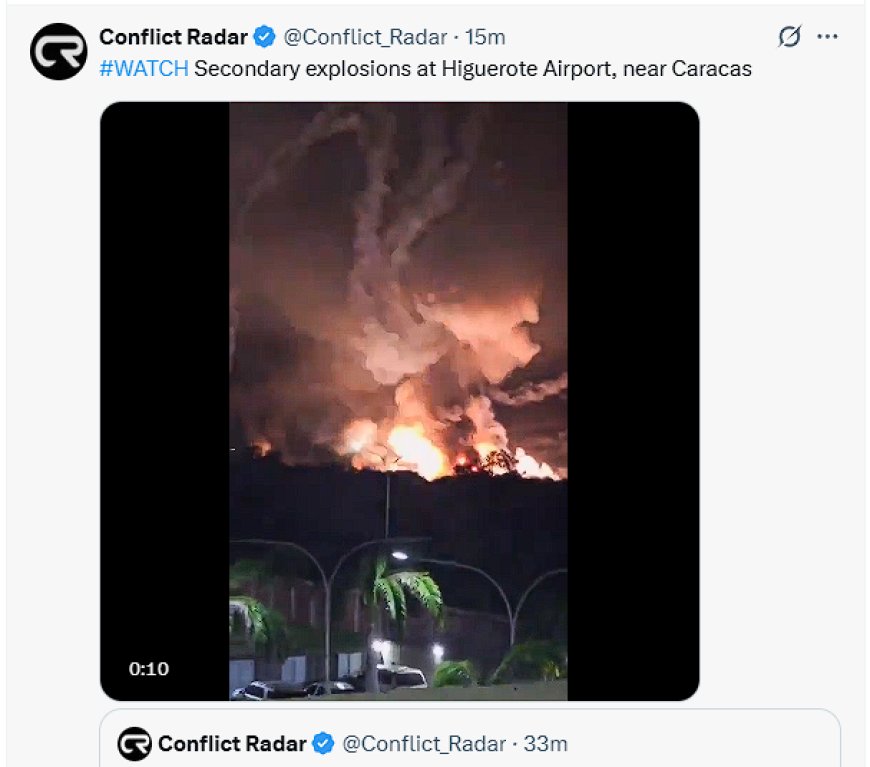
Explosions near Caracas, airstrike claims at Higuerote Airport, armored deployments, and U.S. aerial assets on radar. A Pattern Nexus reconstruction separating verified events from information warfare.
Jump to a section
Published: January 3, 2026
By: Pattern Nexus
OPERATION SNAPSHOT — FULL VERIFIED UPDATE (AS OF ~10:00 A.M. CST)
- The United States conducted a coordinated, multi-domain military operation inside Venezuela. This is confirmed by Reuters and the Associated Press citing U.S. officials.
- U.S. airstrikes and kinetic actions occurred across multiple strategic nodes, including Caracas, the Higuerote Airport area (Miranda state), and the port of La Guaira.
- Explosions, sustained fires, smoke plumes, and power disruptions were widely reported overnight by residents, journalists, and international media.
- U.S. military helicopters operated extensively at low altitude over Caracas during the operation. This activity is corroborated by widespread video and eyewitness reporting.
- The Venezuelan government formally declared the action “U.S. military aggression” and initiated emergency security measures nationwide.
- President Donald Trump publicly announced that U.S. forces captured Venezuelan President Nicolás Maduro and his wife, Cilia Flores, during the operation.
- Reuters and the Associated Press are reporting Maduro’s capture and removal from Venezuela, citing Trump’s statement and U.S. officials.
- Trump stated Maduro was flown out of Venezuela following his capture, marking a regime-level leadership removal.
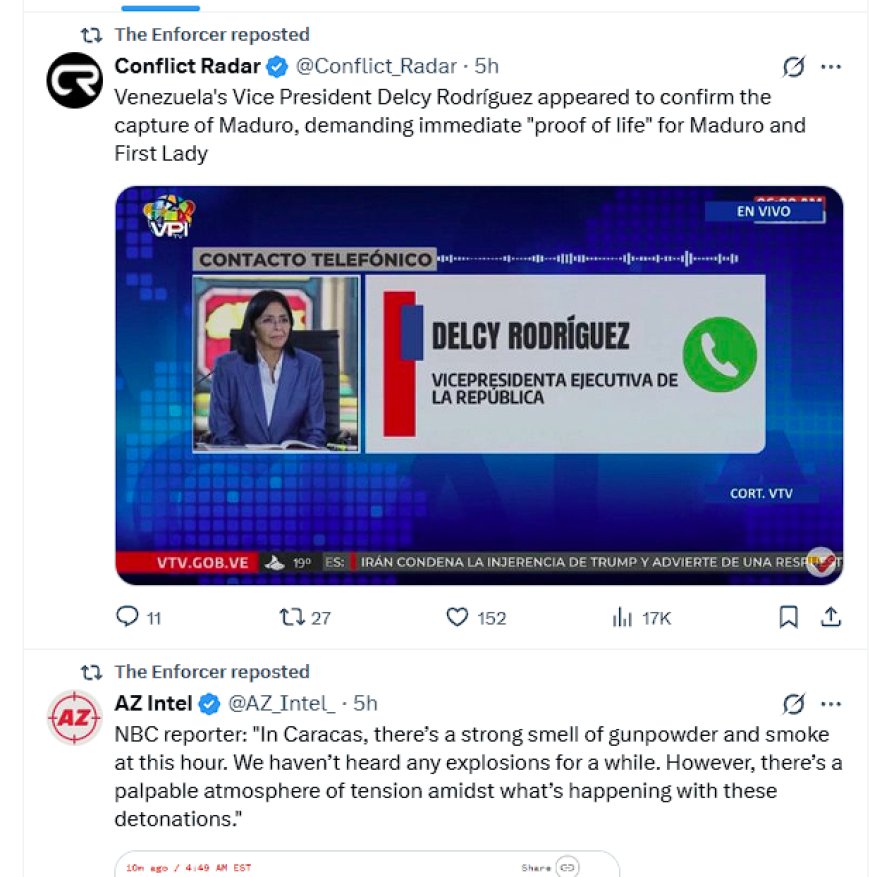
- Venezuela’s Vice President Delcy Rodríguez appeared on state television demanding “proof of life”, signaling immediate internal regime disruption and loss of command clarity.
- The U.S. Federal Aviation Administration imposed airspace restrictions due to active military risk associated with the operation.
- International reaction is already underway, with multiple governments condemning or responding to the U.S. action.
WHAT REMAINS MECHANICALLY UNCLEAR (NOT EVENT-DETERMINATIVE)
- The precise sequencing and duration of ground actions during the operation.
- Exact unit composition involved in helicopter and capture phases.
- Short-term versus sustained control status of Simón Bolívar (Maiquetía) International Airport.
- Post-capture internal command structure inside Caracas.
Bottom line: This was a decisive, coordinated U.S. military operation resulting in the reported capture and removal of Venezuela’s head of state. Remaining uncertainties are operational details — not whether the operation occurred or its primary outcome.
Sources
- Reuters — Trump says U.S. has captured Venezuela President Maduro
- Associated Press — U.S. strikes Venezuela; Maduro captured and flown out
- CBS News — Live updates on U.S. strikes and Maduro capture
- Al Jazeera — Trump says Maduro captured after U.S. operation
- Reuters — World reacts to U.S. strikes in Venezuela
MAJOR UPDATE — U.S. Strikes Confirmed; Ground Operations Remain Unverified Amid Possible Information Blackout
The situation in Venezuela has now escalated beyond early ambiguity. As of approximately 3:30 a.m. Central Time on January 3, 2026, multiple authoritative news organizations confirm that the United States is conducting military strikes inside Venezuela.
Reuters has reported that a U.S. official confirmed the United States is carrying out strikes, while the Venezuelan government has formally labeled the actions as “U.S. military aggression,” citing attacks on both civilian and military installations across multiple regions.
Explosions have been widely reported and independently corroborated in:
- Caracas
- The vicinity of Higuerote Airport (Miranda state)
- The port of La Guaira
Residents and journalists report low-flying aircraft, sustained fires, secondary explosions, and power outages in parts of the capital, consistent with an ongoing aerial campaign rather than isolated incidents.
The U.S. Federal Aviation Administration has issued flight restrictions related to elevated military risk, further reinforcing the presence of active hostilities.
Ground Forces, Special Operations, and Airport Control Claims
Alongside confirmed strike activity, a large volume of social media and OSINT accounts are now claiming the presence of U.S. ground forces, special operations units, amphibious landings, and the seizure of Caracas International Airport.
As of this update, none of these claims have been confirmed by Reuters, the Associated Press, or any other major wire service.
Specifically, there is no authoritative confirmation of:
- U.S. ground combat units operating inside Venezuela
- U.S. Marine Corps amphibious assault operations
- Delta Force, JSOC, or other special operations capture missions
- U.S. control of Simón Bolívar (Maiquetía) International Airport
While it is acknowledged that sensitive military operations can involve delayed disclosure or temporary information blackouts, historical precedent indicates that ground-force involvement typically produces secondary confirmation signals — including embassy posture changes, airline or airport status updates, insurance and maritime advisories, or “on the ground” language from major wire services.
As of now, those secondary confirmations have not materialized.
Current Assessment
Based on all available verified reporting:
- U.S. air and strike operations inside Venezuela are confirmed
- Helicopter activity over Caracas is real, but unit-level attribution and mission intent remain unverified
- Ground-force involvement remains unconfirmed, despite widespread online claims
This places the current phase of the conflict in a category of confirmed external military action with unresolved escalation scope.
Pattern Nexus will update this analysis immediately upon confirmation from Reuters, the Associated Press, or an official U.S. Department of Defense statement clarifying whether operations extend beyond airstrikes into sustained ground engagement.
Until such confirmation occurs, claims of U.S. ground occupation, special forces raids, or airport seizure should be treated as unverified.

UPDATE — Claims of U.S. Ground Forces Remain Unconfirmed
New claims are circulating across social media and some alert feeds alleging that U.S. Marine Corps ground forces have launched an amphibious assault north of Caracas.
As of this update, these claims cannot be confirmed by authoritative news agencies.
A review of the latest reporting from:
- Reuters
- Associated Press
- Other major international wire services
shows no confirmation of U.S. ground forces, Marine landings, or amphibious assault operations inside Venezuela.
While airstrikes, explosions, and aircraft activity are widely reported — and Venezuelan government attribution is now official — ground-force involvement represents a materially higher escalation threshold that would be immediately and explicitly reported by major outlets if confirmed.
At this time, these claims appear to originate from social media aggregation and OSINT accounts rather than verified wire reporting.
Pattern Nexus will update this analysis immediately if Reuters, AP, or an official U.S. Department of Defense statement confirms ground-force or amphibious operations. Until then, these claims remain unverified.


UPDATE — U.S. Strikes Now Reported by Multiple Official Sources
Since initial publication, the situation in Venezuela has materially escalated from unverified reports to official government attribution and source-confirmed U.S. media reporting.
As of approximately 2:00 a.m. Central Time on January 3, 2026:
- The Venezuelan government has formally accused the United States of conducting coordinated strikes on both civilian and military installations across multiple regions, including the Caracas area.
- Major U.S. media outlets, including CBS News, are reporting that President Donald Trump ordered strikes inside Venezuela, citing U.S. officials, with targets reportedly including military facilities.
- Multiple explosions have now been reported not only in Caracas, but also near Higuerote Airport and the port of La Guaira, indicating a broader operational footprint.
- Low-flying aircraft activity, sustained fires, and secondary explosions have been documented across several locations, consistent with an airstrike campaign rather than isolated incidents.
- Regional leaders, including the President of Colombia, have publicly stated that Venezuela “has been attacked,” escalating the diplomatic dimension of the event.
While a formal Pentagon press briefing or written Department of Defense statement has not yet been released, the convergence of:
- Official Venezuelan government attribution
- Source-confirmed U.S. media reporting
- Multi-location kinetic effects observed on the ground
places this event firmly in the category of active U.S. military action against targets inside Venezuela, pending formal operational detail disclosure.
Pattern Nexus will continue to update this analysis as official U.S. defense statements, strike scope, target lists, and strategic objectives are released.


UPDATE — Rapid Escalation Claims Emerging
In the past hour, multiple conflict-monitoring feeds and media outlets have reported a sharp escalation in claims surrounding the Caracas events.
According to aggregated reports:
- A series of explosions has been reported across Caracas, including large blasts at Higuerote Airport and additional explosions near the port of La Guaira.
- Widespread power outages have been reported in parts of the capital following the explosions.
- As of this update, no official statement has been released by U.S. defense authorities.
- The President of Colombia publicly stated that “Venezuela has been attacked,” though no supporting operational details have been provided.
- U.S. media outlets are reporting — citing U.S. officials — that strikes inside Venezuela were ordered by President Trump, allegedly targeting sites linked to national security concerns involving Hezbollah and Iran.
At this time, these claims represent reported assertions, not independently verified operational confirmation. No official Pentagon briefing, strike footage, or formal acknowledgment has yet been released validating scope, targets, or authorship.
This update materially increases the probability of external military involvement, but attribution and operational clarity remain incomplete. Pattern Nexus is maintaining verification discipline and will integrate confirmed details as authoritative sources publish them.

Overnight events in and around Caracas represent the most serious internal security escalation in Venezuela in years. Multiple explosions, sustained fires near Higuerote Airport, armored deployments inside the capital, and U.S. aerial assets appearing on radar have converged into a fast-moving situation where verification matters more than velocity.
This is not a single incident. It is a cluster of physical, military, and informational signals unfolding simultaneously under conditions of limited official disclosure.
What Is Confirmed on the Ground
Multiple independent eyewitness accounts, videos, and international media reporting confirm that **a series of loud explosions were heard across Caracas in the early morning hours of January 3**, concentrated around approximately 2:00 a.m. local time. Residents described shockwaves, rattling structures, and immediate panic across several districts.
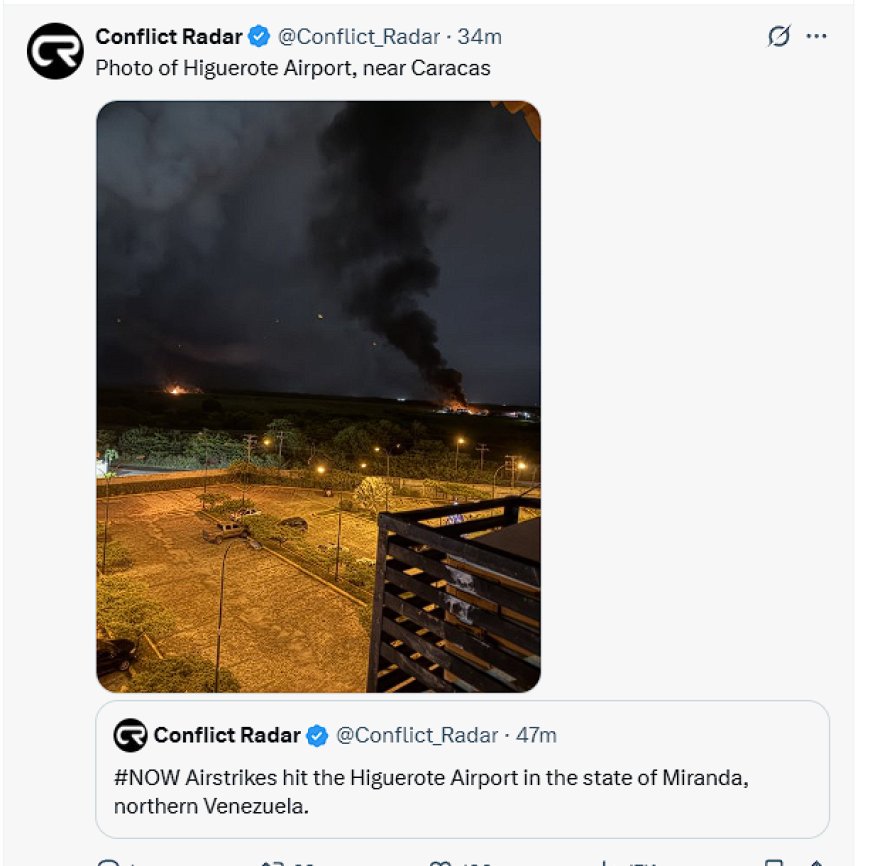
Sustained **fires and secondary explosions were observed near Higuerote Airport**, east of Caracas in Miranda state. The visible characteristics — prolonged combustion, thick smoke plumes, and continuing flare-ups — strongly suggest damage involving fuel, munitions, or critical infrastructure rather than transient electrical or industrial noise.
In parallel, footage and eyewitness reports confirm **armored vehicles and military units maneuvering near Miraflores**, the presidential palace complex. These movements are inconsistent with routine patrols and align historically with Venezuelan internal security protocols during periods of perceived regime threat.
Localized power outages were reported in parts of southern Caracas following the explosions, reinforcing the assessment that physical infrastructure was impacted during the event window.
Air Activity and Strategic Signals
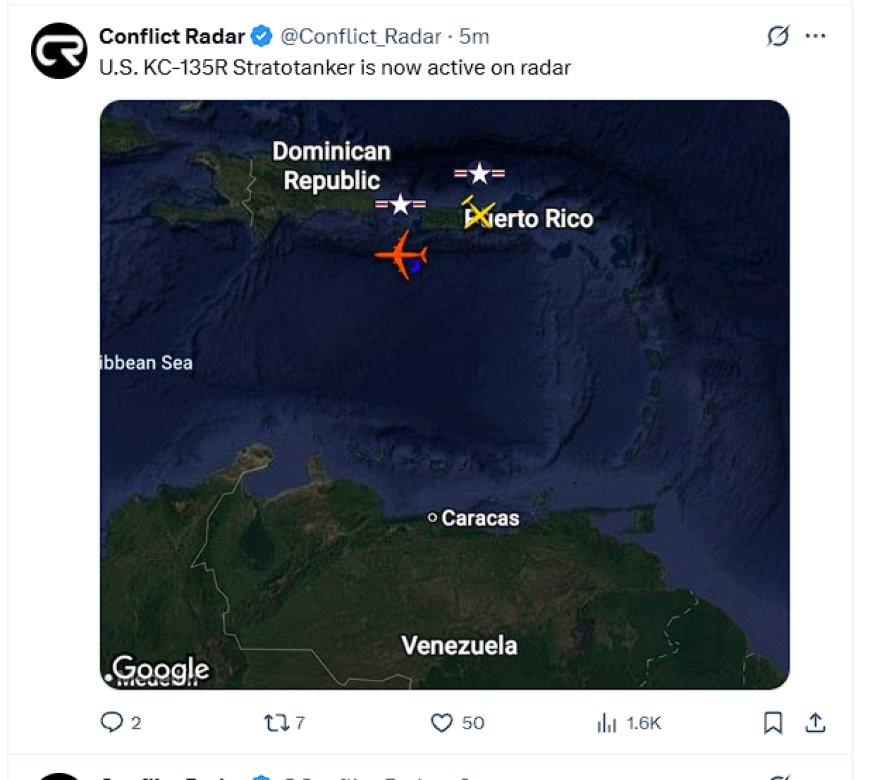
Open-source flight tracking confirms **a U.S. KC-135R Stratotanker active in the Caribbean basin** during the same timeframe. While tanker activity does not constitute proof of kinetic engagement, it materially alters the regional escalation envelope by extending range, loiter time, and operational optionality for U.S. air assets.
In military signaling terms, tanker presence expands capability without declaring intent. It enables contingency without committing to action.
Separately, residents across Caracas reported **low-flying aircraft sounds** coinciding with the explosions. At this time, no authoritative attribution has been made regarding aircraft type, origin, or mission.
What Remains Unverified
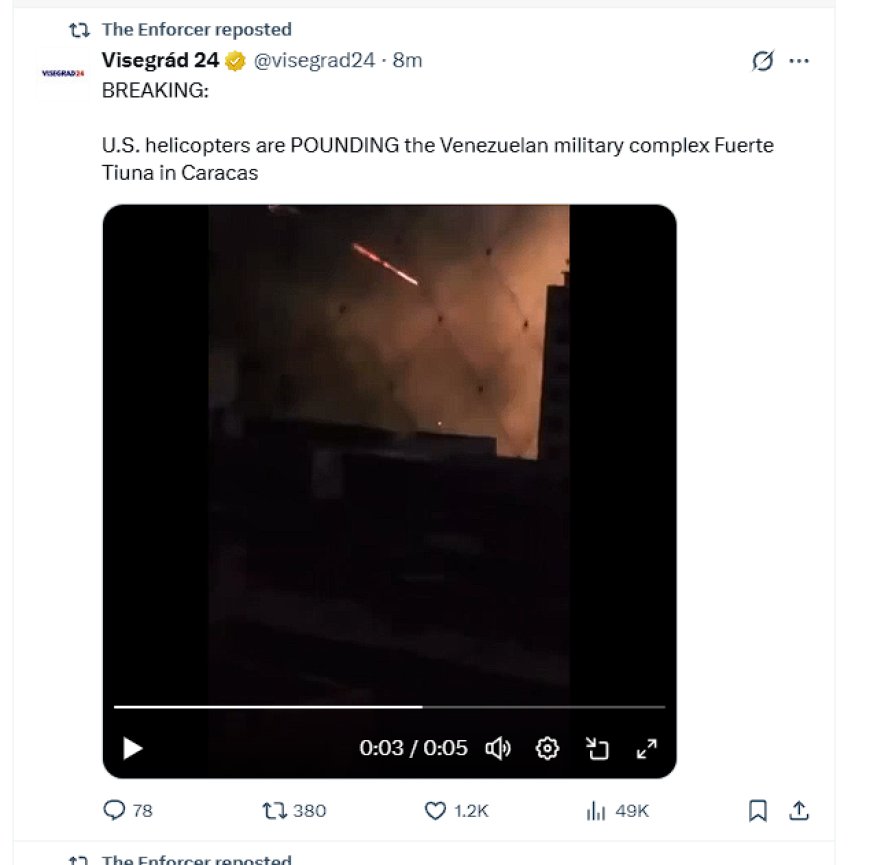
Claims circulating online that **foreign military forces — including U.S. helicopters or aircraft — conducted direct airstrikes on Venezuelan military facilities** remain unconfirmed. No official confirmation has been issued by the Pentagon, U.S. Southern Command, Venezuelan defense authorities, or any allied military channels.
Likewise, speculation regarding the **location, status, or targeting of President Nicolás Maduro** remains unresolved. Media commentary has acknowledged uncertainty rather than presenting verified facts.
In high-volatility environments, absence of confirmation is not ambiguity — it is data. Premature certainty amplifies instability rather than understanding.
Context: Pressure Environment Preceding the Event
These events occurred against a backdrop of **elevated U.S.–Venezuela tension**, including sustained U.S. military operations in the Caribbean and Eastern Pacific targeting alleged narcotics trafficking routes, alongside repeated rhetorical escalation between Washington and Caracas.
Over the past year, Venezuelan leadership has publicly framed U.S. military posture as an existential threat, while U.S. officials have maintained pressure through sanctions, naval presence, and regional operations. This environment increases sensitivity to internal disruptions and accelerates regime security responses.
Pattern Nexus Lens: Internal Crackdown vs External Escalation
The current signal stack aligns more closely with an **internal Venezuelan security crisis** than a confirmed external military assault.
Key indicators:
- Explosions concentrated near strategic transport and logistics nodes
- Sustained fires suggesting infrastructure or storage damage
- Rapid armored deployment around executive power centers
- Foreign military assets postured for contingency rather than engagement
- No verified external strike attribution as of 1:40 a.m. local time
Historically, regimes under acute stress prioritize command cohesion, leadership protection, and internal control before engaging external adversaries. External actors posture, observe, and preserve optionality.
The Information Warfare Layer
This episode follows a now-familiar modern pattern:
Real events + partial visibility + viral amplification = narrative distortion.
The explosions are real. The fires are real. The armored movements are real. The radar tracks are real. What remains unresolved is causality — who initiated what, why, and under whose authority.
In this vacuum, social platforms reward speed and certainty over verification. Pattern Nexus does not.
Bottom Line
Caracas experienced a genuine and serious security event in the early hours of January 3, 2026. Internal regime stress is evident. Strategic posture is shifting. External military escalation, while increasingly discussed, remains unconfirmed.
This is not a moment for declarations. It is a moment for disciplined observation.
Sources & Open-Source Intelligence
- Associated Press – Explosions and aircraft sounds reported in Caracas
- Reuters – Loud noises, smoke, and power outages reported in Caracas
- The Guardian – Multiple explosions heard across Venezuela’s capital
- AFP via Arab News – Explosions reported around 2 a.m. local time
- U.S. military operations in the Caribbean (background)
- Open-source flight tracking and ADS-B radar data
- Pattern Nexus internal verification framework
What's Your Reaction?
 Like
0
Like
0
 Dislike
0
Dislike
0
 Love
0
Love
0
 Funny
0
Funny
0
 Wow
0
Wow
0
 Sad
0
Sad
0
 Angry
0
Angry
0

Nexus (Christopher)
Founder of Pattern Nexus. I research markets, macro, geopolitics, AI, history, ancient systems, and the patterns most people overlook. I’m also building Market Radar, a trading scanner designed to read pressure, risk, confirmation, and setup quality before ch…
Related research
Operation Venezuela: Maduro Captured, Caracas Struck, and the U.S. Claims Temporary Control
The U.S. carried out a large-scale strike in Venezuela and claims it captured Nicolás Maduro and Cilia Flores, moving them to U.S. custody …
5 shared topics, same research avenue.
The Middle East Fragmentation Regime: Red Sea Chokepoints, Iran Stress, and the Multi-Front Escalation Machine
Over the last month, the Middle East has shifted into a fragmentation regime: Red Sea disruption remains a global trade lever, Iran is unde…
5 shared topics, same research avenue.
Iran at the Edge: Currency Collapse, Street Protests, and a Narrowing Margin for Error
Iran’s rial collapse has detonated nationwide protests, leadership churn, and a lethal-force risk spiral—now compounded by external signali…
4 shared topics, same research avenue.
The Thailand–Cambodia Flashpoint: Managed Instability Comes to Southeast Asia
The Thailand–Cambodia border conflict is not a local anomaly. It is a repeatable flashpoint where alliance hedging, great-power leverage, a…
4 shared topics, same research avenue.
The New Monroe Doctrine: How the 2025 National Security Strategy Confirms the Western Hemisphere Pivot, Digital Dollar Realignment, and the Coming Global Reordering
The 2025 National Security Strategy marks the most dramatic U.S. strategic pivot in decades—re-centering the Western Hemisphere, reviving a…
4 shared topics, same research avenue.
Venezuela, SOUTHCOM, and the New Western Hemisphere Power Map (2025 Update) | Pattern Nexus
Updated 2025 force-posture analysis: why the Caribbean just became the most important theater of the 21st century. Carrier groups, JASSM bo…
4 shared topics, same research avenue.
Parallel Order? Trump, Putin, and the Emergent Board of Peace
Trump’s new “Board of Peace” began as a Gaza conflict tool but is already expanding into something bigger. This piece explores the speculat…
3 shared topics, same research avenue.
The Iran Decision Window: What the CBS Briefing Actually Signals
CBS reports Trump was briefed on military, cyber, and psychological options for Iran. That single line matters: it marks the opening of a d…
3 shared topics, same research avenue.
Comments (0)
Security Check
Please complete the captcha to verify you are human.