
The Monetary Break: How Nixon, Silver, & the Eurodollar Rewired the Global System (1968–1979)
Between 1968 and 1979, the collapse of the gold window, the rise of the Eurodollar, and the Petrodollar shift transformed the global monetary system. Nixon’s 1971 shock, oil crises, offshore dollar expansion, and financial deregulation rewired the world’s liquidity architecture and created the modern dollar empire.
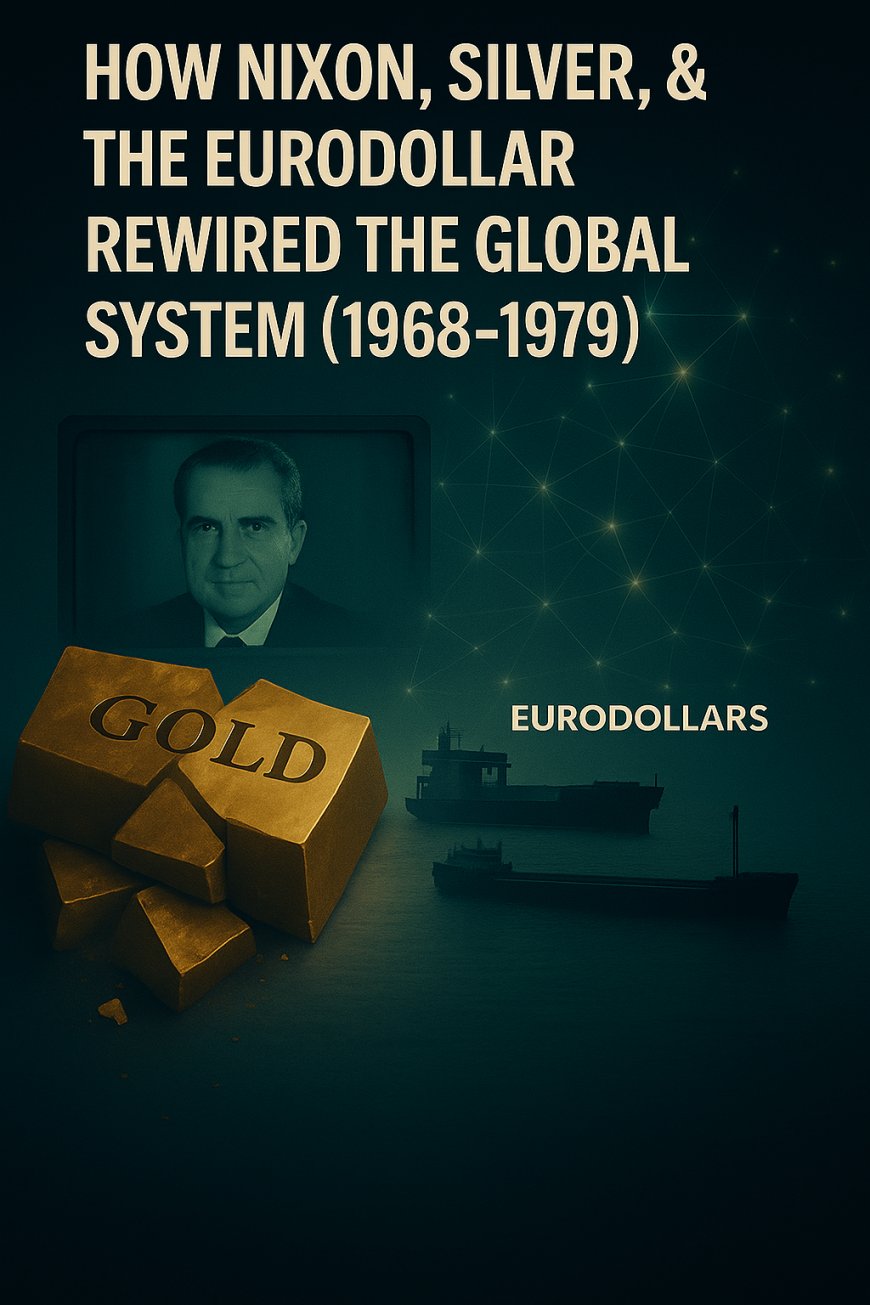
The Late-1960s Stress: Triffin’s Dilemma Goes Live
By the late 1960s, the postwar dollar–gold system was living on borrowed time. On paper, the rules said one thing:
- the dollar was convertible into gold at $35 per ounce for foreign governments
- other currencies were pegged to the dollar within narrow bands
- the IMF and World Bank would help smooth temporary imbalances
In reality, the math was breaking.
The United States was running growing fiscal and balance-of-payments deficits — funding the Vietnam War, Great Society programs, and a global security footprint. At the same time, Europe and Japan had rebuilt. Their export machines were strong, their external positions healthier, and they were accumulating dollars as reserves.
Over time, foreign official and private claims on dollars piled up far beyond the U.S. gold stock valued at $35/oz. Economists like Robert Triffin had already pointed out the structural trap:
To supply the world with dollar liquidity, the U.S. had to run deficits — but those deficits eventually undermined confidence in the dollar’s gold backing.
By the late 1960s, this wasn’t a theoretical paper. It was a line of central bankers quietly showing up and asking the U.S. Treasury for gold. France under de Gaulle was especially vocal, criticizing the “exorbitant privilege” of the dollar and converting dollars into gold to test the system’s limits.
The result: a slow-motion bank run on the gold window. The only way to stop it was to close the window.
The Nixon Shock: Closing the Gold Window
On August 15, 1971, President Richard Nixon addressed the nation in a televised speech. Most people remember it — if at all — as “ending the gold standard.” Technically, he announced the “temporary suspension” of dollar convertibility into gold for foreign governments, along with wage and price controls and a surcharge on imports.
In practice, the suspension was permanent.
The move was framed as defending the dollar from “speculators,” but it was really an admission that the U.S. could no longer credibly promise to exchange foreign-held dollars for gold at $35/oz. The quantities no longer matched. The world held far more dollar claims than the U.S. could cover with official gold reserves.
The immediate effects were:
- a break with the explicit Bretton Woods dollar–gold link
- a wave of currency instability and competitive adjustments
- a transition period of ad hoc agreements and “snake in the tunnel” arrangements among European currencies
But something deeper happened under the surface. By cutting the gold link, the U.S. removed the last hard constraint on dollar supply. From then on, the dollar would be backed not by a metal at a fixed price, but by:
- the U.S. Treasury market
- the scale and liquidity of dollar-denominated assets
- the embedded role of the dollar in trade, finance, and energy invoicing
- the military and political weight behind that structure
The world did not move to a neutral multipolar currency system. It moved into a new phase of dollar dominance — just with a different anchor.
After Bretton Woods: Floating Currencies and a Dollar Without Gold
After the Nixon shock, policymakers tried a series of patchwork fixes. The Smithsonian Agreement in 1971 attempted to realign exchange rates and restore a kind of modified peg system. It didn’t hold. By 1973, major currencies had largely shifted to floating exchange rates against the dollar.
This was the official “end of Bretton Woods” in the sense of fixed parities. But underneath, the dollar remained at the center of the system:
- trade invoices were still overwhelmingly denominated in dollars
- central banks still held dollar reserves on a large scale
- global banks used dollars as their primary funding and lending currency
Without the gold link, the key constraints shifted:
- external balance was no longer framed as “do we have enough gold?”
- it became “can we roll our dollar debt, attract capital, and manage inflation without blowing up the bond market?”
The U.S. had effectively traded one type of discipline (gold) for another (market and geopolitical discipline). But the real innovation of the 1970s wasn’t in official policy. It was in the shadows.
The Rise of the Eurodollar: Offshore Dollars, Onshore Power
While the official system was breaking down, another system had been growing for years in the background: the Eurodollar market.
“Eurodollars” are simply U.S. dollar deposits held outside the United States — in banks in London, continental Europe, and eventually many other jurisdictions. By the late 1960s and 1970s, this market had become a major source of global dollar credit.
Why it mattered:
- Eurodollars sat outside U.S. reserve requirements and many regulations.
- They allowed banks to create dollar claims without direct U.S. oversight.
- They provided a flexible, wholesale funding market for global trade and lending.
- They offered higher yields than tightly regulated U.S. deposits, attracting capital.
This offshore dollar system meant the world could have more “dollars” — in the sense of spendable, transferable claims — than the U.S. directly issued. It was a decentralized credit engine that still pointed back to the same core:
- dollars as unit of account
- U.S. Treasuries and high-grade dollar assets as collateral
- U.S. banks and markets as ultimate clearing and support nodes
The paradox is important. By the 1970s, the dollar became less of a physical thing (backed by metal) and more of a network protocol:
A global web of contracts, deposits, and loans all referencing “USD” — even when the Federal Reserve wasn’t directly involved.
That is the Eurodollar era: an offshore credit system that amplified U.S. monetary power while also making it harder to measure and control.
Oil Shocks and Inflation: Energy as the New Anchor
As the monetary system was mutating, energy detonated.
In 1973, following the Yom Kippur War and Western support for Israel, OPEC announced an oil embargo and production cuts. Oil prices spiked from roughly $3 per barrel to around $12 in a short period. A second shock later in the decade, tied to the Iranian Revolution and broader instability, pushed prices even higher.
The consequences were brutal:
- inflation surged across advanced economies
- growth slowed, giving rise to “stagflation” — high inflation with weak growth
- energy-importing countries saw trade balances implode
- corporate and household costs exploded as everything tied to transport and power repriced
But there was another layer: in a world where oil was priced in dollars, a surge in oil prices meant a surge in dollar demand. Countries needed more dollars to buy the same barrels. Oil exporters earned huge surpluses — in dollars — that had to go somewhere.
This is where the concept of the dollar’s new anchor shows up. After gold, the system’s real collateral became:
- the global need for dollar-priced energy
- the recycling of oil exporters’ dollar surpluses into Western financial markets
The more the world ran on oil priced in dollars, the more entrenched dollar dependence became — even as the currency no longer promised anything in metal.
The Petrodollar Deal: Saudi Arabia, Treasuries, and Security
In the mid-1970s, the U.S. and Saudi Arabia deepened a strategic arrangement that would structure global finance for decades. The unwritten but well-understood bargain worked like this:
- Saudi Arabia would continue to price oil in dollars.
- It would invest a substantial portion of its surplus dollars into U.S. Treasuries and other dollar assets.
- The U.S. would provide security guarantees, weapons, and political backing to the Saudi monarchy.
Other major oil exporters informally followed a similar pattern, channeling surplus dollars into Western financial markets.
This “petrodollar” system did several things at once:
- locked in global demand for dollars via the energy system
- provided a steady bid for U.S. Treasuries, helping finance deficits at scale
- anchored key Middle Eastern regimes inside a U.S.-centric security and financial order
- fused energy policy, foreign policy, and monetary policy into one architecture
If Bretton Woods was gold-backed dollar hegemony, the 1970s delivered oil-backed, network-backed dollar hegemony. The underlying principle remained the same: the world could function, trade, and secure energy only by plugging into the dollar system.
The First Cracks of Deregulation and Shadow Banking
High inflation and interest-rate caps inside domestic banking systems created an obvious arbitrage:
- regulated deposits at home with capped rates
- offshore markets and securities with higher returns
Capital started to flow into offshore dollar assets, Eurodollar deposits, and new financial instruments. Banks and non-bank institutions learned how to:
- raise funds offshore
- lend in dollars beyond domestic credit controls
- slice, package, and trade claims in more complex ways
At the same time, policymakers in the U.S. and U.K. began chipping away at earlier New Deal-era and postwar financial controls. This process would accelerate in the 1980s and 1990s, but the 1970s were when:
- financial repression became politically and economically unsustainable
- inflation forced a rethinking of interest-rate policy
- markets and instruments outside the old regulatory perimeter grew in importance
Shadow banking — credit intermediation outside traditional deposit-taking banks — did not have that name yet. But the logic was already in motion. The combination of Eurodollars, petrodollar recycling, and regulatory arbitrage created a multi-layered dollar system that would later feed into securitization, derivatives, and global leverage cycles.
Why the 1970s Look Like the Blueprint for 2026–2035
The 1970s are not just a history lesson in inflation and oil shocks. They are a blueprint for what happens when a monetary regime hits its design limits and mutates under stress.
A Core Asset Under Strain
Then, the strain showed up as a gold–dollar mismatch. The U.S. could not honor all claims at $35/oz, and foreign central banks were testing the peg. Now, the strain shows up in different places: Treasury market depth, collateral chains, and the need to absorb massive issuance while funding energy and AI buildouts.
A New “Anchor” Emerges
Then, the system shifted from gold to oil — from metal to energy — as the practical anchor of global demand for dollars. Now, we are sliding toward a world where the anchor may be a hybrid of:
- energy corridors and critical fuels
- compute capacity and data-center infrastructure
- tokenized high-grade collateral and programmable settlement rails
Offshore and Parallel Systems
Then, Eurodollars and petrodollars created a parallel dollar universe outside direct U.S. monetary policy, but still reinforcing its centrality. Now, we see private credit funds, offshore vehicles, digital assets, and experimental settlement networks forming layers that may sit parallel to, but still reference, core dollar instruments.
Policy Behind the Curve
Then, policymakers were caught between inflation, unemployment, and external imbalances — often reacting rather than designing. Now, central banks and treasuries are juggling inflation episodes, asset bubbles, geopolitical fragmentation, and the need to finance enormous capital expenditures in energy and compute.
The Pattern Nexus point is not that “history repeats” in a nostalgic way. It’s that the structural rhyme is obvious:
When the old constraint fails (gold then, traditional collateral and plumbing now), the system either collapses or mutates into a higher-complexity regime.
The 1970s show how mutation works in practice: through crisis, ad hoc deals, and the quiet creation of new pipes (Eurodollars, petrodollars) that become “normal” only in hindsight.
Pattern Nexus Framework: From Gold Fortress to Dollar Web
In the Pattern Nexus “Cycles of Power” series, each chapter is a layer:
- Part 1: build the industrial hardware (1870–1914).
- Part 2: build the dollar fortress to control it (1947–1953).
- Part 3: build the command line — the compute–defense complex (1956–1969).
- Part 4: break the old monetary rules and spin up a new, more fluid dollar web (1968–1979).
This decade is where:
- the explicit promise (gold convertibility) dies
- the implicit power structure (dollar centrality) survives and evolves
- the anchor shifts from metal to energy and network effects
- offshore and shadow structures become essential, not peripheral
The key Pattern Nexus takeaways:
- Monetary regimes do not end cleanly. They decay slowly, then snap in public — and the replacement regime is often already half-built in the shadows.
- The real backing of a currency is not what speeches say it is, but what the world must use that currency for — energy, trade, collateral, or survival.
- Offshore systems are not bugs — they are how empires scale. Eurodollars let the dollar extend far beyond the direct reach of the Fed while still reinforcing its dominance.
- Crisis is when the real deals happen. The petrodollar framework and floating-rate world weren’t voted on by the general public; they were improvised by elites under pressure.
- We are now at the front end of another mutation. Understanding the 1970s is less about nostalgia and more about having a decoder ring for what’s about to happen next.
From here, the series can move into the Volcker shock, full-on deregulation, the eurodollar supercycle, and finally the digital and AI-linked era — but the pivot point where the old fortress becomes a web is here.
FAQ: Quick Answers and “So What?”
Did Nixon “end the gold standard” in one day?
He ended official dollar convertibility into gold for foreign governments at a fixed price. Domestically, the U.S. had already been off a direct gold standard for ordinary citizens for decades. The key change was external: foreign central banks could no longer demand gold at $35/oz, which broke the Bretton Woods parity system.
What exactly are Eurodollars?
Eurodollars are U.S. dollar deposits held outside the United States, primarily in foreign banks. They are not “European dollars” as such; they are just offshore dollar claims. They grew into a massive market for funding trade, lending, and financial transactions, largely beyond direct U.S. regulatory control, but still tied to the dollar system.
What is a petrodollar?
Petrodollars refer to U.S. dollars earned by oil-exporting countries through the sale of oil priced in dollars. When oil exporters reinvest those dollars in U.S. Treasuries and other Western assets, it helps finance U.S. deficits and deepens the global dollar system’s reach.
Why didn’t another currency replace the dollar after Bretton Woods collapsed?
Because no other country had a comparable combination of deep capital markets, global military presence, energy-security leverage, and institutional trust. The dollar was already deeply embedded in trade contracts, reserves, and financial infrastructure. When the gold peg broke, it was easier for the system to mutate around the dollar than to replace it.
What’s the practical lesson for investors and builders today?
That when anchors change — from gold to oil, from oil to something else — the shift shows up first in plumbing and pricing, not in headlines. Watching how liquidity moves, how collateral is defined, and how energy and compute are financed tells you more about the next regime than any official announcement ever will.
Sources
- Overview of the Nixon shock and the end of dollar–gold convertibility. Nixon Shock
- Background on the Bretton Woods system and its breakdown in the early 1970s. IMF – The End of Bretton Woods
- Explanation of the Triffin dilemma and reserve-currency tensions. IMF – Triffin Dilemma
- History of the Eurodollar market and offshore dollar banking. Bank of England – The Rise and Fall of the Eurodollar
- Overview of the 1973 oil crisis and subsequent price shocks. Britannica – Arab Oil Embargo
- Analysis of the petrodollar system and U.S.–Saudi financial arrangements. Council on Foreign Relations – The Petrodollar System
- Historical review of global inflation and stagflation in the 1970s. Federal Reserve History – The Great Inflation
- Discussions of financial deregulation and the erosion of capital controls in the 1970s. OECD – Financial Market Deregulation
Ποια είναι η αντίδρασή σας;
 Μου αρέσει
0
Μου αρέσει
0
 Μη Αγαπημένο
0
Μη Αγαπημένο
0
 Αγάπη
0
Αγάπη
0
 Αστείο
0
Αστείο
0
 Ουάου
0
Ουάου
0
 Λυπημένος
0
Λυπημένος
0
 Θυμωμένος
0
Θυμωμένος
0

Founder of Pattern Nexus. I research markets, macro, geopolitics, AI, history, ancient systems, and the patterns most people overlook. I’m also building Market Radar, a trading scanner designed to read pressure, risk, confirmation, and setup quality before chasing a move. Pattern Nexus is where I connect the dots between data, history, technology, and the bigger system playing out around us.













Σχόλια (0)