
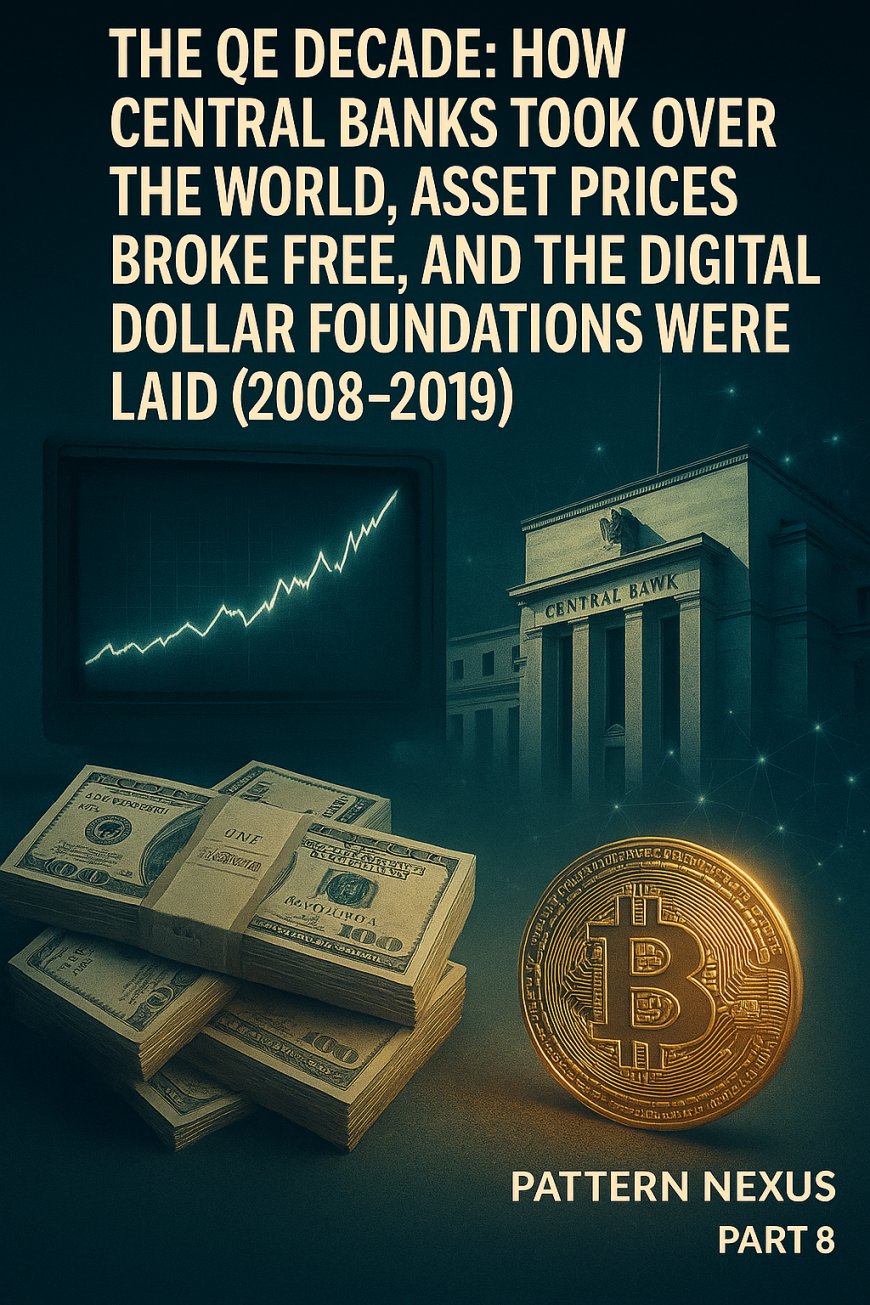
The QE Decade: How Central Banks Took Over the World, Asset Prices Broke Free, and the Digital Dollar Foundations Were Laid (2008–2019)
After the 2008 crisis, the global system didn’t deleverage — it migrated. Between 2008 and 2019, QE, ZIRP, swap lines, and new regulations turned central banks into the core liquidity engine, inflated asset prices, hollowed out safe yields, and quietly laid the foundations for the digital dollar, stablecoins, and the AI–energy megacycle to come.
The Breakpoint: From Private Collateral to Public Balance Sheets
By the end of Part 7, the private engine of the global dollar system had torn itself apart. U.S. housing had been turned into global collateral through securitization, shadow banking, and repo. When that collateral cracked, the shock did not stay inside U.S. suburbia — it detonated in London, Frankfurt, Tokyo, and beyond.
Money-market funds broke the buck. Interbank lending spreads exploded. Foreign banks that had borrowed dollars short to buy U.S. mortgage securities found themselves trapped. Trade finance stalled. The eurodollar system — an offshore dollar universe built over decades — suddenly discovered that the “dollar” in eurodollars ultimately lived on the Federal Reserve’s balance sheet.
Policymakers had three theoretical paths:
- Allow mass default and deep depression — politically suicidal.
- Nationalize and radically restructure finance — politically unthinkable.
- Socialize the funding problem onto public balance sheets — politically ugly but feasible.
They chose option three. The crucial pattern:
- Private shadow money (repo, ABCP, SIVs, structured credit) evaporated.
- Central banks stepped in as lenders of last resort on a scale nobody had modeled.
- Then they didn’t step back — they stayed.
What began as emergency firefighting hardened into a regime. The QE decade is not a “recovery period” between crises. It’s a structural phase change:
- from market-based collateral engines to central-bank-based liquidity engines
- from private leverage discipline to public balance sheet management
- from “let markets clear” to “do whatever it takes” whenever markets wobble
QE and ZIRP: How the New Liquidity Engine Actually Works
Quantitative easing (QE) is often described in cartoon form: “the central bank prints money and buys bonds.” That’s directionally true, but the details matter if you want to understand why the 2010s looked like low inflation, high assets, and weird distortions instead of immediate hyperinflation.
What QE Actually Does on the Balance Sheet
At the plumbing level, QE is a swap:
- The central bank buys a bond (government or agency, sometimes private) from a bank or large investor.
- It pays by crediting that institution’s reserve account at the central bank.
- The bond moves from private hands to the central bank’s asset side; reserves appear on the liability side.
No helicopters. No bags of cash. Just:
- fewer long-duration assets in private portfolios
- more instantly liquid, risk-free reserves in the banking system
Why This Matters for Yields and Asset Prices
When a central bank buys a big chunk of the bond market:
- it removes duration risk from private portfolios
- it pushes bond prices up and yields down
- it forces investors to rebalance into other assets to hit return targets
The result:
- borrowing costs fall across the curve
- equities, credit, and real estate become more attractive relative to ultra-low yields
- asset prices rise — not because of fundamentals alone, but because the denominator (discount rate) has been squashed
ZIRP: When Time Is Priced at Almost Zero
Zero Interest Rate Policy (ZIRP) anchors the front end of the curve at or near zero. Combined with QE, it tells markets:
- the cost of short-term funding will be negligible for a long time
- carry trades — borrowing short to buy longer-duration assets — are implicitly encouraged
- discounting future cash flows at near-zero yields makes distant earnings look huge in present value terms
This is the mathematical skeleton behind:
- the tech mega-cap boom
- real estate re-inflation
- the reach for yield into private credit and alternatives
Dollar Swap Lines: The Quiet Globalization of the Fed
The QE decade is also the decade when the Federal Reserve quietly became the de facto central bank of the world’s dollar system — not just for U.S. entities, but for a club of major foreign central banks.
What Swap Lines Actually Are
A dollar swap line is a standing agreement between the Fed and another central bank. In a stress event:
- The foreign central bank borrows dollars from the Fed, posting its own currency as collateral.
- It then on-lends those dollars to banks and institutions in its jurisdiction that need dollar funding.
- At maturity, the foreign central bank returns the dollars and gets its own currency back.
Key point: the Fed is still controlling supply, but local central banks decide who gets the dollars on the ground.
The Function: A Global Dollar Backstop
Swap lines matter because:
- global banks outside the U.S. run huge dollar books — assets and liabilities
- their home central banks cannot print dollars to backstop them
- swap lines solve this by turning the Fed into a wholesale dollar supplier of last resort
Every time a stress event hits — 2008, the Eurozone crisis, the 2011 dollar squeeze, 2014–2016, 2020 — swap lines are activated or expanded. Markets learn a simple rule:
“In the end, the Fed will keep the dollar pipes pressurized for the core club.”
Hierarchy: Who’s In the Club, Who’s Out
Swap lines are not universal. They form a hierarchy:
- inner circle: major advanced economies and systemically relevant central banks
- outer circle: everyone else, who must scramble for dollars in markets or via the IMF
That hierarchy is the early blueprint of the digital dollar hierarchy to come:
- some jurisdictions get frictionless wholesale access to the core
- others live further out on the credit and liquidity frontier
- the “exorbitant privilege” of the dollar becomes institutionalized through crisis management
The Eurozone Crisis: Second Front of the QE Era
While the U.S. was digging itself out of a housing wreck, Europe was discovering that its monetary union had been built with several key bolts missing.
A Currency Without a Fiscal Spine
The Eurozone had:
- a single currency (the euro)
- a central bank (the ECB)
- but fragmented fiscal authorities and no full-blown fiscal union
Banks in each member state:
- held large amounts of their own government’s bonds
- funded themselves in cross-border markets
- relied on implicit assumptions that all sovereign debt inside the euro was basically risk-free
When Greek, Portuguese, Irish, Spanish, and Italian sovereign risk came into question, the feedback loop was brutal:
- sovereign bond yields spiked
- banks holding those bonds looked weak
- fears about bank bailouts increased sovereign risk
The ECB’s Reluctant Transformation
At first, the ECB approached the crisis cautiously — limited bond purchases, haircuts, crisis programs layered on top of a rulebook built for normal times. But as the survival of the euro itself came into question, the institution pivoted:
- long-term refinancing operations (LTROs) gave banks multi-year funding
- new asset purchase programs targeted stressed sovereigns
- a commitment to do “whatever it takes” to preserve the euro changed market psychology
That phrase implemented a simple idea: the ECB’s balance sheet would be used, if necessary, as a combined monetary and quasi-fiscal backstop for the union.
Basel III and the Regulatory Rebuild: Making Debt Sacred
In the aftermath of 2008, regulators worldwide were tasked with making the system “safer.” The main toolkit was the Basel III framework and related reforms. On paper, these rules:
- raised the quantity and quality of bank capital
- introduced new liquidity standards
- tightened oversight of trading and off-balance-sheet exposures
Under the hood, they also reshaped the demand side of sovereign debt and high-grade assets in ways that meshed perfectly with QE.
Capital, Liquidity, and “High-Quality Liquid Assets”
Basel III introduced:
- Liquidity Coverage Ratio (LCR): banks must hold enough high-quality liquid assets (HQLA) to survive a 30-day stress scenario.
- Net Stable Funding Ratio (NSFR): encourages more stable, longer-term funding structures.
- stricter definitions of Tier 1 capital and leverage ratios.
Crucial detail: the definition of HQLA heavily favored:
- sovereign bonds from advanced economies
- central bank reserves
- some supra-national and agency debt
How Regulation Amplified QE’s Effects
Put together:
- QE removed large volumes of government bonds from private markets and replaced them with reserves.
- Basel III required banks to hold more government bonds and reserves to qualify as “safe” and liquid.
- Risk weightings and capital charges made these assets especially attractive.
The result:
- structural demand for sovereign debt and reserves rose
- yields on these instruments fell and stayed low
- the system became more reliant on the continued issuance and support of these “safe” assets
Debt was not just normalized; it was canonized. Sovereign paper — especially U.S. Treasuries — became the foundation of:
- regulatory compliance
- liquidity buffers
- collateral frameworks
- central bank operations
Safe-Asset Scarcity and the Age of Negative Yields
In a world where:
- central banks buy trillions of dollars’ worth of bonds
- regulators tell banks to hold more of those same bonds and reserves
- aging populations and risk-averse institutions want “safe” income streams
you eventually hit a simple constraint: there aren’t enough obviously safe assets to satisfy everyone at positive yields.
Why Yields Went Below Zero
By the mid-2010s:
- large chunks of European and Japanese government bonds traded at negative yields
- investors were literally paying governments for the privilege of holding their debt
- some corporate bonds also dipped into negative territory
This was not “markets going crazy.” It was the logical consequence of:
- central banks compressing term premia and signaling low rates for a long time
- Basel III and similar regimes pushing institutions into HQLA
- pension funds and insurers needing duration to match liabilities regardless of yield
Financial Repression by Design
The QE decade was, in many ways, a modern form of financial repression:
- governments borrow cheaply for long horizons
- central banks hold large portions of their debt
- banks, pension funds, and households absorb the cost through low or negative real returns
Savers, especially small savers and retirees, bore an invisible tax:
- cash and safe bonds yielded little or less than inflation
- to maintain purchasing power, they had to accept more risk
- anyone unwilling or unable to move out the risk curve fell behind
The Asset Inflation Decade: Everything Rally, Real-Economy Drag
If you owned assets between 2009 and 2019, the decade looked like a long, volatile climb. If you lived primarily on wages, it felt more like running in place while everything you needed — housing, education, healthcare — accelerated away from you.
How QE Floated the Asset Ark
Mechanically:
- low rates made borrowing cheap for corporations and investors
- QE pushed investors into equities, credit, and real assets in search of returns
- corporate buybacks reduced share counts, boosting earnings per share and stock prices
- venture funding flowed into high-growth, long-duration tech bets
You got:
- a U.S. equity bull market, especially in mega-cap tech
- compressed credit spreads and a boom in corporate debt issuance
- re-inflated housing markets in many urban centers
- record valuations for “story stocks” and private unicorns
The Real Economy: Zombification and the Wage Problem
In the real economy:
- productivity growth remained mediocre
- wage growth lagged asset gains
- cheap financing allowed weak companies to survive longer than they might have otherwise — “zombie firms”
Cheap debt:
- encouraged financial engineering (buybacks, M&A) over long-gestation productive investment
- allowed large incumbents to entrench moats with low-cost capital
- made it harder for small firms and new entrants without collateral to compete
The result was a world where:
- the asset side of balance sheets did great
- the income side of household budgets did not keep up
- the system increasingly depended on asset valuations staying elevated to support confidence and demand
Populism, Inequality, and the Politics of Perpetual Rescue
The QE decade is also the decade of:
- Occupy Wall Street
- the Tea Party
- Brexit
- Donald Trump and “drain the swamp”
- the Yellow Vests in France
- surging support for outsider parties and movements across continents
Correlation is not causation — but in this case, the structural linkage is obvious.
The Narrative Gap
From the vantage point of official narratives:
- the system had been saved from depression
- banks were better capitalized
- unemployment eventually fell
- inflation stayed “under control”
From the vantage point of large segments of the population:
- the people who caused the crisis were rescued
- no senior insiders went to prison
- homeownership became harder for younger generations in many markets
- wages stagnated relative to asset prices
The visual experience was brutal: charts of stock indices and elite wealth soared while your rent, healthcare premiums, and student loans climbed and your pay check didn’t.
Populism as a Monetary Feedback Loop
This is not just politics; it’s macro feedback:
- monetary policy supports asset prices to keep the system stable
- that support disproportionately benefits those who already own assets
- the perceived gap between “Wall Street” and “everyone else” widens
- anger and distrust fuel populist movements and distrust of institutions
Populist pressures:
- make fiscal compromises harder
- increase political risk premiums
- encourage more short-termism and theatrical conflict
Ironically, that can increase reliance on central banks as the “only adults in the room,” deepening the cycle of monetary reliance and political dysfunction.
Crypto’s Birth: 2008 as Monetary Origin Story
In October 2008, right in the middle of the global banking panic, a pseudonymous figure posted a white paper to a mailing list. It proposed a “peer-to-peer electronic cash system” that would not rely on trusted intermediaries or central banks.
That system became Bitcoin.
Bitcoin as a Reaction, Not an Accident
Bitcoin’s origin story is inseparable from:
- bank failures and bailouts
- political anger at “too big to fail”
- fear of currency debasement through QE
- a sense that the existing monetary architecture was both opaque and rigged
Embedded in the first Bitcoin block was a newspaper headline about bank bailouts. The message was clear: this protocol is an answer to that world.
From Bitcoin to Crypto and Stablecoins
Over the QE decade:
- Bitcoin evolved from fringe idea to a global speculative asset and “digital gold” narrative
- alternative crypto assets emerged, promising new protocols, smart contracts, and decentralized finance
- stablecoins arrived, explicitly tying digital tokens to the U.S. dollar, Treasuries, and cash
Stablecoins, in particular, are a direct child of the QE regime:
- they wrap dollar exposure into blockchain-native instruments
- they offer pseudo-yield via backing in money-market instruments and short-term Treasuries
- they bridge between regulated safe assets and permissionless digital rails
Crypto is therefore not a separate universe. It’s a parallel ecosystem built in reaction to, and on top of, the post-2008 dollar system.
Digital Dollar Foundations: From Swap Lines to Stablecoins
By the end of the QE decade, the world had quietly assembled most of the components needed for a digital dollar hierarchy — without calling it that.
Layer 1: Sovereign and Central Bank Balance Sheets
At the top:
- U.S. Treasuries as the ultimate risk-free collateral inside the system
- the Federal Reserve as the final backstop for dollar liquidity
- swap lines mapping which central banks are plugged directly into the core
Layer 2: Regulated Intermediaries and “Safe” Claims
In the middle:
- banks, money-market funds, insurers, and asset managers holding government debt and reserves
- post-crisis regulations codifying what counts as high-quality liquid assets
- payment systems and clearinghouses built around this infrastructure
Layer 3: Digital Wrappers and Tokenized Claims
Around the edges:
- stablecoins that mirror dollars and short-term Treasuries on-chain
- crypto exchanges acting as informal, sometimes chaotic FX markets for fiat–crypto hybrids
- experiments with tokenized securities, including tokenized Treasuries and money-market fund shares
From a Pattern Nexus perspective, the QE decade:
- created the safe-asset scarcity and yield compression that made yield-bearing digital wrappers attractive
- cemented Treasuries and reserves as the core asset behind everything from swap lines to stablecoins
- normalized large central bank balance sheets as the anchor for digital representations of value
Zero Rates, Big Tech, and the AI–Energy Infrastructure Pipeline
One more quiet development of the QE decade: the rise of big tech from “fast-growing firms” into quasi-sovereign infrastructure providers — and the build-out of the early foundations for the AI–energy industrial complex.
Cheap Capital and Tech Megacaps
In a low-rate, QE world:
- investors flocked to companies with long-duration cash flow stories
- mega-cap tech benefited from network effects, asset-light models, and global markets
- cheap debt allowed large platforms to finance acquisitions, buybacks, and infrastructure at minimal cost
Over the decade:
- cloud computing became the backbone of digital commerce and data
- data centers proliferated, quietly ramping power consumption
- software ate workflows; platforms swallowed entire sectors
Power, Data, and Latent AI Capacity
The QE decade didn’t deliver full-blown AI; it built the substrate:
- hyperscale data centers concentrated compute and storage
- global fiber and peering connected everything
- renewables and gas built out grids in ways that would later collide with AI’s power needs
Cheap capital made long-horizon infrastructure bets easier to finance. Low yields pushed investors toward any story that promised growth and optionality. Big tech became:
- the safest “growth” asset in the portfolio
- a proxy sovereign for compute and data infrastructure
- the only set of actors positioned to flip the AI switch at global scale when hardware and models caught up
Seen through the Pattern Nexus lens, 2008–2019 is the bootstrap phase of the AI–energy–dollar triangle:
- QE and low rates → asset inflation and cheap capital
- cheap capital → big tech infrastructure and data center buildout
- that infrastructure → latent capacity for the AI boom once model and hardware breakthroughs arrive
Pattern Nexus Framework: What the QE Decade Really Did
Stepping back, Part 8 is where the macro cycle map crosses a major threshold. Organizing it in Pattern Nexus terms:
1. Engine Shift: From Private Collateral to Public Liquidity
Before 2008:
- housing and shadow banking were the main dollar collateral engines
- private leverage, repo chains, and securitization drove credit creation
After 2008:
- central banks became the core liquidity engine via QE and swap lines
- sovereign debt and reserves replaced private mortgage collateral at the heart of the system
- policy choices about balance sheet size became macro destiny
2. Hierarchy: The Dollar Stack Became More Explicit
The QE decade:
- clarified who sits at the center of the dollar network (U.S. + core allies)
- used swap lines and regulations as tools to reinforce that hierarchy
- turned Treasuries into the indispensable high-quality liquid asset behind everything from bank buffers to stablecoin backing
3. Society: Asset Owners vs. Everyone Else
Monetarily:
- QE boosted asset prices and suppressed yields
- zero rates penalized savers and pushed risk-taking
Socially:
- inequality widened along lines of asset ownership
- populist movements challenged the legitimacy of the regime
- the idea that “markets are free” became harder to defend when central banks were clearly underwriting them
4. Technology: Building the Rails for the Next Regime
Under the surface, 2008–2019:
- established central bank balance-sheet activism as normal
- pushed safe yields low enough that alternative yield wrappers (crypto, DeFi, tokenization) became attractive
- funded big tech infrastructure that would later become the backbone for AI, cloud, and digital payment systems
5. Path Dependency: Why the 2020s Had to Look the Way They Do
Once you accept:
- permanent central bank footprint
- safe-asset scarcity
- asset-dependent economic stability
the 2020s configuration becomes almost inevitable:
- fiscal and monetary fusion in crises (“whatever it takes” squared)
- massive deficits absorbed and intermediated by QE-like programs
- digital payment and collateral systems that wrap Treasuries and reserves into increasingly programmable forms
- AI and energy infrastructure financed on the assumption that the central-bank–Treasury complex will always be there to smooth shocks
FAQ: Quick Answers and “So What?”
Did QE “print money” in a way that guaranteed inflation?
QE created reserves and altered portfolios, but by itself it did not guarantee consumer-price inflation. In the 2010s, much of the effect showed up as asset price inflation and low yields. Banks did not mechanically lend out reserves; borrowers and banks still had to want to transact. The more inflationary outcomes come later, when QE-style tools are combined with aggressive fiscal expansion and supply shocks.
Why didn’t central banks just reverse QE once the crisis was over?
Because markets and balance sheets had adapted to the new level of support. Attempts to slow purchases or discuss shrinking balance sheets triggered volatility and tighter financial conditions. The taper tantrum showed that even changing the slope of the balance sheet mattered. In practice, central banks discovered they could not fully exit without risking the kind of instability they were created to prevent.
Did post-crisis regulation actually make the system safer?
It made some parts safer and created new vulnerabilities. Banks became better capitalized and less reliant on specific forms of short-term funding. But more activity migrated into non-bank structures (shadow banking 2.0), and regulatory demand for safe assets reinforced the very debt structures that central banks were also supporting. Risk did not disappear; it moved and changed shape.
How exactly did QE feed inequality?
QE boosted the prices of financial and real assets more directly than it boosted wages. Households that already owned homes, stocks, and businesses saw their wealth expand. Those with limited asset ownership relied mainly on labor income and bank deposits, which lagged behind. Over time, this gap compounded. QE wasn’t the only driver of inequality, but it acted as a powerful amplifier.
Why did crypto emerge in this specific period?
Crypto emerged as a reaction to the 2008 crisis and its aftermath. The perception that central banks and governments had bailed out insiders, debased money, and centralized control over the system created demand for alternatives. Bitcoin’s design and timing were explicitly tied to that environment. Later crypto and stablecoin ecosystems built on the same discontent — and on the yield and collateral distortions created by the QE regime.
What should investors and builders focus on when thinking about the QE decade?
Focus on regime features, not just one-off events:
- central banks as permanent portfolio players
- sovereign debt and reserves as the core collateral for everything
- safe-asset scarcity and its downstream effects on yields, risk appetite, and innovation
- the political feedback loop between monetary rescue and populist backlash
- the quiet construction of digital dollar rails and AI–energy infrastructure under the surface of a “low inflation” decade
If you understand those, the 2020s don’t look random; they look like the next phase of a very long script.
Sources
- Federal Reserve material on QE, balance sheet policies, and emergency programs. https://www.federalreserve.gov/monetarypolicy/bst.htm
- BIS research on global dollar funding, swap lines, and safe-asset shortages. https://www.bis.org/publ/qtrpdf/r_qt1812f.htm https://www.bis.org/publ/work590.htm
- IMF and academic work on global imbalances, Bretton Woods II, and post-crisis liquidity. https://www.imf.org/external/pubs/ft/wp/2005/wp05187.pdf https://www.imf.org/external/pubs/ft/wp/2012/wp12226.pdf
- ECB documentation on non-standard measures and the Eurozone crisis response. https://www.ecb.europa.eu/pub/pdf/scpops/ecbocp147.pdf
- Basel III framework and related regulatory reforms. https://www.bis.org/bcbs/basel3.htm
- Historical and analytical overviews of the global financial crisis and its aftermath. https://www.federalreservehistory.org/essays/global-financial-crisis-of-2007-09 https://www.brookings.edu/articles/the-aftermath-of-the-financial-crisis-2010-2019/
- Early Bitcoin and crypto primary material (white paper and historical context). https://bitcoin.org/bitcoin.pdf
Ποια είναι η αντίδρασή σας;
 Μου αρέσει
0
Μου αρέσει
0
 Μη Αγαπημένο
0
Μη Αγαπημένο
0
 Αγάπη
0
Αγάπη
0
 Αστείο
0
Αστείο
0
 Ουάου
0
Ουάου
0
 Λυπημένος
0
Λυπημένος
0
 Θυμωμένος
0
Θυμωμένος
0

Founder of Pattern Nexus. I research markets, macro, geopolitics, AI, history, ancient systems, and the patterns most people overlook. I’m also building Market Radar, a trading scanner designed to read pressure, risk, confirmation, and setup quality before chasing a move. Pattern Nexus is where I connect the dots between data, history, technology, and the bigger system playing out around us.













Σχόλια (0)