
Daily Market Wrap-Up – December 8, 2025
Daily cross-asset wrap for December 8, 2025. Equities faded into the close while the 10-year Treasury pushed higher toward 4.2% even as markets price in a near-certain Fed rate cut this week. Commodities softened, the dollar treaded water, and crypto stayed bid.
December 8, 2025
Market overview
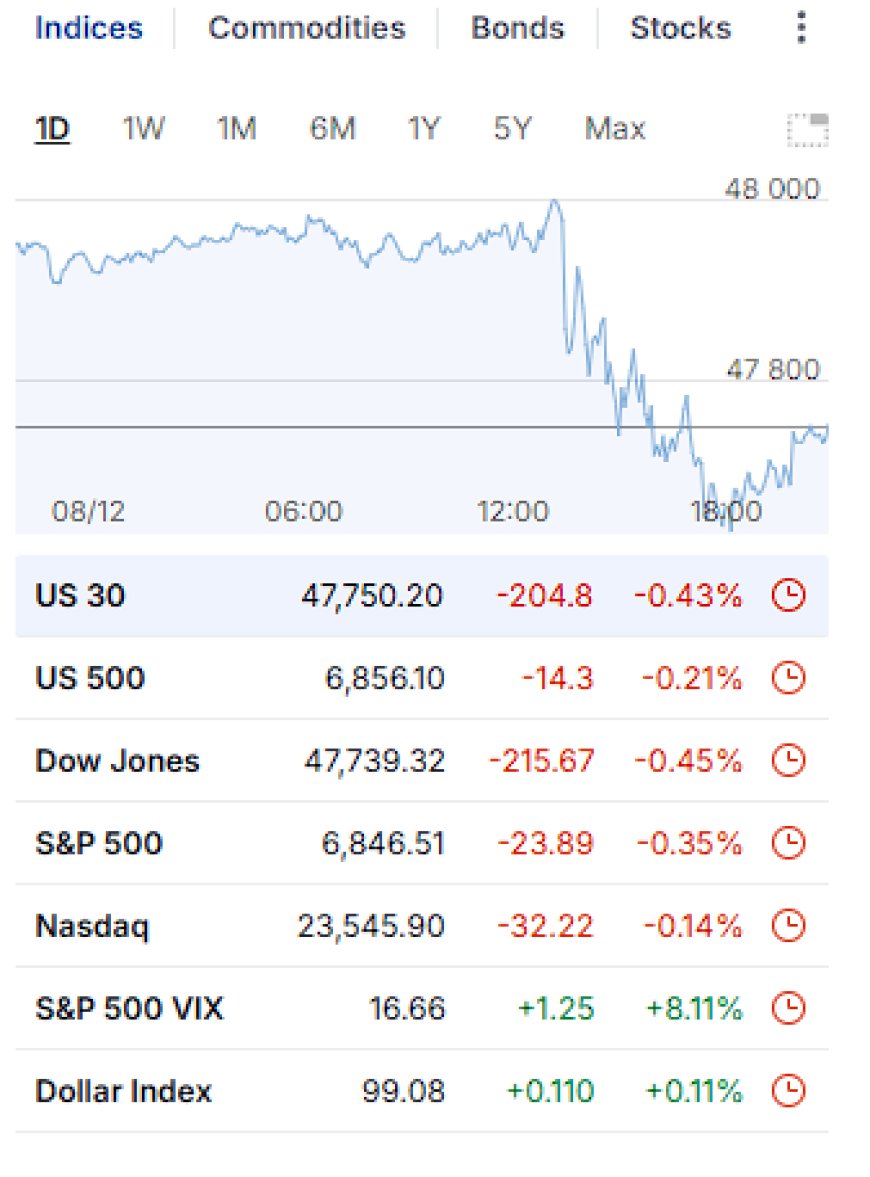
On the surface, Monday looked like a modest risk-off bleed: U.S. indices drifted lower into the close, with the Dow / US 30 down around 0.4%, the broad US 500 off roughly 0.2%, and the Nasdaq fractionally negative. Volatility firmed, with the S&P 500 VIX up more than 8%, while the Dollar Index hovered just above 99, basically unchanged.
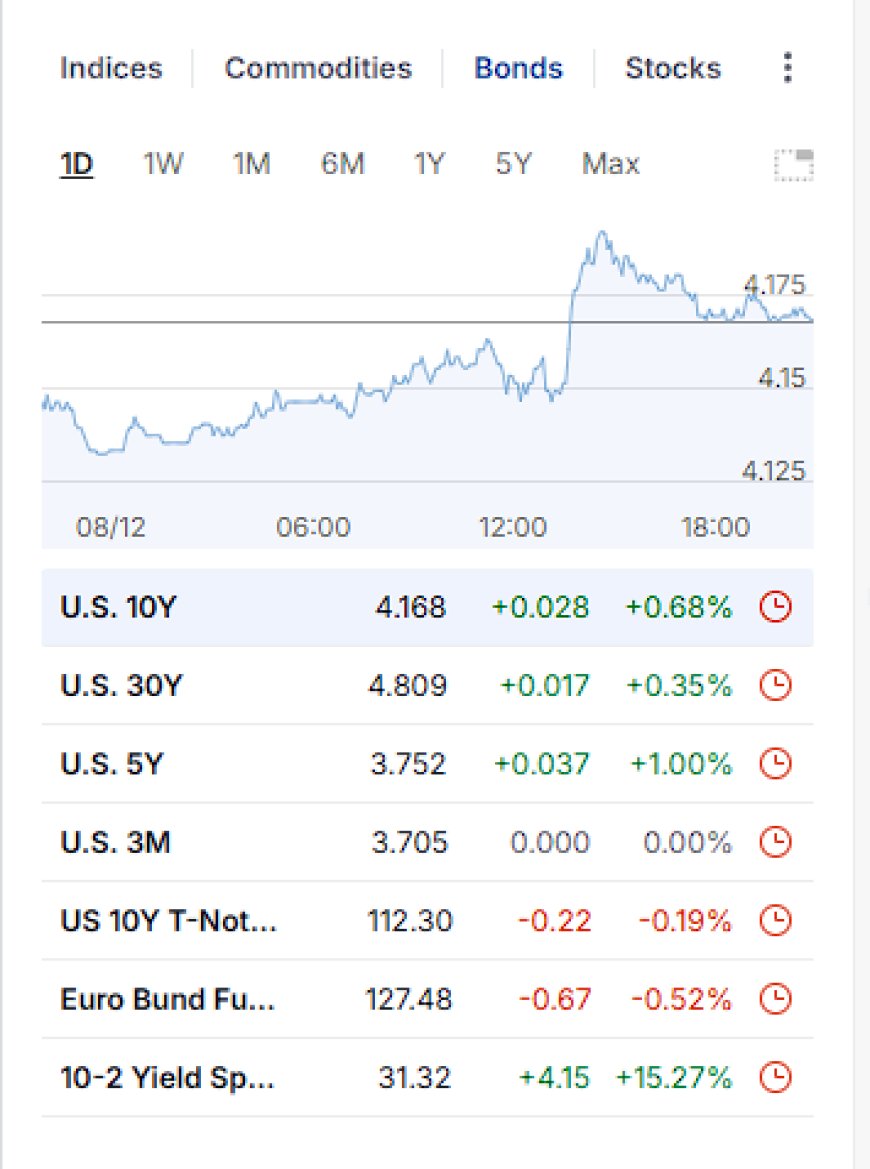
Underneath that, the real story sat in the rates complex. In the first full week after QT officially ended on December 1, the U.S. 10-year yield climbed to roughly 4.17%, adding a few basis points and extending the rebound that has been building since late autumn. That move came even as futures markets are pricing close to a 90% probability that the Fed cuts its policy rate again at this week’s meeting. Post-QT, higher long-end yields now say more about structural pressures than about mechanical balance-sheet drain.
Bond market: the 10-year vs. the Fed
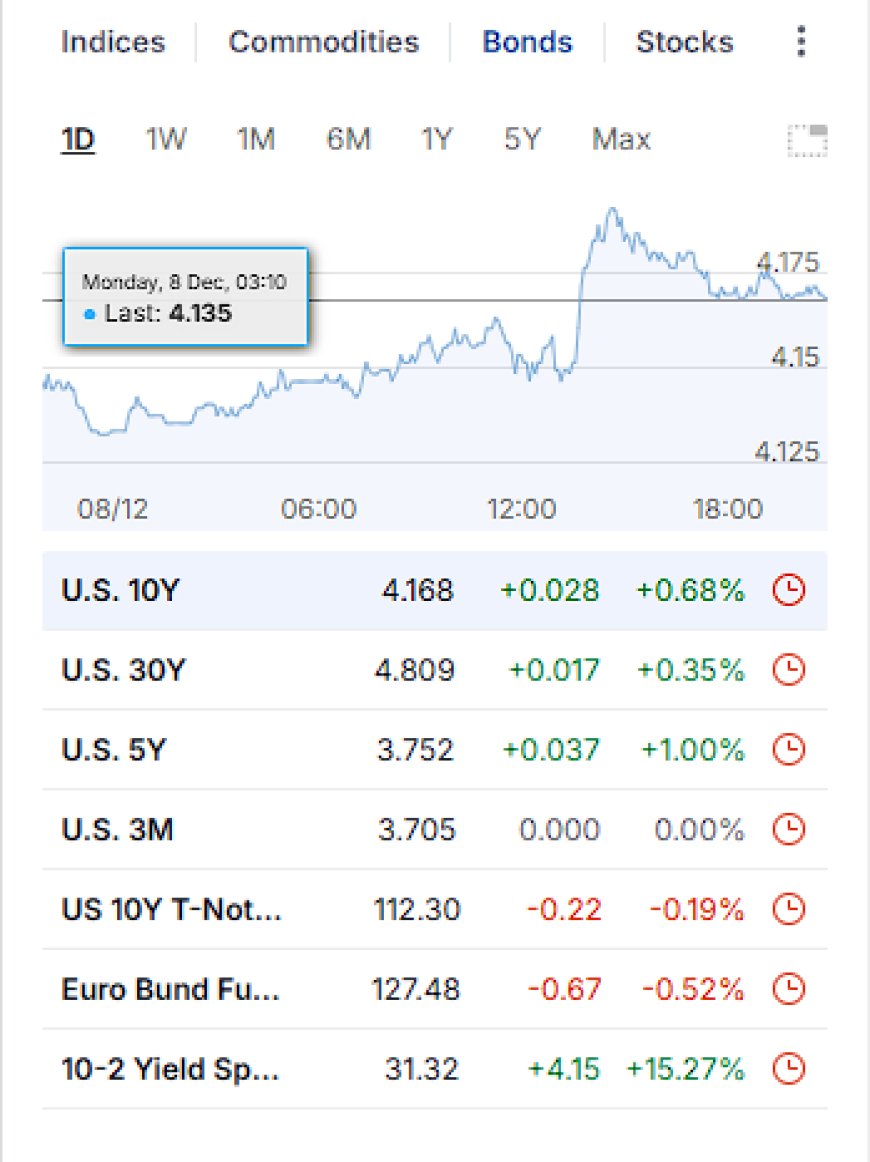
Across the curve, yields pushed higher, especially in the belly and the long end. The 10-year finished near 4.17%, up about 3 basis points on the day. The 5-year hovered around 3.75%, while the 30-year approached the high-4.7% area. Short bills remained comparatively steady, anchoring the front end near the policy rate, while the rest of the curve continued to reprice term premium, structural supply, and risk premia.
The core tension into this week is now very clear: the Fed is expected to deliver another 25 bp cut, but the bond market is not rewarding that with easier long-term financing. Since the cutting cycle began in late summer, the 10-year and 30-year have drifted higher, not lower, as investors demand compensation for persistent services inflation, heavy Treasury issuance, and a world that still looks more fractured than stable.
Mortgage markets are feeling this directly. Even with QT behind us and policy rates edging down, 30-year mortgage rates have pushed higher again alongside the 10-year. Hopes that rate cuts and the end of balance-sheet runoff would quickly translate into cheaper housing finance have not materialized. The message from bonds is simple: the Fed can cheapen overnight money, but it doesn’t control long-duration risk unless it is willing to absorb duration again.
That is where the “asset expansion” conversation quietly re-enters the picture. With QT done, the next structural lever is no longer to slow the runoff; it is whether and when the Fed eventually allows the balance sheet to grow again through reserve-management purchases, more aggressive bill buying, or outright duration absorption. None of that is on the official agenda for this week, but a 10-year trading comfortably above 4% in a post-QT, rate-cut environment is exactly how those future conversations get priced in early.
Equities and volatility
Equities spent most of the session moving sideways before an afternoon fade pulled the major indices into the red. Megacaps and cyclicals did most of the dragging, with some defensives and low-volatility names holding up better. The move was not dramatic in price terms, but the combination of a higher VIX and higher yields suggests that investors are quietly tightening their risk tolerances into the Fed meeting.
The “rates up, stocks down” pairing is noteworthy in a context where incoming data have been flagging slower labor momentum and softer sentiment. If the long end keeps pressing toward 4.2–4.3% while growth data cool, equity multiples are forced to fight a higher discount-rate environment even as the official policy stance shows “easing.” That is not a crisis, but it is pressure.
Commodities and energy
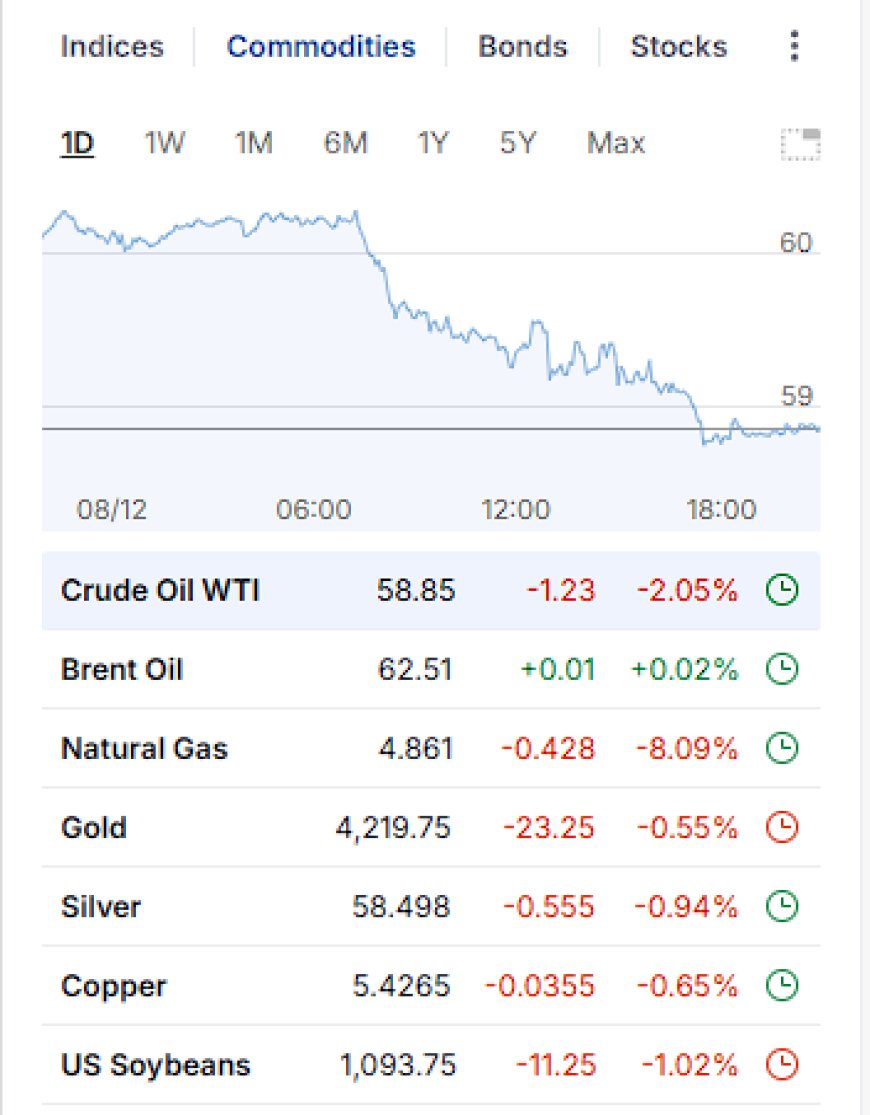
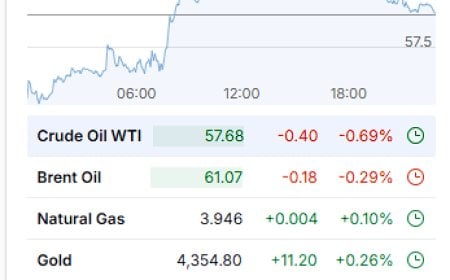
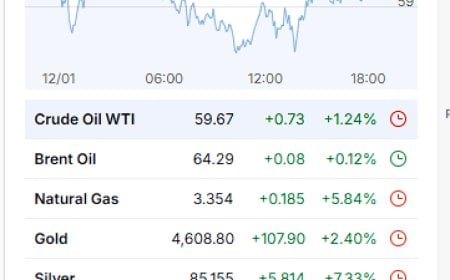
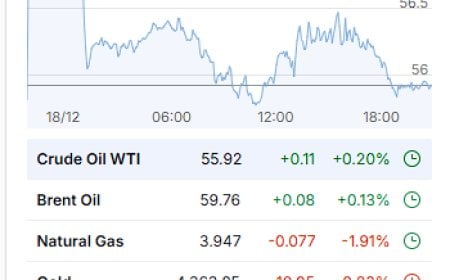
Commodities traded with a distinctly weaker tone, led by energy. WTI crude fell just over 2% into the high-$58s, essentially erasing most of last week’s bounce. Natural gas dropped nearly 9% on the day, extending a sharp retracement from recent weather-driven spikes. Industrial and precious metals were lower as well, with gold off about half a percent and copper edging down.
Falling energy prices alongside rising yields is an important signal combination. It suggests that the bond market’s repricing is not about an immediate inflation scare from oil, but about structural issues: term premium, long-term fiscal concerns, and the still-uncertain global growth path. For the real economy, softer crude and gas prices offer some relief to consumers and headline inflation, but they also underline concerns about demand softness and a still-choppy industrial cycle.
Crypto majors
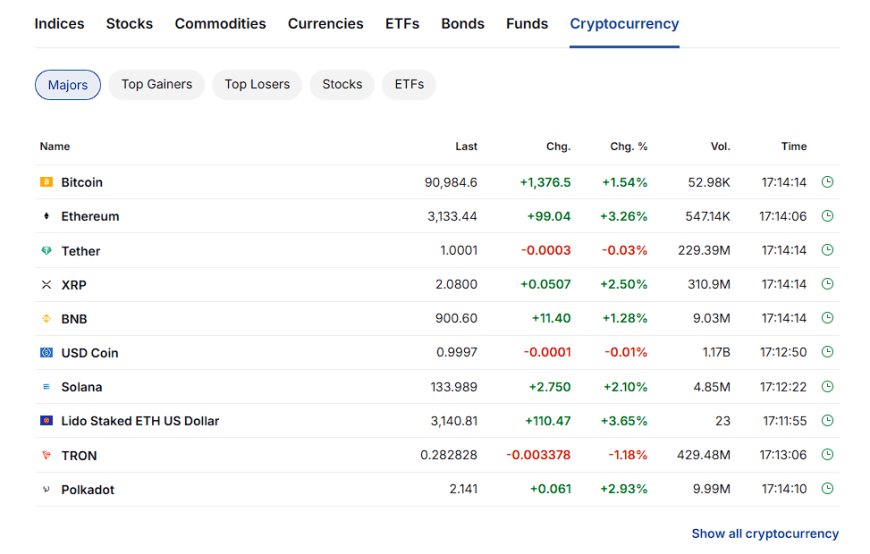
Crypto continued to trade like the purest expression of liquidity expectations. Bitcoin reclaimed and held the $90k handle with a gain of roughly 1.5%. Ethereum outperformed with a move north of 3%. Large-cap tokens such as XRP, Solana, and Lido Staked ETH posted solid advances, confirming that the strength was broad rather than isolated.
The contrast with equities is instructive. While stock indices faded into the close, spot crypto traded as if the forward liquidity profile is improving, not worsening. Traders appear to be using the crypto complex to express a medium-term view that the end of QT plus continued rate cuts will eventually require some form of additional balance-sheet or liquidity support, even if that is still several quarters away.
Dollar and FX majors
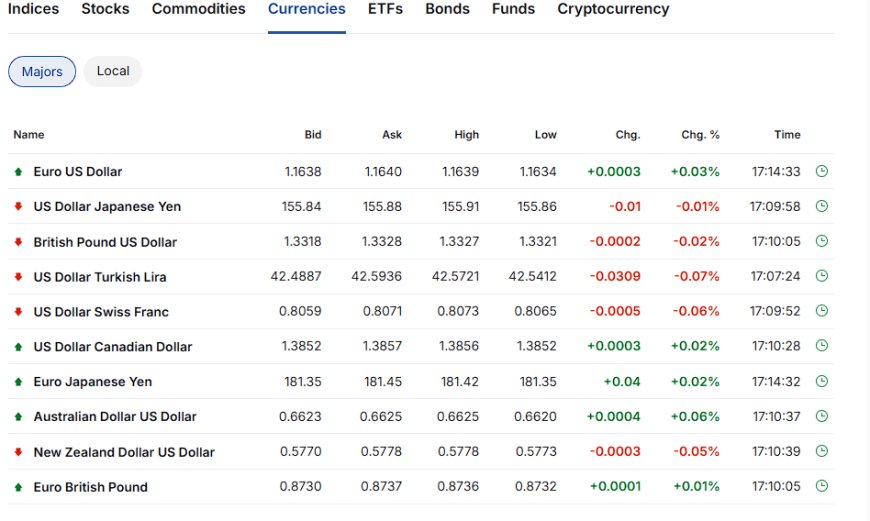
FX markets largely marked time ahead of the Fed. The dollar index drifted near the 99 level, not far above last week’s local lows. EUR/USD inched slightly higher, USD/JPY was effectively flat, and commodity-linked currencies such as AUD and CAD saw only minor moves.
With another cut already heavily priced, currency traders are waiting for Powell’s tone and the updated projections. A more hawkish-sounding cut—heavy emphasis on inflation risk, light on future easing—could give the dollar a short-term lift. A more dovish messaging mix that leans into labor softness and policy flexibility could re-open the path toward the mid- to high-98s on the index.
Single-stock standouts
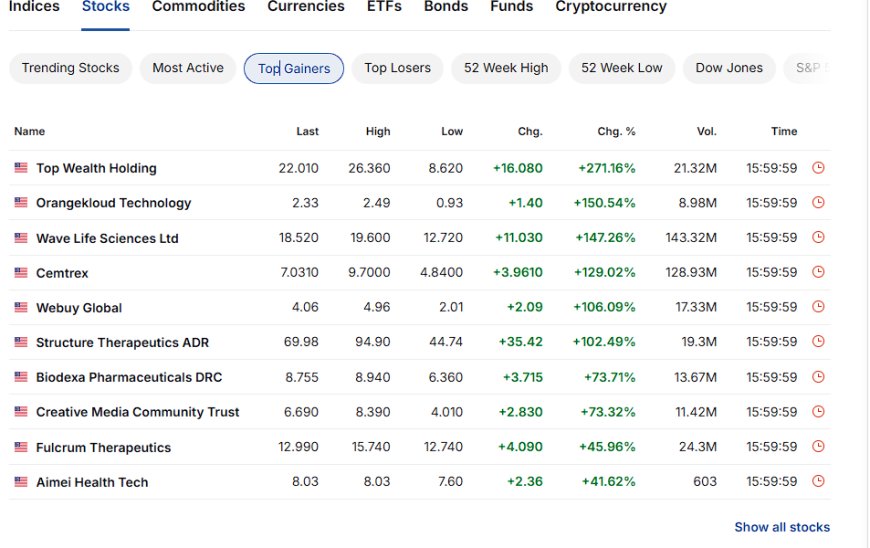
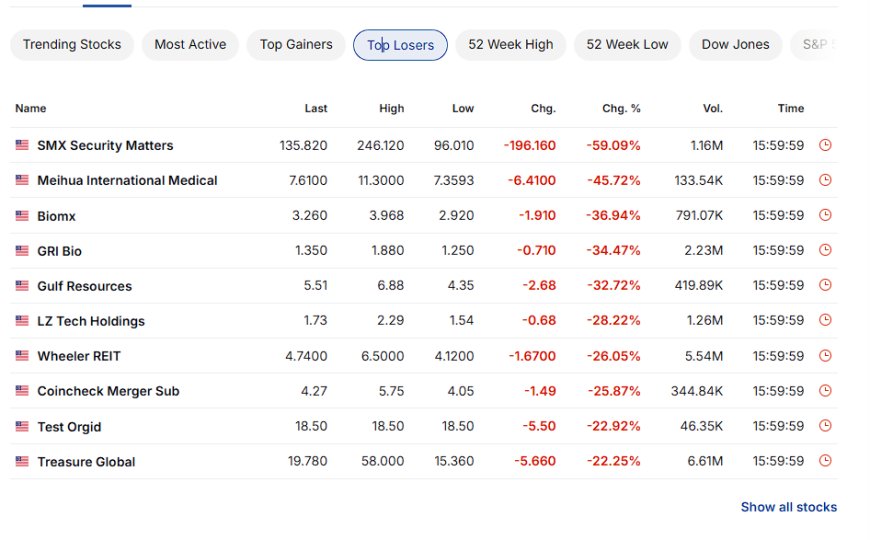
The extreme movers list was dominated by smaller, idiosyncratic stories on both sides of the tape. On the upside, several biotech and specialty healthcare names posted triple-digit percentage gains on very specific catalysts. On the downside, a cluster of microcap and special-situation names saw 20–60% drawdowns tied to earnings, capital-raising needs, or liquidity concerns.
The absence of large-cap leaders from either the top-gainers or top-losers lists reinforces that today’s session was more about cross-asset positioning into the Fed than it was about a full-blown equity sentiment break. The big money is rotating around the edges while it waits for clarity on policy and the curve.
Big-picture read-through
Step back from the tick charts and one thing stands out: this is the first real read on how markets behave in a post-QT environment, and the answer is that the long end is still not willing to relax. The Fed is easing at the front end, the balance sheet is no longer shrinking, and yet the 10-year is pushing higher into the mid-4s.
That disconnect shows up everywhere. Mortgage rates are not falling in line with policy cuts. The term structure has shifted higher since the last meeting, not lower. The 10-year now trades comfortably above the effective funds rate instead of compressing toward it. In other words, headline policy looks easier, but the real-world cost of long-term capital is not.
For risk assets, that regime is workable but not painless. Equities can function in a 4–4.3% 10-year world as long as earnings hold up and recession odds remain contained. But every incremental tick higher in the 10- and 30-year raises the hurdle rate on stretched valuations and leverage-heavy sectors. Crypto and other high-beta plays, for now, are choosing to focus on the end of QT and the forward liquidity story, treating the current chop as the uncomfortable middle chapter between “tightening” and “expansion.”
The key question heading into midweek is whether Powell acknowledges this post-QT disconnect head-on. If he leans heavily into inflation vigilance and downplays the need for additional easing, markets may interpret that as a signal that the Fed is content to let long-end yields do some of the tightening work, pressuring equities and credit in the short term. If, instead, he emphasizes labor softness, financial conditions, and optionality on further cuts, bond vigilantes may keep pushing the long end higher—and the conversation about future asset expansion will move from background chatter to a more explicit, 2026-focused narrative.
Pattern Nexus Lens
From a Pattern Nexus lens, today’s cross-asset tape is the first clean datapoint in the post-QT phase of the 2024–2026 liquidity supercycle we’ve been mapping. The balance sheet has stopped shrinking, but the system is still behaving as if structural tightness has not been resolved. That tension is exactly where the next regime will be born.
The 10-year inside the Gravity Band, post-QT
The 10-year closing near 4.17% sits right inside the 3.8–4.3% “gravity band” that we’ve outlined in prior Pattern Nexus work. Before December 1, that band was being held up in part by QT: reserve bleed, duration overhang, and the slow removal of balance-sheet support. Now QT is over, but the yield has not migrated to the lower half of the band the way a textbook would suggest. Instead, it remains pinned near the top.
That tells you this is no longer about mechanical balance-sheet runoff. It’s about structural supply (huge and persistent issuance), uneven foreign demand, geopolitical risk premia, and a world that increasingly demands a higher real return to absorb U.S. duration. When the Fed cuts and ends QT but the long end stays elevated, you are not in “normalization” territory—you are in structural recalibration territory.
Policy is easing; the world is still tight
Rate cuts and an end to QT are, on paper, an easing package. But in a high-debt, collateral-sensitive system, the effective stance is determined by the interaction between the policy rate, the balance sheet, and the long end of the curve. Today’s configuration looks like this:
- Front end: easing via rate cuts.
- Balance sheet: neutral after QT, no longer a headwind but not yet a tailwind.
- Long end: still elevated, reflecting supply, risk, and term premium.
That mix is why equity multiples feel pressure while crypto trades the future. The present is tighter than the policy headlines suggest; the future is more liquid than the current term structure reflects.
From post-QT transition to QE-style 2026
Now that QT is out of the way, the next structural decision is about direction, not about “pausing” anything. Either the Fed is content to let the long end do the work, or it eventually moves back into some form of balance-sheet support to stabilize housing, credit, and the Treasury funding channel. That path doesn’t have to be called QE for the market to treat it like QE-lite.
In the Pattern Nexus framework, that path looks like this:
QT (2022–Dec 1, 2025): Reserves drain, duration stress builds, gravity band becomes visible.
Post-QT transition (Dec 2025–2026): Rate cuts plus neutral balance sheet; long end tests how tight conditions can stay without mechanical drain.
Liquidity reacceleration (2026+): Some mix of bill purchases, reserve-management expansion, or explicit duration absorption begins to creep back in, even if under a different label.
Crypto as forward liquidity radar
The behavior of BTC, ETH, and the broader complex fits this arc almost perfectly. Crypto is not trading today’s term premium; it is trading the eventual response to it. An economy that cannot tolerate structurally high long-end yields forever will eventually choose liquidity and curve stability. Crypto is front-running that choice.
Geopolitics and duration friction
Lastly, geopolitical frictions—from the Caribbean to Eastern Europe and the Middle East—continue to cap the willingness of foreign buyers to absorb Treasuries at scale. QT ending does not magically fix that. This is why the long end still looks heavy even as the “plumbing” side stops tightening. The world is more fragmented, and fragmented systems demand more yield.
In short: the Fed ended QT, but the cycle didn’t suddenly become easy. The tape on December 8 is the market’s way of saying that the structural story is still unresolved—and that whatever comes next on the balance-sheet front will define the 2026 liquidity regime.
Mi a reakciód?
 Tetszik
0
Tetszik
0
 Nem tetszik
0
Nem tetszik
0
 Szeretet
0
Szeretet
0
 Vicces
0
Vicces
0
 Hűha
0
Hűha
0
 Szomorú
0
Szomorú
0
 Mérges
0
Mérges
0

Founder of Pattern Nexus. I research markets, macro, geopolitics, AI, history, ancient systems, and the patterns most people overlook. I’m also building Market Radar, a trading scanner designed to read pressure, risk, confirmation, and setup quality before chasing a move. Pattern Nexus is where I connect the dots between data, history, technology, and the bigger system playing out around us.












Hozzászólások (0)