
Stablecoins Are Becoming the Dollar’s New Control Layer
Stanley Druckenmiller’s stablecoin call matters because it points to something bigger: stablecoins are evolving into a new dollar distribution and control layer built on Treasuries, compliance, and programmable rails.



Druckenmiller is probably right on direction, but most people are still reading the story too narrowly. Stablecoins are not just “crypto dollars.” They are private wrappers around sovereign collateral, distributed through programmable rails, governed by compliance logic, and increasingly integrated into mainstream payment networks. That makes them far more important than most of the crypto sector and far more strategic than many people in traditional finance want to admit. The real question is not whether stablecoins grow. The real question is who controls the rails, who captures the reserve float, who absorbs the Treasury demand, how much deposit share gets pulled away from banks, and how much monetary freedom gets traded away in exchange for speed, convenience, interoperability, and global dollar reach.
Stablecoins are not anti-dollar. They are the export version of the dollar system, made API-native, programmable, and globally portable.
The more successful stablecoins become, the more they threaten deposits, monetary sovereignty, and private freedom. That means growth and control will likely rise together.
The biggest bull case is not “crypto goes up.” It is that stablecoins become a new demand channel for Treasury bills while compressing payment friction across borders and time zones.
Stablecoins matter because they sit exactly where Pattern Nexus spends most of its time looking: at the interface between state power, collateral, software, and behavior.
Druckenmiller Is Seeing the Endpoint
When Stanley Druckenmiller says he assumes the payments system will run on stablecoins in 10 to 15 years, he is not making a throwaway crypto comment or a meme-market prediction. He is identifying the likely endpoint of a broader migration already underway. The key point is not that every transaction will literally move over a public chain in its current form. The key point is that money movement is becoming more digital, more modular, more software-defined, and more detached from legacy banking hours, geography, and batch settlement logic.
That is why stablecoins matter far more than most of the broader crypto universe. A huge portion of crypto remains speculative theater, narrative churn, leverage recycling, and financialized attention capture. Stablecoins are different. They do something real. They move dollar value quickly, globally, and around the clock. They make settlement portable. They make cash balances programmable. They allow treasury functions to become software-native. They reduce friction in environments where traditional rails are slow, expensive, over-filtered, closed on weekends, or simply unavailable.
That last point is easy to miss if you only look at the story through a U.S. retail lens. The strongest use case is not a domestic consumer deciding whether to buy coffee with a token. The strongest use case is the edge of the dollar system: remittance corridors, crypto-native settlement, online commerce, global business payments, capital trapped behind local banking frictions, and individuals in weaker monetary jurisdictions looking for a faster or more stable digital dollar balance. In other words, stablecoins are strongest where the old system is most inconvenient, slow, or inaccessible.
The Pattern Nexus read is that stablecoins should not be thought of primarily as crypto assets. They should be thought of as monetary infrastructure. Once you do that, the entire frame changes. The conversation stops being about whether stablecoins are “good for crypto” and becomes whether they are becoming a new operating layer for the dollar system itself.
The most important thing about stablecoins is not the token. It is the compression of settlement time, the widening of dollar access, and the conversion of money into software-compatible infrastructure.
Stablecoins Are Becoming a New Dollar Export Rail
The deeper reason stablecoins matter is that they effectively export the dollar system in a more modular form. Traditional offshore dollar access has historically moved through banks, correspondent networks, trade finance plumbing, Eurodollar channels, offshore credit creation, and the wider trust structure of the U.S. financial system. Stablecoins introduce another layer on top of that architecture. They do not replace the old dollar system cleanly, but they increasingly act as an edge-layer interface for it.
This matters because edge layers often end up becoming more visible to users than the core itself. Most people do not think about the deep plumbing of card networks, clearing systems, or reserve mechanics when they tap a phone or send a payment. They just care whether it works. Stablecoins are beginning to fit into that same pattern. The more wallets, apps, exchanges, merchant tools, fintech products, card programs, and treasury systems wrap stablecoins into a cleaner user experience, the less the end user needs to care about the blockchain or token details under the hood.
That is exactly why the payments angle should not be dismissed as some niche crypto use case. Once a monetary layer becomes interoperable with software, its distribution path changes. A company can integrate stablecoin support through APIs. A payroll platform can settle cross-border balances faster. A merchant processor can reduce settlement latency. A global freelancer can hold dollar value without first depending on a local banking rail. A treasury desk can use programmable rules for disbursements, reconciliation, and weekend liquidity management. Those are not fantasies. Those are concrete functional advantages.
And once stablecoins move from speculative utility to operational utility, the addressable market gets much larger. The story shifts from crypto-native trading and DeFi to commerce, treasury, settlement, remittances, and cross-platform financial infrastructure. That is a completely different scale question. It is one reason why sell-side forecasts have started to move from “interesting product category” to “trillion-dollar issuance path.”
This is also why the most useful way to think about stablecoins is not as some final monetary form, but as a translation layer. They translate sovereign collateral and regulated financial trust into internet-native units that can move across software systems more easily than deposits can. That is the real disruption. Not the branding. Not the ticker. Not the blockchain ideology. The translation layer.
A Private Wrapper Around Sovereign Collateral
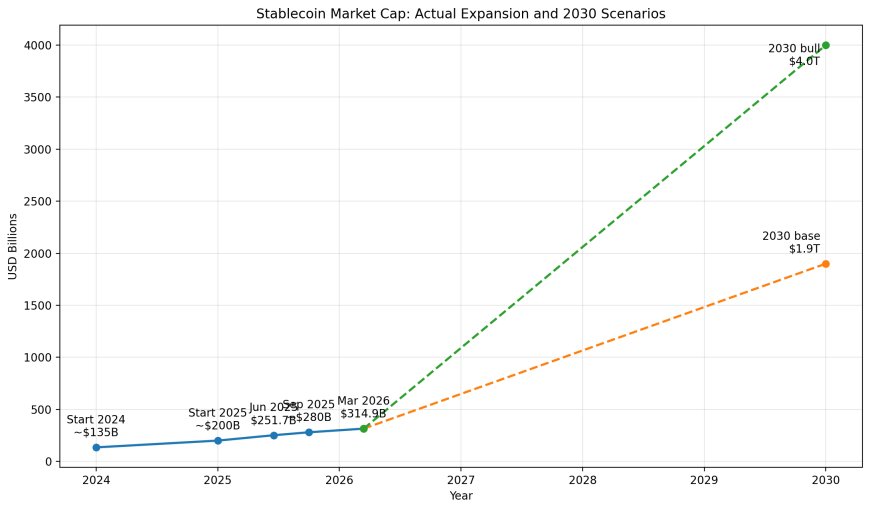
Here is the structural point most commentary still misses: stablecoins are not just digital cash. They are liabilities issued by private entities that sit on top of reserve assets. In practice, that means the largest and most systemically relevant stablecoins increasingly function like private distribution wrappers around Treasury bills, repo exposure, and bank cash. That is why the macro angle matters so much more than the average crypto debate.
The U.S. government sees that clearly now. With the GENIUS Act, Washington effectively said this industry can grow, but only inside a visible compliance perimeter. Reserve requirements, monthly public disclosures, Bank Secrecy Act obligations, issuer oversight, and explicit technical capabilities around lawful enforcement are not side details. They are the architecture. They define what kind of stablecoin future the United States is actually willing to permit.
This is where the Pattern Nexus framework becomes useful. Stablecoins are not a rebellion against the state. They are a negotiated extension of state-compatible money. The collateral remains tied to the sovereign system. The issuers operate inside legal and regulatory jurisdiction. The rails increasingly connect to mainstream payment and banking interfaces. The value proposition is speed, programmability, portability, and interoperability, but the trust anchor remains the old system underneath.
That means the actual product is not “decentralized freedom money” in the romantic sense. The actual product is a hybrid instrument: public trust backing the base layer, private firms operating the wrapper, software distributing the access layer, and regulators shaping the enforcement perimeter. Once you see it that way, it becomes obvious why stablecoins can be both innovative and politically acceptable at the same time.
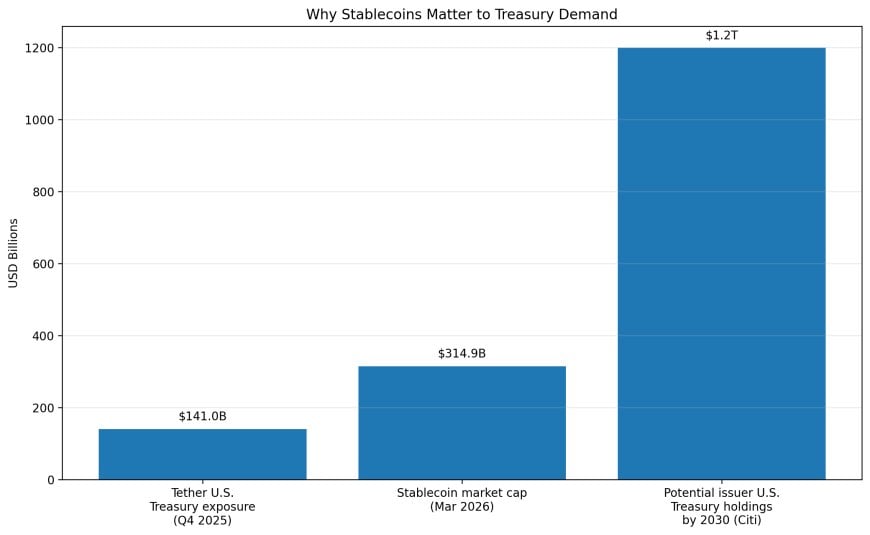
Once you understand that, you can see why Druckenmiller’s comment is bigger than a payments soundbite. If stablecoins keep scaling, they do not just create a new fintech category. They create a new buyer class for short-duration sovereign collateral. Tether’s Treasury exposure has already reached levels that would have sounded absurd a few years ago. Circle’s reserve model is explicitly centered on cash and highly liquid government-linked assets. Citi now models a future where stablecoin issuance reaches the multi-trillion-dollar range. That changes how you should think about the category.
It means stablecoin growth can support Treasury bill demand, reinforce dollar distribution abroad, create a new class of globally portable monetary instruments, and pull a portion of money movement outside the traditional deposit-and-branch model without actually leaving the dollar system. In some ways, that is the most important point in the whole article: stablecoins can restructure the outer edge of the monetary system without overthrowing the center.
That is exactly why the category attracts such contradictory reactions. Crypto people often overstate the freedom side and understate the compliance side. TradFi people often understate the product utility and overstate the idea that this is all just temporary speculation. Both readings miss the fact that stablecoins are useful precisely because they fuse monetary trust, legal structure, and software distribution into one instrument.
- Stablecoins turn sovereign collateral into portable digital settlement units.
- They create a new buyer base for short-term U.S. government paper.
- They shift part of the dollar system from bank-hour infrastructure into software and APIs.
- They widen the dollar’s reach without requiring every user to enter the U.S. banking system directly.
Treasury Demand, Deposit Pressure, and the Front End of the Curve
This is where the stablecoin story becomes macro-relevant in a way many market participants still underestimate. If stablecoins keep growing, the reserve side of the business matters just as much as the payments side. That is because reserve-backed stablecoins need large pools of cash, Treasury bills, repo-linked liquidity, and operational banking capacity. The larger the stablecoin universe gets, the more it starts to matter who owns the bills, what maturities they own, how flows behave under stress, and how quickly inflows and outflows can ripple into front-end funding conditions.
From a Treasury market perspective, stablecoins can be read as a diversification of the investor base for U.S. short-term government debt. That is the bullish interpretation. In a world where the United States runs large deficits and foreign official demand is no longer the simple, one-directional anchor it once was, any new structural buyer of bills matters. Stablecoin issuers are not central banks, but they can become meaningful allocators to the front end of the curve through reserve policy alone.
From a banking perspective, however, the same trend is more ambiguous. Every dollar parked in a stablecoin is a dollar that may not be sitting as a conventional bank deposit. If stablecoins become easier to hold, easier to move, and more interoperable with cards, merchant gateways, fintech apps, and treasury systems, then the old moat around deposits becomes less secure. That does not mean banks disappear. It means their role changes. Part of what used to be plain vanilla deposits becomes token-compatible liquidity living in a different wrapper.
That opens a second-order issue: if money migrates toward stablecoins, what happens to the institutions that relied on those deposits as a funding base? The answer is probably not a dramatic overnight collapse, but it does mean pressure. It means competition for balances. It means more sensitivity around regulatory treatment. It means bank-issued tokenized deposits and deposit tokens become more likely, not less likely, because incumbents will not just surrender the rail layer without building their own alternatives.
That is also why Citi’s coexistence framework is important. The likely outcome is not one format to rule them all. It is a layered ecosystem. Stablecoins win where open interoperability, global portability, crypto-native functionality, and software integration matter most. Bank tokens win where regulated institutional trust, balance-sheet familiarity, and direct corporate integration are most important. Traditional deposits remain relevant where convenience, insured retail behavior, and old-school banking inertia still dominate. The market likely segments by use case rather than ideology.
There is a rate-sensitive angle too. Reserve-backed issuers make money on the assets sitting behind the token. In a higher-rate environment, that reserve float becomes economically attractive. In a lower-rate environment, the economics shift and scale matters more. That means the stablecoin business is not just a payments story. It is also a spread story. The winner is not only the issuer with the best technology or broadest adoption. It is also the issuer with the strongest distribution, balance-sheet discipline, compliance credibility, and ability to defend margins when the reserve environment changes.
Then comes the stress question. What happens if a large stablecoin faces a redemption wave, a confidence shock, regulatory action, or a material de-peg event? The front-end Treasury angle that looks supportive during growth can become destabilizing during outflows if enough reserve assets need to be sold or repositioned quickly. That does not mean the model fails. It means scale increases both utility and systemic relevance. Once stablecoins are big enough, they stop being “crypto plumbing” and become part of funding market plumbing.
In other words, the Treasury bull case and the systemic-risk case are not opposites. They are the same mechanism viewed in different regimes. Inflows compress and support. Outflows can destabilize and amplify. That is exactly the kind of duality Pattern Nexus watches for everywhere: the thing that creates efficiency in normal conditions often becomes a transmission channel in stress conditions.
The New Permission Stack: Payments, Compliance, and Control
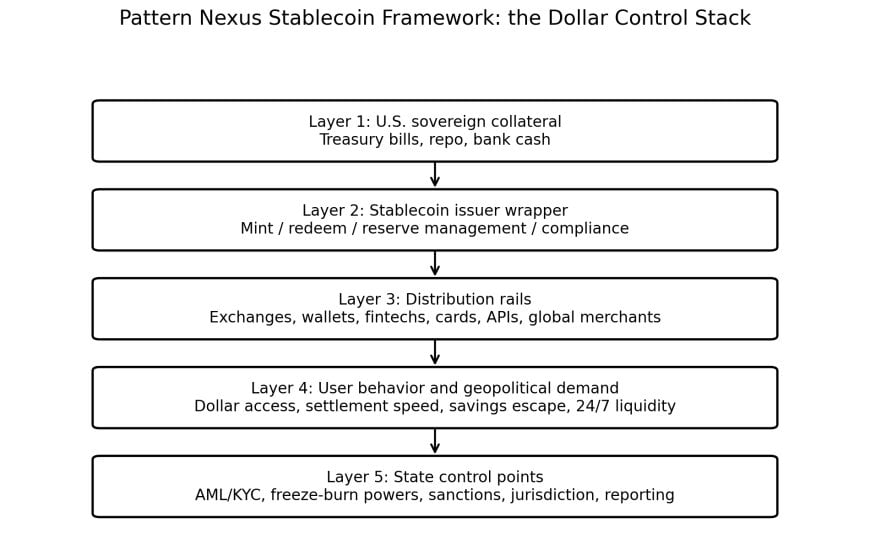
This is where most commentary becomes too shallow. Stablecoins are usually discussed as either a crypto adoption story or a regulatory debate. They are both, but that still misses the full system. In reality, stablecoins form a permission stack.
At the bottom sits the collateral base: Treasury bills, repo-linked liquidity, and bank cash. Above that sits the issuer wrapper: minting, redemption, reserve management, policy, governance, and compliance. Above that sits distribution: exchanges, wallets, fintech apps, merchant gateways, cards, APIs, and increasingly mainstream payment companies. Above that sits user demand: traders, businesses, remittance users, online platforms, emerging-market savers, treasury desks, and anyone who values faster settlement or easier dollar access. Wrapped around all of it sit state control points: KYC, sanctions, reporting, surveillance, legal jurisdiction, and explicit enforcement hooks.
That last point matters more than many crypto natives want to admit. A lot of stablecoin growth will likely happen precisely because the state can tolerate it. Why can the state tolerate it? Because compliant stablecoins do not remove control. They reorganize it. They make money movement faster while retaining hooks for monitoring, intervention, and legal enforcement. That is why the U.S. framework is so revealing. The reserve side gets formalized. The disclosure side gets formalized. The AML side gets formalized. And the issuer is expected to have the technical ability to act when ordered.
Pattern Nexus would phrase it this way: stablecoins are not neutral public money and they are not designed to be. They are strategic instruments sitting between free-flowing digital value and sovereign oversight. That is why they can scale. If they were genuinely uncontrollable at scale, the political system would be far less likely to legitimize them. Their growth path exists because the architecture is being shaped into something the state can live with.
At the same time, the private sector is not waiting for the perfect end-state. Visa is already building stablecoin-linked card pathways. On-chain settlement is already moving into more mainstream interfaces. Stablecoins are being pushed outward from exchanges into broader commercial contexts. That is exactly what powerful legacy systems do when faced with real change. They do not always kill it. Often they win by wrapping it, standardizing it, integrating it, and owning the interface layer.
There is also a geopolitical angle that deserves more attention. Dollar-pegged stablecoins can strengthen the dollar’s reach in regions where local banking systems are weak, inflation is chronic, capital controls are restrictive, or trust in domestic monetary policy is poor. That is bullish for dollar relevance, but it is not automatically bullish for local monetary sovereignty. In weaker jurisdictions, stablecoin adoption can function like an unofficial digital dollarization process. People do not need to love Washington or Wall Street for that to happen. They only need to distrust their local currency more.
That creates a strange outcome. Stablecoins can simultaneously look like market freedom from the bottom up and geopolitical extension of dollar influence from the top down. Both are true. That is why simplistic narratives fail here. Stablecoins are liberating in one dimension and consolidating in another. They reduce friction for users while potentially increasing the strategic reach of the dominant reserve currency system.
Still, the bullish case has real fault lines. Deposit substitution can pressure banks. Large issuer concentration can create reserve and governance risk. Redemption stress can feed into funding markets. Non-U.S. jurisdictions may see them as a sovereignty threat. Political systems may push for stronger transaction identity requirements over time. And the more systemically important stablecoins become, the more likely they are to face treatment closer to public utility infrastructure than freewheeling crypto products.
That is why the real stablecoin story is not utopian. It is strategic. This is the digitization of dollar reach through privately operated but increasingly state-compatible rails. It is a new form of monetary distribution with geopolitical implications. It is part payments story, part Treasury story, part bank-disintermediation story, part software story, and part control story. And that is exactly why it matters.
Pattern Nexus Lens
Stablecoins should be viewed as a new dollar distribution mechanism operating at the intersection of sovereign collateral, private infrastructure, software orchestration, and regulatory power. That is why they fit the broader Pattern Nexus framework so well. They are not just financial products. They are control-system components.
They expand the dollar’s footprint without requiring every user to enter the U.S. banking system directly. They create fresh demand for safe collateral. They compress settlement across time and geography. They give fintechs and platforms new ways to build around money. They offer households and businesses in unstable jurisdictions a practical digital dollar escape valve. At the same time, they preserve or even strengthen enforcement hooks when built inside a formal regulatory perimeter.
From that angle, stablecoins are essentially a private-public hybrid. Public trust anchors the collateral. Private firms manage issuance and distribution logic. Software handles the edge-layer interface. State power remains present in the background through disclosure, sanctions, identity, and legal seizure capability. That is not decentralization in the idealized sense. It is a redesign of monetary reach.
The cleanest way to say it is this: stablecoins are not ending the dollar system. They are updating the packaging, expanding the distribution, and tightening the integration between money and software. That is why Druckenmiller’s comment matters. He is not really making a crypto prediction. He is pointing at a shift in the architecture of the monetary order.
Stablecoins are not the end of the dollar system. They are the next export format of the dollar system.
FAQ
Are stablecoins mainly bullish for crypto prices?
Sometimes, but that is still too small a frame. The larger story is that stablecoins are becoming infrastructure for settlement, collateral transformation, treasury operations, and global dollar access. That matters whether or not the rest of crypto performs well.
Why would governments support stablecoin growth if stablecoins can threaten banks and local currencies?
Because the incentives cut both ways. Stablecoins can increase dollar reach, improve payment competitiveness, create Treasury demand, and expand domestic leadership in digital finance. Governments may tolerate or encourage them if the rails remain visible, regulated, and legally controllable.
Do stablecoins replace banks?
Not cleanly. They may pressure deposits and take share in some settlement flows, but banks, tokenized deposits, card networks, and stablecoins will likely coexist. The more realistic outcome is layered competition and integration rather than total replacement.
Why do Treasuries matter so much in the stablecoin story?
Because the reserve side is the hidden engine. A large stablecoin issuer effectively becomes a major buyer of short-duration government paper. That means stablecoin adoption is not just a payments story. It is also a sovereign collateral and market-structure story.
Is this bullish for the dollar?
In many ways, yes. Dollar-pegged stablecoins can extend the reach of the dollar system into more software environments and more jurisdictions. But the same process can also create stress for local monetary sovereignty outside the United States and new concentration risks inside the system.
Sources
These sources support the current data points, legal framework, reserve structure, Treasury-market implications, and payment-network integration discussed in this piece.
- Decrypt — Stanley Druckenmiller Bullish on Stablecoin Growth
- White House — The President Signed into Law S. 1582
- White House Fact Sheet — President Trump Signs GENIUS Act into Law
- Congress.gov — GENIUS Act
- Tether — Q4 2025 Results and Treasury Exposure
- Circle — Transparency & Stability
- Citi — Stablecoins 2030
- Brookings — The Rise of Stablecoins and Implications for Treasury Markets
- BIS — Annual Report Chapter on the Future Monetary System
- Visa — USDC Settlement in the United States
- Visa — Stablecoin-Linked Cards Expansion with Bridge
Mi a reakciód?
 Tetszik
0
Tetszik
0
 Nem tetszik
0
Nem tetszik
0
 Szeretet
0
Szeretet
0
 Vicces
0
Vicces
0
 Hűha
0
Hűha
0
 Szomorú
0
Szomorú
0
 Mérges
0
Mérges
0

Founder of Pattern Nexus. I research markets, macro, geopolitics, AI, history, ancient systems, and the patterns most people overlook. I’m also building Market Radar, a trading scanner designed to read pressure, risk, confirmation, and setup quality before chasing a move. Pattern Nexus is where I connect the dots between data, history, technology, and the bigger system playing out around us.
















Hozzászólások (0)