
The Supreme Court’s tariff case is an underpriced macro tail risk. A loss could trigger refunds, disrupt trade policy, and force a rapid White House pivot.
The Supreme Court’s challenge to the administration’s IEEPA tariffs is one of the most underpriced macro risks in markets right now. With prediction markets assigning barely a 25% chance of a pro-administration ruling, traders and policymakers are ignoring the possibility that billions in duties could be invalidated—or even refunded. This piece breaks down the legal stakes, the economic shock potential, the emergency fallback tools the White House could activate, and why this ruling could reshape pricing, Treasury issuance, and corporate planning over the next 1–2 quarters.
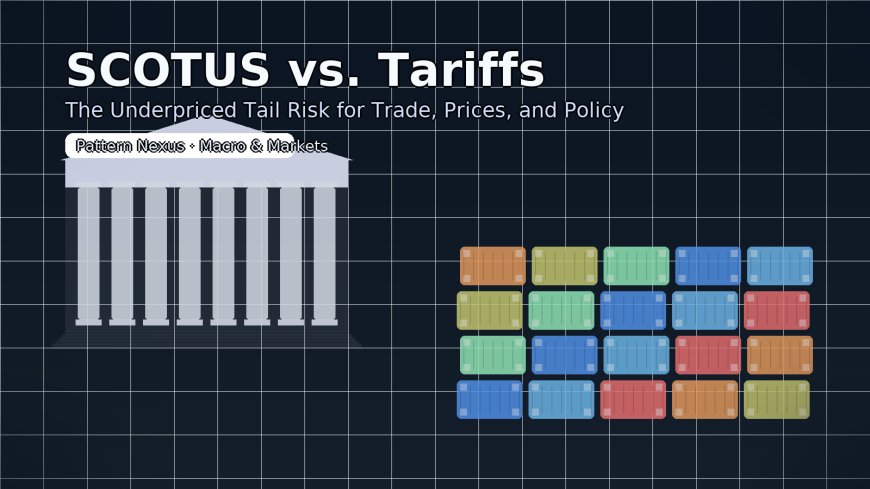
SCOTUS vs. Tariffs: The Underpriced Tail Risk That Could Upend Trade, Prices, and Policy
If the Court strikes down IEEPA tariffs and refunds follow, the White House can pivot — but the *interim uncertainty* is the real shock absorber markets are not pricing.
- The legal core: SCOTUS is weighing whether the administration stretched IEEPA—a national emergency law—far beyond intent by using it as a de facto tariff engine.
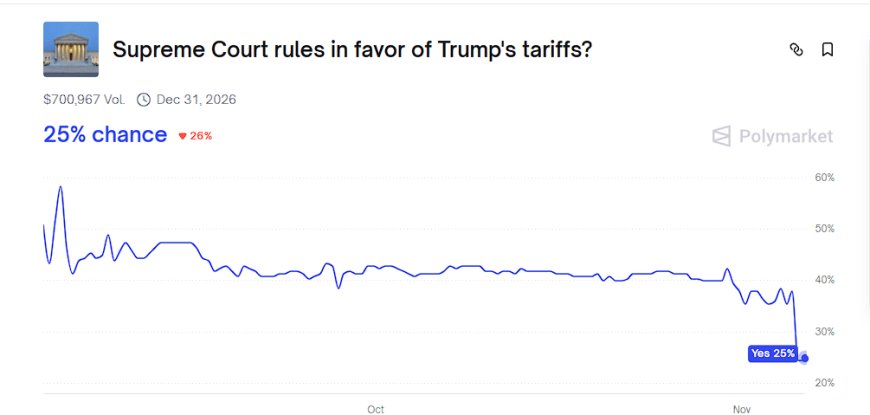
- Markets’ read: Polymarket odds slid to ~25% that the administration wins. Traders are implicitly pricing a legal defeat as the **baseline**, but not the **macro spillovers** that come with it.
- If the administration loses: Parts of the 2025 tariff system could be voided. Depending on remedy language, it could require refunds to importers — possibly significant, but procedurally slow.
- The pivot: The White House isn’t out of tools. It can rapidly rebuild the tariff regime under:
- Trade Act §122 — temporary, capped tariffs
- Section 301 — targeted, legally sturdier tariff actions
- Macro implications: Refunds = a one-time liquidity bump for importers. A brief disinflation pulse in tradable goods. Treasury might slightly shift issuance toward bills to smooth cash flow. But the real risk is a 1–2 quarter policy vacuum during the transition.
-
SCOTUS is not weighing a technicality — it’s weighing whether the executive branch can use an emergency war-powers statute as a shadow tariff engine.
This lands at the worst possible moment: the U.S. is mid-way through a global supply chain rebuild, attempting to harden industrial capacity, expand semis, and re-anchor critical imports.A sudden legal stop followed by a multi-month pivot is not priced. Markets assume:
-
tariffs may be invalidated,
but they are not pricing the vacuum between invalidation and replacement, nor the refund-timing liquidity wave that hits unevenly across sectors.
This is the mispriced tail risk.
-
What markets are pricing
- 25% odds the administration wins
- High likelihood tariffs in their current form are struck down
- A belief that the White House will “just reissue” tariffs quickly
What markets are not pricing
✅ refund-timing uncertainty
✅ cash-flow distortions for major importers
✅ pricing freezes during the 1–2 quarter vacuum
✅ Treasury issuance shifts to bills
✅ FX volatility during the regime switch
✅ inventory volatility as supply chains pause then restart
✅ political headlines amplifying uncertainty
This is the zone where traders are flying blind.
1) What case is before SCOTUS?
The Supreme Court is examining whether the President can use the International Emergency Economic Powers Act (IEEPA) — a Cold War–era emergency statute — to impose broad tariffs that look less like emergency sanctions and more like a general tax regime.
This case puts three doctrines under a bright light:
- Separation of powers: Does IEEPA give the President unilateral tariff authority, or does that trespass into Congress’s Article I power to levy duties?
- Major Questions Doctrine: If tariffs reshape entire sectors of the economy, can such sweeping authority be inferred from statutory silence?
- Revenue vs. Regulation: If a measure raises revenue rather than regulates harmful activities, is it outside IEEPA’s purpose?
**Why this case matters:** If SCOTUS says “no,” the administration’s 2025 tariff architecture must be rebuilt from scratch under narrower trade statutes — creating a temporary policy hole that markets have not priced.
2) If the administration loses: invalidation & refunds
The legal outcome doesn’t just determine whether tariffs stay. It determines who gets paid back, how much, and how fast. That’s the real macro hinge point.
Three realistic remedy paths:
- Invalidate + refunds for protestors only
The most conservative outcome: only importers who filed official protests or preserved rights get refunds. - Invalidate + broader refunds
This expands eligibility beyond protesters — politically sensitive, logistically difficult, and likely to trigger follow-on litigation. - Remand to lower courts
Lower courts determine scope, eligibility, timelines, and documentation standards. This prolongs uncertainty.
Regardless of scale, the mechanics matter more than the headlines:
- Refunds flow through **CBP’s protest/drawback infrastructure** — slow, documentation-heavy.
- Expect **months, not weeks**, for processing.
- Importers with airtight paperwork will move to the front of the queue.
- Accounting treatment (COGS adjustments, pass-through to customers) becomes a strategic variable.
What if the administration wins?
- Status quo persists: IEEPA-as-tariff survives for now; further cases likely narrow scope at the margins.
- Markets: Mild risk-off for importers; reflationary impulse in tariff-heavy baskets persists.
- Policy: Expect additional challenges focused on remedy tailoring, major-questions boundaries, and retroactivity.
This is a logistics challenge masquerading as macro policy. Firms with better documentation effectively receive faster stimulus.
Refund Scenarios: Magnitude & Timing
Low-end scenario (~$8–12B)
Only protest-protected entries. Very narrow. Minimal macro impact, but concentrated benefits.
Mid-range scenario (~$25–35B)
Broader eligibility including “similarly situated” importers. This is the most likely political compromise.
High-end scenario ($50B+ but slow)
If SCOTUS forces a broad remedy and CBP processing must scale.
Processing time = 9–18 months, not weeks.
Documentation tiers
- Tier 1 – Protest-filed entries
Tier 2 – Importers with preserved records under 19 CFR rules
Tier 3 – General import entries requiring additional verification
Tier 4 – Disputed entries (slowest)
Accounting impact
Refunds don’t behave like pure stimulus:
- They lower COGS retroactively
- They distort earnings timing
- They create quarter-to-quarter margin noise
- Pass-through to customers varies sector-by-sector
This is why analyst models will break during the transition window.
3) Day-2 policy pivots: how the White House can re-route
If SCOTUS slaps down IEEPA tariffs, the administration’s move is not retreat — it’s restructure and re-paper. Key tools:
- Trade Act §122 — temporary, emergency tariffs capped around 15% for ~150 days. Ideal as a **bridge regime**.
- Section 301 — targeted tariffs based on unfair trade practices. Slower, but legally defensible and more durable.
- Sector-specific authorities — AD/CVD, steel/aluminum national security paths, and product-specific controls.
The pivot path is clear: broad → narrow → legally fortified. Markets aren’t thinking through that sequencing.
4) Macro & markets: pricing, liquidity, and curve mechanics
Short-run effects (next 1–2 quarters)
- Refunds = liquidity injection. Import-heavy firms get a short-term cash boost.
- Disinflation pulse. Prices of tariff-heavy goods (electronics, home goods, industrial components) soften temporarily.
- Issuance mix shifts. Treasury may lean on T-Bills to manage cash-flow bumps tied to refunds.
- FX impact. Narrower tariffs = marginally risk-on, modestly USD-negative, but highly dependent on replacement regime.
Medium-term normalization (3–6 months)
- Replacement tariffs push some prices back up.
- Catalog repricing and supply contracts introduce volatility.
- Inventory planning remains clouded until new lists are finalized.
We’re in a global industrial rebuild phase — power, materials, semis, data centers, logistics. A legal hit to tariff plumbing injects noise into that rebuild at the worst possible time.
Why the 1–2 Quarter Vacuum Matters More Than the Tariffs
When tariffs vanish without immediate replacement:
- Price freezes occur.
Retailers stop repricing because refund eligibility is unknown. - Inventory buffers expand.
Firms pull forward orders “just in case,” amplifying freight volatility. - Spread compression hits import-heavy SKUs.
Sellers compete on uncertainty rather than fundamentals. - Supply-chain planning breaks.
Contracts tied to tariff-inclusive pricing become misaligned. - FX channels amplify noise.
Asian suppliers adjust quotes daily due to dollar volatility.
This period won’t last long but will be chaotic — and markets aren’t prepared.
5) Sector map: who benefits, who bleeds
Winners (short-run)
- Big box: Target, Walmart, Costco
- E-commerce: Amazon, Temu-aligned supply chains
- Consumer electronics: Lenovo, Samsung, Asus
- Logistics firms: Expeditors, K+N, DHL
Losers (short-run)
- Domestic steel & aluminum
- Tariff-protected textile producers
- Niche industrials benefiting from 2025 tariff walls
- SME manufacturers competing with Asia-based distributors
This is a temporary dislocation, not a structural reordering — once §301 lists return, pricing re-converges.
6) Operator playbook: what smart firms do now
- Preserve documentation — the #1 determinant of refund speed.
- Run scenario pricing — A/B/C matrices for different refund + replacement regimes.
- Hedge the window — FX and inventory hedges for a volatile 1–2 quarter gap.
- Watch the bill curve — issuance tweaks may move front-end funding costs.
- Communicate early — customers and vendors hate uncertainty more than change.
- Renegotiate freight contracts with flexible surcharges
Carriers will temporarily misprice lanes due to rate volatility. - Monitor SKU-level gross margins weekly
Refund timing creates margin spikes and collapses on random cycles.
7) Politics: strategy, optics, sequencing
A loss is a headline setback — but politically survivable. The larger story is how quickly the administration pivots to restore leverage under §122 and §301.
Expect messaging like:
- “Refunds reflect judicial process, not a shift in trade posture.”
- “New, more targeted measures will be legally robust.”
“China and strategic competitors should expect continued economic pressure.”
Why the politics matter
Even if the administration loses, it gains a political narrative:
- “The Court is limiting U.S. leverage against China.”
- “We will rebuild the tariff regime within constitutional boundaries.”
- “Refunds reflect legal process, not policy change.”
The **window between invalidation and replacement** is the market’s blind spot — a period where firms freeze pricing, pause commitments, and delay imports.
8) What to watch next
- Remedy language — determines refund scope.
- §122 timing — the speed of the temporary bridge matters.
- First draft of §301 lists — reveals the administration’s longer-term structure.
- Treasury issuance guidance — any shift toward bills confirms cash-flow management.
- Earnings calls — SKU repricing, margin compression, inventory decisions.
Timeline at a glance
- Ruling day (T0): Legal outcome + initial market move
- T0–T+2 weeks: Remedy guidance; importers begin CBP prep
- T+1–2 months: §122 bridge, first §301 list drafts
- T+1–2 quarters: Refund processing begins; contract/pricing resets
✅ Conclusion
Base Case (65%)
- SCOTUS strikes down IEEPA usage
- Refunds limited to protestors + similarly situated importers
- 1–2 quarter vacuum
- §122 bridge tariffs
- First §301 lists arrive within 60–90 days
- Temporary disinflation → mild re-inflation cycle
Bear Case (25%)
- Broad refunds ordered
- CBP overwhelmed
- Treasury forced to shift issuance toward bills
- FX volatility spills into risk assets
- Supply-chain repricing shock
Bull Case (10%)
- SCOTUS narrows remedy
- No major refunds
- White House re-papers tariffs within 30 days
- Minimal macro disturbance
Final take
The risk is not the ruling — it’s the gap between legal invalidation and policy reconstruction.
That gap is the unpriced shock absorber in markets.
FAQ
Is IEEPA a tariff law? Not explicitly. It’s an emergency powers statute used to block or regulate transactions tied to threats; using it to levy broad tariffs raises separation-of-powers issues.
Will I get a refund automatically? No. Eligibility and documentation requirements will be set by the remedy; expect CBP processes and delays.
Do tariffs disappear if IEEPA loses? No. Expect a pivot to §122 and §301 — narrower but sturdier.
Risks to the base case
- Standing/remedy narrowing: Court could limit refunds to protestors only, muting macro impact.
- Chevron/MQD interactions: If the Court avoids broad holdings, agencies may retain more room than markets assume.
- Congressional action: Statutory patch could re-authorize temporary measures faster than expected.
Sources
- SCOTUSblog – “Justices question scope of presidential emergency authority in tariff case” (Nov 2025)
Detailed recap of oral arguments, highlighting judicial skepticism toward IEEPA as a broad tariff tool. - SCOTUSblog – “President Trump's tariffs v. the Supreme Court's duties”
Explains the separation-of-powers issues, major-questions doctrine, and what’s legally at stake. - Reuters – “U.S. Supreme Court seems skeptical of Trump administration’s tariff authority” (Nov 5, 2025)
Outlines market uncertainty, refund risks, and early reactions from importers and trade groups. - Reuters – “Businesses brace for refund battle if Supreme Court strikes down tariffs” (Nov 6, 2025)
Discusses documentation requirements, timelines, and what importers should expect if refunds are ordered. - Washington Post – “Supreme Court questions emergency powers used for tariffs” (Nov 5, 2025)
Focuses on the government’s argument that tariffs were regulatory, not revenue-raising. - U.S. Code – International Emergency Economic Powers Act (IEEPA), 50 U.S.C. §§ 1701–1708
Full text of the statute at the center of the case. - U.S. Code – Trade Act of 1974 §122 (19 U.S.C. §2132)
Emergency balance-of-payments tariff authority (temporary, capped). - U.S. Code – Section 301, Trade Act of 1974 (19 U.S.C. §2411)
Targeted tariff authority used historically against unfair trade practices. - CBP – Official guidance on protests and refund eligibility
Details for importers on documentation, timelines, and procedures relevant to tariff refunds. - CBP – Drawback program overview
Provides context for refund-processing channels and timelines. - Polymarket – “Supreme Court rules in favor of Trump’s tariffs?” betting market
Real-time predictive odds showing market expectations surrounding the ruling.
Note: Refund magnitudes cited in reporting are scenario-based and depend on the Court’s remedy language. Operators should focus on eligibility, documentation, and timing rather than headline totals.
Related on Pattern Nexus
- The Silent War Chest — Why the Fed & Treasury Are Hoarding Cash (and Prepping YCC)
Brief: How the policy complex stockpiles cash and signaling power to manage yields when markets won’t cooperate.
Tie-in: If SCOTUS forces tariff refunds and a pivot, this “war chest” becomes the backstop for managing funding and term premia. - Treasury’s Line in the Sand — The 10-Year & the Bond Market
Brief: Where Treasury draws its implicit boundary for long-end yields and how issuance levers nudge the curve.
Tie-in: A tariff-refund cash-flow hit could tweak bill-vs-note issuance; this piece explains the playbook and curve dynamics. - The Reverse-Repo Trap — How the Fed Manages Liquidity
Brief: Why the RRP/Repo complex is the stealth valve for dollar liquidity and collateral cycles.
Tie-in: If broad tariffs are unwound, repo/RRP becomes the pressure gauge for the near-term disinflation/liquidity ripple. - End of the 40-Year Bond Supercycle — The Regime Changed
Brief: Why duration no longer behaves like the old playbook and what drives the new rate regime.
Tie-in: SCOTUS-driven tariff changes hit pricing and issuance into a new regime, not the old—this frames market reactions. - Yen Carry Trade Unwind — The Dollar Shockwave
Brief: How carry dynamics and FX hedging flows transmit shocks across funding and risk assets.
Tie-in: A tariff pivot/refund window can jolt cross-border flows; this explains the FX channel that amplifies the impact. - Systemic Realignment — Digital Sovereignty & Multipolar Liquidity
Brief: The shift from a single-center liquidity world to competing corridors and policy blocs.
Tie-in: Narrower, re-papered tariffs under §122/§301 fit the broader realignment in trade, tech, and capital lanes. - The Calm Before the Liquidity Storm — QE 2026
Brief: Why structural constraints point to another liquidity phase and how it could be triggered.
Tie-in: A legal shock (tariff refunds + policy vacuum) is exactly the kind of catalyst that accelerates the next liquidity pivot. - The Dollar’s Last Stand
Brief: The dollar’s evolving role as system utility vs. simple store of value, and why policy plumbing matters.
Tie-in: Tariff regime changes alter trade invoicing, flows, and basis—this piece frames the USD lens for the ruling’s fallout.
Mi a reakciód?
 Tetszik
0
Tetszik
0
 Nem tetszik
0
Nem tetszik
0
 Szeretet
0
Szeretet
0
 Vicces
0
Vicces
0
 Hűha
0
Hűha
0
 Szomorú
0
Szomorú
0
 Mérges
0
Mérges
0

Founder of Pattern Nexus. I research markets, macro, geopolitics, AI, history, ancient systems, and the patterns most people overlook. I’m also building Market Radar, a trading scanner designed to read pressure, risk, confirmation, and setup quality before chasing a move. Pattern Nexus is where I connect the dots between data, history, technology, and the bigger system playing out around us.












Hozzászólások (0)