
The Convergence: AI, Energy, and the Final Liquidity Regime (2020–2045?)
The last 150 years built an industrial machine, a dollar fortress, offshore dollar webs, a global leverage cycle, and a QE-driven digital dollar stack. Part 10 of the Pattern Nexus megaseries ties the arc together and maps where it’s likely heading next: an AI–energy industrial core, programmable dollars, hard-asset politics, and a final liquidity regime that decides who gets to adapt — and who gets left behind.
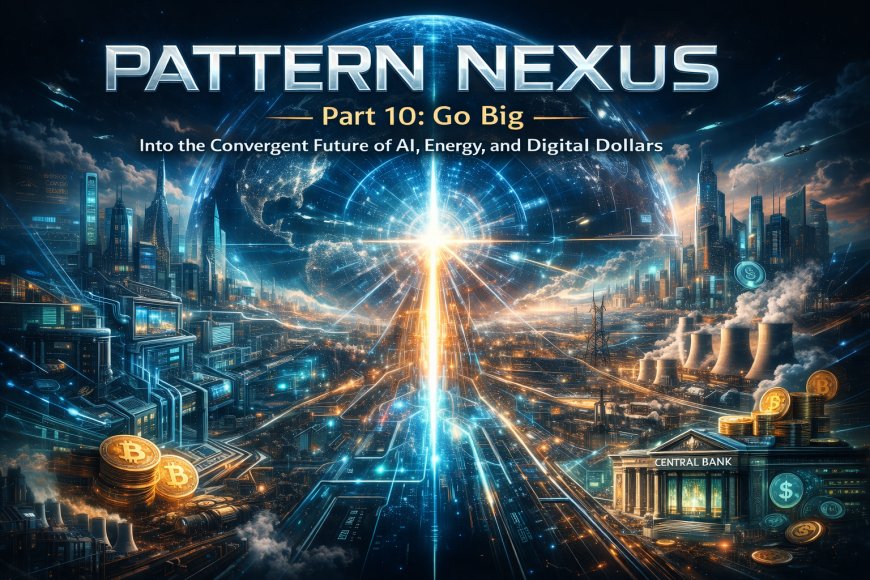
The Long Cycle So Far: Parts 1–9 in One Map
To understand why the 2020s feel so unstable, you have to see them as the endpoint of a machine that has been compounding for a century and a half. A compressed recap of the Pattern Nexus series so far:
- Part 1 – Industrial Hardware (1870–1914): Steel, rail, coal, and oil create the first full-stack industrial civilization. Liquidity and credit scale to match.
- Part 2 – Dollar Fortress (1947–1953): Bretton Woods, the Marshall Plan, capital controls, and the 1951 Accord turn the U.S. into the issuer and architect of a gold-anchored dollar system.
- Part 3 – Command Line (1956–1969): The compute–defense complex, early networks, and Cold War logistics become the nervous system of power.
- Part 4 – Monetary Break (1968–1979): Bretton Woods collapses, the gold window closes, oil becomes the practical anchor, and Eurodollars plus petrodollars spin up a networked dollar web.
- Part 5 – Leverage Machine (1979–1994): Volcker, deregulation, and financial innovation weaponize high real rates and expanding credit to discipline the world.
- Part 6 – Asian Liquidity Supercycle (1994–2001): Globalization, emerging-market crises, and export-surplus recycling turn the U.S. into the demand sink and collateral core.
- Part 7 – Housing Collateral Engine (2001–2008): U.S. mortgages become global money. Shadow banking and securitization turn suburbia into the world’s funding engine — until it breaks.
- Part 8 – The QE Decade (2008–2019): Central banks replace private collateral engines. QE, ZIRP, swap lines, Basel III, and safe-asset scarcity build the foundations for a digital dollar and AI–energy regime.
- Part 9 – The Shock Decade Begins (2020s): Pandemic, war, supply shocks, and fiscal–monetary fusion break the illusion of “normal.” The system shows you its firmware in real time.
Part 10 takes that arc and does two things:
- shows how the existing structures force specific choices in AI, energy, and money
- lays out realistic paths for what 2030–2045 can look like if you pay attention to the plumbing instead of the narratives
The 2020s Shock Stack: Pandemic, War, and Fiscal Dominance
The 2020s open with a multi-layer shock stack that accelerates trends already baked into Parts 7 and 8:
Pandemic as Stress Test and Excuse
A global pandemic:
- blows a hole in GDP and tax revenue
- forces governments into emergency spending and income support
- pushes central banks into buying a wider range and quantity of assets
The line between monetary and fiscal policy blurs. “Independence” gives way to “coordination.” What was once sold as temporary crisis theater becomes a template:
- large deficits → absorbed via central bank balance sheets
- support for specific sectors → routed through credit facilities and guarantees
- direct household backstops → normalized as tools for future emergencies
War, Sanctions, and Weaponized Interdependence
As great-power rivalry moves from theory into practice:
- sanctions regimes target banks, energy flows, and key commodities
- reserve assets are frozen or blocked
- payment networks become tools of coercion
The message to the rest of the world is simple:
If your critical reserves and payment rails sit inside a rival’s jurisdiction, they are not “yours.” They are contingent privileges.
This doesn’t kill the dollar system. It hardens it — and pushes everyone else to explore hedges.
Inflation as Political and Monetary Stress Test
Pandemic response, supply-chain shocks, war, and underbuilt energy capacity combine into the first serious inflation wave in decades. The policy reaction:
- rapid rate hikes from near-zero to levels not seen since the pre-QE era
- attempts at QT (quantitative tightening) that clash with funding needs
- political pressure as households feel squeezed by food, housing, and energy costs
The deeper signal:
- the system cannot simultaneously deliver low inflation, high asset prices, cheap government funding, and geopolitical rearmament without friction
- something has to give: either real living standards, asset valuations, currency stability, or political stability
From QE to QF: The Age of Fiscal–Monetary Fusion
In Parts 7 and 8, central banks primarily acted through balance-sheet mechanics and signaling — buying assets, setting rates, and backstopping markets. In the 2020s, the center of gravity shifts toward explicit fiscal–monetary fusion.
QF: Quantitative Fiscal as Operating Mode
Call it whatever you like — “Modern Monetary Theory in practice,” “financial repression 2.0,” or “QF” — the practical configuration looks like this:
- governments run sustained, politically driven deficits for war, health, infrastructure, and industrial policy
- central banks become structural buyers of that debt, directly or indirectly
- regulations and incentives nudge private institutions to hold more sovereign paper
- inflation tolerance rises quietly, so long as nominal GDP expands and the system can roll its debt
The balance sheet of the state and its central bank merges into a single macro actor:
“We will issue whatever liabilities we need, and we will manage yields and distribution through a mix of policy, regulation, and backstops.”
Why There Is No Clean Exit
The deeper into this configuration you go:
- the more asset valuations depend on policy support
- the more banks and funds depend on sovereign paper for “safety”
- the more politically impossible it becomes to allow true market clearing
Attempts at normalization (shrinking balance sheets, running primary surpluses, letting yields float freely) hit a wall:
- bond markets wobble
- risk assets sell off
- funding costs threaten real-economy viability
The path of least resistance is always the same:
Recommit to the backstop, find a new narrative, and push the problem forward in time.
Industrial Policy As Liquidity Allocation
In this environment, “industrial policy” is not just about picking winners; it’s about choosing who gets access to cheap, patient capital:
- data centers, grids, and AI fabs
- defense, intelligence, and dual-use tech
- critical resources: copper, rare earths, semiconductors, water corridors
The state–central bank complex becomes the top of the capital stack:
- it doesn’t just smooth the business cycle; it routes liquidity into preferred infrastructures
- the line between “macro policy” and “allocation of survival tools” blurs
The AI–Energy–Data Core: New Industrial Hardware
The original industrial supercycle ran on steel, rail, coal, and oil. The convergence regime runs on compute, bandwidth, data, and electricity — with copper, transmission, and cooling as the physical choke points.
AI as the New Command Line
In Part 3, mainframes and early networks shifted power by giving states and corporations a command line into logistics and warfare. In the 2020s and 2030s, AI systems:
- optimize resource allocation: energy dispatch, logistics, pricing, credit scoring
- automate white-collar cognitive labor and parts of decision-making
- generate code, models, and synthetic environments at scale
The “AI–industrial complex” is not just models. It is:
- chip fabrication and packaging
- hyperscale data centers, cooling, and grid interconnects
- network infrastructure and spectrum
- data acquisition, labeling, and governance
AI is both:
- a productivity lever for those who own it
- a bargaining chip for states trying to maintain relevance and control
Energy as the Limiting Reagent
Compute is just concentrated electricity plus hardware. As AI demand scales:
- data centers become one of the fastest-growing loads on grids
- regions with surplus power and regulatory flexibility become magnets for infrastructure
- projects in nuclear, hydro, gas, and renewables get pulled into an AI-driven demand story
The relationship flips:
- energy used to be “a cost line” for tech
- now tech becomes “the anchor customer” for new energy buildouts
Grids, Copper, and Physical Bottlenecks
The limiting factors for the AI–energy industrial core are not just capital and code; they are:
- permitting timelines and local opposition for lines and plants
- availability of copper, transformers, and skilled labor
- geography: where water, cooling, and stability exist simultaneously
The convergence regime therefore isn’t purely digital. It is intensely physical. Whoever can:
- deploy capital fast into energy and grid projects
- secure long-term rights-of-way and resource basins
- tie those to compute clusters and AI workloads
gains a structural advantage that looks a lot like owning railroads and oil in 1900 — but with software and surveillance on top.
Digital Dollars, Stablecoins, and Programmable Control
Parts 8 and 9 show how QE, swap lines, and safe-asset scarcity create the preconditions for digital dollar instruments. Part 10 is where those tools go from niche to structural.
Three Layers of the Digital Dollar Stack
You can think of the emerging dollar stack as three nested layers:
- Core: Fed balance sheet, U.S. Treasuries, and swap lines
- Institutional: banks, money-market funds, custodians, and regulated stablecoin issuers holding those core assets
- Edge: wallets, platforms, and protocols exposing “dollar-like” claims to end users and machines
At the edge, you get:
- retail and institutional stablecoins
- tokenized Treasuries and money funds
- embedded finance inside apps and AI agents
At the core, you get:
- policy debates about CBDC vs. private rails
- regimes deciding which tokenized instruments count as “inside the perimeter”
- regulatory levers over access, identity, and programmability
Programmability as Carrot and Stick
Once value moves in programmable rails, a new menu of options appears:
- time-limited or location-limited payments
- automated tax withholding and compliance
- embedded subsidies or penalties tied to behavior (energy use, emissions, location choices)
- granular controls on where certain funds can be spent
The same tools can:
- make fiscal response faster and more targeted in a crisis
- tighten enforcement and surveillance
- create soft social-credit dynamics without calling them that
Stablecoins as Shadow Eurodollars
In parallel, private stablecoins and tokenized dollar instruments act like:
- a new wave of offshore dollar creation, this time on-chain
- a bridge between U.S. funding markets and jurisdictions with weak banking systems
- a de facto retail interface for people outside the swap-line club
To the extent they are backed by short-term Treasuries and bank deposits, they:
- increase marginal demand for U.S. government debt
- pull more of the world’s savings into the core dollar system
- turn U.S. policy choices into global weather events for anyone holding those tokens
Geopolitics 2.0: Blocs, Corridors, and Liquidity Spheres
As AI, energy, and digital money stack on top of each other, geopolitics reconfigures around a few practical questions:
- who controls the cleanest and cheapest power at scale?
- who controls the leading AI models, fabs, and platforms?
- who controls the dominant settlement rails and collateral standards?
Blocs, Not Globalization
Instead of a flat global market, you get overlapping blocs:
- a U.S.-centric bloc organized around the dollar, Western finance, and allied tech/energy corridors
- a Eurasian or alternative bloc organized around different rails, resource routes, and security architectures
- non-aligned or swing states that arbitrage between them
Each bloc seeks:
- payment systems it can’t be cut off from
- compute and energy supply that can survive sanctions
- alliances that guarantee access to food, fuel, and critical inputs
Corridors as the New Ports
The strategic assets of the convergence era are:
- energy corridors (pipelines, HVDC lines, LNG routes)
- data corridors (undersea cables, landing stations, IXPs)
- resource corridors (lithium, copper, rare earths, grain, water)
Control can mean:
- sovereign ownership
- regulatory veto power
- military reach and deterrence
Access becomes a liquidity question: if you lose access to a corridor, you lose the ability to turn your assets, labor, and infrastructure into money on acceptable terms.
Climate, Scarcity, and the Return of Hard-Asset Politics
None of this happens in a vacuum. Climate volatility and resource constraints overlay the convergence in ways that bring back a very old kind of politics: who eats, who freezes, who floods, and who moves.
Adaptation as Capital-Allocation Problem
As climate risks bite:
- insurance markets reprice or withdraw from certain geographies
- infrastructure maintenance moves from “later” to “now or collapse”
- migration pressures rise as some regions become less habitable or less economically viable
The system has to decide:
- which cities and regions get defended with hard infrastructure
- which ones are quietly written off
- who gets financed to move, rebuild, or retool
That is not just climate policy; it is balance-sheet triage.
Hard Assets in a Soft-Money World
Against a backdrop of:
- persistent fiscal deficits
- high debt loads
- intermittent inflation waves
hard assets regain strategic status:
- productive land and water access
- energy-producing and grid-critical real estate
- infrastructure-adjacent property (ports, hubs, corridors)
- select metals and materials tied to electrification and compute
The key difference from older eras is that:
- the value of these assets is mediated through digital money and AI-optimized markets
- their political risk is higher, as states look for ways to socialize costs and capture upside
Scenarios 2030–2045: Four Paths Through the Convergence
No one can script the future line by line. But the pipes you’ve already built constrain the plot twists. A realistic scenario set for 2030–2045 looks something like this:
Scenario 1: Managed Convergence (Soft Landing, Hard Choices)
In this path:
- inflation is episodic but contained through a mix of rate moves and targeted controls
- fiscal deficits remain large but are partially offset by growth in AI- and energy-driven productivity
- digital dollar rails and stablecoins coexist with cash and legacy banking under tighter, coherent regulation
- blocs compete but avoid direct military escalation; corridors are contested mostly through economics and covert means
Asset owners still win, but the system buys social peace with:
- expanded transfer programs
- subsidized basic services
- managed migration and resettlement
This is the “long muddle-through” regime. Painful, but survivable for most.
Scenario 2: Fragmented Hard Landing (Disorderly Deleveraging)
In this path:
- inflation and rate volatility trigger genuine funding crises in one or more major blocs
- bond markets revolt against sustained deficits without credible growth stories
- asset prices finally reset in a way central banks cannot fully cushion
- political systems lurch toward more extreme responses: capital controls, windfall taxes, nationalizations
Digital money rails become tools for:
- controlling outflows
- triaging recipients of support
- enforcing rationing or conditional access
This is a “crisis then forced adaptation” regime. Survivable, but only if you are not over-levered, overexposed, or fully dependent on policy promises.
Scenario 3: Techno-Authoritarian Convergence (High Control, High Efficiency)
In this path:
- AI and digital rails are aggressively integrated into governance and economic control
- programmable money and identity systems become mandatory for key transactions
- large platforms and states merge functions in practice, if not in name
- social and political dissent is managed through a mix of incentives, censorship, and access throttling
The upside:
- fast mobilization of resources for energy transition, infrastructure, and industrial projects
- high measured efficiency and stability
The downside:
- fragility to policy error or elite conflict
- limited exit options for those on the wrong side of decisions
Scenario 4: Decentralized Counter-Systems (Archipelagos of Autonomy)
In this path:
- centralized systems become so extractive or incompetent that parallel structures gain traction
- local or networked communities build semi-autonomous stacks: energy, food, compute, and finance
- crypto, mesh networks, and off-grid infrastructure move from “hobbyist” to “necessary hedge”
These counter-systems:
- don’t replace the core regimes
- act as pressure valves and innovation labs
- offer real but uneven protection for those able to opt in
The reality is likely a blend: some sectors and regions in Scenario 1, some in Scenario 3, and pockets of Scenario 4 emerging in response.
Pattern Nexus Playbook: How Real People Navigate the Final Liquidity Regime
The point of mapping cycles is not academic satisfaction. It is survival and positioning. For individuals, builders, and small operators, the convergence regime suggests a few hard rules:
1. Optimize for Resilience First, Upside Second
In a world of policy-driven volatility and physical bottlenecks:
- avoid single points of failure in income, geography, and funding
- prioritize skills and assets that remain useful across multiple scenarios
- treat government programs as helpful, but not guaranteed
2. Anchor in Real Cash Flows Tied to Necessities
Businesses and assets linked to:
- housing and local services
- energy and maintenance
- food, logistics, and repair
will be in demand across almost any path, even if margins and regulations change.
3. Understand the Rails You Depend On
You should be able to answer:
- which payment systems do I actually use, and how censorable are they?
- where do my savings sit in the capital stack (deposits, securities, tokens)?
- what jurisdictions and legal systems ultimately govern my claims?
Blindly trusting “the system” is a luxury the convergence regime will strip away from most people.
4. Use AI as Leverage, Not as a Crutch
For individuals and small firms:
- use AI to multiply your pattern recognition, throughput, and decision support
- avoid becoming just “cheap human glue” in someone else’s AI workflow
- build proprietary data, processes, or relationships that models alone can’t easily replicate
5. Treat Policy Like Weather and Regime Change Like Climate
Day-to-day:
- rates move, headlines flash, political dramas cycle
Underneath:
- the long shift from private collateral to public liquidity
- the entrenchment of the digital dollar stack
- the build-out of AI–energy infrastructure
- the rise of hard-asset politics
Those are the climate. Align with that, and you can survive a lot of weather.
Pattern Nexus Framework: The Completed Long Cycle Map
With Part 10, the series closes the loop:
- Part 1: The Industrial Supercycle — build the machine.
- Part 2: The Dollar Fortress — lock the machine in a monetary cage.
- Part 3: The Command Line — wire the machine to compute and defense.
- Part 4: The Monetary Break — mutate from gold to oil and offshore credit.
- Part 5: The Leverage Machine — weaponize rates and deregulation.
- Part 6: The Asian Liquidity Supercycle — globalize the dollar web.
- Part 7: The Housing Collateral Engine — overconcentrate and collapse.
- Part 8: The QE Decade — install central-bank liquidity as the new core.
- Part 9: The Shock Decade Begins — stress-test the firmware with pandemic, war, and inflation.
- Part 10: The Convergence — compress AI, energy, and digital money into a final liquidity regime.
Three core Pattern Nexus takeaways:
- Regimes end by mutation, not by vote. Gold didn’t “end”; it was bypassed. Housing didn’t “end”; it was socialized and repriced. QE won’t “end”; it will morph into fiscal–monetary fusion and digital control layers.
- The real backing of money is forced usage. Gold, oil, Treasuries, swap lines, stablecoin backing, and AI–energy corridors are all ways of forcing the world to use a given unit. Watch what people must use, not what they are told is “backing” their currency.
- Small players survive by exploiting scale’s blind spots. Empires and megacorps optimize for averages and big levers. They are bad at edge cases, local nuance, and bespoke resilience. That is where individuals and small operators can still win — if they see the pattern early enough.
FAQ: Quick Answers and “So What?”
Is this saying the dollar “will die” in the 2030s?
No. The more realistic view is that the dollar system mutates again. Its global share may shrink at the margin, but its core role in collateral, settlement, and reserves will likely persist so long as U.S. markets, law, and military power remain relatively strong. The bigger shift is inside the regime: from analog dollars to digital, from market discipline to policy allocation.
Is an AI-driven productivity boom going to fix the debt problem?
It can help, but only if the gains are large enough and broadly distributed enough to outrun interest costs, demographics, and political promises. If AI gains are captured by a narrow set of platforms and fiscal demands keep rising, the structural pressures on the regime remain. AI is an amplifier, not a guaranteed savior.
Will digital dollars automatically lead to dystopian control?
They make fine-grained control possible. Whether that potential is realized depends on political choices, legal constraints, and the availability of counter-systems. Expect attempts at tighter control in crises. Expect resistance and workarounds where those controls become too heavy-handed or incompetent.
How do real estate, small business, and local operators fit into this picture?
They are where abstract regimes become concrete reality. Housing, local services, and small-scale infrastructure remain essential. The risk is not obsolescence; it is being squeezed between higher input costs, tighter regulation, and larger players accessing cheaper capital. Surviving that means owning irreplaceable local advantages and managing leverage ruthlessly.
What should I pay attention to over the next 5–10 years?
At minimum:
- the shape and scale of central bank balance sheets
- how deficits are financed and who is required to hold the debt
- where data centers and new energy projects are actually being built
- which digital dollar and stablecoin rails are being blessed, banned, or co-opted
- changes in property, tax, and capital controls that affect your specific region and sector
Those five things tell you more about your future than most day-to-day political drama.
Sources
- Central bank reports and research on QE, balance sheet policies, swap lines, and post-2020 interventions. (Federal Reserve, ECB, BIS, IMF)
- Energy and grid planning documents on data center loads, electrification, and infrastructure bottlenecks. (IEA, national grid operators, industry white papers)
- Policy and academic work on fiscal–monetary interactions, financial repression, and safe-asset scarcity.
- Regulatory materials and industry analyses on stablecoins, tokenization, and digital payment systems.
- Research and reporting on AI compute growth, data center expansion, semiconductor supply chains, and cloud infrastructure.
- Historical macro, geopolitical, and climate-risk literature linking resource constraints, monetary regimes, and political change.
Apa Reaksi Anda?
 Suka
0
Suka
0
 Tidak Suka
0
Tidak Suka
0
 Cinta
0
Cinta
0
 Lucu
0
Lucu
0
 Wow
0
Wow
0
 Sedih
0
Sedih
0
 Marah
0
Marah
0

Founder of Pattern Nexus. I research markets, macro, geopolitics, AI, history, ancient systems, and the patterns most people overlook. I’m also building Market Radar, a trading scanner designed to read pressure, risk, confirmation, and setup quality before chasing a move. Pattern Nexus is where I connect the dots between data, history, technology, and the bigger system playing out around us.












Komentar (0)