
Data Gravity
Data gravity centralizes power. Platforms pull activity into their ecosystems, fuse identity with behavioral trails, and turn prediction into permission. The result is governance by scoring, eligibility, and invisible veto power—without borders or laws.
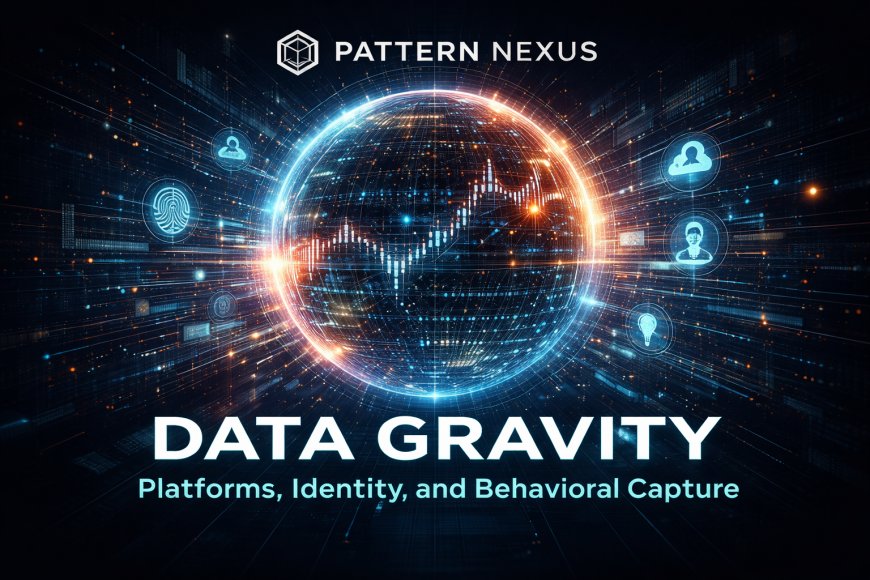
In the age of control systems, power rarely needs to shout. It can simply measure. Data gravity pulls behavior into centralized ecosystems, fuses identity to activity, and turns prediction into permission. The result is quiet governance: eligibility, access, pricing, ranking, enforcement—executed by platforms, standards, and compliance stacks rather than legislatures and borders.
Executive Summary
Data gravity is the force that centralizes modern life. The more data a system holds, the more services it can optimize. The more services it can optimize, the more people rely on it. The more people rely on it, the more behavior routes through it. And once behavior routes through it, the platform does not just “know” reality—it starts to price, rank, and permission reality.
That is the pivot from “information” to “control.” Data gravity is not primarily about storage. It is about fusion: identity + behavior + context, held in one place long enough to become predictive. Once prediction becomes reliable, it becomes governance. The system can preempt. It can restrict before an event happens. It can deny access based on probability rather than proof.
System Reality: When the system can measure you continuously, it can govern you continuously.
In 2024–2025, the architecture hardened on two fronts at the same time:
- Platform governance regimes: The EU’s Digital Services Act (DSA) and Digital Markets Act (DMA) moved from theory into enforcement, defining a European template for governing platform power through systemic obligations and gatekeeper rules.
- Identity and data-border regimes: Europe adopted the eIDAS 2.0 regulation underpinning the EU Digital Identity Wallet; India notified the DPDP Rules 2025 to operationalize its DPDP Act; the U.S. finalized restrictions tied to bulk sensitive personal data transactions with countries of concern; and California expanded “anti-friction” deletion infrastructure for data brokers.
These moves do not end data gravity. They reorganize it. They change who is allowed to operate at scale, what compliance posture is required, and where the permission gates sit.
Key Idea: The control question is not “who has data?” It is “who can fuse identity to behavior, and then turn prediction into permission?”
What “Data Gravity” Actually Means
“Data gravity” started as a technical observation: large datasets are hard to move, so compute moves toward the data. In the control-systems era, the term becomes bigger. Data gravity is a political-economic force that centralizes activity and then converts centralization into power.
It runs on a simple loop:
Text Diagram:
Data → Better Service → More Users → More Behavior → More Data → Better Prediction → Stronger Control → (back into the loop)
There are three upgrades that turn “data gravity” into “governance gravity”:
- Identity binding: data stops being anonymous fragments and becomes a continuous record.
- Cross-domain fusion: your browsing, location, payments, contacts, and content signals begin to reinforce each other.
- Decision coupling: predictions are coupled to outcomes (eligibility, pricing, ranking, restrictions).
That last step is the real one. If prediction does not change outcomes, it is analytics. If prediction changes outcomes, it is governance.
Myth vs Mechanism: Myth: data is “information.” Mechanism: data is a permission layer disguised as analytics.
This is why modern debates often miss the center. People argue about “privacy” as if the only output is ads. Ads are the surface. The deeper output is classification: risk tiers, trust tiers, relevance tiers, and enforcement tiers—applied continuously.
Platforms as Control Surfaces
A platform becomes a control surface when society routes essential activity through it. At that point, the platform has toggles that behave like policy:
- account creation, denial, and recovery
- ranking and visibility
- monetization eligibility
- payment enablement and cutoff
- API access and throttling
- verification requirements
- content enforcement and amplification rules
Once toggles exist, they will be used—sometimes for safety, sometimes for compliance, sometimes for risk management, sometimes to protect incumbency. Intent varies. The control outcome is consistent: decisions with governance effects.
System Reality: Platforms do not need ideology to govern. They only need toggles.
Control surfaces create a specific kind of power: power without confrontation. A platform does not need to “win” a debate. It can reduce your distribution. It can flag your account. It can limit your reach. It can throttle your throughput. Most enforcement is not a ban. It is an invisible downgrade.
In Part V (Compute Control), the mechanism was throughput throttling via hardware, packaging, power, and access. In Part VI, it is throughput throttling via ranking, eligibility, and identity gating. Same pattern. Different layer.
Hidden Constraint: When your business depends on platform routing, policy updates function like economic weather—sudden, non-negotiable, and system-wide.
Identity as Infrastructure
Identity is the hinge between data and control. Without identity, data is noisy and fragmented. With identity, data becomes a continuous record that can be scored, priced, restricted, and monetized.
Modern identity has three layers:
- Assertion: “I am this person.”
- Authentication: “Prove it repeatedly.”
- Authorization: “Given who you are, what are you allowed to do?”
The third layer is the control layer. Authorization is where identity becomes permission.
System Reality: Identity becomes control when it is used to decide eligibility, not just to prevent fraud.
This is why the digital identity push matters. Europe’s eIDAS 2.0 regulation (EU 2024/1183) entered into force in May 2024, supporting the European Digital Identity Wallet initiative. The explicit narrative is trust, interoperability, and user-friendly cross-border authentication. The control-systems reading is more mechanical:
- standardized identity increases interoperability (real benefits)
- standardized identity also increases the system’s ability to permission behavior across services
- permissioned identity can be used for portability or for gating—depending on governance design
Digital identity is not inherently authoritarian. The risk emerges when identity becomes a centralized switch controlled by a narrow set of institutions, with limited transparency and limited recourse.
Myth vs Mechanism: Myth: identity is “login.” Mechanism: identity is the handle the system uses to apply governance.
Behavioral Capture: From Attention to Telemetry
Behavioral capture is the process of converting human activity into machine-readable signals. It is not limited to what you say. It includes what you hover over, what you re-watch, what you scroll past, what you save, what you share privately, what you buy after exposure, and what you ignore.
In legacy media, the system measured outcomes through coarse tools: ratings, surveys, sales, and delayed feedback. In digital ecosystems, the environment is instrumented. Every action becomes telemetry, and telemetry becomes training data for prediction systems.
This creates an asymmetric relationship:
- the user experiences content and utility
- the platform experiences a measurement and optimization system
Over time, the measurement system becomes the “real product,” because it is what drives:
- ranking
- targeting
- pricing
- fraud detection
- enforcement
- product design
System Reality: People think the product is content. The product is behavioral telemetry.
The more domains that telemetry touches, the more it becomes a model of the person rather than a record of activity. Once that happens, the platform stops reacting to you and starts anticipating you. Anticipation is power because it lets the system act before you do.
Prediction Becomes Permission
When prediction becomes reliable enough, systems begin using it to allocate access. This is the moment data becomes governance. It already exists in:
- fraud and risk scoring
- payment processor restrictions
- platform trust tiers
- advertising eligibility
- monetization approvals
- content distribution thresholds
The shift is profound: the individual no longer needs to “break a rule” to experience enforcement. The prediction of risk becomes sufficient. That is governance by probability rather than governance by law.
System Reality: In a probabilistic governance system, you can be restricted for what the model thinks you might do.
This is also why modern “censorship” often looks like nothing. Your content is not deleted. It simply stops moving. Your business is not banned. It simply becomes ineligible for key features. Your account is not terminated. It is quietly demoted into a lower trust tier where everything costs more effort.
This model becomes self-justifying because it hides behind risk management. If the system restricts you, it can always claim “policy,” “safety,” or “fraud prevention.” And because enforcement is implemented through thresholds, outsiders cannot easily audit it. That is control at scale: plausible deniability plus high enforcement reliability.
Throttling as Enforcement
Control systems prefer throttles over bans. Throttles reduce backlash. Throttles lower legal exposure. Throttles preserve optionality. And throttles can be tuned continuously.
There are four major throttle types in the data layer:
- Visibility throttles: ranking changes, reach suppression, discoverability limits.
- Eligibility throttles: monetization denial, ad account restrictions, verification gating.
- Friction throttles: extra steps, delays, repeated verification prompts, increased fees.
- Pricing throttles: individualized offers, individualized limits, individualized risk pricing.
Text Diagram:
Ban = Discrete enforcement (high backlash)
Throttle = Continuous enforcement (low backlash, high control)
Throttling is also why the system can feel irrational. From the inside, the person experiences inconsistent outcomes. From the platform’s perspective, the person is being routed through a probabilistic model that updates continuously. The platform experiences “optimization.” The person experiences “arbitrary power.”
Hidden Constraint: The more the system relies on models, the less governance feels like law—and the more it feels like weather.
The Broker Layer: Shadow Markets for Real People
Most people think “data” is what they post. That is not the high-risk category. The high-risk category is data that is:
- granular
- continuous
- linkable to identity
- saleable across markets
That is the broker layer. Data brokers aggregate signals and sell them at scale. This is where behavioral capture becomes a supply chain: apps and ad-tech generate signals, brokers package them, and buyers use them for targeting, risk profiling, or surveillance.
This matters because the broker layer is the part of the system that can be used by anyone with money: corporations, investigators, criminals, foreign services, domestic agencies, political operators. The market itself becomes a control surface because it converts people into tradable objects.
System Reality: If a market exists for identity-linked telemetry, it will be used by whoever can pay.
This is why 2024–2025 enforcement actions around sensitive location data are important. When regulators describe location data as “sensitive” and take action against brokers, the subtext is clear: continuous identity-linked telemetry is not just a privacy issue. It is a targeting capability.
California’s Delete Act and related registry and deletion mechanisms are a structural counter-move: shifting from individual exhaustion to centralized deletion routing. The goal is not perfection. The goal is to reduce the broker layer’s advantage, which is built on friction and fragmentation.
Second-Order Effect: Privacy rights that require hours of paperwork are not rights. They are public relations.
Regime Control: DSA, DMA, eIDAS 2.0, DPDP Rules 2025, and Data Borders
Regulation does not “end” data gravity. It reshapes who can operate inside it, and where the permission gates sit. The control-systems question is always the same: does the rule reduce centralization, or does it raise the cost floor and therefore concentrate power in the hands of those who can afford compliance?
Europe: DSA as a Platform Governance Regime
The Digital Services Act became broadly applicable across the EU on February 17, 2024, with stricter requirements applying to designated very large online platforms and search engines. Mechanically, DSA is an attempt to convert platform governance from private toggles into auditable obligations: transparency, risk assessments, and systemic responsibility for how platforms amplify and manage content and harm.
DSA’s strategic effect is not only “safety.” It also formalizes the idea that platforms are infrastructure layers subject to public governance. Once that is normalized in one major jurisdiction, it becomes a template.
Europe: DMA as an Anti-Gatekeeper Architecture
The Digital Markets Act targets gatekeeper behavior by imposing conduct rules on designated firms. The enforcement trajectory through 2025 matters because it signals that the EU is willing to treat certain platform behaviors as structural power, not just business tactics.
System Reality: The DMA is not about punishing success. It is about redesigning the interoperability and distribution rules that gatekeepers used to lock in gravity.
Europe: eIDAS 2.0 and the EU Digital Identity Wallet
The EU Digital Identity framework is the identity counterpart to DSA/DMA. Where DSA/DMA govern platform behavior, eIDAS 2.0 governs identity portability and authentication infrastructure. The stated goal is secure, interoperable digital identity across borders. The control-systems implication is that identity becomes standardized and therefore easier to route through policy and compliance logic.
India: DPDP Rules 2025 as Data Governance Hardening
India’s DPDP Rules 2025 were notified in November 2025 to operationalize the DPDP Act. The intent is to harden consent mechanisms, define obligations for data fiduciaries, and create enforceable data governance at scale. In practice, this becomes a “data border”: it governs what can be collected, how it can be used, how it can flow, and what accountability mechanisms are required.
When a major market hardens data rules, it changes platform strategy. Data collection becomes more permissioned. Identity and consent become more formal. And compliance posture becomes a competitive advantage.
Myth vs Mechanism: Myth: privacy rules simply protect consumers. Mechanism: privacy rules also reshape who can operate at scale by raising the compliance floor.
United States: Bulk Sensitive Data as National Security
In 2025, the U.S. finalized restrictions tied to bulk sensitive personal data transactions with countries of concern. This is a recognition that data flows are strategic. If adversaries can buy or acquire sensitive personal data at scale, they can build targeting and coercion capability without firing a shot.
System Reality: When states treat data transfers like strategic transfers, data has officially become a strategic resource.
California: Delete Act and Anti-Friction Deletion Infrastructure
California’s approach is one of the clearest “anti-friction” moves in the U.S. privacy landscape: centralized deletion routing, broker registration pressure, and enforcement posture. The strategic logic is to reduce the broker layer’s advantage, which is built on the inability of individuals to fight thousands of entities one by one.
Data Sovereignty and Geopolitical Leverage
Data behaves differently than oil or metals. Its value scales with:
- linkability to identity
- cross-domain fusion
- freshness
- model capability
- distribution reach
This makes the geopolitical contest less about “who has the most raw data” and more about “who can fuse the most domains into a coherent model of reality.” Once fused, the system can:
- predict behavior
- target persuasion
- identify vulnerabilities
- apply eligibility-based control
- map networks and influence
This is why data localization, identity infrastructure, and restrictions on cross-border data flows are accelerating. These are not only “privacy” moves. They are sovereignty moves. They are attempts to keep the reality-modeling capability inside the jurisdiction, where it can be governed—or weaponized—on domestic terms.
Second-Order Effect: The most valuable strategic resource may be training-grade telemetry fused to identity, not raw data volume.
Escape Velocity: How Data Gravity Breaks
Data gravity is strong, but it breaks in predictable ways. You do not beat gravity with speeches. You beat it with architecture.
- Interoperability mandates: forced portability reduces lock-in.
- Identity portability: users control credentials across services, reducing dependency.
- Privacy-by-default architecture: instrumentation becomes constrained and expensive.
- Anti-friction enforcement: centralized deletion/opt-out collapses broker advantages.
- Decentralized protocols: routing shifts from corporate platforms to open standards.
- Trust collapse: users and advertisers flee after credibility failure.
But escape is hard because platforms do not just hold data. They hold routing, identity, payments, and social graphs. Exiting a platform often requires rebuilding your own infrastructure stack:
- communication channels
- payment rails
- discovery and distribution
- authentication
- backup and storage
Myth vs Mechanism: Myth: you can “just stop using” the platform. Mechanism: the platform is entangled with identity, work, and routing—so exit requires rebuilding your infrastructure.
This is why data gravity persists. Not because people love it. Because exit is expensive and fragmentation is punished by network effects.
Pattern Nexus Lens
Part VI is the quiet center of the control-systems series.
Money controls participation through rails. Standards control compatibility. Energy controls uptime. Compute controls capability throughput. Data controls reality modeling.
Data gravity is the mechanism by which reality becomes machine-readable and therefore governable. Once behavior is measured continuously and fused to identity, prediction becomes permission. Permission becomes throttling. Throttling becomes enforcement. And enforcement becomes a governance layer that rarely needs a courtroom.
System Reality: The most durable power in the modern world is the power to classify reality at scale, then apply rules to classifications.
This is why privacy debates often miss the point. The deepest issue is not advertising. The deepest issue is that measurement systems become decision systems, and decision systems become governance—quietly, continuously, and at scale.
FAQ
Is data gravity inherently bad?
No. Centralized data can reduce fraud, improve safety, and enable better services. The risk is when data fusion becomes a permission and enforcement layer without transparency, portability, or recourse.
How is “data control” different from censorship?
Censorship is about content. Data control is about eligibility and throughput: what you are allowed to access, how visible you are, what you can monetize, what gets recommended, and whether you can participate at all.
Does digital identity automatically mean authoritarianism?
No. Digital identity can be built to empower portability and privacy. The control risk emerges when identity becomes a centralized permission gate controlled by narrow institutions with limited transparency.
Why do platform regulations sometimes increase concentration?
Because compliance is expensive. Rules intended to constrain incumbents can raise the cost floor and make it harder for smaller challengers to operate at scale.
What breaks data gravity fastest?
Portability, interoperability, anti-friction opt-out/deletion infrastructure, and architectures that reduce identity-binding and cross-domain fusion by default.
Sources
- European Commission: Digital Services Act overview
- European Commission: DSA VLOP/VLOSE supervision and thresholds
- European Commission: Digital Markets Act overview
- European Commission (Apr 22, 2025): DMA breach findings regarding Apple and Meta
- European Commission: EU Digital Identity Wallet program
- Government of India (MeitY): DPDP Act and DPDP Rules documentation
- Deloitte (India): DPDP Rules 2025 notification overview
- U.S. Federal Register (Jan 2025): DOJ final rule implementing EO 14117 (bulk sensitive personal data)
- FTC (Dec 2024): Action regarding location data sale (Gravy Analytics/Venntel)
- FTC (Dec 2024): Action regarding location data sale (Mobilewalla)
- California Privacy Protection Agency: Delete Act advisories and enforcement updates
Apa Reaksi Anda?
 Suka
0
Suka
0
 Tidak Suka
0
Tidak Suka
0
 Cinta
0
Cinta
0
 Lucu
0
Lucu
0
 Wow
0
Wow
0
 Sedih
0
Sedih
0
 Marah
0
Marah
0

Founder of Pattern Nexus. I research markets, macro, geopolitics, AI, history, ancient systems, and the patterns most people overlook. I’m also building Market Radar, a trading scanner designed to read pressure, risk, confirmation, and setup quality before chasing a move. Pattern Nexus is where I connect the dots between data, history, technology, and the bigger system playing out around us.


















Komentar (0)