
Housing QE by Proxy: How Weaponizing Fannie and Freddie’s Buffers Turns the GSEs into Political Liquidity Machines
Floating the idea of using Fannie Mae and Freddie Mac’s capital buffers to buy mortgages is more than a housing tweak. It’s an attempt to run QE through the GSEs instead of the Fed, turning housing finance into a political liquidity machine and removing the crash pad when the cycle turns.


Using Fannie and Freddie’s capital buffers to buy mortgages is not “helping homeowners.” It is running QE through the housing credit pipes and pretending the crash pad for the next crisis is dispensable.
If you hollow out the GSE buffers to chase lower mortgage rates, you don’t eliminate risk – you concentrate it. When the cycle turns, the damage doesn’t stop at housing. It runs through banks, servicers, and the sovereign backstop itself.
This isn’t just about housing. It’s one more branch in a broader regime shift: fiscal QE, industrial and defense subsidies, stablecoin–Treasury loops, and now housing liquidity as a direct political control lever.
1. What’s actually being proposed in plain language
Strip away the spin and the talking points and the proposal looks roughly like this: Fannie Mae and Freddie Mac – the two giant government-sponsored enterprises (GSEs) that sit at the center of U.S. mortgage finance – have built up large capital buffers over the last decade and a half. Instead of leaving that capital in place as a cushion for the next stress event, the idea is to deploy it into mortgage buying to force rates lower by brute balance sheet power.
The pitch to voters is simple: Fannie and Freddie have “hundreds of billions” set aside. Let them use that to buy mortgages, shrink spreads, and get people out of 7%–8% 30-year loans and back into something closer to 4%–5%. In other words: don’t wait for the Fed to cut. Use the GSEs as a shortcut and make housing “affordable” again through direct intervention in the secondary market.
Underneath that simple story is a very different mechanical reality. Fannie and Freddie’s post-crisis capital build has been the result of a deliberate policy choice: after 2008, the state forced them to retain earnings and gradually rebuild loss-absorbing capital so that next time the system cracked, they wouldn’t immediately detonate and require another emergency bailout. They are the circuit breakers. The buffers are the crash pads.
Turning those buffers into a kind of political quantitative easing – housing QE by proxy – is not just a parameter tweak. It’s an attempt to run liquidity policy through semi-public entities whose capital is supposed to absorb losses, not underwrite a campaign promise.
In a healthy system, GSE capital is there to eat losses when the mortgage market cracks – not to subsidize rate optics at the top of the cycle. Once you spend the crash pad, you don’t have it anymore when the car hits the wall.
2. How the system works now: Fed, Treasury, and the GSE buffers
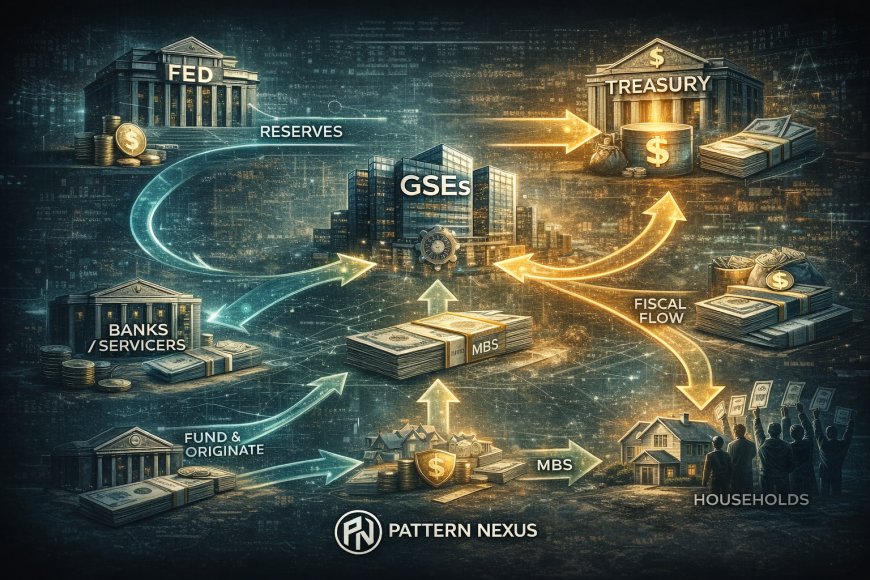
To understand why this proposal is such a regime shift, you have to separate out the roles in the current architecture.
The Federal Reserve is the only entity in the system that can create reserves at will. When the Fed did large-scale asset purchases after 2008 and again in 2020–2021, it wasn’t just buying Treasuries and mortgage-backed securities (MBS) with “money.” It was expanding the asset side of its balance sheet and crediting the banking system with newly created reserves on the liability side. That’s quantitative easing: reserve creation against purchased assets, with the Fed as the buyer of last resort at scale.
Treasury, by contrast, cannot print reserves. It issues debt, collects taxes, and spends. The treasury account at the Fed moves up and down as cash flows in and out, but Treasury is not a monetary authority. It is a fiscal and issuance authority, with its own toolkit – tax policy, spending programs, subsidies, guarantees, and targeted credit channels.
Fannie Mae and Freddie Mac sit in a third space. They are shareholder-owned companies with an implicit (and after 2008, effectively explicit) government backstop and a tight regulatory leash. They buy and guarantee mortgages, package them into securities, and stand behind those securities with their capital. Over time, regulators and policymakers have required them to build that capital up. Their buffers are there so that when defaults spike and losses hit, they can absorb those losses without immediately snapping the system.
In other words:
- The Fed controls the reserve and rate backdrop.
- Treasury sets fiscal and debt issuance.
- GSEs are the mortgage credit transmission and absorption mechanism.
The proposal to repurpose GSE buffers into a rate-suppression tool blurs those boundaries. It doesn’t explicitly change the Fed’s legal mandate. It doesn’t create a new Treasury program through Congress with an on-budget subsidy. It instead reaches for the quasi-public balance sheets in the middle of the system and says: use those.
Mechanically, there are only a few ways to do that. Fannie and Freddie could:
- Use retained earnings and capital to buy more MBS at thinner spreads than a private investor would accept.
- Price guarantees more aggressively, eating future loss risk in exchange for today’s lower rates.
- Leverage themselves more heavily, increasing assets relative to capital in order to absorb more mortgages now.
All three paths share the same basic shape: the system takes on more embedded risk in exchange for near-term rate optics. You get cheaper mortgages now in exchange for a thinner defense if anything breaks later.
3. We’ve seen this movie: 2008, S&Ls, and housing as a crash amplifier
None of this is happening in a vacuum. U.S. housing has already played the role of crash amplifier multiple times in the last half-century. The Savings and Loan (S&L) crisis in the 1980s and the GSE-centered mortgage crisis in 2008 are both case studies in what happens when you run housing finance with aggressive promises and thin buffers.
In the S&L era, thrift institutions funded long-term, fixed-rate mortgages with short-term deposits. When interest rates spiked, their funding cost blew out while the asset side limped behind. Mark-to-market, they were deeply insolvent. Policy delayed the reckoning, regulators looked away, and the eventual cleanup was one of the most expensive financial rescues in U.S. history up to that point.
In the 2000s, the GSEs and the broader private-label securitization machine turned housing into a leveraged bet on ever-rising prices. Fannie and Freddie’s guarantees, capital structure, and political protection allowed them to run large balance sheets against modest capital, while Wall Street spun up even more leveraged structures on top. When prices rolled over and defaults climbed, “this is safe, government-linked housing credit” abruptly became “this is the core of a global crisis.”
The post-crisis regime – conservatorship, capital rebuilding, tighter regulation – was supposed to be the correction. The GSEs were not abolished. Instead, they were turned into more tightly controlled utilities with explicit capital requirements and a slow march back toward balance-sheet resilience.
That is the context in which the current idea lands. Instead of acknowledging that Fannie and Freddie’s rebuilt buffers are a hard-won asset – the difference between “we can absorb a hit” and “we are immediately back to 2008 triage” – the political impulse is to treat them as a pot of idle cash that can be pointed at mortgage rates.
That’s not a new error. It’s the same pattern:
- Use housing finance as a political tool.
- Relax constraints to juice affordability in the short run.
- Ignore the way risk stacks up in the middle of the system.
- Act surprised when a downturn turns into a systemic event.
The difference now is that this would be happening on top of a deeply financialized, post-QE world where sovereign debt levels, central bank balance sheets, and private credit all interact with housing in more complicated ways than in the 1980s or even 2008. You’re not just playing with one stack. You’re nudging a keystone in a much larger, more interconnected arch.
4. Housing QE as a control system: fiscal, industrial, and political layers
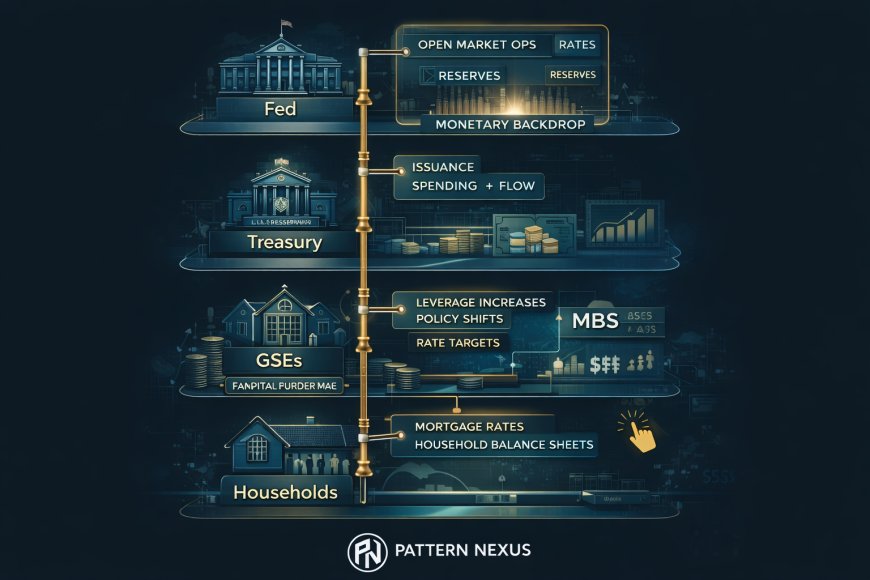
Step back from the plumbing and look at the pattern across sectors. The U.S. has been quietly shifting from a world where “QE” was primarily a central bank tool into a world where multiple arms of the state are effectively running their own versions of balance-sheet or guarantee-driven easing.
Industrial policy is now heavily subsidized through tax credits, guarantees, and demand backstops for semiconductors, batteries, and energy infrastructure. Defense production is being ramped with multi-year appropriations and implicit guarantees of demand for munitions, ships, and aerospace. Stablecoin issuers are plugging into the Treasury market as synthetic dollar pipes, creating a shadow demand for short-term government paper that behaves like a liquidity tap.
In that context, “housing QE by proxy” is not an isolated brainstorm. It’s the next logical move in a regime where policymakers increasingly see balance sheets – public, quasi-public, regulated private – as levers in a broader control system.
The advantage of using GSEs rather than the Fed or an explicit new Treasury program is political and optical:
- You don’t have to fight over visible, on-budget subsidies in Congress.
- You don’t have to admit you’re reviving QE in a world that thinks QT “ended the experiment.”
- You can pitch it as “we’re just letting Fannie and Freddie use their own cash to help homeowners.”
Underneath the optics, you are doing something much more interesting: you are hard-wiring the mortgage system itself as a policy actuator. If households are angry about housing costs, turn the GSE dial. If financial conditions are too tight, turn the GSE dial. If you want to support construction, SFR operators, and homebuilders, turn the GSE dial.
That is what a control system looks like: you identify a variable (housing costs and credit access), you embed sensors (delinquency data, rate spreads, construction starts, sentiment), and you install actuators (GSE balance sheet posture, guarantee pricing, underwriting standards). Policy becomes a matter of feedback loops, not just laws.
The problem is that every control system has limits and failure modes. If you are using the crash pad as the actuator, you’re burning through your margin for error to move the needle today. When the system hits an extreme – recession, unemployment spike, global shock, credit event – the actuator you’ve been pulling on is also the thing that was supposed to keep the structure from collapsing.
5. Who wins, who loses: homeowners, landlords, banks, and the state
From a narrow, short-term perspective, it’s not hard to see the winners if housing QE by proxy were pushed hard.
Existing homeowners with high-rate mortgages could benefit from refinance windows that wouldn’t otherwise exist at the same level of rates. Homebuilders could see more demand if monthly payments fall for a given nominal price level. Single-family rental (SFR) operators might get another leg of support on asset valuations if cap rates compress again off the back of lower mortgage yields.
Politically, an administration that can claim to have “fixed” mortgage rates without waiting on the Fed gets credit from a large, loud, and stressed voting bloc. In a system where housing has been the main wealth engine for the median household for decades, that matters.
The losers show up later and, as usual, are less obvious:
- Future homeowners could be walking into a more fragile system. Their low-rate mortgage might be sitting on top of a GSE stack that has less ability to absorb losses if the economy turns.
- Taxpayers are implicitly on the hook for any gap between what the GSEs can absorb and what the market can tolerate if there’s a severe downturn. If buffers are thin, the gap is larger.
- Banks and mortgage servicers are exposed to a more binary regime: either the GSEs keep the machine humming, or you’re back in a world where market functioning depends on emergency facilities and ad hoc rescues.
- Private capital in housing credit is competing with a state-linked actor that doesn’t price risk the same way and isn’t under the same capital market discipline. That distorts price signals and can crowd out or misallocate private risk-taking.
The state, as usual, sits on both sides. On one hand, it gains a powerful lever: the ability to dial mortgage rates without asking the Fed or Congress. On the other hand, it inherits more contingent liabilities. The more you run day-to-day policy through semi-public balance sheets, the more you turn “one-off bailouts” into the default expectation.
If you’re a landlord or SFR operator, a regime like this also changes your strategic calculus. You’re no longer just reading Fed dots, inflation prints, and labor data. You’re reading the political appetite for running housing QE through Fannie and Freddie, the electoral cycle, and the willingness of regulators to tolerate thinner GSE capital in exchange for “affordable” optics.
In other words: housing becomes even more explicitly political. Not just through zoning, permitting, and local policy, but through the credit pipes themselves.
6. Scenario tree: full-send housing QE, half-measures, or stalled experiment
The last piece is to think in scenarios. Not as a prediction, but as a way to map how this could actually play out if it moves from trial balloon to implementation.
Scenario A: Full-send housing QE via GSEs. In this path, political leadership leans hard into the idea. Regulators are leaned on to relax effective capital constraints, GSEs are encouraged to run more aggressive guarantee pricing and MBS purchases, and the message is clear: use your buffers to get rates down. Mortgage spreads tighten, primary rates fall more than they would have otherwise, and you get a visible improvement in monthly payment math. The cost is invisible: the buffers shrink relative to risk, and the system is now more brittle.
Scenario B: Half-measures and signaling. Here, the rhetoric is loud but the implementation is more modest. Some programs are tweaked at the margin – targeted refi windows, specific product designs for stressed cohorts, modest shifts in capital treatment – but regulators push back on draining buffers outright. You still move in the direction of politicized housing QE, but the damage is limited by institutional resistance and legal constraints.
Scenario C: Stalled experiment. It’s also possible the idea crashes into the legal and regulatory wall. Treasury cannot print reserves. GSE conservatorship and capital rules are not easily rewritten without full legislative work. The courts and financial stability community push back. The net effect is more like a stress test of how far public appetite has shifted toward using semi-public balance sheets as political tools, with little direct mechanical impact.
The risk is that Scenario B slowly drifts into Scenario A over time. Once the mental model shifts from “buffers are sacred” to “buffers are an underutilized asset that can be pointed at voters,” you’ve changed the regime. At that point, the debate becomes about how much of the crash pad to spend, not whether to spend it at all.
From a Pattern Nexus perspective, the details of this one proposal matter less than the direction of travel: an increasingly integrated control system where monetary policy, fiscal policy, quasi-public balance sheets, and sector-specific credit pipes are all being pulled into one blended toolkit. Housing QE by proxy is just the housing-shaped piece of that larger machinery.
Pattern Nexus Lens
At the surface level, this looks like a fight about mortgage rates and homeowner relief. Underneath, it’s a fight about where control sits in the system and how much slack is left in the crash structures that keep financial shocks from propagating all the way up to the sovereign.
When you treat GSE buffers as political ammunition, you are doing two things at once. You’re telling the public that housing affordability can and will be managed with direct balance sheet tools. And you’re telling the system that the entities meant to be loss absorbers are now also policy actuators. That changes the geometry of risk.
In a control-systems view, this is the equivalent of taking the emergency brakes on a train and wiring them into the throttle. Yes, it gives you more ways to modulate speed in the short run. It also means that if the situation ever gets away from you, the thing you were relying on to stop the train is already half-burned.
That’s the deeper pattern: we are moving from a world of segmented, specialized institutions to a world of fused control stacks, where every major balance sheet – central bank, Treasury, GSE, industrial champions, defense primes – is a potential lever. The benefits are real. So are the tail risks.
Housing QE by proxy is not just about cheaper mortgages. It’s about whether the institutions designed to absorb shocks are going to be used as everyday policy levers – and what happens when a real shock finally tests how much buffer is left.
FAQ
Can Treasury actually “print money” through Fannie and Freddie?
No. Only the Federal Reserve can create reserves. Treasury cannot print in the central bank sense. What it can do, directly or indirectly, is lean on quasi-public entities like the GSEs to use their balance sheets more aggressively – taking on more risk, relaxing capital build-up, or structuring programs that effectively subsidize certain forms of credit. That doesn’t create new reserves, but it does change the pricing and distribution of risk inside the system.
Does this mean 3% mortgages are coming back?
Not by magic. Mortgage rates are a function of the underlying risk-free curve (Treasury yields), MBS spreads, credit risk, prepayment risk, and a set of plumbing and regulatory factors. Using GSE buffers to force down spreads can move the mortgage rate for a given Treasury yield, but it can’t repeal the underlying rate environment. You can narrow the gap between the 10-year yield and the 30-year mortgage. You can’t arbitrage away the entire structure without consequences elsewhere.
What happens in a downturn if GSE buffers have been drained?
That’s the core concern. If you’ve spent down GSE buffers chasing short-term affordability optics, the system has less shock absorption capacity when defaults rise and collateral values fall. Losses that would have been partially absorbed at the GSE layer now have to be socialized more explicitly – through emergency facilities, direct Treasury support, or broader systemic stress. You’re trading a smoother ride today for a sharper impact later if things go wrong.
How is this different from the Fed buying MBS during QE?
When the Fed bought MBS in prior QE rounds, it was acting as a monetary authority expanding reserves and influencing financial conditions across the entire system. It took duration and credit risk onto its balance sheet, but it did so with an explicit macro mandate and central bank tools. Using Fannie and Freddie’s capital to push mortgage rates down is a different animal: it shifts the balance sheet burden to entities that are supposed to be loss absorbers in the housing system, not macro stabilizers for the entire economy.
Why does this matter if politicians “will just bail them out again” anyway?
The expectation of a bailout doesn’t make the interim path irrelevant. The structure of who gets hit when, how quickly stress propagates, and what tools are available in the moment all depend on the integrity of buffers and the clarity of institutional roles. If you erode those buffers and blur those roles, you can still end up at “bailout,” but the route there is more chaotic, and the collateral damage can be larger – for households, for financial institutions, and for the sovereign’s credibility.
Sources
A non-exhaustive set of public materials on GSE capital, post-2008 reforms, mortgage market structure, and the role of MBS in prior QE cycles.
- Federal Housing Finance Agency – Oversight, Capital Framework, and GSE Conservatorship Resources
- Fannie Mae – Financial Reports and Capital Disclosures
- Freddie Mac – Financial Reports and Capital Disclosures
- Federal Reserve – Agency Mortgage-Backed Securities Holdings and QE Program Details
- Congressional Research Service – Background on Fannie Mae, Freddie Mac, and Federal Housing Policy
- Congressional Budget Office – Analyses of Federal Housing Finance and GSE Reform
- Bank for International Settlements – Papers on QE, Asset Purchases, and Financial Stability
Apa Reaksi Anda?
 Suka
0
Suka
0
 Tidak Suka
0
Tidak Suka
0
 Cinta
0
Cinta
0
 Lucu
0
Lucu
0
 Wow
0
Wow
0
 Sedih
0
Sedih
0
 Marah
0
Marah
0

Founder of Pattern Nexus. I research markets, macro, geopolitics, AI, history, ancient systems, and the patterns most people overlook. I’m also building Market Radar, a trading scanner designed to read pressure, risk, confirmation, and setup quality before chasing a move. Pattern Nexus is where I connect the dots between data, history, technology, and the bigger system playing out around us.











Komentar (0)