
Quantum Control, Cryptographic Risk, and the Energy Stack
Quantum computing is no longer a lab curiosity. It is becoming a control-layer technology with implications for security, money, and energy systems.
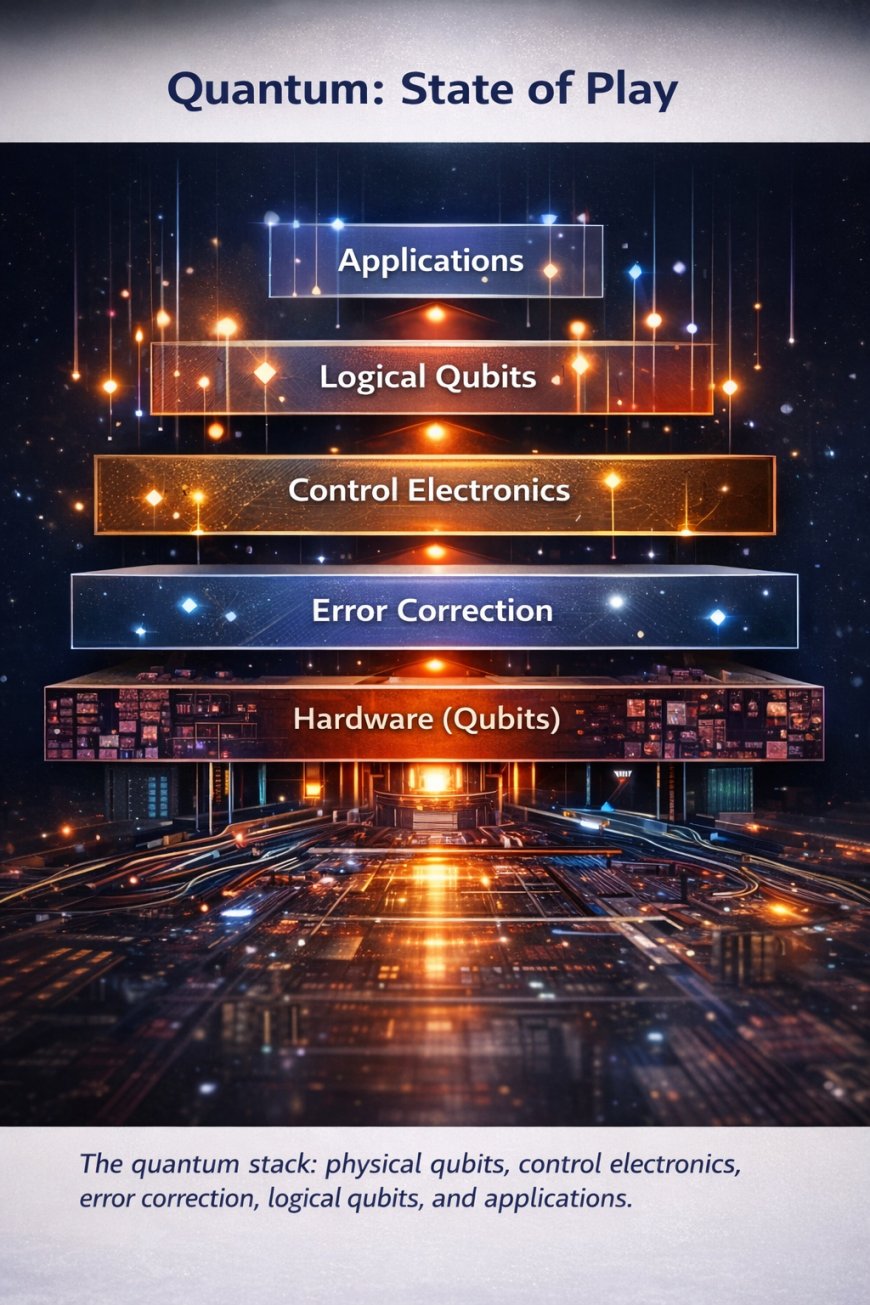
Quantum computing is transitioning from theoretical breakthrough to strategic control layer. Its convergence with cryptography, finance, and next-generation energy reshapes how power, trust, and infrastructure are contested between the United States and China. The risk is not “quantum breaks everything tomorrow.” The risk is uneven migration, opaque capability, and a long trust-stack transition that reprices security, money, and sovereignty before the public notices the plumbing has changed.
Summary
The quantum era is no longer defined by isolated demonstrations of advantage. It is defined by the slow assembly of a fault-tolerant control stack: physical qubits, classical control systems, error correction, logical qubits, and application pipelines that can survive real-world noise. This transition introduces systemic risk long before universal quantum computers arrive. The risk regime is shaped by “race conditions”: who migrates first, who migrates last, and whether any actor can deploy capability asymmetrically and opaquely against legacy trust infrastructure. Quantum is not just compute. It is a trust-stack forcing function.
Why This Matters
Modern civilization rests on three invisible pillars: cryptographic trust, abundant energy, and reliable compute. Quantum computing pressures all three, but not in a Hollywood “one day everything fails” way. It pressures them through uneven readiness, uneven disclosure, and uneven migration. The most dangerous phase is not the end-state. It is the transition: a period when some systems are quantum-safe, many are not, and adversaries can selectively exploit the lag.
Quantum also changes geopolitics because it changes verification. In a world where some computations become easier (codebreaking, materials simulation, certain optimization classes) the “control layer” shifts toward those who can build and operate the stack, and toward those who can weaponize the transition period. This is why quantum cannot be analyzed as a lab curiosity. It must be analyzed as a systems contest spanning physics, manufacturing, supply chains, standards, and money.
Quantum: State of Play
After a decade of experimental “quantum supremacy” demos, the decisive shift in 2024–2025 is the move from physical qubit counts to logical qubits and demonstrable error suppression. That is what marks the beginning of scalable quantum engineering rather than experimental novelty. The core problem has always been noise: decoherence, gate errors, crosstalk, and measurement errors. Error correction is the only known way to scale through that barrier.
In 2024, quantum computing entered the era of logical qubits and quantum error correction milestones. The frontier is no longer “how many qubits.” The frontier is “how long can a logical qubit remain stable under continuous operations, and what is the overhead to keep it stable.” That overhead is the price of admission for everything people want quantum to do: chemistry, materials, high-value optimization, and eventually cryptography attacks.
IBM’s 2024 error-correction milestone is emblematic: a quantum low-density parity-check approach designed to reduce overhead versus the surface code baseline. The significance is not the marketing name. The significance is overhead reduction. If you need fewer physical qubits per logical qubit, you compress the path to scale by years. Overhead is the hidden tax that dominates every “when will quantum do X” forecast.
Google’s Willow announcement sits in the same category: the important claim is not a contrived benchmark headline. The important claim is the error-correction story: does scaling qubits reduce errors in the encoded logical object, or does scaling make the system less controllable and more chaotic. If error suppression improves with scale, quantum stops being a curiosity and becomes an engineering trajectory.
Across the industry, the “three nines” threshold on critical operations has been treated as a gating factor: once physical operations are good enough, adding error correction can yield net improvement. The hard part is not achieving a great number in one place. The hard part is maintaining that performance while adding qubits, wiring, control channels, calibration cycles, and thermal constraints. Quantum scales like a control system, not like a spreadsheet.
Multiple firms updated their roadmaps in 2024–2025 to highlight logical qubit targets and error-corrected milestones, reflecting a pivot from qubit count theater to “useful qubits.” The sector is converging on the same reality: logical qubits are the currency that matters.
China’s quantum research has continued to generate legitimate scientific headlines, especially in photonic experiments and quantum communications. Photonic “advantage” demonstrations can be real and still be non-general. They demonstrate capability in a constrained task class, not a universal machine that runs arbitrary algorithms. This matters because geopolitical messaging often conflates “a quantum advantage demo” with “a general-purpose quantum computer,” which is not the same category.
Net: 2024–2025 marks a turning point where error correction moved from theory to implementation across the industry narrative. That does not mean “Q-day is here.” It means the field is assembling the control stack required for Q-day to eventually be possible.
The US–China Quantum Race
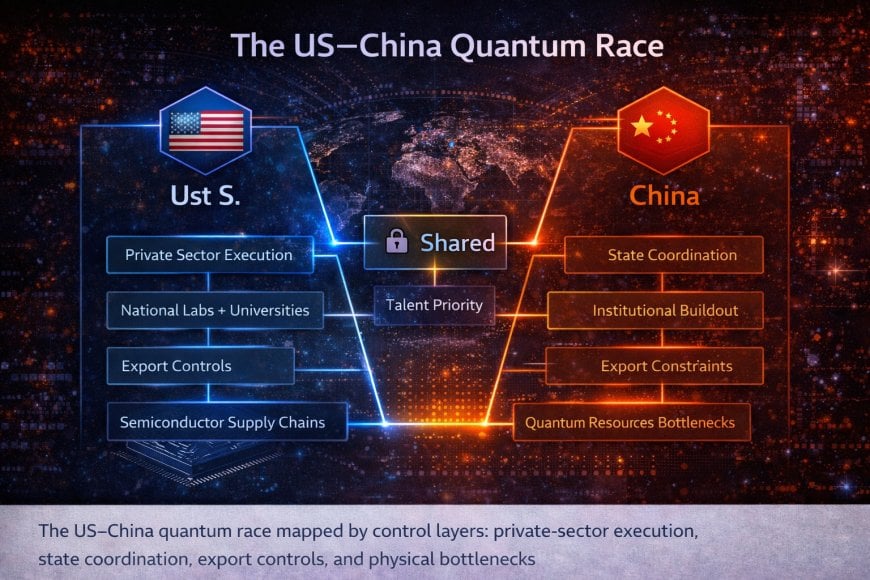
Quantum has become a core piece of the US–China strategic competition because it sits at the intersection of intelligence, military systems, industrial advantage, and cyber leverage. The United States leads in private-sector execution and in the “productization path” from lab to cloud-accessible platforms. China leads in state coordination, large-scale institutional buildout, photonic experimentation visibility, and quantum communications deployment emphasis. These advantages are not symmetric, and they map to different threat profiles.
The U.S. approach is ecosystem-driven: national labs, universities, and private firms iterating fast, with capital markets and procurement pulling prototypes into operational contexts. The China approach is state-coordinated: national labs, long-horizon programs, and coordinated industrial substitution when supply chains are cut. Both approaches can produce breakthroughs. The difference is where the bottlenecks land: the U.S. fights coordination and integration friction across many actors; China fights choke points and export constraints but can concentrate resources rapidly once priorities are set.
Policy has moved from “fund the science” into “shape the competitive landscape.” Controls on technology transfer, outbound investment restrictions, and export controls on enabling hardware aim to slow capability accumulation. But in systems contests, constraints also create feedback: they force substitution, domestic production, and parallel supply chains. What looks like “slowing the competitor” can also become “teaching the competitor where the bottlenecks are.”
The quantum race is not isolated. It sits on top of classical compute, semiconductors, packaging, precision timing, and large-scale infrastructure. Quantum machines still need classical computing for control, calibration, decoding, and verification. A nation constrained in cutting-edge classical compute may be constrained in how aggressively it can operate and validate large quantum systems. This is why compute export controls and quantum export controls interact. They are parts of one strategic stack.
Talent is a battlefield. Quantum is interdisciplinary: physics, electrical engineering, cryogenics, materials, control theory, compilers, and error-correcting code research. The constraint is not just money. It is trained people, and the ability to keep them in pipelines that translate breakthroughs into operating systems. That is why education policy, visas, research security, and corporate hiring strategies show up as national-security policy in disguise.
Finally, quantum communications is often used as “proof of quantum leadership.” It matters, but it is not equivalent to universal quantum computing. Quantum key distribution networks and satellites can be strategically relevant without implying the ability to run Shor’s algorithm at scale. The race must be framed correctly or policy and markets will misprice the timeline.
Chokepoints and Control Layers
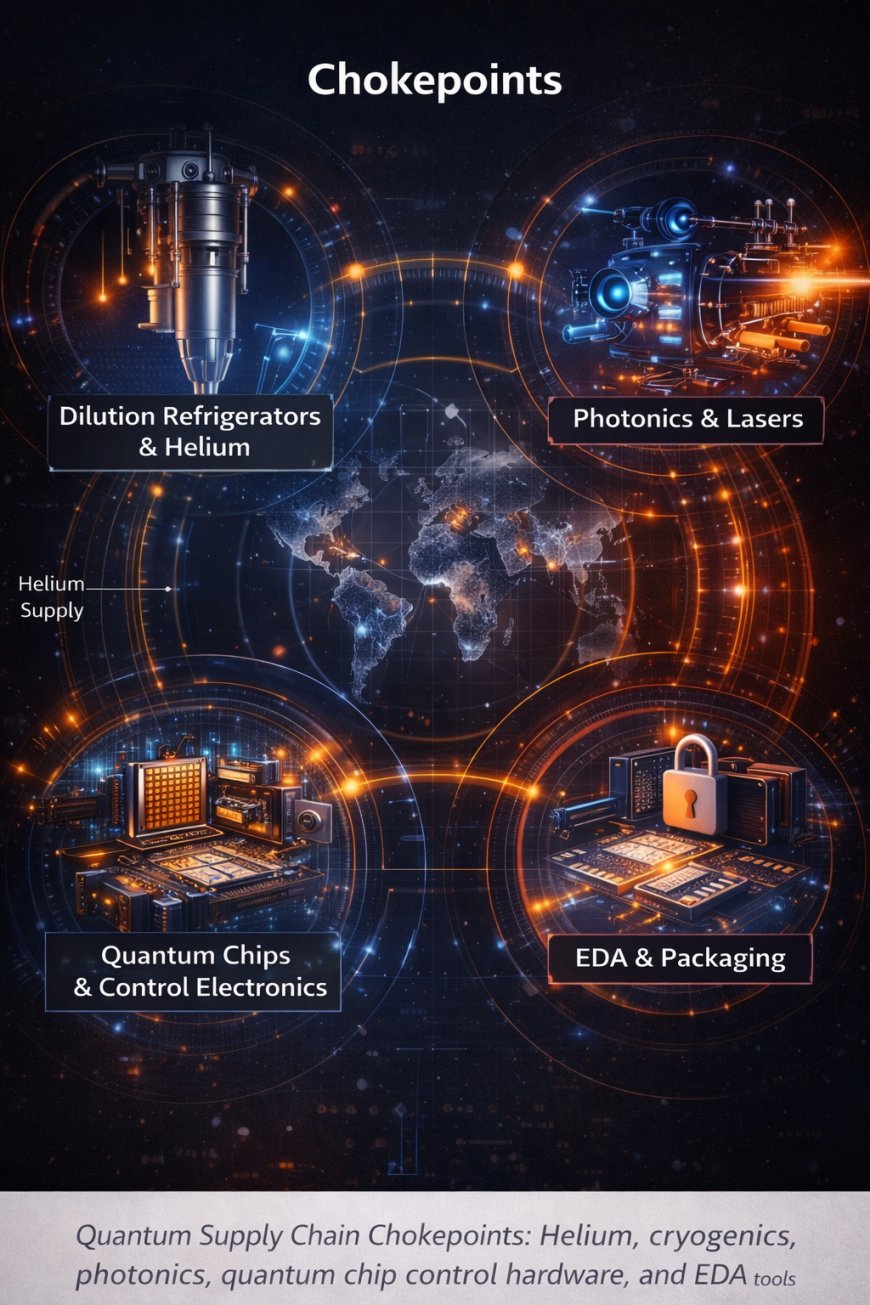
Quantum progress is bottlenecked by physical reality. The public hears about qubits. The system cares about everything around them: cryo, wiring, amplifiers, lasers, vacuum, packaging, vibration isolation, calibration automation, and decoding compute. This is where “compute as a control layer” becomes literal: you are building a machine where the quantum core is fragile and everything else exists to keep it stable long enough to do useful work.
Concrete chokepoints that matter in the 2024–2025 era:
- Dilution refrigerators and ultra-low-temperature cryogenics: Long lead times, specialized manufacturing, and operational complexity. Scale is not just “buy more fridges.” It is power, helium logistics, and integration.
- Helium constraints and cryo supply chains: Availability, price volatility, and prioritization conflicts across medical, industrial, and research demand.
- Photonics and laser systems: For ion traps and photonic architectures, laser stability and photonic integration become the scaling constraint.
- Quantum-grade materials and fabrication yield: Superconducting films, Josephson junction repeatability, defect control, and wafer-level uniformity. Yield kills timelines.
- Packaging and interconnect: As you scale qubits, wiring becomes a heat and noise problem. Packaging is not a “later.” It is a now.
- Classical control electronics: RF chains, cryo-CMOS ambitions, low-noise amplifiers, and control channel scaling. You cannot scale qubits without scaling control.
- Error correction decoding compute: The decoder is part of the machine. If decoding cannot keep up with syndrome extraction, error correction becomes a theoretical luxury rather than an operational tool.
- Standards and validation: Benchmark caveats matter. “Advantage” claims can be real and still not translate to general capability. Verification and reproducibility are a control layer too.
This is why the race is best modeled as a layered system:
- Physics constraint layer: decoherence, thermal noise, fundamental error channels.
- Engineering constraint layer: control, calibration, wiring, packaging, reproducible fabrication.
- Supply chain layer: cryo, helium, lasers, photonics, materials, specialized tooling.
- Security layer: what cryptography becomes vulnerable, and when migration must complete.
- Financial layer: trust premia, operational risk, and how transition costs propagate through money systems.
- Geopolitical control layer: export controls, talent constraints, and sovereign compute/power strategy.
Quantum hype dies on chokepoints. Quantum progress accelerates through chokepoints when a stack becomes manufacturable, automatable, and scalable. That is the real contest.
Money, Banking, Crypto, Bitcoin
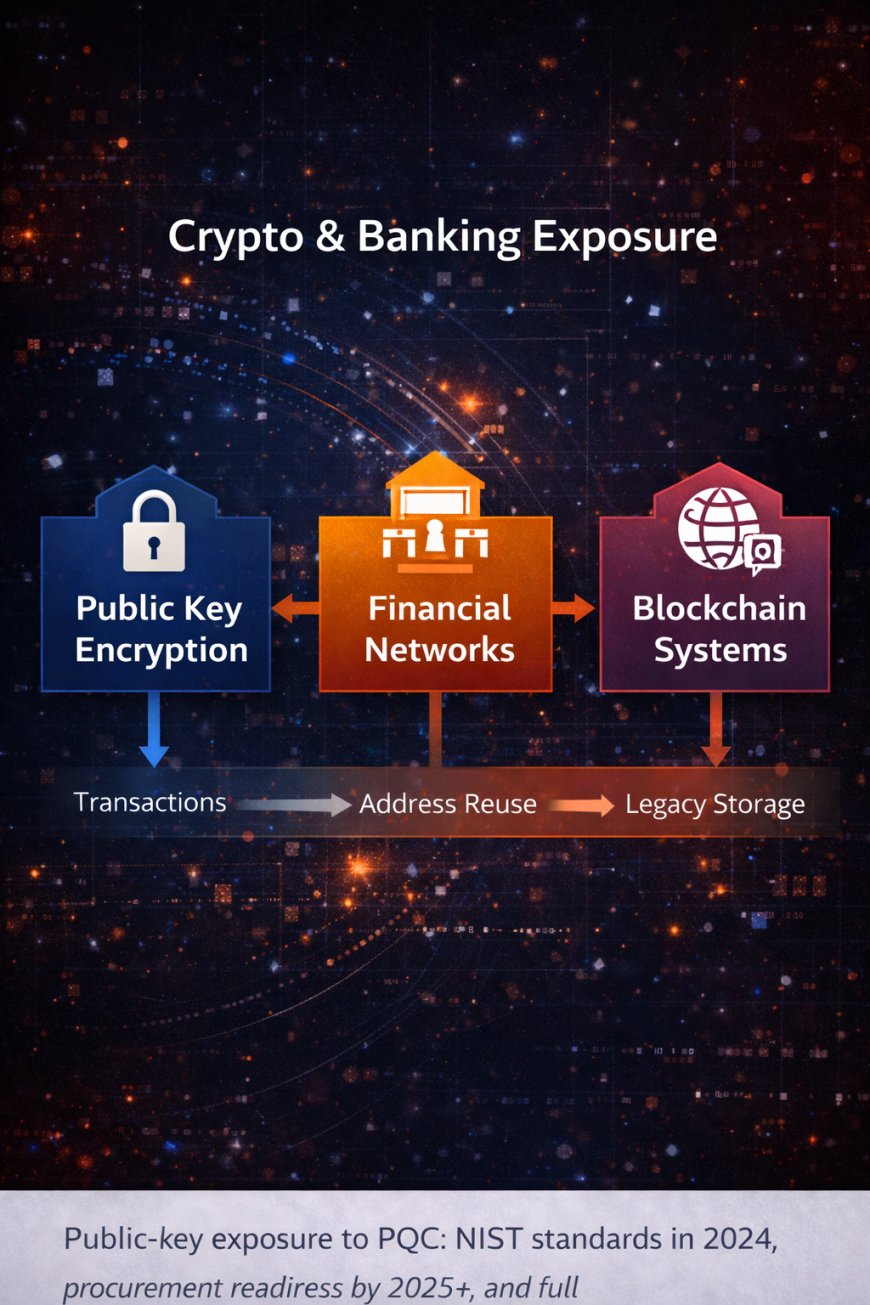
Quantum matters to money because money is a trust system. Modern finance depends on public-key cryptography for identity, secure key exchange, and digital signatures across banking, payments, trading, custody, and internal infrastructure. The central risk is not that symmetric cryptography collapses overnight. The central risk is that RSA and elliptic-curve systems become forgeable under a sufficiently capable quantum computer running Shor’s algorithm, while symmetric systems face a smaller (but real) security margin reduction under Grover’s algorithm.
What quantum threatens first, conceptually:
- Public-key encryption and key exchange: RSA and classic Diffie-Hellman/ECDH classes underpin secure session establishment across the internet and internal systems.
- Digital signatures: RSA and ECC signatures underpin identity, certificates, code signing, transaction authorization, smart cards, and blockchain ownership.
- Harvest-now, decrypt-later: The most immediate real-world risk is archival: adversaries capture encrypted traffic today and decrypt it later when capability arrives.
What quantum does not “magically break” tomorrow:
- Symmetric encryption and hashes as a category: They can be strengthened with parameter choices and larger keys; the threat is more about security margin than collapse.
- Every system equally and instantly: Risk is uneven. Some sectors migrate early, others lag. The lag becomes the attack surface.
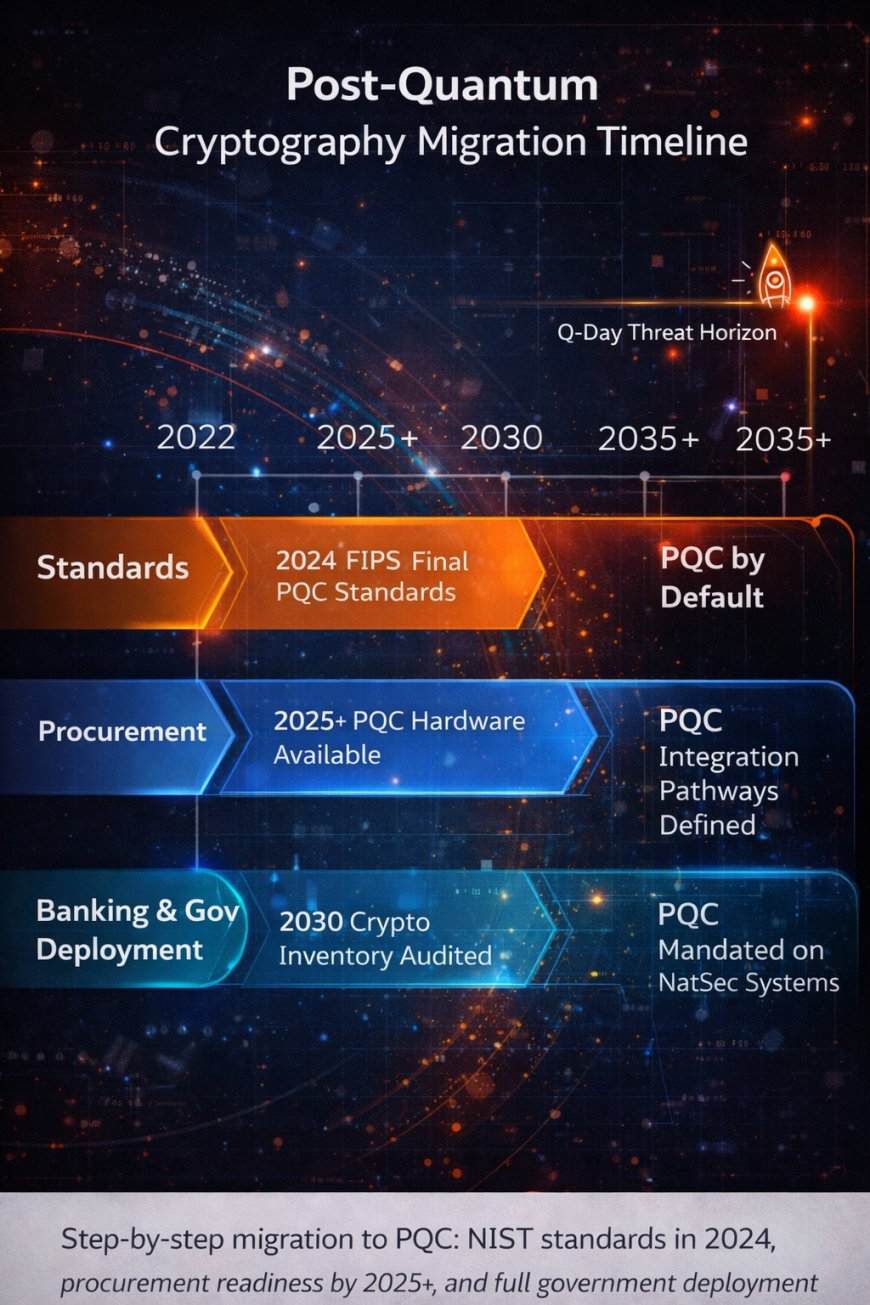
In the U.S., the post-quantum transition has shifted from abstract planning to standards and mandates. NIST has approved FIPS standards for post-quantum algorithms, which turns PQC from “candidate” to “procurement reality.” National security guidance pushes a mid-2030s end-state for quantum-resistant adoption across high-risk systems. The timeline exists because migration is hard: cryptographic inventory, software dependencies, embedded devices, HSM replacements, vendor coordination, and compliance.
Banking rails are not a single system. They are layered infrastructure: TLS/PKI, internal signing, HSM-backed keys, SWIFT messaging security, settlement system interfaces, and identity stacks spanning staff authentication to server-to-server trust. This is why “upgrade the algorithm” is not a plan. The plan is crypto agility plus staged migration: hybrid modes, phased certificate transitions, and long-tail replacement of devices that cannot be patched.
Crypto and Bitcoin require a separate “myths vs operational reality” section because the internet collapses nuance into panic. The realistic framing:
- Bitcoin is not “broken today.” The capability to break widely used elliptic curves at scale requires large, error-corrected quantum systems that do not exist publicly today.
- Bitcoin has key exposure pathways. When public keys are revealed on-chain (spend events, address reuse, older script types), the exposure window becomes relevant under a future Shor-capable attacker.
- Governance is the bottleneck. The technical concept of migrating to quantum-safe signatures is straightforward. The coordination across the ecosystem is slow.
- Market structure matters. If quantum capability is suspected, liquidity conditions, exchange behavior, custody practices, and “flight to safety” reflexes will dominate price action before any protocol-level response completes.
On-chain, the key point is that many address types hide the public key until spending, which reduces immediate exposure. But exposure is not zero. Address reuse, exposed pubkeys, and custody concentration are where risk clusters. Custody is a centralization vector: exchanges and large custodians represent high-value targets, and their operational security posture matters more than ideological arguments about decentralization.
Post-quantum migration for public blockchains is feasible but complex. Signature sizes can be larger. Verification costs can differ. Backwards compatibility and upgrade mechanisms matter. Hybrid approaches (requiring both classical and post-quantum signatures for a period) reduce “one-shot” migration risk. The trade-off is throughput, block size pressure, wallet upgrades, and long transition windows.
From a macro and liquidity lens, the transition reprices trust. Cryptographic transition is a hidden cost that lands as operational risk, compliance spending, and “trust premia” in the system. In a world already sensitive to confidence, collateral quality, and systemic fragility, a trust-stack rewrite adds a new axis of stress. The critical risk is surprise capability: an actor that can exploit legacy cryptography quietly, selectively, and for long enough to gain advantage before the rest of the system migrates.
Fusion as the Adjacent Stack
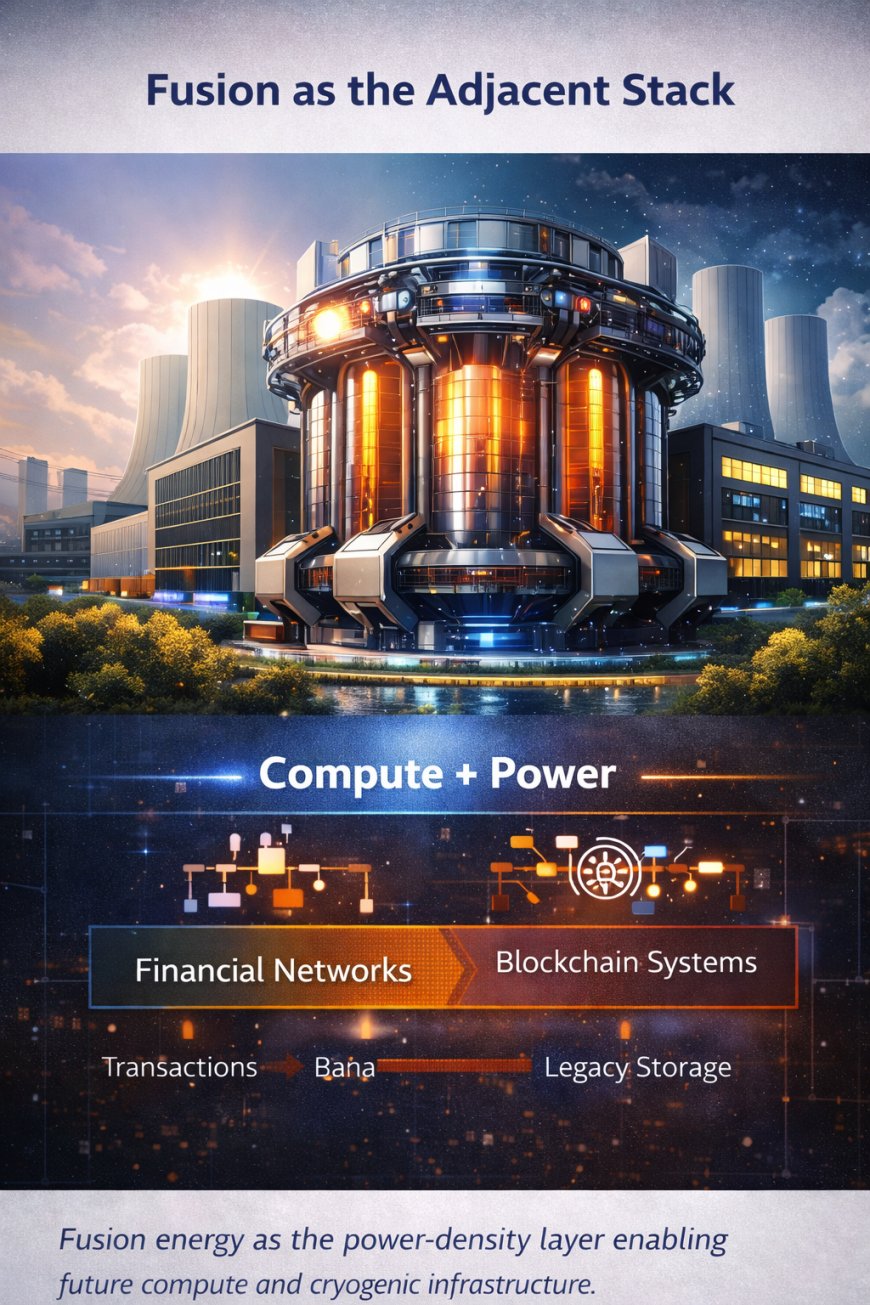
Fusion is not included here as a forced tangent. It belongs in this analysis because the future is compute-heavy and energy-constrained. AI buildouts have already exposed grid limits, siting constraints, and power procurement competition. Quantum at scale is not “free” either: cryogenics, control systems, and co-located classical compute require power and infrastructure. When compute becomes a control layer, power becomes the gating factor under it.
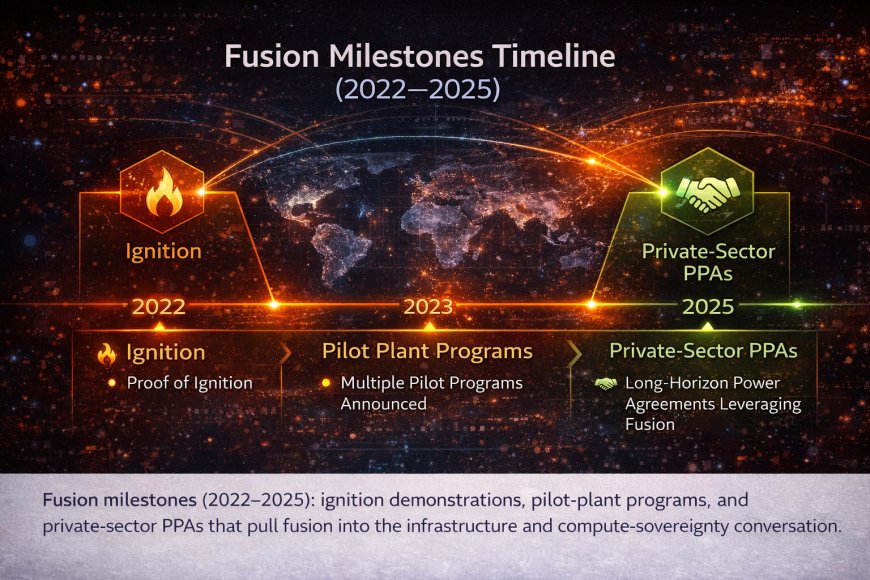
Fusion’s narrative changed after ignition milestones demonstrated that net energy gain is possible under specific experimental conditions. That does not mean commercial fusion is solved. It means the feasibility conversation moved from “impossible” to “engineering and economics.” That shift matters because it pulls capital, policy focus, and industrial strategy into the sector.
The private fusion landscape is no longer just a list of hopeful startups. It is a capitalized ecosystem pursuing different approaches: tokamaks with high-field magnets, pulsed magnetic concepts, inertial approaches, and alternative confinement. Some firms have signed aggressive power purchase agreements that effectively bet reputation and financing access on timelines. These agreements do not prove fusion works, but they do prove the sector is now treated as infrastructure-adjacent rather than purely experimental.
China is investing heavily in fusion as well, and the pattern resembles the broader tech contest: build institutions, scale facilities, coordinate supply chains, and push toward demonstration milestones. Fusion’s chokepoints overlap with quantum’s in interesting ways: superconductors, cryogenics, precision manufacturing, power electronics, vacuum systems, and materials science. Even if fusion timelines slip, the industrial spillovers matter.
Why fusion matters to the quantum race specifically:
- Power density and reliability: Long-duration, firm power supports datacenters and industrial clusters without fragile fuel supply chains.
- Industrial heat and manufacturing leverage: Abundant power changes the cost curve for materials processing and heavy industry, which feeds back into advanced manufacturing competitiveness.
- Compute sovereignty: Nations that can power compute at scale can host and control strategic infrastructure, not just invent it.
- Geopolitical repricing: If fusion becomes real, energy leverage shifts, and so does the map of strategic dependencies.

The correct stance is neither “fusion is here” nor “fusion is forever away.” The correct stance is: fusion is a strategic adjacency. If it works, it becomes a sovereignty multiplier for the compute stack. If it fails, it still generates spillovers in magnets, materials, control systems, and industrial capability that feed into the same geopolitical contest.
2024–2025 Update Layer
This section is intentionally date-anchored. These are the recent items that changed the narrative layer through 12/27/2025. They are not all equally important, but together they define why 2024–2025 feels like a regime shift in both quantum and the cryptography transition.
- 2024-03-27: IBM publishes a major error-correction milestone focused on lowering overhead via qLDPC-style approaches and roadmap framing toward scalable fault tolerance.
- 2024-08-13: NIST announces approval of post-quantum cryptography FIPS standards (Kyber and signature standards), shifting PQC from “candidates” to procurement-grade standards.
- 2024-12-10: Google’s Willow announcement triggers renewed focus on error correction and the “does error decrease with scale” claim, reframing what matters more than benchmark headlines.
- 2024-12-17: Private fusion expands from R&D into grid-scale intent as firms announce and negotiate major plant plans and commercialization paths with datacenter-heavy regions in mind.
- 2025-05-30: NSA publishes Commercial National Security Algorithm Suite 2.0 guidance with a 2035 transition expectation for national security systems and interim milestones that pull vendors into compliance timelines.
- 2025-07-30: Helion begins construction steps for its planned fusion plant tied to a Microsoft power agreement, explicitly linking fusion commercialization to datacenter-era power demand narratives.
- 2025-12-11: BIS Project Leap publishes a practical report on PQC deployment considerations for payment systems, emphasizing that transition is governance, performance, and interoperability as much as crypto primitives.
- 2024–2025: Export-control and industrial-policy posture continues to treat quantum enabling infrastructure (not just chips) as a strategic domain, reinforcing the “chokepoints matter” model.
What Breaks First
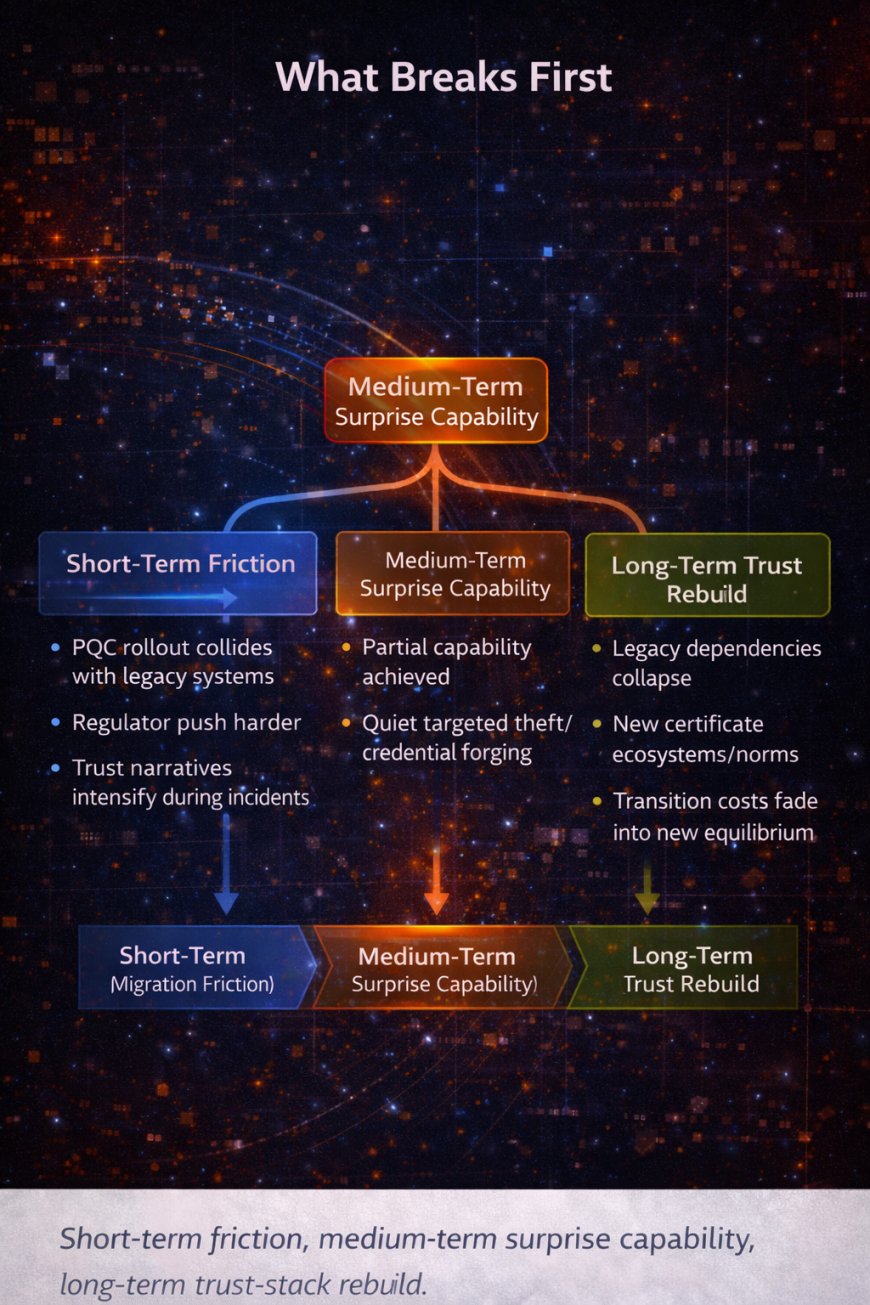
Quantum risk is best modeled as a scenario tree because the outcome is not a single event. It is a transition path. The highest-risk scenario is not open quantum dominance. It is selective, opaque deployment that undermines trust before systems are upgraded.
Branch 1: Short-term friction (now through late-2020s)
- Trigger: PQC rollout collides with legacy systems, performance regressions, vendor lag, and incomplete crypto inventories.
- System effect: “Crypto agility” becomes a competitive differentiator; regulators push harder; procurement cycles accelerate.
- Market effect: Cyber risk premia rise; operational resilience becomes a valuation factor; trust-stack narratives intensify during incidents.
Branch 2: Medium-term surprise capability (late-2020s into 2030s)
- Trigger: A credible actor achieves capability beyond public expectations or achieves partial capability against specific key sizes or deployment flaws.
- System effect: Quiet exploitation is more likely than public chaos at first; targeted decryption, credential forging, and selective theft where key exposure is high.
- Market effect: Reflexive risk-off in digital trust assets; flight to institutions perceived as upgraded; pressure for emergency standardization and rapid migration.
Branch 3: Long-term trust-stack rebuild (2030s onward)
- Trigger: PQC becomes default across major protocols, hardware refresh cycles complete, and legacy public-key dependencies collapse into shrinking islands.
- System effect: The trust stack stabilizes on new primitives, new certificate ecosystems, new hardware baselines, and new compliance norms.
- Market effect: Transition costs fade; a new equilibrium emerges; “quantum-safe” becomes assumed rather than marketed.
The main point: the risk is transition-phase asymmetry. The attacker only needs one lagging island. The defender has to migrate everything.
Indicators to Watch
- Logical qubit count (with demonstrated error suppression): The number that matters more than raw qubits. Watch the jump from “single logical qubit demos” toward multi-logical-qubit operations.
- Error per logical operation and stability time: Not just gate fidelity on a lab bench, but encoded performance under continuous cycles.
- Code distance progress (where disclosed): Growth in code distance with improving logical error rates is a meaningful “scale is working” signal.
- Decoder throughput and integration: If decoding compute becomes a bottleneck, error correction stalls at the systems level.
- Cryogenic supply lead times: Dilution refrigerator production capacity and lead times are a real-world constraint on scaling superconducting approaches.
- Helium availability and pricing pressure: Cross-sector demand (medical, space, industry, research) creates systemic fragility in scaling cryo-heavy architectures.
- PQC deployment defaults in major protocols: The moment hybrid or PQC-first modes become default in major browsers, cloud edge networks, or VPN stacks is a regime marker.
- Government procurement deadlines and compliance audits: Deadlines force vendors to ship support. Procurement is an accelerant; audit is the enforcement mechanism.
- Bank crypto-inventory completion and HSM refresh cycles: Watch for public statements and regulatory guidance that implies “inventory done, rollout scheduled.”
- Payment-system pilots and interoperability reports: Central-bank and BIS pilots reveal real friction: performance, operational constraints, and governance barriers.
- Blockchain quantum-readiness proposals that move beyond talk: Formal improvement proposals, testnet deployments, and wallet/vendor readiness are more important than social media debates.
- Crypto custody concentration metrics: If risk clusters in a few custodians, those become systemic targets in any future capability scenario.
- Fusion pilot plant funding and permitting momentum: Watch if pilot programs translate into site approvals, supply contracts, and grid-integration planning rather than press releases.
- Datacenter power contracting escalation: AI already pressures power. If fusion PPAs and long-horizon contracting increases, that signals “compute-power convergence” is being treated strategically.
PN Lens
Quantum is not just compute. It is a trust-stack control layer. The correct model is not “technology forecast.” The correct model is “systems transition under competitive pressure.”
- Control-layer framing: Quantum is a control stack (physics + engineering + decoding + infrastructure), not a single device.
- Chokepoints over headlines: Cryo, helium, lasers, packaging, and control electronics determine real timelines more than marketing qubit counts.
- Trust transitions precede visible failure: The highest-risk period is when migration is incomplete and capability is uneven or hidden.
- Governance lag is the dominant risk: Standards can be approved and still not be deployed; rollout is a decade-long coordination problem.
- Compute and power are coupled: The AI era exposed grid constraints; quantum at scale intensifies the coupling; fusion is an adjacent sovereignty lever.
- Geopolitics is stack competition: US vs China competition is ecosystem vs coordination, under export controls that reshape supply chains and incentives.
- Second-order effects dominate: The first-order event might be technical; the second-order consequence is market trust, operational paralysis, or selective exploitation.
FAQ
Will quantum break Bitcoin soon?
No. The realistic threat requires large-scale error-corrected systems that are not publicly demonstrated today. The real risk is long-horizon and migration-dependent, with asymmetric exposure where public keys are revealed, addresses are reused, or custody concentrates risk.
Is “quantum supremacy” the same as a useful quantum advantage?
No. Supremacy/advantage demos can be real and still be narrow, contrived tasks that do not translate to broad economic utility. The meaningful shift is error correction and scalable logical-qubit performance, not benchmark theatrics.
What are logical qubits, and why do they matter?
Logical qubits are error-corrected qubits built from many physical qubits, designed to behave reliably under operations. They are the unit of “useful quantum compute.” Breaking cryptography or running deep algorithms requires many logical qubits, not just many noisy physical qubits.
What exactly does quantum threaten in cryptography?
The main conceptual threat is to RSA and elliptic-curve systems (public-key encryption, key exchange, and signatures) under Shor’s algorithm. Symmetric encryption and hashing face a smaller security-margin reduction under Grover’s algorithm and can be strengthened with parameter choices.
Why is post-quantum cryptography taking so long if the algorithms exist?
Because deployment is the hard part. Systems must be inventoried, vendors must ship support, legacy hardware must be replaced, interoperability must be maintained, and the long tail of embedded and industrial systems must be refreshed over years.
Could an adversary exploit quantum capability secretly?
Yes, and that is why “harvest now, decrypt later” is taken seriously. Quiet exploitation against high-value legacy targets is a more plausible early risk than public chaos.
Are quantum communications and quantum computing the same thing?
No. Quantum communications (including QKD) can provide secure key distribution under certain models and infrastructure assumptions, but it does not imply universal quantum computing capability. They are adjacent domains often conflated in public narratives.
Is fusion required for quantum computing?
Not immediately. But power density becomes decisive as compute scales. The broader point is that compute sovereignty is power sovereignty. Fusion matters because it could change the long-run constraint environment for datacenters, industrial clusters, and cryogenic-heavy infrastructure.
What is the most important single thing institutions should do now?
Build cryptographic agility and execute inventory-driven migration plans to PQC: know where RSA/ECC lives, prioritize long-life and high-sensitivity systems, deploy hybrid modes where appropriate, and refresh hardware security infrastructure on a schedule that completes before mid-2030s deadlines.
What is the highest-risk failure mode?
Governance lag plus asymmetric capability: a world where some systems are upgraded, many are not, and selective exploitation undermines trust before a coordinated response is possible.
What should retail investors focus on in this theme?
Avoid simplistic “quantum breaks everything” narratives. Focus on transition winners: providers of cryptographic agility, secure hardware, critical infrastructure modernization, and the real chokepoints that scale the stack (control electronics, packaging, cryo, and energy infrastructure).
What to Watch Next
- Logical qubits scaling beyond “demonstrations”: watch for multi-logical-qubit operations with sustained error suppression over longer circuits.
- Error correction that survives full-stack integration: not just lab numbers, but performance under realistic control, wiring, and calibration overhead.
- Public disclosures about decoder performance and code distance: any transparent reporting that ties scale to improving logical error rates.
- Default hybrid/PQC modes at major internet edges: large CDNs, cloud providers, browsers, and VPN stacks flipping defaults is a regime marker.
- Government enforcement posture: movement from memos to audits, procurement restrictions, and compliance-driven replacement cycles.
- Bank migration signals: public or regulatory indicators that core infrastructure is moving past inventory into rollout and HSM refresh.
- Payment-system interoperability learnings: new BIS/central-bank reports that quantify overhead and operational constraints.
- Bitcoin/Ethereum formal quantum-readiness proposals: movement from discussion to concrete improvement proposals, testnets, and wallet readiness.
- Custody concentration and operational security posture: whether crypto custody becomes more distributed or remains concentrated in high-value targets.
- Cryogenics and helium stress signals: lead-time increases, price spikes, or procurement constraints that slow superconducting scaling paths.
- Export-control expansions into enabling infrastructure: not just chips, but tooling and components that define chokepoints.
- Fusion policy acceleration: pilot programs translating into permits, supply contracts, and real construction timelines, not just funding announcements.
- More fusion PPAs and datacenter-aligned contracting: signals that the compute-power convergence is being treated as strategic infrastructure.
- Grid buildout constraints and permitting friction: the practical limiter for compute expansion, regardless of whether fusion arrives on schedule.
- Cross-domain spillovers: superconductors, materials, and control systems advances that accelerate both quantum and fusion stacks.
Sources
Primary
- IBM Quantum – Landmark IBM error correction paper on Nature cover (2024-03-27)
- Scott Aaronson – The Google Willow thing (2024-12-10)
- NIST CSRC – Post-Quantum Cryptography FIPS Approved (2024-08-13)
- BIS – Project Leap: Quantum-proofing payment systems (2025-12-11)
- NSA – Announcing the Commercial National Security Algorithm Suite 2.0 (2025-05-30)
- U.S. Department of Energy – Fusion Energy Strategy 2024 (2024-06)
Policy & Standards
- White House OMB – Memorandum M-23-02 on Migrating to Post-Quantum Cryptography (2022-11-18)
- U.S. Congressional Research Service – Preparing Secrets for a Post-Quantum World—NSM-10 (2022-05-09)
- FedScoop – NSA sets 2035 deadline for adoption of post-quantum cryptography across natsec systems (2022-09-07)
Company Announcements
- Helion Energy – Announcing Helion Fusion PPA with Microsoft (2023-05-10)
- Reuters – Helion Energy starts construction on nuclear fusion plant to power Microsoft data centers (2025-07-30)
- S&P Global Commodity Insights – Helion Energy breaks ground on fusion power plant, slated to be online in 2028 (2025-07-30)
- Reuters – Commonwealth Fusion Systems plans grid-scale fusion power plant in Virginia (2024-12-17)
- Reuters – Eni strikes more than $1B power deal with Commonwealth Fusion Systems (2025-09-22)
Background / Explainers
- Physics World – Quantum processor enters unprecedented territory for error correction (2024-12)
- Finextra – BIS and central banks test post-quantum cryptography in payments (2025-12-11)
- AP News – US aims to create nuclear fusion facility within 10 years, Energy chief says (2023-09-27)
- PYMNTS – BIS-led collaboration completes successful tests of post-quantum cryptography in payment system (2025-12-11)
Apa Reaksi Anda?
 Suka
0
Suka
0
 Tidak Suka
0
Tidak Suka
0
 Cinta
0
Cinta
0
 Lucu
0
Lucu
0
 Wow
0
Wow
0
 Sedih
0
Sedih
0
 Marah
0
Marah
0

Founder of Pattern Nexus. I research markets, macro, geopolitics, AI, history, ancient systems, and the patterns most people overlook. I’m also building Market Radar, a trading scanner designed to read pressure, risk, confirmation, and setup quality before chasing a move. Pattern Nexus is where I connect the dots between data, history, technology, and the bigger system playing out around us.














Komentar (0)