
Artemis II Launches: Reopening the Deep-Space Stack
Artemis II has launched, but the real story is bigger than a lunar flyby. This Pattern Nexus analysis breaks down why the first crewed SLS-Orion mission matters as a systems return, a transport-layer test, and the opening move in the long view on space.
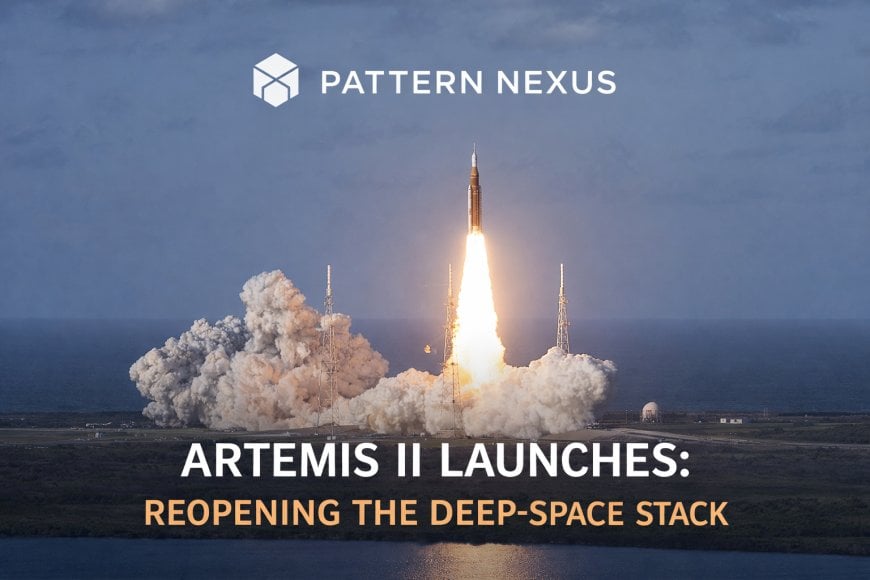
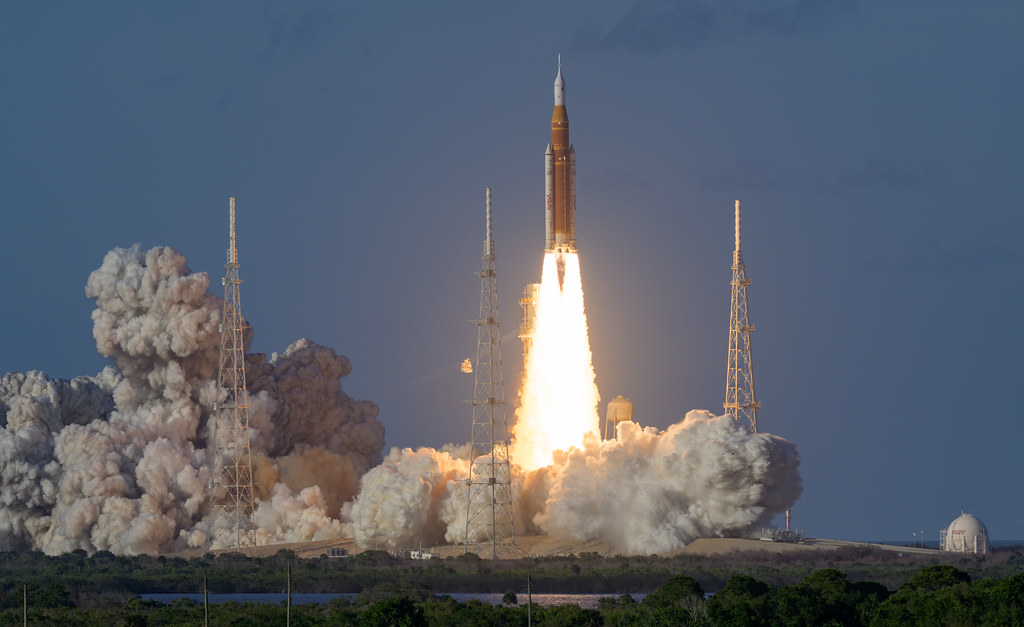

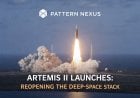
Artemis II launched on April 1 and immediately became far more important than a normal headline can capture. Yes, this is the first crewed lunar flyby mission in more than 50 years. Yes, it is the first crewed flight of SLS and Orion. But the bigger point is that it marks the reopening of the human deep-space transport layer: rocket, capsule, life support, navigation, communications, orbital maneuvering, crew procedures, and recovery logic all being tested together in live conditions. That is why this matters. The Moon is the headline. The reactivation of a full operational stack is the story. And if this is the first part of our long view on space, then the frame starts here: access comes first, then infrastructure, then cadence, then permanence. Artemis II is the point where space stops being mostly aspiration and starts looking like system architecture again.
This was not a nostalgia launch. It was a live systems validation run for human deep-space operations.
The risk is not whether one launch can happen. The real risk is whether the system can repeat, scale, and maintain continuity.
The Moon is not just a destination. It is the proving ground for transport, logistics, governance, and eventually settlement architecture.
What Happened on Launch Day
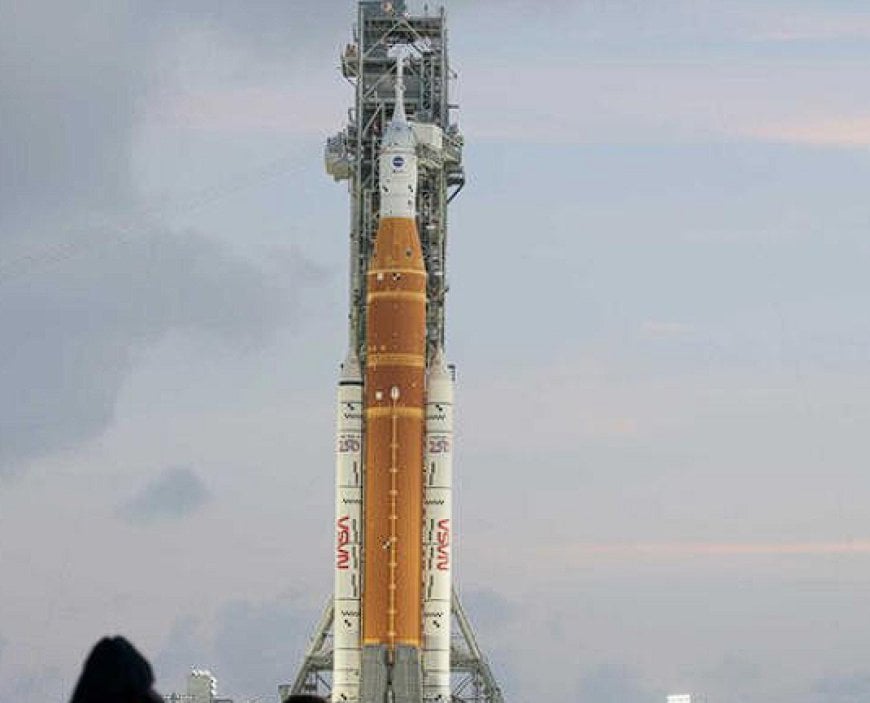
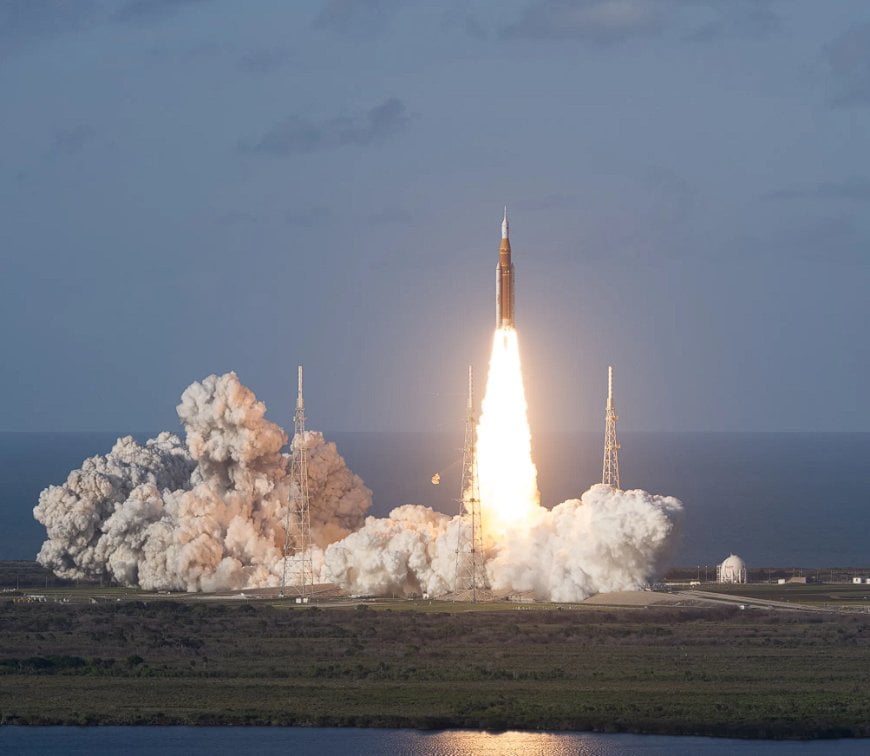
Artemis II lifted off at 6:35 p.m. EDT from Launch Complex 39B at Kennedy Space Center, sending commander Reid Wiseman, pilot Victor Glover, mission specialist Christina Koch, and CSA astronaut Jeremy Hansen into the first crewed Artemis mission. On the surface, that sounds simple enough: big rocket, loud fire, another Moon headline. But the first minutes after launch showed why this mission matters so much more than a ceremonial return.
The SLS left the pad with 8.8 million pounds of force and more than 75% of that initial thrust coming from the twin solid rocket boosters. Those boosters separated about two minutes into flight. Then came fairing separation, core stage cutoff, and core stage separation, followed by Orion’s solar array wing deployment. In other words, this was not just “did it launch.” This was a chain of timing-sensitive, mission-critical events that all had to work in sequence, and they did.
From there, the mission immediately moved into the real work. Orion powered up on orbit, the crew began spacecraft checkout, and the mission completed both the perigee raise maneuver and the apogee raise burn to refine the vehicle’s orbit around Earth. Those two burns matter because they are part of the bridge between launch and actual deep-space operations. A rocket leaving the pad is one thing. A crewed system transitioning correctly into the next operational regime is another.
Just as important, the mission did what real test flights are supposed to do: it surfaced issues without breaking the mission. NASA reported a short communications dropout after the perigee raise maneuver in which the ground temporarily could not receive data from the crew or spacecraft. The crew said they could still hear the ground, and the issue was resolved. Later, during early in-flight setup, the crew reported a blinking fault light during a toilet checkout. Ground teams began working the issue. That is not weakness. That is reality. This is exactly why crewed test flights exist. You do not validate a stack by pretending friction is not part of the stack.
The meaningful success was not just liftoff. It was successful sequence execution through ascent, separation events, power configuration, orbit-raising burns, and mission continuation after minor anomalies.
Why Artemis II Matters More Than a Flyby
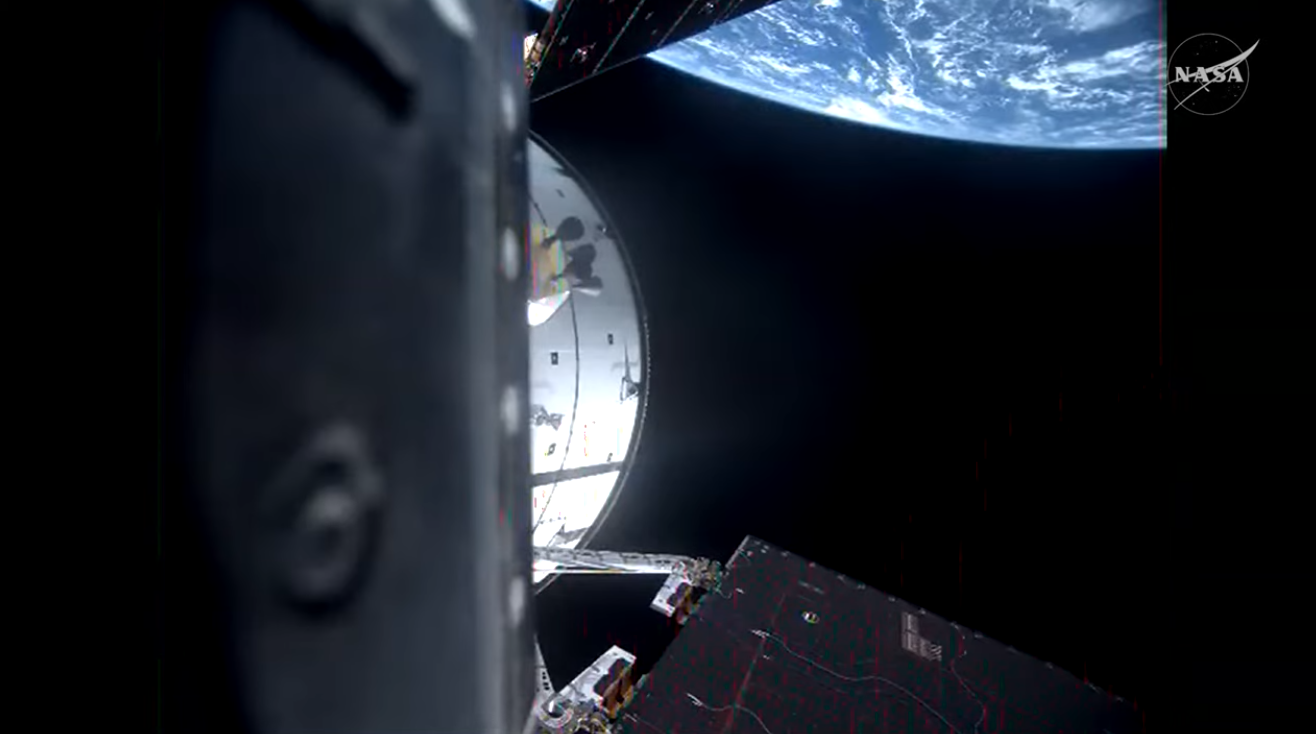
A lot of people are going to frame Artemis II like this: it is the one before the “real” Moon mission. That read is wrong. Artemis II is already a real mission because the hard part at this stage is not symbolic destination marketing. The hard part is re-establishing operational continuity beyond low Earth orbit after more than half a century.
Artemis II is the first crewed flight of SLS and Orion. It is a roughly 10-day mission. It will send astronauts on a free-return trajectory around the Moon and back, carrying them about 4,700 miles beyond the lunar far side. NASA also frames it as a life-support and operations validation mission, not just a transit stunt. That means the spacecraft itself is being tested as a living system: power, thermal control, communications, maneuvering, waste systems, procedures, emergency operations, and crew performance under actual deep-space conditions.
There is another layer here that matters even more. Artemis II will push humans beyond Earth’s protective magnetosphere for the first time in over 50 years. That is the line between “advanced orbital program” and true deep-space human flight. The environment changes. Radiation exposure changes. Communications geometry changes. Navigation assumptions change. The margin for lazy thinking collapses.
The immediate next step after the early orbit-raising burns is the proximity operations demonstration, where the crew will manually maneuver Orion relative to the detached interim cryogenic propulsion stage. That may sound technical and unglamorous, but it is exactly the kind of thing that decides whether a program is real. Real programs do not live on slogans. They live on docking logic, control authority, sensor trust, handover between communications networks, and the ability to do precise operations when conditions are not perfect.
That is why Artemis II matters more than a lunar flyby headline. It is validating the transport spine. Not the full permanent architecture yet. Not the full surface architecture yet. Not a complete Moon economy yet. But the transport spine, which comes first. Without repeatable crewed transport, the rest is branding.
- It validates human-rated deep-space transport with crew aboard.
- It tests life support and operational procedures in the actual mission environment.
- It exercises communications, navigation, and manual handling in a regime beyond routine Earth orbit.
- It proves whether the SLS-Orion stack can begin functioning as a repeatable system rather than a one-off event.
The Long View on Space Starts Here
If this is the first part of our long view on space, then the place to start is not with sci-fi aesthetics, Mars fantasy timelines, or glossy talk about civilization among the stars. It starts with throughput. It starts with whether humans can reliably move crew, hardware, power, data, and support systems beyond low Earth orbit and keep doing it over and over.
Space is not conquered by one dramatic launch. It is organized by layers. First comes access. Then comes transport continuity. Then orbital and surface infrastructure. Then cargo cadence. Then life support reliability. Then local mobility, energy, maintenance, and governance. Then you get something that looks like permanence. Artemis II matters because it marks the point where that stack starts to come back into view as an actual build sequence instead of a marketing mood board.
NASA’s current Artemis architecture makes this clearer than a lot of commentary does. The agency is now talking about increased mission cadence, an added 2027 mission to test system capabilities closer to home, a first lunar landing target in 2028 under the updated sequence, roughly annual missions thereafter, commercial landers, Gateway in lunar orbit, cargo deliveries through CLPS, and a broader partner network tied together by the Artemis Accords. That means the Moon is no longer being treated only as a destination. It is being treated as a layered operating environment.
That is the shift people should pay attention to. Once a program stops being only about reaching somewhere and starts becoming about maintaining access, it begins to take on strategic weight. Now we are talking about cislunar infrastructure. Now we are talking about standards, docking, resupply, orbital outposts, surface mobility, and commercial interfaces. Now we are talking about who builds the rails, who writes the norms, who supplies the hardware, and who gets continuity.
In other words, the long view on space is not “when do we plant another flag.” The long view is “who builds the recurring system.” Artemis II is important because it is the first serious crewed step in that direction. It is not the whole answer, but it is the beginning of a more meaningful question: who will control the deep-space stack once it becomes economically, politically, and strategically real?
Artemis II is chapter one because it reopens the transport layer. Before settlement, industry, mining, sovereignty debates, or real lunar permanence, there has to be a functioning system that gets humans there and back reliably.
How This Extends the Prior Pattern Nexus Space Thesis
This article is not a reset. It is a continuation. Pattern Nexus was already arguing months ago that Artemis II mattered less as a symbolic “return to the Moon” story and more as a systems story about reopening cislunar space as a live operational domain. That was the core of the January thesis: Artemis II was not a nostalgia lap. It was the reboot of the deep-space logistics chain, and that chain had to come back online before any serious lunar economy, durable off-world presence, or next-stage geopolitical layer above Earth could become real.
Launch day strengthens that earlier thesis rather than replacing it. The visible event was simple enough for TV: a rocket left the pad, a crew is headed around the Moon, and the world got the first crewed lunar-mission visuals in more than fifty years. But the real event was structural. What actually came back online was a live stack: heavy-lift launch, human-rated spacecraft, orbital maneuvering, power deployment, crew operations, systems checkout, communications handling, procedural discipline, and mission continuation under minor anomalies. That is the difference between memory and capability. A civilization does not regain frontier reach because it remembers how it used to do something. It regains it when the full operational sequence starts working again under current conditions.
That is exactly why the January Artemis II piece on Pattern Nexus framed this mission as the reopening of cislunar space as an operational domain. That framing was ahead of the headline cycle because it did not treat the Moon as a destination in isolation. It treated the Moon as part of a broader chain. Once humans can move repeatedly through cislunar space again, the Moon stops functioning as myth and starts functioning as infrastructure. It becomes a place where staging, communications, logistics, navigation, energy, docking, delivery cadence, and eventually surface systems begin to matter more than symbolic firsts.
The Moon Base Alpha piece pushed that logic further. That article argued the Moon was no longer just a flag-planting exercise. It was becoming a logistics node, an energy problem, and a control layer. That framing matters here because Artemis II is the transport prerequisite for everything that comes after it. Before there is a meaningful lunar industrial footprint, before surface permanence, before serious south-pole operations, before routine cargo waves, before protected power systems, before long-duration habitation, you need a transport spine that is real, survivable, and repeatable. Artemis II is part of that transition point.
The Blue Ghost article extended the thesis again from another angle: lunar access becomes more meaningful once it is routinized. That piece was not really about a single private lander touchdown. It was about procurement rails, standardized navigation, reference frames, reliability thresholds, and repeated delivery cadence. In other words, it was about the invisible layers that turn exploration into infrastructure. Artemis II sits above that same logic, but at the crewed level. Blue Ghost and CLPS matter because they help create repeatable lunar delivery rails. Artemis II matters because it helps reactivate the human transport layer above those rails. Put together, those two trends move the lunar environment away from one-off heroics and toward system architecture.
The March 26 Pattern Nexus piece on NASA’s Moon Base push, MoonFall, nuclear missions, and the Mars drone layer pushed the thesis another step outward. That article was already working through what real permanence would require: nuclear continuity, survival through the lunar night, dependable power, repeat surface operations, and new operational layers for Mars where thin atmosphere and distance change the engineering equation. Artemis II does not solve those problems, but it is directly upstream of them. You do not get long-view space buildout by jumping to the final chapter. You get there by activating layers in order: transport, cadence, cargo, power, mobility, shelter, maintenance, governance.
That is why this article should explicitly connect back to those earlier Pattern Nexus pieces. The through-line is not “space is exciting.” The through-line is that space is beginning to harden into a stack. First access. Then repeatability. Then standards. Then logistics. Then infrastructure. Then economic and strategic meaning. Pattern Nexus has already been framing the Moon this way: not as romance, but as a future operating environment where control systems, interfaces, supply chains, and permissions will matter just as much as rockets.
The other reason to deepen this section is that NASA’s updated Artemis architecture now reinforces the same long-view framing. The agency added a new 2027 demonstration mission in low Earth orbit to test commercial lander integration and rendezvous logic, is targeting the first lunar landing in early 2028 under the revised sequence, and says Artemis V in late 2028 is when it expects to begin building its Moon base. That means Artemis II is no longer just “the mission before the landing.” It is the first crewed restoration of the transport layer inside a larger multi-mission build sequence that now clearly points toward cadence, surface operations, and infrastructure.
So the prior Pattern Nexus space thesis holds up, and launch day makes it stronger. The real milestone was never just proximity to the Moon. It was reconstituting the chain that makes everything else possible. Artemis II validates that first layer. The next question is not whether the Moon is back in the news. The next question is who builds the rails above this transport spine, who defines the standards, who controls the interfaces, and who gets continuity once cislunar space starts functioning like real territory in operational terms.
Pattern Nexus had already framed Artemis II as the reboot of the deep-space logistics chain and cislunar space as the next control layer. Launch day strengthens that exact read. The headline is a lunar flyby. The real shift is that the transport layer is functioning again inside a broader infrastructure sequence.
Pattern Nexus Lens
The cleanest way to understand Artemis II is through systems, not spectacle.
Space is becoming a control system. Not in the cartoon sense. In the real sense. A control system is the arrangement of incentives, permissions, bottlenecks, standards, operating layers, recovery paths, and continuity mechanisms that determine who can actually act inside an environment. The reason Artemis II matters is that it is not just proving a spacecraft. It is helping rebuild an operating framework.
Think about the stack already forming around the Moon. SLS and Orion are the crew transport spine. Commercial landers bridge orbit to surface. CLPS becomes an early cargo relay model. Gateway is the orbital node. Deep Space Network becomes communications infrastructure. Spacesuits and rovers become surface mobility layers. The Artemis Accords become part of the governance and rules layer. That is not just exploration. That is the beginning of a permission structure for cislunar space.
That is why the “just a flyby” take misses the point. A flyby is the visible mission profile. The invisible mission is systems integration. Once the transport layer works, everything above it becomes thinkable in a different way. Not guaranteed. Not easy. Not cheap. But structurally possible.
And that leads to the larger point. The future of space will not be decided only by who can launch. It will be decided by who can repeat, who can sustain, who can supply, who can govern, and who can absorb failure without losing continuity. That is true on Earth. It will be even more true off Earth. Artemis II is important because it moves the conversation from symbolic return toward repeatable architecture.
The Moon is the testbed, but the real build is a deep-space operating system: access, power, comms, docking, cargo, governance, and continuity. Artemis II is the reopening of that system’s human transport layer.
Sources & References
These sources support both layers of the article: the immediate Artemis II launch facts and the broader Pattern Nexus continuity argument that this mission is part of a larger shift from symbolic exploration toward repeatable deep-space infrastructure.
NASA provides the launch-day and architecture facts: liftoff timing, ascent milestones, early mission operations, Artemis II mission scope, and the revised sequence now pointing toward 2027 integration testing, 2028 surface operations, and early Moon-base construction. Pattern Nexus provides the continuity layer: earlier articles had already framed Artemis II as a logistics reboot, the Moon as infrastructure, and lunar access as a standards-and-cadence problem rather than just an exploration story.
Pattern Nexus Continuity Sources
- Pattern Nexus — Artemis II Is the Reboot: The Deep-Space Logistics Chain Returns
- Pattern Nexus — Moon Base Alpha: Why the Moon Is Becoming Infrastructure
- Pattern Nexus — NASA’s Moon Base, MoonFall, Nuclear Missions, and the Drone Layer of Mars
- Pattern Nexus — Touchdown as Infrastructure: NASA Confirms Blue Ghost, CLPS, and the New Lunar Delivery Rail
- Pattern Nexus — Voyager at the Helopause: Mapping the True Edge of the Solar System
- Pattern Nexus — Star Catcher Breaks DARPA’s Record — The Space Solar Race Just Entered a New Phase
- Pattern Nexus — Space Search Index
FAQ
Is Artemis II landing on the Moon?
No. Artemis II is a crewed lunar flyby mission, not a surface landing. Its purpose is to validate the SLS-Orion crewed deep-space stack and critical operations before later surface missions.
Why is a flyby still such a big deal?
Because the real milestone is not just getting near the Moon. It is re-establishing crewed deep-space capability: launch, life support, navigation, communications, orbital maneuvering, and human operations outside the routine low Earth orbit regime.
Why does this matter in the long view on space?
Because permanence comes after continuity. Before there is a serious lunar operating environment, there has to be a working transport layer that can put humans into that environment repeatedly and safely. Artemis II is part of rebuilding that layer.
Sources
These sources support the launch-day sequence, early mission events, Artemis II mission profile, and NASA’s broader Artemis architecture.
- NASA — LIVE: Artemis II Launch Day Updates
- NASA — Liftoff! NASA Launches Astronauts on Historic Artemis Moon Mission
- NASA — Artemis II Mission Page
- NASA — First Flight With Crew Important Step on Long-term Return to the Moon, Missions to Mars
- NASA — Moon to Mars | Artemis Program Overview
- NASA — Strengthens Artemis: Adds Mission, Refines Overall Architecture
- NASA — Artemis II Flight Update: Perigee Raise Maneuver Complete
- NASA — Artemis II Flight Update: Apogee Raise Burn Complete
- NASA — Artemis II Science
あなたの反応は?
 いいね
0
いいね
0
 嫌い
0
嫌い
0
 愛
0
愛
0
 面白い
0
面白い
0
 ワオ
0
ワオ
0
 悲しい
0
悲しい
0
 怒っている
0
怒っている
0

Founder of Pattern Nexus. I research markets, macro, geopolitics, AI, history, ancient systems, and the patterns most people overlook. I’m also building Market Radar, a trading scanner designed to read pressure, risk, confirmation, and setup quality before chasing a move. Pattern Nexus is where I connect the dots between data, history, technology, and the bigger system playing out around us.











コメント (0)