
Market Wrap: Dow 50K, Metals Cool, Yields Whip (Feb 11, 2026)
Feb 11, 2026 market wrap plus an 11-day rewind: Dow tags 50,000, metals cool after the late-Jan vertical and violent margin-driven unwind, the dollar narrative turns into a control-systems debate, and the 10Y whips around while the index-level tape pretends it’s calm.

Dow 50K is a nominal headline. The real story is the rules underneath: credit, funding, and credibility.
The “dollar fear” conversation isn’t about vibes. It’s about governance, enforcement, and whether the pipes stay trusted.
The 10Y isn’t “confused.” It’s pricing a tug of war between growth slowing, inflation stickiness, and policy credibility.
Metals cooling after a vertical run is not “game over.” It’s the system forcing leverage to breathe.
When the index looks flat but rates and metals are swinging, that’s the wrapper lying. Look at the pipes.
Today’s tape
I’m going to keep this grounded because I’m tired and I’ve got real life in front of me (turnovers, paint, carpet, school deadlines). The market doesn’t care. It prints anyway. So here’s the clean read: the index-level tape is pretending it’s stable, commodities are cooling after the late January violence, and the rates complex is still the most honest thing on the screen.
Indices: the wrapper looks calm
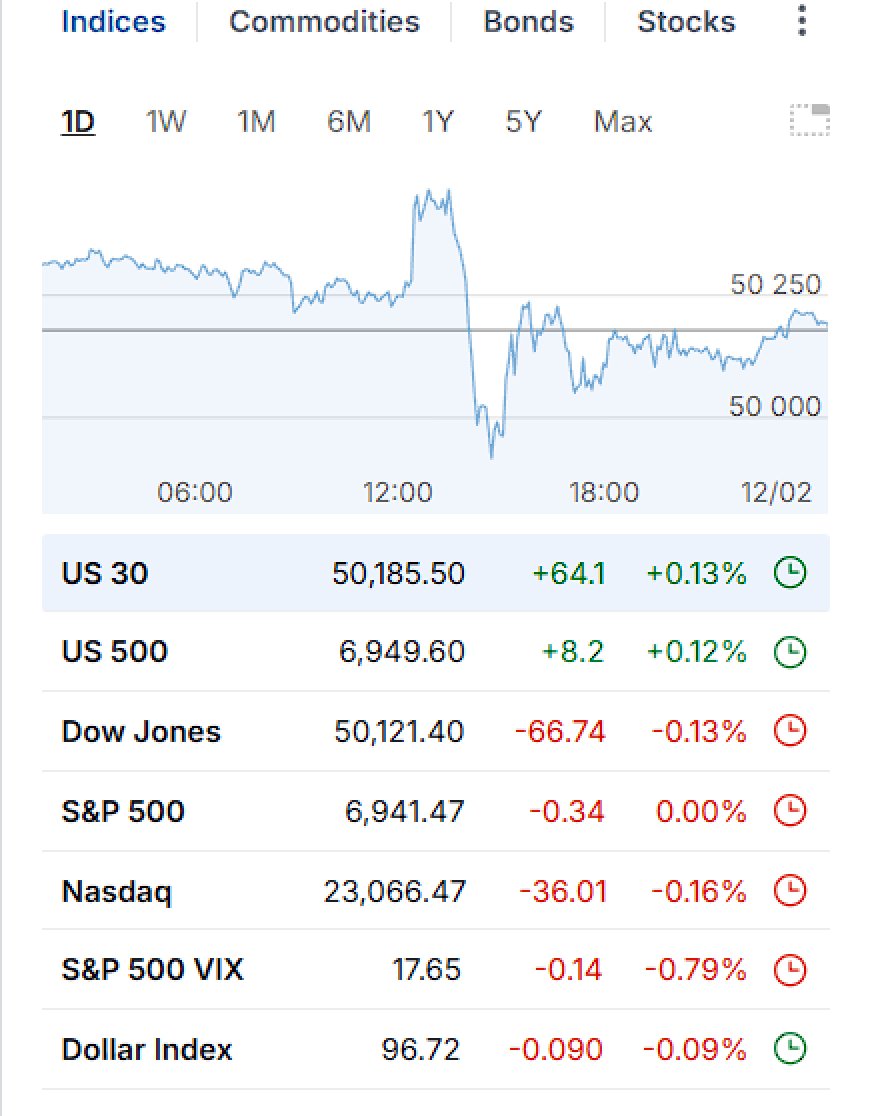
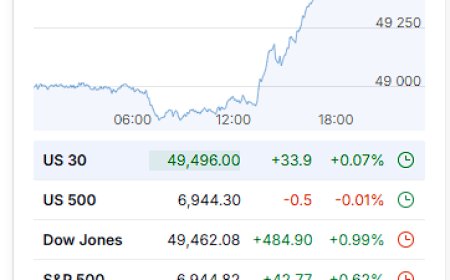
The snapshot has the broad tape basically flat: S&P essentially unchanged, Nasdaq slightly red, VIX not panicking, and the dollar index barely moving. That’s what late-cycle liquidity theater looks like. People see a green US30 print and think “risk on.” Then they wonder why everything feels expensive and unstable in real life. Different layer.
Dow 50,000 is a psychological print and a political headline. It is not automatically “prosperity.” In a world where the unit of account is being stretched, nominal highs are expected. The question is what it buys you, what it costs to fund, and who gets squeezed when the system rebalances.
Commodities: metals cool, energy steadier
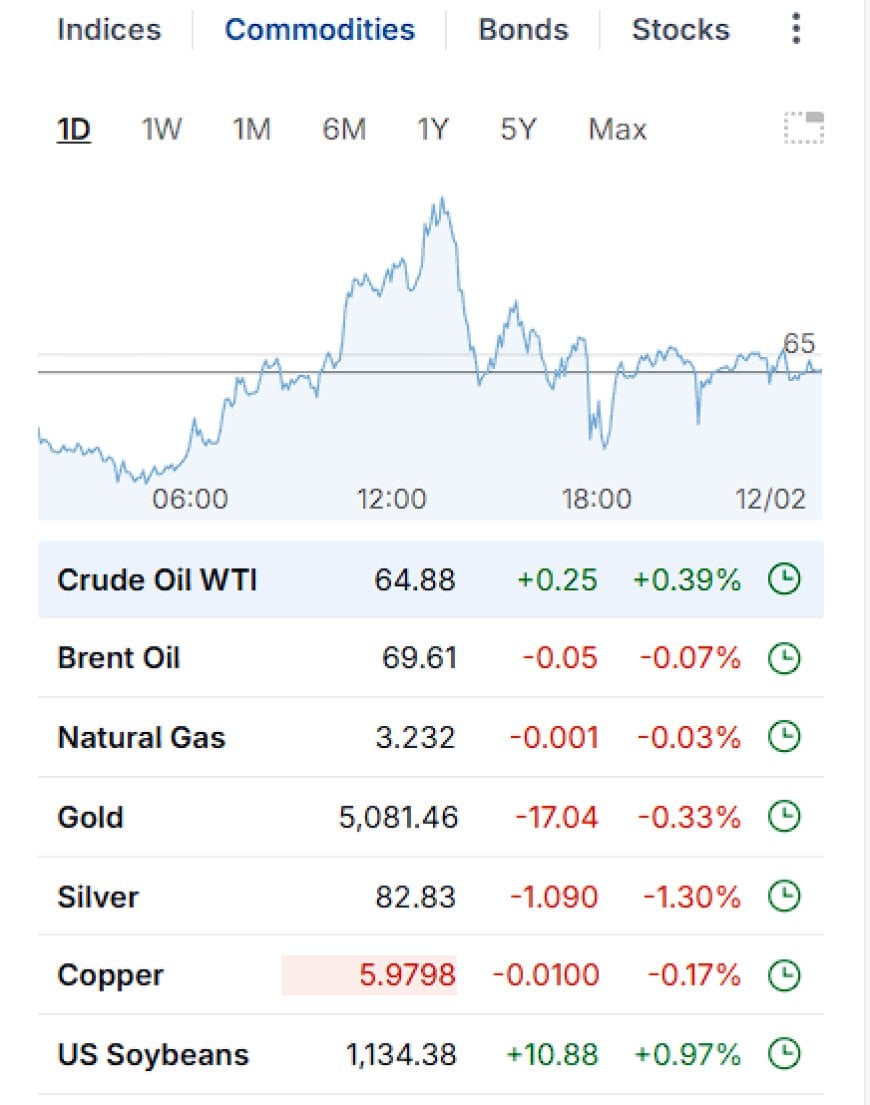
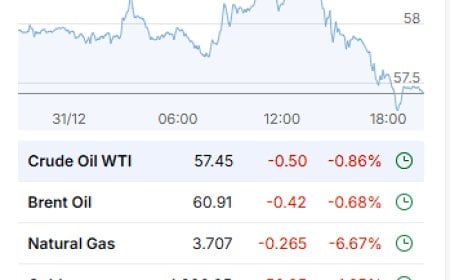
Metals in our panel are down on the day (gold slightly red, silver more red), oil is mixed to slightly up, and copper is soft. That’s not a narrative. It’s mechanical. After the late January vertical and the brutal unwind that followed, you should expect a regime where metals don’t trend nicely. They spike, cool, wick, and reset.
Rates: the 10Y is still the story
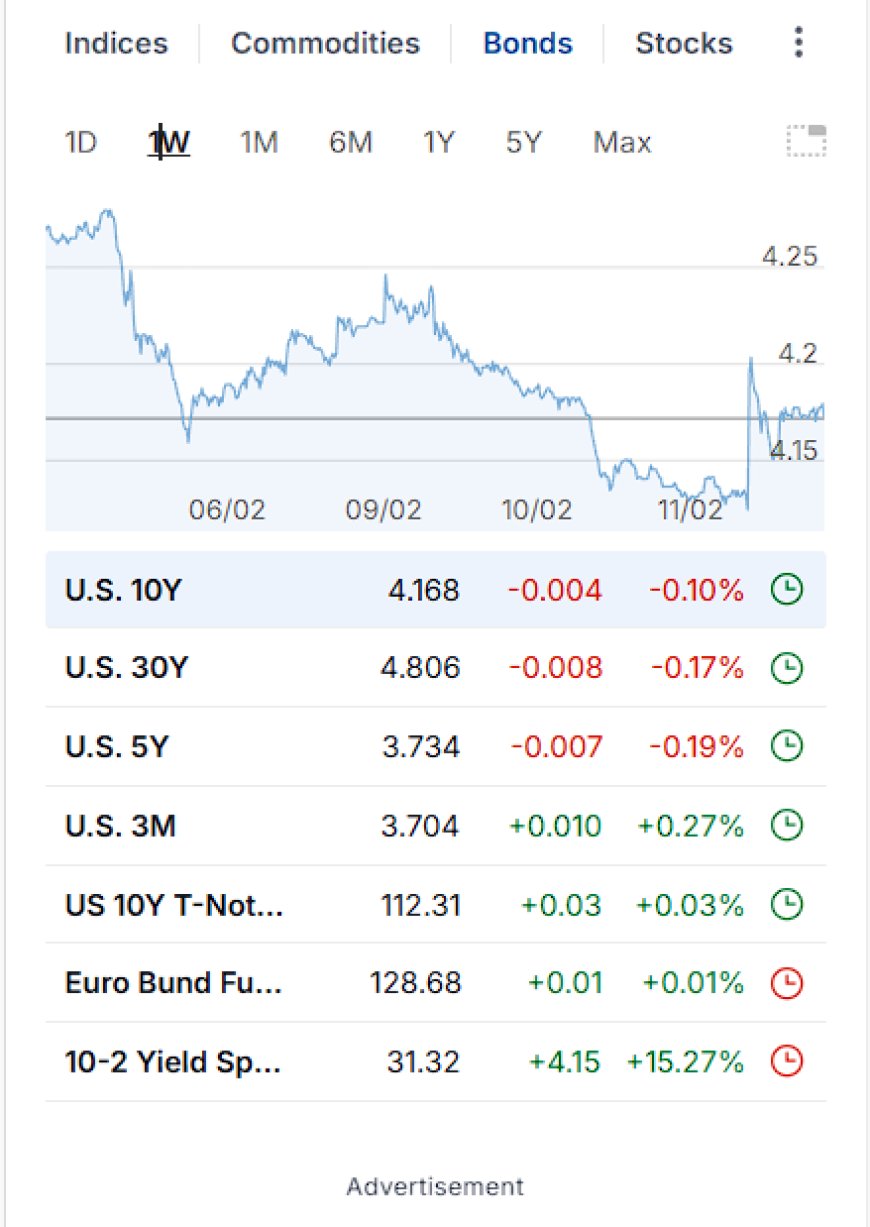
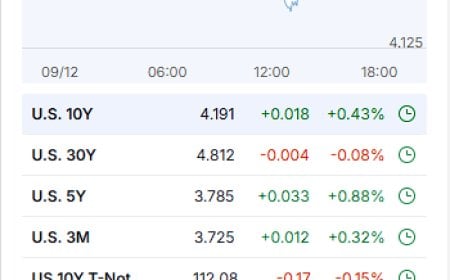
We said it straight: “10 year is all over the place.” That’s accurate. When the 10Y can’t hold a clean trend for more than a few sessions, it’s because the market is constantly re-ranking probabilities: growth slowing vs inflation not dying vs policy credibility changing vs fiscal gravity. If you want the simplest cheat code for the last 11 days, it’s this: yields are doing the thinking the headlines refuse to do.
The last 11 days: what actually changed
The clean way to describe the past 11 days is credibility stress testing. Not apocalypse. Not euphoria. Stress testing. We had three major forces running at the same time: policy politics (Fed independence chatter and chair transition risk), hard macro prints (labor and consumption), and mechanical leverage dynamics (metals margin, rate volatility).
1) Metals did the classic two-step: vertical move, then a margin-style unwind
Late January was the “metals are screaming” moment. Then the system did what it always does when too much leverage crowds the same door: it tightened conditions and forced liquidation. The core point: margin is a control lever, and it matters more than any influencer narrative when positioning gets crowded.
When metals go vertical, the market isn’t “discovering truth.” It’s loading leverage onto a belief. Then the risk layer responds. Margin is a control lever. It forces the crowd to prove they can hold the position with real collateral, not vibes.
2) The “dollar fear” narrative turned into a pipes argument
We said people are freaking out about the dollar. That’s not random. Over this window the conversation kept circling the same core issue: can the world replace the dollar, and if not, what does “dollar weakening” actually mean?
Here’s my take in plain English: the dollar is not just a currency, it’s a permissions system backed by legal enforcement and network depth. So the debate isn’t “will BRICS tweet a new unit.” The debate is “does the governance layer stay credible enough that everyone keeps using the pipes.”
3) Policy politics moved from background noise to tradable risk
The chair transition story matters less as a personality story and more as a regime story. Once the market starts pricing independence and continuity as variables, you get higher volatility across rates, FX, and the long-duration equity complex.
4) Macro prints: labor got revised down, spending stalled, confidence tried to bounce
This is the part that actually explains why the 10Y can’t sit still. Labor revisions change the slope of the “soft landing” narrative, and retail sales that stall add friction to growth assumptions. Meanwhile, sentiment can improve for a minute and still coexist with pressure in the bills layer. That’s not a contradiction. It’s a system oscillating.
5) The Dow tagged 50,000 in the middle of this, because nominal prints are what the machine produces
The Dow briefly tagged 50,000 and the world clapped. That’s exactly how these cycles top out structurally: nominal highs with underlying instability. Again, not a crash call. A framework call.
What I’m watching next
- Rates first: if the 10Y keeps whipping, the market is telling you the regime is unstable even if the index doesn’t admit it.
- Dollar narrative: watch the governance layer (Fed independence chatter, policy signaling, institutional trust). That’s where the real risk premium lives.
- Metals behavior: after a margin-style unwind, you usually get a choppy basing process. If it re-accelerates, it’s a credibility message.
- Real economy prints: the revision story matters because it changes the slope of the “soft landing” narrative. Revisions are the quiet weapon.
11-day math: the simple % reality check
I like narratives, but I trust arithmetic more. Here’s the simplest way to see what this window actually did (using the values we already referenced in our Jan 29 vs today snapshots).
Approx 11-day move (Jan 29 → Feb 11, based on our panels):
US30: ~+6%
S&P (US500): ~+2.8%
Nasdaq: ~+3.4%
DXY: ~-3.3%
Gold: ~-3.1%
Silver: ~-25%
Read that again: “calm market” at the index layer can coexist with a two-week silver drawdown that reads like liquidation, and a notable DXY slide across the same window. That’s why I keep saying the wrapper hides the pipes.
The pipe map: why the wrapper lies
Pattern Nexus isn’t “pick the asset.” It’s “map the system.” So here’s the pipe map for this window — the parts that actually move the parts you can see.
Think of the 10Y as a stack of components, not one “rate”: 10Y ≈ expected policy path + term premium + fiscal risk premium + credibility premium. When multiple components are moving in opposite directions, you don’t get a clean trend. You get whips.
Scoreboard
Pattern Nexus Lens
If you only remember one sentence from this whole wrap, make it this: the market is a control system that routes claims through pipes. That’s it. That’s the framework.
Dow 50K is the headline layer. The pipes layer is the part people avoid because it’s not fun. Pipes are: the funding curve, collateral rules, margin, the legal enforcement layer, central bank credibility, and the political constraints around policy.
Over the last 11 days, you watched pipes assert themselves. Metals ran, then leverage got forced to breathe. Rates whipped, because the regime can’t settle on a clean probability distribution. The dollar debate got louder, because the world is trying to diversify without breaking the system it still depends on. Fed independence chatter surfaced, because when the chair transition becomes political theater, the market prices that as volatility.
This is why I never get hypnotized by “asset is real” arguments. Gold is not holy. Fiat is not fake. They’re both wrappers. The base layer is production and energy and enforcement and logistics. Money is the routing interface that decides who gets what share of that base layer.
Stop asking “where is the Dow going.” Start asking “what changed in the pipes.” When pipes change, the market reroutes claims first and explains later.
FAQ
Does Dow 50K mean the economy is healthy?
Not automatically. It means the nominal claim set is being bid. In a stretched unit-of-account world, nominal highs are common. The health question is purchasing power, funding costs, and how evenly the system distributes the “gain.”
Why is the 10Y so unstable?
Because the market is pricing multiple competing forces at once: revisions in labor data, sticky inflation risk, policy credibility, and fiscal gravity. When the answer is not stable, the yield is not stable.
Why can metals cool down without the bigger thesis changing?
Vertical moves attract leverage. Leverage forces air pockets. Margin and liquidation create violent resets. Cooling is mechanical. The longer-horizon bid is credibility-driven.
What’s the real “dollar fear” issue?
Trust in the pipes. Settlement networks, enforcement credibility, and policy stability. Replacement is slow, but political pressure can still destabilize expectations.
Sources
Key reporting used for the 11-day rewind (labor revisions, Dow 50K milestone, metals margin unwind, dollar narrative, Fed chair transition and independence chatter, retail sales).
- U.S. job growth weakens; benchmark revisions show fewer jobs than thought (Reuters, Feb 11, 2026)
- Dow briefly hits 50,000; payroll data and Fed path in focus (Reuters, Feb 6, 2026)
- Gold and silver suffer historic weekly drops; margin dynamics cited (Reuters, Feb 2, 2026)
- Dollar disorder risk and market sensitivity (Reuters, Feb 3, 2026)
- Dollar rebound expected to fade; Fed independence worries noted (Reuters, Feb 4, 2026)
- Five things to know about Kevin Warsh as Fed chair pick (Reuters, Jan 30, 2026)
- Central bank discussion highlights threats to Fed independence as a global risk (Reuters, Feb 11, 2026)
- U.S. retail sales flat in December after prior decline (Reuters, Feb 10, 2026)
- U.S. consumer sentiment improves in early February (Reuters, Feb 6, 2026)
あなたの反応は?
 いいね
0
いいね
0
 嫌い
0
嫌い
0
 愛
0
愛
0
 面白い
0
面白い
0
 ワオ
0
ワオ
0
 悲しい
0
悲しい
0
 怒っている
0
怒っている
0

Founder of Pattern Nexus. I research markets, macro, geopolitics, AI, history, ancient systems, and the patterns most people overlook. I’m also building Market Radar, a trading scanner designed to read pressure, risk, confirmation, and setup quality before chasing a move. Pattern Nexus is where I connect the dots between data, history, technology, and the bigger system playing out around us.












コメント (0)