
The Unrealized Gains Trap: Property Taxes Are the Warning, Not the Excuse
A viral argument says if homeowners already pay property taxes on assessed value, then rich people should be taxed on unrealized stock gains too. But that logic misses the actual danger. Property tax is not a clean argument for expanding unrealized-gains taxation. It is the live demonstration of what happens when government turns paper value into a real recurring bill before cash exists. This Pattern Nexus research paper breaks down the difference between realization and assessment, the history of U.S. tax expansion, the income tax’s shift from narrow elite levy to mass withholding system, the AMT’s expansion problem, and why “it only starts with billionaires” is not a serious historical argument.
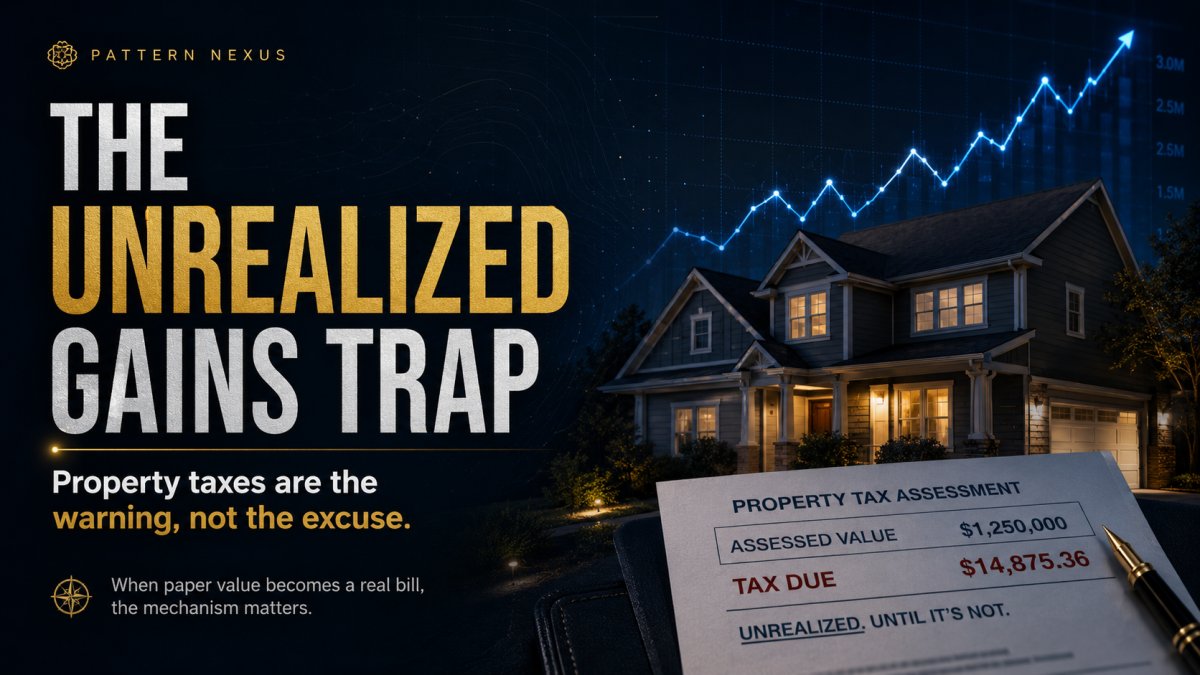
The Unrealized Gains Trap: Property Taxes Are the Warning, Not the Excuse
The viral argument says homeowners already pay taxes on “unrealized” property value, so billionaires should pay taxes on unsold stock gains too. But that does not prove what people think it proves. It proves the danger.
Quick Read
A popular meme argues that taxing unrealized stock gains should be acceptable because homeowners already pay property taxes based on assessed home value. But that comparison does not defend unrealized-gains taxation. It exposes the problem with assessment-based taxation.
A house going up on paper does not put cash in the owner’s hand. A stock portfolio going up on paper does not automatically create spendable money either. The key issue is not whether the asset is valuable. The issue is whether the state can convert estimated value into a recurring cash obligation before a sale, before liquidity, and before the gain is actually realized.
Property taxes are not taxes on realized profit. They are taxes on assessed value. That distinction matters. And if people do not understand why “it starts with billionaires” can later move down the system, they do not understand American tax history, withholding, the Alternative Minimum Tax, or how government revenue machinery expands once built.
The Core Error
Property taxes do not justify taxing unrealized gains. They show how dangerous it is when paper value becomes a cash bill.
The Real Line
The dividing line is not rich vs. poor. The dividing line is realized cash event vs. government-assessed value.
The Historical Pattern
Taxes often enter through a narrow moral target and later expand through crisis, inflation, spending needs, and administrative convenience.
The Warning
Once assessment power is normalized, the next fight becomes what counts as wealth and which assets get pulled into the system.
The Meme Gets the Direction Wrong
The argument looks clever at first glance:
You can’t tax rich people on unrealized stock gains because “it’s not real money until it’s sold,” but my property taxes keep going up based on the unrealized value of my house.
The problem is that this does not prove unrealized stock gains should be taxed. It proves the opposite. It proves the state already has a mechanism that turns estimated asset value into a real cash obligation before the owner sells anything.
That is not a reason to expand the model. That is the warning sign.
A house increasing in assessed value does not mean the owner has cash in hand. It does not mean the owner made a realized profit. It does not mean the owner can pay a higher bill without pulling from wages, savings, rent, debt, or other income. Yet the property tax bill still arrives in cash terms. That is the core issue. The government is not waiting for realization. It is using assessment.
That distinction is everything.
When people use property tax as a defense for unrealized-gains taxation, they are basically saying: “Look, the government already taxes one category of unsold asset value. Why not expand that logic?” But if you own property, run a business, manage rentals, or understand basic liquidity, the sane response is: why would we want more of that?
Property tax is not a clean moral argument against billionaires. It is a live example of how asset-based taxation can detach from cash flow. It taxes the ownership position, not the sale event. It taxes the assessment, not necessarily the actual economic ability to pay.
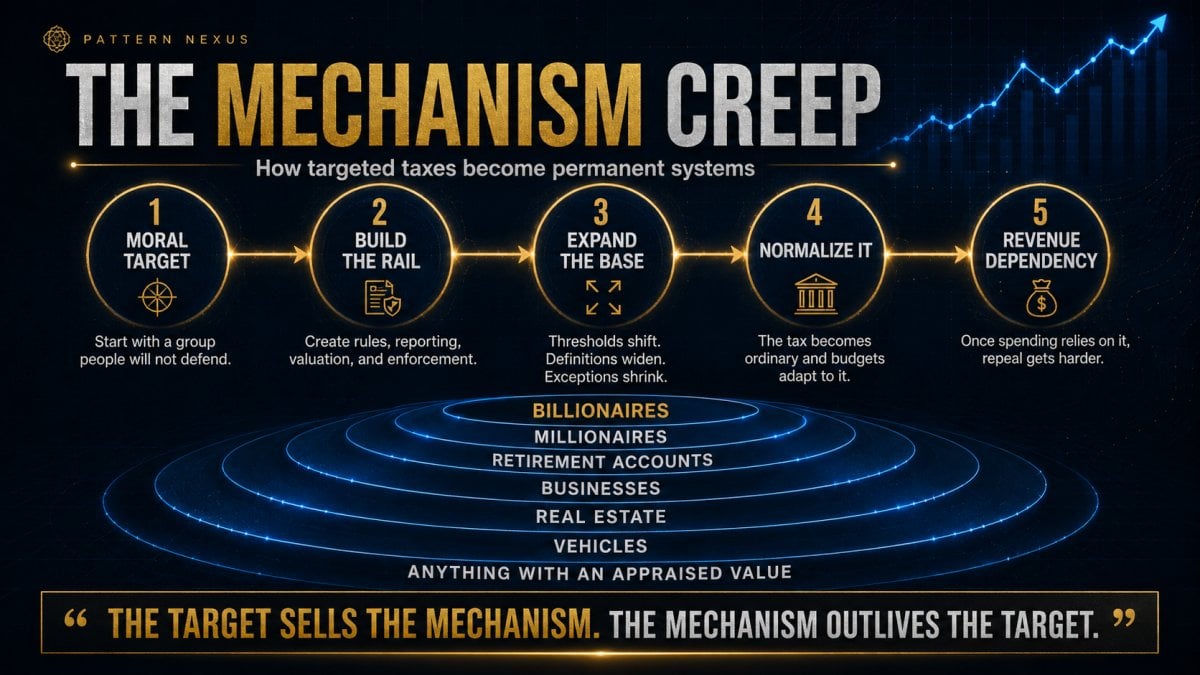
Realization vs. Assessment
Under normal capital-gains logic, the gain is not taxed simply because an asset increased in quoted value. The gain becomes taxable when the asset is sold or otherwise disposed of. The IRS describes a capital gain as the difference between adjusted basis and the amount realized from the sale of a capital asset. It also lists homes, stocks, bonds, and personal-use property as capital assets.[1]
That is the realization principle in plain English: you bought something, it went up, but the taxable capital gain generally occurs when you sell it and actually realize the gain.
Property tax operates on a different logic. Property tax is not usually asking whether you sold the property at a profit. It is asking what the property is assessed to be worth, what rate applies, what levy local government approved, and what share of the local tax burden your parcel carries. The Tax Policy Center describes property tax as a tax on the value of real property or personal property, with real property taxes primarily levied by local governments such as cities, counties, and school districts.[2]
In other words, property tax is not a tax on realized profit. It is a tax on ownership value as determined by an assessment process.
That is why the meme is wrong. It assumes the contradiction is:
“Why can they tax my house value but not a billionaire’s stock value?”
The better question is:
“Why are we comfortable letting government turn paper value into a real recurring bill before a cash event exists?”
Once you see the difference, the entire meme collapses. It is not exposing hypocrisy. It is exposing how normalized one version of assessment-based taxation already became.
What Property Tax Actually Proves
Property tax proves three things people should be very careful about.
First: assessed value is not liquidity.
Your home can increase in assessed value while your income stays flat, your insurance doubles, your maintenance costs rise, and your cash position gets worse. The county may say your property is worth more. That does not mean your bank account is worth more.
This is the liquidity mismatch. The bill is real. The gain is theoretical until sale.
Second: assessment systems become political machines.
Local governments rely heavily on property taxes. In 2021, state and local governments collected $630 billion in property taxes, and local governments collected $609 billion of that amount. Property taxes accounted for 30 percent of local general revenue and nearly half of local own-source general revenue.[2]
That matters because once government budgets depend on a revenue stream, the revenue stream becomes structurally protected. It funds schools, municipalities, county services, pensions, payroll, bond obligations, and operating budgets. That does not automatically make every dollar illegitimate. But it does mean the system develops a dependency on the tax base.
The same would happen with any broad unrealized-gains mechanism. Once the rail exists, once revenue projections depend on it, once agencies staff around it, once compliance systems are built around it, the political fight changes. It stops being a philosophical argument and becomes a budget-defense argument.
Third: the owner pays in cash even when the gain is not cashed out.
Property assessment methods vary by jurisdiction. Some are based on sale price, some on income potential, some on physical attributes, and some are reassessed annually while others are reassessed over longer cycles.[3] But however the formula works, the bill ultimately comes due in money.
That is the part the meme skips. The state is not taking a percentage of your “paper gain” in theory. It is demanding payment from your actual cash flow.
And if you cannot pay, the consequences are not theoretical. Property taxes can become liens. Delinquency can create legal pressure, foreclosure risk, tax sale exposure, mortgage consequences, and forced displacement depending on the state and county structure.
So no, property tax is not the gotcha argument for taxing unrealized gains.
It is the case study in why assessment power should be treated with suspicion.
American Tax History Is Mechanism Expansion
This is where the historical part matters.
If someone hears “it starts with billionaires, then moves down” and thinks that is paranoia, they do not understand how American taxation developed. They do not understand how tax systems are sold, normalized, expanded, and converted into permanent administrative machinery.
The modern federal income tax was not introduced as the mass paycheck-withholding system Americans live under now. The Sixteenth Amendment took effect in 1913, giving Congress power to tax incomes without apportionment among the states.[4] But in that first year, due to exemptions and deductions, less than 1 percent of the population paid income taxes at a rate of only 1 percent of net income, according to the National Archives.[4]
The IRS historical timeline records that Congress adopted a 1 percent tax on net personal income over $3,000, with a surtax of 6 percent on incomes over $500,000.[5] That is a very different political creature from the modern income tax.
Then war, spending, administration, and political demand changed the system.
By World War I, top rates exploded. By the 1940s, the income tax became a mass tax. The IRS notes that the Revenue Act of 1942 increased taxes and increased the number of Americans subject to income tax. Then, in 1943, Congress passed the Current Tax Payment Act requiring employers to withhold taxes from wages and remit them quarterly.[6]
That is the real transformation. The income tax became not just a tax, but a payroll rail.
Withholding changed the psychological structure of taxation. The government no longer waited for most people to write a check after fully seeing their gross income. The state inserted itself before the paycheck reached the worker. That is not a small administrative detail. That is the normalization layer.
So when people say, “Don’t worry, this only applies to billionaires,” the correct response is: that is how mechanisms are always made politically acceptable.
It starts with an unsympathetic target. It starts with moral language. It starts with a group most people do not feel the need to defend. Then the system builds the rail. After that, the fight is no longer about the original target. The fight becomes thresholds, definitions, exemptions, inflation adjustments, enforcement, reporting, valuation methods, and what counts as taxable capacity.
This does not mean every tax is evil. It means the machinery matters.
Pattern Nexus looks at systems, not slogans. The slogan is “tax the rich.” The system question is: what new power is being created, what assets can be assessed, who controls valuation, how often does payment come due, what happens when values fall after taxes are paid, and how far can the tax base move once the precedent exists?
The AMT Example: “Only the Rich” Became a System Problem
The Alternative Minimum Tax is the cleanest example of this pattern.
In 1969, Treasury Secretary Joseph Barr told Congress that 155 taxpayers with incomes over $200,000 had paid no federal income tax in 1966. The political reaction was massive. According to the Tax Policy Center, members of Congress received more letters about those 155 taxpayers than about the Vietnam War. Congress responded by creating an add-on minimum tax.[7]
That is the classic pattern: a small number of rich taxpayers becomes the moral target, and a new tax mechanism is created in response.
But the AMT later became a much broader problem because key parameters were not indexed for inflation. The Congressional Budget Office warned in 2004 that the AMT had affected less than 1 percent of taxpayers before 2000, but was expected to grow rapidly and affect about one-fifth of all taxpayers in 2010. CBO also identified inflation as a key source of the AMT’s expanding reach.[8]
This is exactly the part people keep missing.
The question is not whether the first target is sympathetic. The question is whether the tax design creates a mechanism that can expand beyond the original target. The AMT was sold through outrage over 155 high-income taxpayers. The later policy problem was not limited to those 155 people.
That is what “it starts with billionaires” means.
It does not mean every tax immediately hits everyone the next morning. It means tax systems evolve. Thresholds can fail. Inflation can pull more people in. Budget dependence can harden. Definitions can widen. New categories can be added. A political emergency can justify expansion. And once the administrative rail exists, the cost of expanding it is much lower than the cost of building it from scratch.
The Billionaire Minimum Tax and the New Assessment Rail
To be precise, recent federal unrealized-gains proposals have not been written as a tax on every homeowner or every ordinary investor. The Biden administration’s FY2025 Green Book proposed a 25 percent minimum tax on total income, generally inclusive of unrealized capital gains, for taxpayers with wealth greater than $100 million. It would phase in and become fully phased in above $200 million.[9]
That matters because accuracy matters. The current policy proposal was framed around the ultra-wealthy, not ordinary homeowners.
But that does not end the argument. It starts the real argument.
The real argument is not “Will this exact version hit the middle class tomorrow?” The real argument is: what does this normalize?
The proposal is important because it moves the tax system toward annual inclusion of unrealized capital gains for certain taxpayers. It is not merely raising a rate on realized gains. It is not merely closing a deduction. It is changing the timing principle. It is saying that under certain conditions, the government can count asset appreciation before sale as part of the tax base.
That is a much larger shift than people understand.
The Supreme Court’s 2024 decision in Moore v. United States did not settle the broad constitutional question of whether realization is required for an income tax. The Court explicitly stated that the decision did not resolve the parties’ disagreement over whether realization is a constitutional requirement for an income tax.[10]
That leaves the political and legal fight open. And when the legal boundary is unsettled, the policy boundary becomes even more important.
A tax on unrealized gains requires valuation. Valuation requires administrative rules. Rules require reporting. Reporting requires enforcement. Enforcement requires penalties. And once those systems exist, politicians eventually ask the obvious question: why stop there?
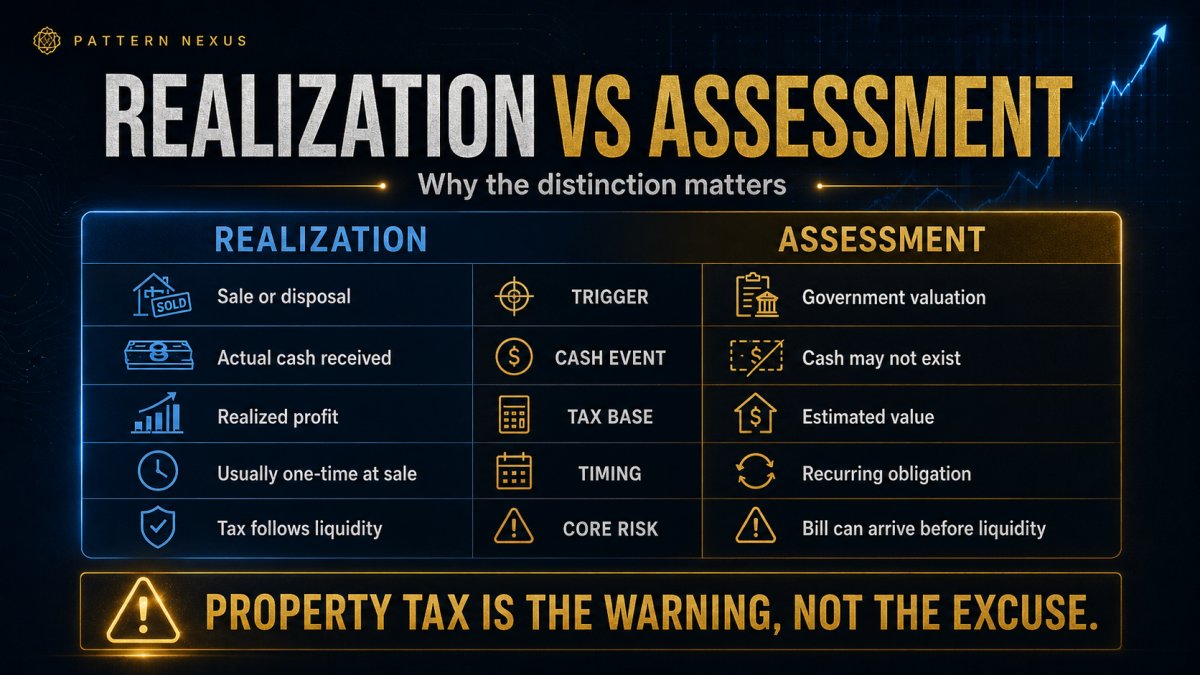
That is the Pattern Nexus concern.
The issue is not whether billionaires have too much power. Many do. The issue is whether the solution should be a new assessment architecture that can eventually be aimed at any asset class with an appraised value.
Because once the logic is accepted, the list can expand:
- Billionaires
- Millionaires
- Founders
- Private businesses
- Real estate portfolios
- Retirement accounts
- Vehicles
- Collectibles
- Land
- Anything that can be appraised, modeled, indexed, or algorithmically valued
That is not a fantasy. That is how assessment logic works. Once value can be estimated, it can be taxed. Once it can be taxed, it can be budgeted. Once it is budgeted, it becomes politically defended.
The Downstream Pass-Through Problem
The other thing the meme ignores is pass-through pressure.
People love to pretend taxes stop at the person legally assigned to pay them. But in the real world, costs move. They move through prices, rents, wages, margins, investment decisions, hiring decisions, maintenance delays, service cuts, and capital allocation.
When property taxes rise, homeowners feel it directly. Landlords feel it and push some portion into rent when the market allows. Commercial owners feel it and push some portion into lease rates. Businesses feel it and push costs into prices, wages, staffing, or investment. No one absorbs infinite cost just because the public wants them to.
This is especially true in real estate because property taxes are recurring, unavoidable, and tied to ownership. The owner cannot simply say, “I did not sell, so I should not owe.” The bill is attached to the asset.
That is why using property tax as a pro-unrealized-gains argument is so backwards. Property tax is one of the clearest examples of how paper valuation becomes downstream pressure.
If the government builds a broader unrealized-gains tax system, the same thing happens in different form. Asset owners do not simply sit there and take every new obligation without adjusting behavior. They sell assets earlier. They borrow differently. They move assets into different structures. They shift investment. They relocate. They change risk exposure. They change compensation. They lobby for exemptions. They pass costs where they can.
That means the policy does not stay clean. It becomes a control system.
A new tax mechanism changes behavior before it even collects revenue. It changes how assets are held, how businesses are structured, how liquidity is managed, and how people think about ownership itself.
Pattern Nexus Lens: The Tax Is Not the Whole System
The deeper Pattern Nexus frame is this:
A tax is never just a tax. It is a permission rail.
It defines what counts as value. It defines when value becomes taxable. It defines who must report. It defines which institutions get visibility. It defines what penalties attach to noncompliance. It defines which assets are liquid enough to hold and which assets become dangerous because the state can demand cash before the asset produces cash.
That is why the unrealized-gains debate matters beyond billionaires.
The public debate stays trapped in moral theater:
- Rich people should pay more.
- Homeowners already pay on assessed value.
- Billionaires borrow against assets and avoid realization.
- Ordinary workers pay every paycheck.
Some of that is true. But it is not the whole system.
The deeper system is valuation power.
Who gets to value the asset? How often? Based on what model? What if the market collapses after the tax is paid? What if the asset is illiquid? What if the owner has control value but no cash flow? What if the value is based on a temporary bubble? What if the valuation model is wrong? What if the owner has to sell into a down market just to pay a tax on a previous paper gain?
Once taxation moves from realized transaction to recurring valuation, the state becomes a permanent appraiser of private balance sheets.
That is the control layer.
And that is why property tax should make people more skeptical, not less skeptical.
Conclusion: The Meme Accidentally Proves the Wrong Side
The meme is not wrong because property taxes do not exist. It is wrong because property taxes prove the danger.
Yes, homeowners are already taxed on assessed value. Yes, that can happen without selling the house. Yes, the owner may not have realized any cash gain. And yes, that should bother people.
It should not make people say, “Let’s do that to more asset classes.”
It should make people ask why paper value is already being converted into real obligations at all.
The issue is not defending billionaires. The issue is defending the boundary between actual realized income and government-assessed theoretical value. Once that boundary weakens, the entire tax system changes.
It starts with billionaires. Then it moves to millionaires. Then retirement accounts. Then businesses. Then real estate. Then vehicles. Then anything with an appraised value. The definition of “wealth” always expands because government spending always expands.
And if someone does not understand that line, they do not understand American tax history.
They do not understand how the income tax began. They do not understand how withholding normalized mass collection. They do not understand how the AMT began as outrage over 155 high-income taxpayers and later became a broader system problem. They do not understand that the target is not the mechanism. The target sells the mechanism. The mechanism survives the target.
That is the real argument.
Property taxes are not the excuse for unrealized-gains taxation.
Property taxes are the warning label.
Sources
- IRS — Topic No. 409, Capital Gains and Losses
- Tax Policy Center — How Do State and Local Property Taxes Work?
- Tax Policy Center — Property Assessment Methods and Assessment Cycles
- National Archives — 16th Amendment to the U.S. Constitution: Federal Income Tax
- IRS — Historical Highlights of the IRS
- IRS — Revenue Act of 1942 and Current Tax Payment Act of 1943 Historical Notes
- Tax Policy Center — What Is the AMT?
- Congressional Budget Office — The Alternative Minimum Tax
- U.S. Treasury — General Explanations of the Administration’s Fiscal Year 2025 Revenue Proposals
- Supreme Court of the United States — Moore v. United States, Opinion
Pattern Nexus closing note: The first target is rarely the final boundary. The real question is not who a tax claims to punish first. The real question is what machinery the tax builds.
Frequently Asked Questions
당신의 반응은 무엇인가요?
 좋아요
0
좋아요
0
 싫어요
0
싫어요
0
 사랑
0
사랑
0
 재미있는
0
재미있는
0
 와우
0
와우
0
 슬프다
0
슬프다
0
 화난
0
화난
0

Founder of Pattern Nexus. I research markets, macro, geopolitics, AI, history, ancient systems, and the patterns most people overlook. I’m also building Market Radar, a trading scanner designed to read pressure, risk, confirmation, and setup quality before chasing a move. Pattern Nexus is where I connect the dots between data, history, technology, and the bigger system playing out around us.










댓글들 (0)