
Mind the Gap: How Economic Inequality Shapes Mental Health
Economic inequality isn’t just an income gap — it shapes human potential, mental health, and social stability. This post connects psychology, sociology, and policy to reveal the hidden costs of inequality.
Mind the Gap: How Economic Inequality Shapes Mental Health
By Christopher Grenke | Pattern Nexus
Economic inequality is more than a statistic — it’s a psychological ecosystem that defines who thrives, who survives, and who struggles to stay afloat. Wealth and poverty decide access to education, healthcare, safety, and mental well-being. The divide isn’t just financial; it’s emotional, cultural, and biological. And that divide is growing.
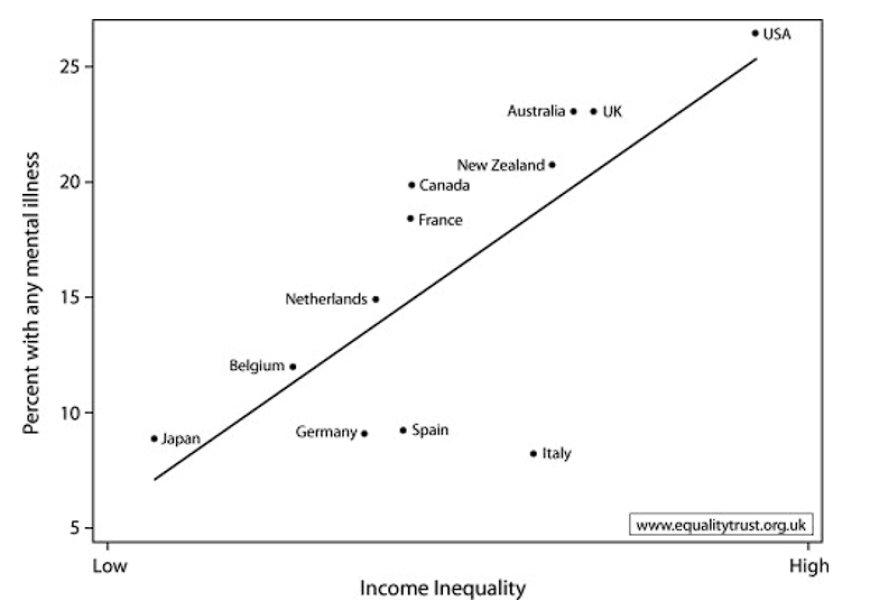
Across the world, some societies are pushing into an AI-driven, spacefaring future, while others remain locked in cycles of poverty that feel centuries old. This divergence isn’t only about income — it’s about opportunity, trust, and hope. Studies show that inequality doesn’t just hurt economies; it erodes the mental health and social fabric of nations (Patel et al., 2018), (Gao et al., 2022).
The Invisible Weight of Inequality
Living in poverty doesn’t just mean having less — it means carrying more stress. Constant uncertainty, fear of loss, and comparison with those who have more create a cycle of psychological strain. Wealth inequality has measurable effects on anxiety, depression, and even lifespan. Researchers have found that societies with smaller wealth gaps tend to have higher trust, stronger communities, and lower crime rates (Wilkinson & Pickett, 2009).
Inequality works like chronic stress — invisible, cumulative, and deeply damaging. It affects how people think, how they see themselves, and how they interact with others. When people believe the system is unfair, social cohesion dissolves. Trust declines, and resentment grows. The result isn’t just individual suffering; it’s collective instability.
How Culture and Systems Reinforce the Divide
Not every culture measures wealth the same way. In some, wealth is land or livestock; in others, it’s digital assets or influence. But the emotional consequences of inequality — envy, shame, despair — appear universal. Anthropology reminds us that inequality has existed in every society, but its expression depends on values. Collective cultures share resources, reducing the mental burden of scarcity. Individualistic cultures often amplify competition, intensifying anxiety and social comparison (Ahuja et al., 2015).
Sociology exposes how inequality becomes institutionalized. Systems of education, housing, and healthcare don’t just reflect inequality — they reproduce it. When certain groups consistently face barriers to access, poverty turns generational. Research shows that unequal systems foster chronic stress, insecurity, and even physiological decline (Elenbaas et al., 2020).
The Psychological Feedback Loop
Inequality affects the mind as much as the market. Studies confirm that income gaps correlate with higher depression and anxiety (Patel et al., 2018). People in unequal societies experience more social comparison, less security, and a diminished sense of worth. Even those who are “doing fine” financially feel pressure to keep up — creating a culture of constant striving and silent burnout.
From a psychological standpoint, inequality becomes self-perpetuating. Economic stress leads to poor mental health; poor mental health leads to reduced productivity and opportunity. Over time, this creates an invisible wall between classes — one built not of money, but of mindset.
Policy and Power: Mental Health as Economic Strategy
Government policy determines how wide the gap becomes — and how heavy it feels. Tax laws, minimum wage standards, healthcare access, and social programs can either cushion or intensify inequality. When policies favor the wealthy, inequality deepens; when they prioritize fairness, societies grow stronger and more stable (Itskovich, 2024).
Policymakers often underestimate the mental health cost of economic design. A low minimum wage, underfunded schools, or inaccessible healthcare don’t just trap people in poverty — they generate psychological trauma that ripples across generations. Economic reform and mental health reform are not separate agendas. They’re the same project.
Bridging the Divide
Closing the gap means more than redistributing wealth; it means redistributing possibility. Access to education, mental health care, and safe communities is what allows people to rise above survival mode and build meaningful lives. Reducing inequality isn’t charity — it’s prevention. It prevents illness, conflict, and despair.
As societies evolve, so must our definition of success. GDP and stock indices can’t measure the health of a civilization if its people are anxious, disconnected, and distrustful. The real measure of progress is psychological: are we creating conditions where people can think, dream, and feel secure?
A Future Worth Building
Inequality has always been part of the human story — but it doesn’t have to define the future. The data is clear: more equal societies are healthier, happier, and more innovative. The solution isn’t just to close the wealth gap, but to bridge the emotional and social divides that grow from it. The goal isn’t to make everyone the same, but to ensure everyone has the same chance to live without chronic fear or despair.
The ground beneath us isn’t falling away; it’s being rebuilt. Every generation inherits both the structures and the stories of those before it. The question is not whether inequality exists, but whether we’re willing to rewrite the story. The mind and the economy are now intertwined — and healing one means healing the other.
References
- Patel, V. et al. (2018). Income inequality and depression: A systematic review and meta-analysis. The Lancet Psychiatry.
- Gao, L., Li, J., & Yang, Y. (2022). How wealth inequality affects happiness: The perspective of social comparison. Frontiers in Psychology.
- Wilkinson, R., & Pickett, K. (2009). The Spirit Level: Why More Equal Societies Almost Always Do Better. Allen Lane.
- Elenbaas, L. et al. (2020). A developmental science perspective on social inequality. Developmental Science.
- Itskovich, E. (2024). Economic inequality, relative deprivation, and crime. Justice Quarterly.
- Ahuja, K. et al. (2015). A theory of individualism, collectivism and economic outcomes. arXiv.
What's Your Reaction?
 Like
0
Like
0
 Dislike
0
Dislike
0
 Love
0
Love
0
 Funny
0
Funny
0
 Wow
0
Wow
0
 Sad
0
Sad
0
 Angry
0
Angry
0

Founder of Pattern Nexus. I research markets, macro, geopolitics, AI, history, ancient systems, and the patterns most people overlook. I’m also building Market Radar, a trading scanner designed to read pressure, risk, confirmation, and setup quality before chasing a move. Pattern Nexus is where I connect the dots between data, history, technology, and the bigger system playing out around us.













Comments (0)