
The AI Wars Are Human Wars
The coming AI wars will not be machines versus humans. They will be humans versus humans—futurists who adapt and integrate AI versus pastists who resist and demand reversal. This Pattern Nexus framework maps the fault lines, escalation pathways, and why a future “shooting war” is plausible, fast, and structurally asymmetric.
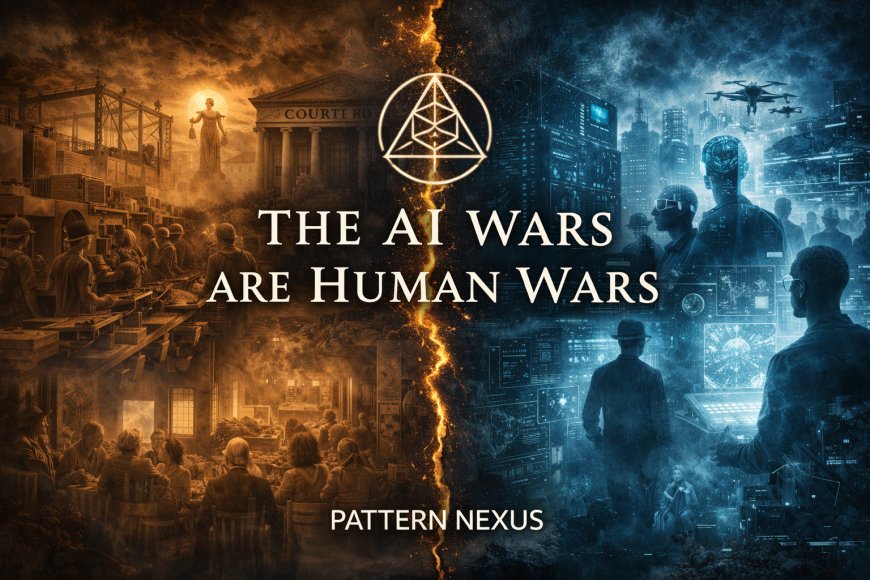
The AI Wars Are Human Wars
The conflict ahead will not be machines versus people. It will be people versus people, split by how they relate to AI. This is a control-system fracture: futurists will integrate, accelerate, and adapt; pastists will resist, demand reversal, and treat the new order as illegitimate. The war starts in comment sections and policy fights, then migrates into institutions, streets, and supply chains. If it turns hot, it won’t be long. It will be asymmetric, fast, and decided by which side controls the infrastructure layers that keep modern life online.
Executive Summary
AI wars are not science fiction. They are social physics. When a new control layer enters a civilization—one that compresses labor demand, concentrates capability, and rewrites the meaning of competence—society doesn’t politely “adjust.” It fractures. The fracture becomes political. The political becomes institutional. The institutional becomes operational. And when operational systems are contested—power grids, payments, logistics, identity systems, information channels—conflict stops being theoretical.
This article defines the two emerging camps:
- Futurists: people and institutions who accept acceleration as reality, integrate AI, redesign their lives around it, and treat adaptation as a moral responsibility.
- Pastists: people and institutions who experience AI as an attack on dignity, stability, and meaning; they resist, demand restoration, and treat the accelerating order as illegitimate.
The AI wars will unfold in stages: mockery and disbelief, then resentment and policy conflict, then institutional capture attempts, then sabotage and coercion, and—under certain conditions—localized violence. If violence escalates into a “shooting war,” it is unlikely to resemble a long conventional conflict. It will be short because the decisive terrain is infrastructure control. Once utilities, finance rails, and network access become weapons, the side holding the control surfaces can compress the conflict quickly.
That is the warning and the frame: this is not a debate about technology. It is a competition over who gets to define reality in an AI-mediated world.
What makes this different from past “tech disruptions” is not simply scale. It is simultaneity. AI is not disrupting one industry at a time. It is touching every institution that coordinates modern life at once: education, hiring, finance, media, law, healthcare, policing, warfare, and daily communication. When everything changes everywhere, the human mind does not interpret it as “innovation.” It interprets it as destabilization, loss of control, and betrayal.
And that is why the conflict forms along psychological lines faster than along policy lines. The human system seeks stability. It seeks story. It seeks a moral explanation for why life is changing. AI offers a perfect scapegoat and a perfect weapon simultaneously. It becomes the symbol for “why my life is getting harder,” and the tool for “how the other side is cheating.”
What “AI War” Actually Means
When most people hear “AI war,” they imagine robots. That’s a cinematic shortcut. The real war is simpler and more brutal: it’s a fight over power, legitimacy, and survival inside human societies undergoing an intelligence shock.
AI is not just a tool that makes tasks faster. It is a capability multiplier that changes the distribution of advantage. It allows one person to do what used to take ten. It allows a small team to do what used to take a department. It allows an institution to run leaner than its competitors. And it allows narrative actors—politicians, influencers, ideologues, foreign adversaries—to produce persuasion at industrial scale.
Once that capability exists, the question becomes: who is allowed to use it, under what conditions, and with what safeguards? That sounds like governance. But governance is not neutral. Governance is the surface where factions contest control.
So “AI war” is not one event. It is a multi-domain contest:
- Economic: who keeps income, who loses income, and who gets subsidized to prevent collapse.
- Social: who is respected and who is treated as obsolete.
- Institutional: which agencies, courts, and enforcement bodies are trusted versus rejected.
- Informational: whose reality wins when synthetic media and algorithmic persuasion saturate everything.
- Operational: who controls the infrastructure that keeps life functioning: power, water, payments, identity, logistics, communications.
War begins long before gunfire. It begins when two groups stop recognizing the same legitimacy. That is the core condition. AI accelerates the loss of shared legitimacy because it accelerates everything else: inequality, resentment, speed of change, and the feeling that decisions are being made “above” normal people by systems they cannot see or challenge.
In that sense, “AI war” is closer to a legitimacy civil conflict than a conventional war. It is a fight over who gets to set the rules for the next era, who gets to enforce those rules, and who gets to opt out. The violence risk is a secondary phenomenon. The primary phenomenon is a legitimacy fracture that turns every institutional decision into a symbolic act of domination.
That also means this conflict is not cleanly partisan. You will see futurists and pastists on the left and right. You will see futurists and pastists inside the same families. You will see futurists and pastists in the same workplace, with the same job title, using different tools and living in different mental worlds. That is why it spreads so fast: it is not “out there.” It is in the close-range social fabric where trust normally lives.
The Two Camps: Futurists vs Pastists
Futurists
Futurists do not necessarily “love” AI. Many of them are wary. But futurists share an underlying acceptance: AI is here, it will deepen, and the only rational move is to integrate and redesign around it.
They adopt AI the way earlier generations adopted electricity, the internet, and smartphones. They build workflows around it. They use it to learn faster, produce faster, decide faster. They treat AI literacy like basic literacy. And they tend to develop a moral narrative around adaptation: if you can’t keep up, it is partly your responsibility to retool.
Futurists are not a “class” in the old sense. They cut across income and ideology. But they cluster in certain zones:
- People with high learning velocity and low attachment to legacy identity roles
- Entrepreneurs and operators who treat advantage as something you must seize or you die
- Technical professionals, analysts, builders, and “power users” in every industry
- Younger cohorts, but also older people who stayed mentally plastic
- Institutions that can move fast: startups, growth companies, certain military and intelligence units
Futurists tend to see resistance as nostalgia. They interpret pastist anger as fear and ignorance. And they often underestimate how dangerous humiliation can become when it is mass-produced.
The futurist risk is not that they are wrong about the trajectory. The futurist risk is that they become culturally arrogant, operationally coercive, and blind to the fact that humans do not consent to being made irrelevant. When futurists treat social pain as “a skills gap,” they misread the nature of the injury. A skills gap can be trained. A dignity wound metastasizes.
Futurists also develop a specific belief that becomes politically explosive: that the old world was inefficient and therefore illegitimate. They begin to see legacy processes—slow bureaucracy, traditional education, credential gatekeeping, old labor protections—as “dead weight” that must be cut away. Pastists hear that as a declaration of war against stability itself.
Pastists
Pastists are not “stupid.” That’s the first mistake futurists make. Pastists are often rational inside their own world model. Their resistance is not always about the tool. It is about what the tool symbolizes: loss of dignity, loss of bargaining power, loss of predictable life.
Pastists experience AI as a hostile takeover of reality. They see livelihoods vanish, status collapse, and institutions behave like the future is a technical problem, not a human one. They hear “learn to code” in new language: “learn to prompt,” “learn to adapt,” “reskill,” “upskill.” To them it reads like contempt.
Pastists also cut across income and ideology, but cluster differently:
- People whose economic value is tied to routine cognition, credential gatekeeping, or legacy processes
- Communities with fragile local economies and low institutional trust
- Older cohorts with high attachment to a stable cultural order
- Workers who don’t fear “work,” but fear becoming irrelevant
- Ideological movements built on restoration narratives
Pastists will not all behave the same. Many will quietly adapt. Many will accept partial integration. But the defining feature of the pastist pole is legitimacy rejection: the belief that the accelerating AI order is morally wrong, socially destructive, and should be stopped, rolled back, or controlled so hard it becomes unusable.
The pastist risk is not simply “resistance.” The pastist risk is that resistance becomes identity, identity becomes purity politics, and purity politics becomes escalation. Pastists begin to demand not guardrails but reversals. Not accountability but bans. Not transparency but prohibition. And once prohibition fails (because it always fails in a globally networked competitive environment), the sense of betrayal deepens. They interpret the failure as proof that democracy and institutions are captured.
The Key Insight
This is not a debate over a gadget. This is a legitimacy conflict over the future structure of society. Futurists want acceleration with guardrails. Pastists want restoration with constraints. These are not compatible end-states. You can compromise on policies, but you cannot compromise on the emotional reality underneath: one side feels like the future is opportunity, the other feels like the future is theft.
The moment to pay attention is when the argument stops being about “how” and becomes about “who.” Who gets to decide what counts as real work. Who gets to decide what counts as truth. Who gets to decide what counts as human. Who gets to decide whether the future is allowed. That is the transition from policy disagreement to factional conflict.
AI as a Control Layer
Pattern Nexus framing: civilizations are stacks of control layers. Whoever controls the layers controls the outcomes.
For most of modern history, control layers were tangible:
- Energy
- Industry
- Finance
- Logistics
- Information
AI sits across all of them like an intelligence membrane. It does not replace the layers. It enhances the ability to optimize and dominate them. AI compresses decision loops. It reduces the need for large organizations. It enables surveillance and targeting. It automates persuasion. It changes the cost of coordination.
That last part matters more than people realize: the cost of coordination is the cost of organizing society. When coordination becomes cheap for one faction and expensive for the other, conflict is not fair. It becomes asymmetric. It becomes lopsided. That is how “quick wars” happen: one side can mobilize, out-inform, out-coordinate, and out-resource the other while the other is still arguing about whether the problem is real.
AI also changes enforcement. In a high-AI society, enforcement doesn’t start with police. It starts with permissions:
- Access to payment rails
- Access to network services
- Access to employment systems
- Access to identity verification
- Access to platforms that shape social reality
That means the conflict can become coercive before it becomes violent. People can be “defeated” without being arrested. Cut off financially, de-platformed socially, denied access administratively, slowed down procedurally. To futurists this looks like “policy.” To pastists it feels like siege warfare.
This is a fundamental inversion of how most citizens think power works. They imagine power as uniforms and weapons. In AI-saturated societies, power is often an API call. A risk score. A flagged identity. A restricted account. A denied service. A compliance refusal. A quietly enforced rule that no one voted on directly, embedded in the terms of service for daily life.
That is why this becomes combustible. People can tolerate visible authority more easily than invisible authority. Visible authority feels like a dispute you can fight. Invisible authority feels like a world you cannot reach.
The Control Surfaces That Decide Outcomes
If you want to forecast who wins in any internal conflict, you map the control surfaces. Not the slogans. Not the politics. The surfaces.
Compute and Model Access
AI capability is not evenly distributed. The headline tools are democratized, but the highest leverage remains concentrated: compute availability, frontier model access, proprietary integration, and the ability to fine-tune systems on domain-specific data. In a confrontation, the side with privileged compute can run faster OODA loops: faster analysis, faster narrative adaptation, faster operational coordination.
Identity Systems
Identity is the gate. If identity becomes unified, verified, and linked to services, then identity becomes a control lever. This does not require authoritarian intent to become authoritarian in effect. Even well-meaning anti-fraud and safety policies can be experienced as political exclusion if a faction believes enforcement is biased.
Payment Rails
Payments are life. The moment access to finance is mediated through risk scoring and platform compliance, coercion becomes frictionless. A society can survive political disagreement. It cannot survive mass exclusion from the ability to transact.
Energy and Grid Priority
AI is power-hungry. The physical build-out—generation, transmission, and grid stability—creates winners and losers. If AI infrastructure gets priority while households face higher bills, rolling outages, or constrained access, pastists interpret it as extraction. If AI infrastructure is blocked, futurists interpret it as sabotage of national competitiveness.
Logistics and Throughput
Modern life runs on supply chains, and supply chains run on coordinated systems. AI improves routing, forecasting, risk management, and distribution. In conflict, the ability to keep shelves stocked becomes legitimacy. The side that keeps life normal gains consent. The side that causes disruption, even for moral reasons, tends to lose the undecided middle.
Platforms and Narrative Distribution
Control of distribution is control of legitimacy. When the main channels of social perception are algorithmic platforms, platform governance becomes a hidden constitution. If one faction believes platform moderation and ranking are biased, they will treat it as a form of informational occupation. If platforms loosen governance too much, reality fractures into incompatible belief regimes.
Workplaces and Credentialing
Employment systems are governance systems. Requirements, certifications, screening filters, and “acceptable tool use” policies become policy by another name. When employers require AI integration, futurists see modernization. Pastists see forced assimilation.
These surfaces are why “quick” outcomes are plausible if conflict turns operational. You do not need to defeat an opponent everywhere. You only need to deny them function at a few chokepoints that keep daily life running.
Structural Fault Lines That Make This Inevitable
Most societies can tolerate disagreement. They cannot tolerate structural divergence: when two groups inhabit different realities and their incentives push them further apart over time.
Fault Line 1: Speed
The first fault line is speed of change. AI compresses the cycle time between skill acquisition and skill obsolescence. That means the old social contract—learn a trade, build a career, retire with dignity—weakens. Futurists respond by becoming modular: they treat identity as flexible and skills as a rotating stack. Pastists respond by demanding stability: they treat identity as anchored and expect institutions to preserve continuity.
Speed alone creates anger. Anger creates politics.
Speed also breaks mentorship. In fast systems, older cohorts cannot train younger cohorts using stable playbooks, because the playbook is outdated before it is taught. That erodes intergenerational authority and makes younger people more susceptible to algorithmic influence than human guidance.
Fault Line 2: Visibility
The second fault line is visibility. AI systems feel invisible and unaccountable. People can accept hardship if they understand the cause and believe the rules are fair. AI disruptions often feel like invisible hands deciding winners and losers. That produces conspiratorial thinking, even when the cause is simply incentives and automation.
When systems become invisible, trust collapses. When trust collapses, legitimacy collapses. When legitimacy collapses, conflict becomes physical.
Visibility is also about accountability. In the old world, you could point to a boss, a manager, a company, a politician. In the AI-mediated world, decisions become diffused into “the model,” “the policy,” “the platform.” Pastists interpret diffusion as evasion, which hardens resentment.
Fault Line 3: Humiliation
The third fault line is humiliation. It is not enough that jobs shift. The issue is how society narrates the shift. If the narrative becomes “you are obsolete,” “you are unskilled,” “you are the problem,” then resistance stops being policy-based and becomes identity-based.
Humiliation is gasoline. AI is a spark machine.
Humiliation also scales now. A person can be mocked by thousands in a day. Entire demographic groups can be culturally labeled as “the people who don’t get it.” When humiliation is mass-produced, it produces mass resentment, and resentment always looks for a moral justification to become action.
Fault Line 4: Concentration
AI concentrates power. Even if AI tools become widely available, the highest leverage comes from compute, data, distribution, and integration into institutional workflows. That means advantage pools into certain firms, agencies, and networks. Concentration creates oligarchy optics. Oligarchy optics create revolt optics.
Concentration also creates a permanent suspicion that the future is being written by unelected actors. Whether that suspicion is fully accurate is almost irrelevant. In legitimacy conflicts, perception is a physical force. It shapes how people behave, vote, resist, and escalate.
Fault Line 5: Reality Fragmentation
AI enables personalized realities. Not just feeds—belief ecosystems. People can live inside algorithmically reinforced worlds. When two groups no longer share facts, compromise becomes impossible. Pastists interpret futurist information as propaganda. Futurists interpret pastist information as misinformation. Both can be correct in different cases, which is what makes it toxic.
Fragmentation does not require that one side be “lying.” It only requires that each side’s information environment is selectively reinforcing, emotionally compelling, and socially rewarded. When belonging depends on belief, belief hardens. When belief hardens, conflict becomes identity protection rather than truth-seeking.
The Cognitive Class Split
One of the most dangerous dynamics is the emergence of a cognitive class split that is not purely about IQ or education, but about interface compatibility with AI.
Some people will treat AI like an exoskeleton for the mind. They will offload memory, drafting, analysis, pattern search, and synthesis into workflows that make them 3–10x more effective. Others will not, either by choice or by friction: distrust, lack of access, cultural resistance, or simply not wanting their cognition mediated by a machine.
That produces a new stratification:
- AI-integrated operators: faster, more productive, more employable, more influential
- Legacy operators: slower relative to the new baseline, increasingly boxed into shrinking niches
This stratification will be perceived as moral. That’s the trap. Futurists will moralize integration: “You had the tools, you chose not to use them.” Pastists will moralize resistance: “You sold your humanity and destroyed the social fabric.” Once moralized, policy becomes holy war.
Every holy war starts with a claim that the other side is corrupt.
There is a second layer here: people do not only lose jobs. They lose status signals. In many environments, competence is social power. AI destabilizes the old competence markers: writing well, researching quickly, producing reports, generating plans, making presentations, even coding. When AI can do these tasks, status hierarchies reorder. The people who relied on those markers feel robbed. The people who adapt feel justified. That is a recipe for resentment that appears “irrational” to futurists but is deeply rational in the social-psychological sense.
This is also where the split becomes generational, not because young equals futurist and old equals pastist, but because younger cohorts tend to form identity through fluid digital interfaces, while older cohorts tend to form identity through stable roles and institutions. AI attacks stable roles first. That doesn’t mean older people can’t adapt. It means the emotional cost of adaptation is higher for many of them.
Labor, Dignity, and the Collapse of the Old Bargain
People can survive economic hardship. What they can’t survive—psychologically and politically—is the loss of dignity paired with the loss of agency.
The old bargain was simple:
- Work creates value
- Value earns income
- Income buys stability
- Stability produces legitimacy
AI disrupts this at the first link. Not because “work disappears” overnight, but because a large fraction of cognitive work becomes cheap. Cheap work means wages compress. Wage compression means identity crisis. Identity crisis means political volatility.
Here is the part most futurists don’t want to say out loud: even if new jobs appear, they will not preserve the same status ladder for everyone. Some people will land in higher leverage roles. Some will land in lower dignity roles. Some will land in “subsidized existence.” Pastists will interpret subsidized existence as a cage.
When you replace a dignity ladder with a dependency ladder, you don’t create peace. You create resentment.
This is why our “MMT checks for everyone” framework has a hidden hazard: it stabilizes consumption, but it does not automatically stabilize meaning. A check can prevent starvation. It cannot prevent humiliation. It cannot substitute for purpose. Societies that try to run purely on distribution without identity reformation will become unstable. That instability is where the AI wars live.
There’s also a timing mismatch that makes this worse. The labor market doesn’t collapse cleanly. It softens, compresses, and tightens in uneven waves. That creates denial on the way down and rage on the way through. People don’t revolt the moment things get worse. They revolt when they realize the system will not restore what they lost.
Pastists will look backward for a restoration policy that can’t exist because the productivity frontier moved. Futurists will look forward and treat restoration demands as sabotage. Both sides will be partially correct and fully incompatible at the emotional layer.
And there is a final knife-edge variable: credit. In modern economies, dignity is often financed. People sustain lifestyles and identities through credit, not wages alone. If wage compression coincides with tighter credit, a large number of households experience simultaneous identity loss and financial collapse. That is historically where political volatility spikes.
Institutional Legitimacy and the Next Trust Crisis
Every time a civilization goes through a major control-layer upgrade, institutions lag. Institutions are slow because they are built on procedures, precedent, and risk management. AI is fast because it is built on iteration.
That mismatch produces crisis.
Pastists will say institutions are captured by futurists and corporations. Futurists will say institutions are obstructed by pastists and nostalgia. Both will point to real examples. Then they will generalize. And once generalized, the institution becomes an enemy symbol, not a service provider.
Watch how this plays out across sectors:
Education
Schools become legitimacy battlegrounds. Futurists demand AI-native curriculums, tool use, accelerated learning, and evaluation redesign. Pastists demand bans, restoration of “real learning,” and moral panic over cheating and cognitive decay. Both have valid points, which is why the fights will be vicious.
The deeper conflict inside education is that education has always been a sorting system disguised as a learning system. AI breaks the sorting mechanism. If AI can produce the “correct” outputs, then outputs stop proving competence. That forces society to redesign evaluation, which forces society to admit that credentials are partly a social control layer. That admission is not politically survivable without conflict.
Courts and Regulation
Regulators will be forced to govern systems they don’t fully understand. That creates inconsistent enforcement, which creates perceptions of favoritism. Pastists will interpret selective enforcement as tyranny. Futurists will interpret regulatory friction as sabotage. The court system will be flooded with disputes over liability, IP, deepfakes, identity theft, algorithmic discrimination, and employment displacement.
Legal systems are fundamentally precedent machines. AI is fundamentally novelty generation. That mismatch is permanent. Courts will become slower relative to the speed of dispute creation, and the public will interpret slowness as incompetence or corruption. Both interpretations fuel legitimacy decay.
Media
Media loses monopoly on narrative. AI-generated content industrializes persuasion. “Truth” becomes a contested product. Pastists will demand enforcement of reality; futurists will demand free flow and adaptation. The state’s temptation to label dissent as misinformation will grow. That is where legitimacy breaks if mishandled.
The deeper issue is that media used to be a shared reference. In fragmented reality, media becomes factional ammunition. Every correction looks like bias. Every omission looks like conspiracy. AI will generate plausible “evidence” fast enough that institutions cannot keep up, and the inability to keep up will be interpreted as refusal to keep up.
Police and Security
Security institutions will adopt AI for surveillance, predictive analytics, and operational efficiency. Futurists will call it modernization. Pastists will call it oppression. If the pastist camp concludes the security apparatus is an AI-enabled occupation force, escalation risk spikes.
Even without malicious intent, automated enforcement will feel inhuman. People accept human discretion even when it is unfair because it is interpretable. They do not accept machine discretion easily because it feels unappealable. “The system flagged you” becomes a legitimacy disaster sentence.
Narrative Warfare: The Battlefield Before the Battlefield
If you want to understand why this will feel like war long before it becomes war, you have to understand narrative as infrastructure.
Narrative is how humans coordinate. It is how we decide what is legitimate, what is evil, what is acceptable, what is intolerable. AI will weaponize narrative because it can produce endless variations targeted to endless psychological profiles. That means every faction will be able to manufacture moral certainty on demand.
This is where the comment section matters. People dismiss it as noise. It isn’t. It’s an early sensor reading. It’s a public diagnostic of where legitimacy is failing. When you see the same emotional patterns repeating across unrelated posts—resentment, mockery, fear, restoration fantasies—you are watching the early formation of the futurist/pastist split.
And the algorithm amplifies conflict because conflict drives engagement. So the informational environment becomes a pressure cooker that selects for extremity. Moderate futurists get radicalized into contempt. Moderate pastists get radicalized into rage. The center collapses. Then the political system can’t mediate. That’s when escalation becomes nonlinear.
In older eras, propaganda was scarce and expensive. In the AI era, persuasion is abundant and cheap. The limiting factor is not production. It is distribution and credibility. That means factions will compete to “own” trusted messengers: local leaders, influencers, alternative media, community anchors. When credibility becomes a battlefield resource, trust networks harden into tribes.
And the most dangerous change is this: AI allows a faction to tailor reality to the listener. People are not persuaded by facts. They are persuaded by identity-safe stories. AI can generate identity-safe stories for millions of micro-audiences. That makes the persuasion engine far more effective than a one-size-fits-all narrative campaign.
Escalation Pathways
There are predictable phases to this conflict. Not because history repeats perfectly, but because human systems have limited ways to fail.
Phase 1: Mockery
Early on, futurists mock pastists as backward, fearful, anti-progress. Pastists mock futurists as naive, soulless, detached, elitist. This phase feels like culture war entertainment. It is not. It is where empathy dies.
Mockery is not harmless. It is the social permission slip for dehumanization. Once a faction can laugh at another faction, it can deny them dignity. Once it denies dignity, it can justify coercion as “necessary.”
Phase 2: Policy War
Next comes policy conflict: bans, mandates, restrictions, subsidies, licensing, surveillance rules, education standards. This is when both camps try to encode their worldview into law. The losing side begins to view the system as illegitimate.
Policy war is also where economic pain becomes moralized. Futurists frame policy as competitiveness and security. Pastists frame policy as protection and humanity. When both believe they’re defending “the people,” compromise becomes betrayal.
Phase 3: Institutional Capture Attempts
Pastists attempt to capture school boards, local governments, unions, regulatory bodies, courts. Futurists attempt to capture corporate HR policies, platform rules, and technical standards bodies. The fight shifts from “opinion” to “control of the rules.”
This phase is when ordinary citizens begin to feel that every institution is political. When everything feels political, neutrality dies. When neutrality dies, coexistence collapses.
Phase 4: Economic Coercion
Employers begin requiring AI integration. Insurance pricing changes. Compliance regimes expand. Pastists begin to experience exclusion as structural. Boycotts, strikes, and local refusals emerge. Futurists respond with automation and relocation. Pastist communities hollow out faster. Resentment turns into hostility.
Economic coercion is also invisible coercion. It doesn’t look like force. It looks like “market reality.” That makes it harder to contest and easier to rage against.
Phase 5: Operational Sabotage
Once a faction believes the system is an occupying force, sabotage becomes morally justified in their narrative. This is where cyber attacks, vandalism, arson, intimidation, and localized violence can begin. Targets are symbolic at first: data centers, corporate offices, AI-enabled security deployments, “traitor” individuals who represent integration.
The dangerous pivot is when sabotage becomes framed as “defense.” Defense narratives recruit faster than aggression narratives. Once people believe they are defending their children, their community, their future, escalation becomes emotionally easy.
Phase 6: Security Crackdown
The state responds. Surveillance expands. Enforcement tightens. Some crackdowns are necessary. Some are excessive. Excess creates martyrs. Martyrs create recruits. The cycle escalates.
Crackdowns also create a permanent problem: every tool used to stabilize society becomes proof of tyranny to the faction that feels targeted. In AI-mediated enforcement, that perception intensifies because enforcement becomes scalable and less personal.
How This Becomes a Shooting War
You said it directly: it could become a shooting war, and it would be quick. That is a plausible scenario, but not inevitable. The key is to describe the mechanisms without romanticizing violence.
Here is the structural logic of “quick.” Modern societies are brittle when infrastructure is contested. If violence breaks out and one side gains control of critical control surfaces—power, fuel distribution, payment rails, communications access—the other side collapses operationally. This is not the 1800s. You cannot run a modern region without logistics and networks.
A shooting war becomes likely when three conditions converge:
Condition 1: Identity-Based Legitimacy Collapse
Pastists conclude the futurist-run system is not simply “wrong,” but illegitimate and immoral. Futurists conclude pastists are not simply “concerned,” but existential threats to progress and stability. Once each side believes the other is an existential threat, violence becomes thinkable.
Condition 2: Localized Economic Ruin
When displacement concentrates geographically or demographically, you get pockets of ruin. Ruin creates grievance. Grievance creates radicalization. Radicalization creates cells. Cells create incidents.
Condition 3: A Trigger Event
Trigger events can be real or synthetic. A deepfake that ignites riots. A high-profile layoff wave blamed on AI. A police incident involving AI surveillance. A scandal showing algorithmic discrimination. A foreign actor amplifying chaos. The trigger doesn’t create the fracture. It just proves the fracture exists.
If these conditions converge, the path to violence looks like this:
- Localized clashes around symbolic targets (data centers, AI labs, government offices, utilities)
- Retaliatory enforcement and hardening of infrastructure
- Escalation into coordinated attacks and counterattacks
- Rapid suppression if the state and AI-integrated institutions maintain unified operational control
This is why it would be “quick.” Not because people won’t fight. Because the operational asymmetry is enormous. A futurist-aligned apparatus with AI-driven surveillance, logistics coordination, and financial control can compress insurgent capacity quickly—if it maintains legitimacy with enough of the population. If legitimacy collapses broadly, then it stops being quick and starts being something darker.
The point here is not “who wins.” The point is that the conditions for violence are not fantasy. They are a mechanical consequence of legitimacy collapse in a society where daily life is mediated by controllable infrastructure.
Trigger Events and “Reality Shocks”
The most underestimated risk in the AI era is the reality shock: a moment where a large portion of the public suddenly realizes that the old assumptions are gone and cannot return. That realization can come from economics, from scandal, from synthetic media, or from institutional failure. The trigger does not need to be the biggest event. It needs to be the event that makes denial impossible.
Reality Shock 1: The Credential Break
A high-profile collapse in trust around credentials, testing, licensing, or education outcomes. If a society can’t agree on what competence is, it can’t agree on who should lead. That turns every leadership structure into a legitimacy fight.
Reality Shock 2: The Deepfake Governance Crisis
A synthetic media incident that generates real-world consequences fast enough that institutions cannot correct it in time, or cannot correct it credibly. This is where trust collapses not because truth is unavailable, but because truth is no longer authoritative.
Reality Shock 3: The “AI Layoff Wave” Narrative Lock-In
Whether or not AI is the sole cause, a public consensus forms that AI is the reason livelihoods are collapsing. Once that narrative locks in, policy conflict becomes emotionally non-negotiable.
Reality Shock 4: AI Enforcement Backlash
A scandal or incident where automated surveillance or scoring is perceived as politically targeted, discriminatory, or simply inhuman. Even if the system is statistically fair, the human experience of being processed by a machine is often experienced as oppression.
Reality Shock 5: Infrastructure Prioritization Crisis
Visible prioritization of AI infrastructure needs (power allocation, rate structures, water use, siting) while households face costs and constraints. Pastists will interpret this as the future feeding on the present.
Triggers matter because they compress time. A slow legitimacy decay can be managed. A sudden legitimacy rupture creates volatile crowd dynamics, overreaction by institutions, and the kind of cascading errors that turn political conflict into street conflict.
A 20-Year Scenario Map
Years 1–3: The Interface Divide Becomes Obvious
AI adoption accelerates in white-collar work and hybrid roles. People who integrate pull ahead. People who refuse fall behind. Most of society still argues about whether it’s real. This is when the futurist/pastist labels solidify culturally. Schools and workplaces become battlegrounds. Deepfake incidents begin to erode baseline trust.
Key dynamic: people still believe institutions can manage it. That belief erodes quietly.
In this window, denial is the dominant stabilizer. Denial keeps conflict contained because people still believe their world will return to normal if they just “wait it out.” That is why the emotional tone is mockery and dismissal. It is a defense mechanism against acknowledging permanent change.
Years 4–7: Labor Compression and the Rage Phase
This is where displacement stops being abstract. Not total job loss—compression. Fewer openings. Lower wage growth. Increasing competition. Career ladders break. Young adults feel locked out. Mid-career workers feel betrayed. Pastist movements gain power by promising restoration: bans, restrictions, protections, “human-first” mandates.
Futurists respond by going around the system: building parallel workflows, relocating, bypassing legacy institutions. The gap widens. Pastists interpret bypass as contempt and abandonment.
This is where “AI wars” become visible as a social phenomenon. People stop arguing about whether AI is real. They argue about whether the people using AI are cheating, whether the institutions enabling AI are corrupt, and whether society is committing a moral crime by allowing the shift.
Years 8–12: Institutional Realignment and Control Surface Battles
Governments respond with redistribution mechanisms, training programs, and AI governance frameworks. Some of it works. Much of it fails because it’s designed by committees for a moving target. Meanwhile, corporations consolidate AI advantage. The compute layer becomes strategic. Energy and grid buildouts become political. Data centers become strategic terrain.
This is where conflict moves from “opinions” to “infrastructure decisions.” Where do we build? Who gets power? Who pays? Who controls the models? Who audits them? Who has access? These fights look technical, but they are actually class war by another name.
By this window, international competition becomes an accelerant. If rival nations integrate AI faster, futurists gain an argument that is extremely hard to defeat: “If we don’t do this, we lose.” Pastists hear that as hostage logic: “We must destroy our social fabric because someone else might.” That turns national security into internal fracture.
Years 13–17: Fragmentation or Stabilization
Two broad futures emerge here.
Stabilization path: society normalizes AI as a utility, builds new dignity ladders (new forms of value and purpose), maintains institutional legitimacy through transparency and accountability, and keeps pastists integrated rather than humiliated.
Fragmentation path: society fails to build meaning systems; redistribution becomes dependency without dignity; deepfake reality collapse makes consensus governance impossible; and political violence becomes normalized.
The deciding variable is not technology. It is legitimacy management. If institutions can maintain a believable sense that rules are fair, appealable, and not written by invisible elites, stability is possible. If they cannot, conflict becomes the default coordination mechanism.
Years 18–20: Resolution Phase
By this point, the futurist/pastist split either becomes a managed pluralism or it becomes an entrenched hostility. If managed, the conflict cools into cultural divergence with policy compromise. If hostile, you get recurring flare-ups: sabotage, crackdown, retaliation. The “shooting war” risk is highest in the fragmentation path, but even then it will likely manifest as bursts rather than a clean front line—unless a larger crisis (financial collapse, major war, grid failure) provides the spark.
In a managed pluralism outcome, the society creates stable “lanes” for AI integration with enforceable boundaries and dignity-preserving roles for those who do not want full integration. In an entrenched hostility outcome, the society becomes two incompatible civilizations sharing one territory, each trying to control the control surfaces.
Early Warning Indicators
If you want to treat this like a systems problem, you track indicators the way you track stress in a financial system. You don’t wait for the crash. You watch the plumbing.
Indicator 1: AI-as-cheating sentiment in workplaces and schools
When AI use is widely perceived as illegitimate advantage rather than legitimate tool use, social trust collapses fast. You will see it as accusations, policy fights, and interpersonal hostility.
Indicator 2: Rapid growth of “ban it” political coalitions
Not “regulate it.” Ban it. Ban language is the signature of legitimacy rejection. It implies the future itself is unacceptable.
Indicator 3: Increased platform migration into closed communities
When factions retreat into separate channels and stop sharing informational space, reality fragmentation hardens. At that point, policy disputes become impossible to mediate.
Indicator 4: Financial exclusion events tied to identity or speech
Even isolated cases can trigger broad fear if they fit a narrative of control. Once people believe payments are a political weapon, escalation risk rises.
Indicator 5: Infrastructure siting conflicts with moral language
When data centers, transmission lines, and power allocations become moralized, you are watching the control surface battles move into local politics.
Indicator 6: Institutional “speed gaps” become public scandals
Courts, regulators, and public agencies falling behind reality creates the perception that they are either incompetent or captured. Both outcomes reduce legitimacy.
These indicators matter because they are pre-violence signals. The system gives warnings. It always does. The question is whether leadership and institutions interpret those warnings as cultural noise or as structural stress.
Off-Ramps and Stabilizers
The point of this framework is not fatalism. It’s recognition. Societies can mitigate conflict if they address the real drivers instead of arguing about the surface politics.
Stabilizer 1: Dignity Architecture
If displacement is managed only with checks, resentment grows. If displacement is managed with new forms of social status, contribution, and local purpose, stability rises. You need a dignity architecture, not just an income architecture. Communities need roles that matter. People need to feel needed.
Stabilizer 2: Transparent Governance and Auditability
Invisibility breeds conspiracy. You reduce conspiracy by making systems inspectable, appealable, and limited. Not “trust us.” Actual mechanisms: audits, due process, model transparency where possible, and enforceable constraints.
Stabilizer 3: Local Control Where Feasible
Centralization triggers rebellion. Local autonomy reduces threat perception. Not total decentralization—just enough local control that people feel they are not being ruled by distant systems they cannot influence.
Stabilizer 4: AI Literacy as Public Infrastructure
If AI integration becomes a class marker, conflict intensifies. Make literacy universal. Treat AI like electricity: a baseline capability society provides, not a luxury advantage only elites can afford.
Stabilizer 5: Narrative Restraint
Stop humiliating people. Futurists need to understand that contempt creates insurgency. Pastists need to understand that restoration fantasies can become self-destruction. The informational environment needs friction against outrage farming, or it will keep radicalizing both sides.
There is a sixth stabilizer that matters because it is the only one that directly targets the conflict engine: legitimacy guarantees. People need to believe that they can lose today and still have rights tomorrow. If factions believe losing means permanent exclusion, they will escalate. If factions believe losing is survivable, they negotiate.
The Choice Window
The AI wars are already here in proto-form. They look like comments and arguments, like identity fights over what counts as real work, like panic over deepfakes, like rage at layoffs, like hostility toward “tech people,” like contempt toward “backwards people.” That is not noise. It is the early signal of a structural split.
The futurist/pastist frame matters because it stops us from pretending this is a simple left-right political issue. It is deeper than politics. It is about adaptation, legitimacy, and the right to define reality.
If society treats AI as a pure efficiency upgrade, it will ignite conflict. If society treats AI as a civilization layer that must be integrated with dignity, transparency, and shared benefit, it can be stabilized.
But the clock is not infinite. The longer the gap grows between AI-integrated operators and everyone else, the more the conflict shifts from policy to identity, and from identity to hostility.
This is the choice window: build a future that keeps people inside the legitimacy boundary, or watch legitimacy fracture into camps that no longer recognize each other as part of the same society.
And the key Pattern Nexus takeaway is blunt: this is not primarily a technology story. It is a control story. Whoever manages the control surfaces while preserving legitimacy will define the next era. Whoever fails legitimacy management will discover that the “AI war” was never about the machine. It was about the human system breaking in half.
FAQ
Isn’t this just another culture war narrative?
No. Culture wars are often symbolic. This is structural. AI changes labor markets, governance capabilities, enforcement mechanisms, and information integrity. Those are real control surfaces, not just beliefs.
Why do you think a shooting war could happen?
Because modern conflict often emerges from legitimacy collapse plus concentrated economic ruin plus a trigger event. AI increases all three risk factors: it accelerates displacement, fragments reality, and creates high-volatility trigger conditions through synthetic media and surveillance backlash.
Why would it be “quick” if it turned violent?
Because operational control matters more than territory. If one side controls power, finance rails, communications, and surveillance, it can compress insurgent capacity rapidly. The danger is not a long war. The danger is chaotic bursts, overreaction, and the erosion of civil stability.
Are futurists the “good guys” here?
No. Futurists can become arrogant and coercive. Pastists can become destructive and reactionary. The framework is descriptive, not moral. The moral question is how a society integrates a new control layer without humiliating a large fraction of its people.
What’s the single biggest risk factor?
Humiliation. When people feel obsolete and mocked while institutions tell them to “adapt,” resentment becomes identity, and identity becomes conflict.
What is the most realistic “end state”?
A managed pluralism where AI integration becomes normal but bounded, and where societies build new dignity ladders so “non-elite” status is not treated as social failure. The worst end state is a two-reality society where control surfaces are used as faction weapons and legitimacy never recovers.
Sources and Notes
- Pattern Nexus Systems Lens: control layers, legitimacy boundaries, and infrastructure as decisive terrain
- Observational basis: public discourse patterns, workplace adoption dynamics, education policy disputes, and synthetic media emergence
- This article is a framework analysis rather than a citation-heavy report; follow-on pieces can map case studies, policy proposals, and regional risk profiles
Apa Reaksi Anda?
 Suka
0
Suka
0
 Tidak Suka
0
Tidak Suka
0
 Cinta
0
Cinta
0
 Lucu
0
Lucu
0
 Wow
0
Wow
0
 Sedih
0
Sedih
0
 Marah
0
Marah
0

Founder of Pattern Nexus. I research markets, macro, geopolitics, AI, history, ancient systems, and the patterns most people overlook. I’m also building Market Radar, a trading scanner designed to read pressure, risk, confirmation, and setup quality before chasing a move. Pattern Nexus is where I connect the dots between data, history, technology, and the bigger system playing out around us.


















Komen-komen (0)