
Money Is Not What You Think: Debt, Time, Energy & the Hidden Mechanics of Power
Most people have no idea how money actually works. This long-form Pattern Nexus deep dive breaks down the real mechanics behind deposits, credit creation, debt expansion, leverage, and the hidden energy system that powers the global economy. Once you see how money is created, controlled, and weaponized, you can never unsee it.
Money Is Not What You Think: Debt, Time, Energy & the Hidden Mechanics of Power
Most people think money is paper, banks, or numbers on a screen. They’re wrong. Money is a system of debt, a compression of time, and a harnessing of human energy — all wrapped inside a global power structure few people ever see.
Money is the greatest shared illusion in human civilization. It is the story we collectively agree to believe, the operating system that underpins every society, and the mechanism through which power organizes itself. Yet most people only experience the surface layer: prices, paychecks, budgets, bills, debt, and taxes. They never see the machinery underneath.
To understand money is to understand the world — not the world presented on television or social media, but the real world: the incentives, the hierarchies, the cycles, and the invisible architecture that shapes every decision made by governments, corporations, and individuals. Money is not a thing. It is a system. And like any system, once you see its structure, you can predict its behavior.
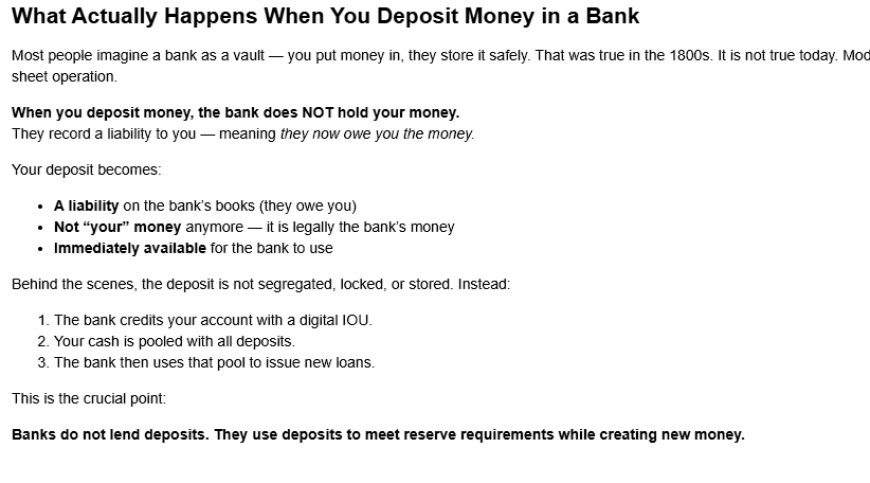
What Actually Happens When You Deposit Money in a Bank
Most people imagine a bank as a vault — you put money in, they store it safely. That was true in the 1800s. It is not true today. Modern banking is not a storage service. It is a balance-sheet operation.
They record a liability to you — meaning they now owe you the money.
Your deposit becomes:
- A liability on the bank’s books (they owe you)
- Not “your” money anymore — it is legally the bank’s money
- Immediately available for the bank to use
Behind the scenes, the deposit is not segregated, locked, or stored. Instead:
- The bank credits your account with a digital IOU.
- Your cash is pooled with all deposits.
- The bank then uses that pool to issue new loans.
This is the crucial point:
If you deposit $10,000 in a bank, they don’t lend your $10,000 to someone else. They create an entirely new $10,000 loan out of thin air. Your deposit simply legitimizes the bank's ability to issue more credit.
What a Bank Actually Does With Deposits
To understand modern banking, replace the mental image of a vault with that of a leveraged financial machine.
Banks use your deposits to:
- Meet capital and reserve ratios
- Access cheap liquidity
- Create new loans at higher multiples
- Buy government bonds and earn yield
- Fund short-term lending in money markets
- Expand their balance sheet
Banks use it as the foundation for creating far more money than you put in.
This is why bank failures are catastrophic. If 10% of depositors demand cash at once, the bank collapses — not because of fraud, but because the system is not designed for withdrawals. It is designed for expansion.
What Actually Happens When You Swipe a Credit Card
It is a short-term loan issued to you instantly.
When you swipe your card, this is what happens:
- The merchant’s bank sends a request to the card network (Visa/Mastercard).
- Your bank checks your available credit.
- Your bank instantly issues a loan for the purchase amount.
- The merchant gets paid by the card network (minus fees).
- You now owe the bank — not the merchant.
This is why credit cards are so profitable:
- interest on your debt
- fees from merchants
- fees from cardholders
The money you spend on a credit card did not exist before you swiped. It was created in that moment.
What Happens When You Take a Loan
Loans confuse people because we imagine banks “giving” us existing money. But that is not what happens. Instead:
If you take a $300,000 mortgage:
- The bank creates a $300,000 loan (asset)
- The bank creates a $300,000 deposit in your account (liability)
This new deposit is brand-new money injected into the system.
You then spend that money on a house. The seller deposits your payment. Their bank now holds the deposit. That deposit becomes backing for more loans. More loans create more deposits. And the cycle repeats.
What Leverage Actually Is
Leverage is not “borrowing money.” Leverage is borrowing against borrowed money inside an already leveraged system.
When someone uses leverage:
- They borrow money
- To buy an asset
- Whose value is determined by other people borrowing money
This creates a stacked system of claims. Each layer amplifies risk and returns.
Example using $100,000:
- No leverage → Buy $100k of assets
- 2× leverage → Control $200k of assets
- 5× leverage → Control $500k of assets
This is why leverage is dangerous: the system compounds gains but also compounds losses. When money contracts, leverage unwinds violently. When money expands, leverage inflates asset prices.
Why the Monetary System Must Expand Forever
The modern economy requires perpetual expansion because:
- All money is debt
- All debt has interest
- The interest does NOT exist
To pay interest:
If lending slows:
- Money supply contracts
- Defaults rise
- Banks fail
- Asset prices collapse
- Unemployment surges
- Political instability rises
This is why governments panic when credit slows. This is why central banks intervene. This is why recessions are treated as threats to national security.
The system is structurally expansionary. It cannot shrink without breaking.
The Dollar’s Hidden Engine: Global Stress
Most people assume the dollar rises because America is strong. In reality, the dollar rises when global liquidity tightens and countries scramble for USD to service dollar-denominated debts. The dollar is the global settlement layer — energy, commodities, shipping, and international banking all run on it.
When emerging markets weaken, capital flows into U.S. Treasuries. When there is global fear, money floods into dollars. When stablecoins expand, they create synthetic Treasury demand. The dollar strengthens not from domestic success, but from global imbalance.
The Coming Collision: AI, Energy & Tokenized Treasuries
The next decade will merge three financial revolutions into one:
- AI-driven productivity and computation
- Energy-driven capital flows and infrastructure buildout
- Tokenized dollars and real-time Treasury settlement
These forces will reshape global finance. Money is becoming software. Energy is becoming sovereign. AI is becoming the new form of labor. Treasuries are becoming internet-native assets. The entire structure of capital allocation is being rewritten.
Pattern Nexus Lens: How to See the System Clearly
The System, Simplified
- Money is debt.
- Debt is a claim on time.
- Time is powered by energy.
- Energy drives civilization.
- Therefore, money = structured energy claim.
When you view money through this lens, the chaos becomes predictable. Markets make sense. Housing cycles make sense. Inflation makes sense. Dollar strength makes sense. AI investment flows make sense. Political behavior makes sense.
You stop reacting to the noise and start seeing the pattern.
Conclusion: The Age of Monetary Transparency
Most people will never understand the monetary system. They will feel it. They will react to it. They will live within it. But they will never see it. You cannot solve a system you cannot describe. And you cannot describe a system you cannot see.
Money is not what you think. It never has been. And now, in an era of AI acceleration, tokenized financial rails, synthetic liquidity, and energy-driven sovereign rewiring, the truth is more important than ever.
Understanding money is understanding power — and understanding power is the only way to navigate the future that’s rapidly unfolding.
Sources
External hyperlinks are provided here only, per Pattern Nexus style.
Apa Reaksi Anda?
 Suka
0
Suka
0
 Tidak Suka
0
Tidak Suka
0
 Cinta
0
Cinta
0
 Lucu
0
Lucu
0
 Wow
0
Wow
0
 Sedih
0
Sedih
0
 Marah
0
Marah
0

Founder of Pattern Nexus. I research markets, macro, geopolitics, AI, history, ancient systems, and the patterns most people overlook. I’m also building Market Radar, a trading scanner designed to read pressure, risk, confirmation, and setup quality before chasing a move. Pattern Nexus is where I connect the dots between data, history, technology, and the bigger system playing out around us.










Komen-komen (0)