
The Calm Before the Liquidity Storm: QE 2026 and the Digital Evolution of Money
Federal Reserve Chair Jerome Powell’s recent comments on ending Quantitative Tightening signal that the liquidity cycle is turning again. With repo market stress quietly building, QE 2026 may arrive sooner than most expect. This time, the easing won’t just involve printed dollars — it will merge with the rise of tokenized assets, digital Treasuries, and programmable money.
The Calm Before the Liquidity Storm
After Jerome Powell’s recent remarks in Philadelphia about ending Quantitative Tightening (QT), the outlines of the next cycle are starting to appear. Combined with fresh data showing a spike in overnight repurchase agreements, the signs of a liquidity turn are unmistakable. We’ve seen this movie before — and the ending rarely changes.
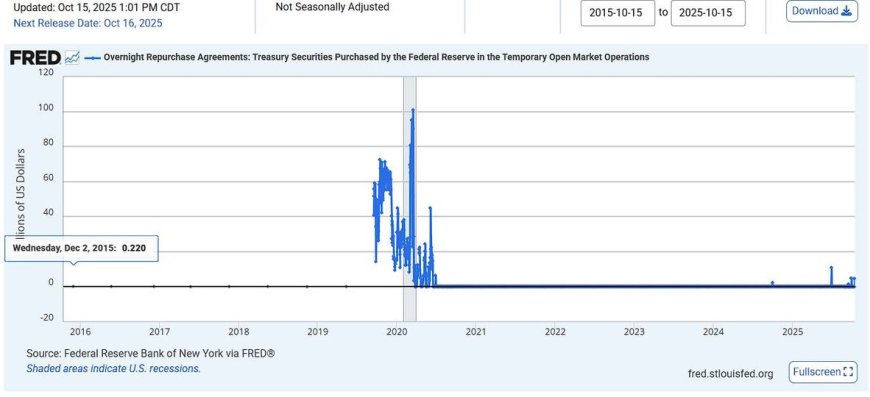
The data from the Federal Reserve Bank of New York (FRED) shows a sharp uptick in repo activity — banks borrowing short-term cash from the Fed in exchange for Treasuries. This is the same early warning pattern that appeared before the 2019 repo crisis and the subsequent launch of QE4. Liquidity stress is like a heartbeat — when it starts to skip, the Fed eventually intervenes.
1. The Liquidity Cycle Never Dies
Since 2008, every tightening cycle has ended the same way: in reversal. The modern financial system cannot survive prolonged liquidity withdrawal. The debt structure is simply too leveraged, the obligations too synchronized, and the derivatives exposure too large for credit to function without constant injections of cash and collateral.
This is the modern liquidity loop:
- The Fed tightens → interest rates rise, money supply contracts.
- Liquidity dries up → repo rates spike, short-term funding cracks.
- Markets destabilize → equity selloffs, bank stress, collateral shortages.
- The Fed reverses → repo operations resume, then Quantitative Easing (QE) restarts.
We saw it in 2008 (QE1 after Lehman), 2011 (QE2 and Operation Twist), 2019 (repo intervention and QE4), and 2020 (pandemic-era QE5). Every “end” of liquidity tightening becomes the beginning of a new easing cycle.
2. The Latest Repo Spike: The Quiet Alarm Bell
In October 2025, the FRED chart revealed the largest surge in repo activity since 2020 — over $15 billion in overnight loans through the Standing Repo Facility (SRF). This facility was built in 2021 to prevent another meltdown like 2019. When it lights up, it means banks can’t find enough liquidity in private funding markets.
In essence, this is the system’s emergency oxygen mask. When banks start using it heavily, they’re telling the Fed: we’re suffocating again.
Historically, spikes in SRF or repo activity precede monetary pivots by 3–6 months. That means the clock is already ticking toward QE 2026.
3. Powell’s Pivot and the End of QT
Powell’s comments in Philadelphia were subtle but telling. He acknowledged that the balance sheet runoff (Quantitative Tightening) is “approaching its end phase” — Fed-speak for “we’ve gone as far as we can without breaking something.”
That admission mirrors Ben Bernanke’s 2013 taper comments and Powell’s 2019 reversal. Each time the Fed signals a slowdown in tightening, repo markets respond first, equities second, and precious metals third. We’re now in that exact alignment again.
As Brookings Institution research notes, QT has always had a limited lifespan because it removes the very liquidity the system runs on. The Fed cannot permanently shrink its balance sheet; it can only pause the rate of expansion.
4. Why the Next QE Will Look Different
When the next wave of easing comes — likely sometime in 2026 — it won’t look like the previous rounds. Instead of purely “printing money,” liquidity will enter the system digitally through tokenized assets and programmable financial infrastructure.
Here’s how that framework is taking shape:
- Tokenized Treasuries: Firms like BlackRock and Circle are already integrating tokenized U.S. Treasury ETFs. These allow near-instant settlement and programmable yield distribution.
- Stablecoin Expansion: Each stablecoin minted (USDC, Tether, etc.) is backed by U.S. Treasuries, creating artificial demand for dollar assets. Every issuance strengthens the dollar’s global dominance.
- CBDCs & BIS Infrastructure: The BIS Project Guardian and Project Mariana are building the rails for cross-border settlement of tokenized reserves and commodities.
In short: the next QE won’t involve the printing press. It’ll involve digital liquidity pipelines — programmable, traceable, and instantaneous.
5. Liquidity, Control, and Global Strategy
When people ask if “the Fed is going to print more money,” the answer is: yes — but differently.
The U.S. isn’t simply flooding markets for short-term relief. It’s also exporting its monetary system globally through digital rails. Each tokenized Treasury, each dollar-backed stablecoin, each U.S.-regulated payment network expands American financial reach.
Every time a company issues a stablecoin, it must buy a U.S. Treasury to back it. That creates constant structural demand for dollars and Treasuries, reinforcing dollar supremacy even as foreign nations try to “de-dollarize.” This is how the U.S. quietly absorbs global liquidity — by monetizing its own debt as the base layer of digital finance.
Meanwhile, competing blocs like BRICS are experimenting with commodity- and gold-backed settlement systems, attempting to build an alternative financial network. Yet even those systems depend on dollar-denominated commodities for pricing — proof that the dollar’s gravitational pull remains intact.
6. The Coming Merge: QE + Tokenization
We’re heading toward a hybrid framework — where liquidity injections, debt monetization, and asset backing merge into a single programmable layer. This won’t happen with an announcement or a new law; it will evolve naturally as central banks digitize their existing operations.
Here’s how the transition unfolds:
- Phase 1: Repo operations expand — Fed adds back liquidity under the radar (2025).
- Phase 2: QT officially ends — balance sheet stabilizes (late 2025).
- Phase 3: QE restarts — this time via tokenized instruments and CBDC-linked liquidity facilities (2026).
At that point, the architecture of global finance will have changed permanently. Liquidity will no longer just move — it will be coded.
7. The Global Liquidity Battlefield
As I wrote on social media, this isn’t just a U.S. phenomenon — it’s a geopolitical liquidity war. Nations are no longer competing primarily over exports, but over who controls the flow of digital collateral.
In places like Argentina, Venezuela, and Nigeria, citizens are turning to stablecoins as a refuge against collapsing local currencies. Each time that happens, the U.S. gains a new foothold in the global monetary network — because every USDC or Tether created equals another Treasury purchased.
China and Russia are racing to build an alternative, gold-anchored payment ecosystem under the BRICS+ framework. But even those systems remain tethered to Western commodity pricing — evidence that full decoupling is nearly impossible.
8. QE 2026: What to Expect
When QE 2026 arrives — whether it’s officially labeled as such or disguised under “liquidity operations” — the flow will be enormous. Expect:
- Renewed Fed balance sheet expansion via tokenized Treasury purchases.
- Reactivation of global dollar liquidity swap lines with Europe and Asia.
- Central bank coordination through BIS digital settlement layers.
- A renewed bull cycle in gold, Bitcoin, and tangible collateral assets.
The “printing” will be digital — but its impact on prices, debt, and trust will be real.
9. The Endgame: Liquidity Always Wins
Markets like to pretend that “this time is different.” But history shows the same rhythm repeating: tightening → breakage → intervention → expansion. The faces change, the technology evolves, but the principle remains: liquidity always wins.
This time, however, the consequences will be deeper — because liquidity is becoming programmable, auditable, and permanent. Once QE merges with tokenization, there’s no going back. The dollar won’t die; it will evolve into a digitally collateralized system of control and efficiency.
In the end, the calm we’re seeing today isn’t stability — it’s the silence before the next liquidity storm.
Sources and References
- FRED: Overnight Repo Operations – Treasury Securities Purchased (2025 Data)
- Brookings: How the Fed Will End QT (2025)
- BIS Project Guardian Report (2024)
- CoinTelegraph: BlackRock Tokenized Treasury Launch (2024)
- IMF: Stablecoins in Emerging Markets (2023)
- Reuters: BRICS Alternative Payment System (2025)
#QE2026 #QuantitativeEasing #FederalReserve #LiquidityCycle #Tokenization #CBDC #PatternNexus
Apa Reaksi Anda?
 Suka
0
Suka
0
 Tidak Suka
0
Tidak Suka
0
 Cinta
0
Cinta
0
 Lucu
0
Lucu
0
 Wow
0
Wow
0
 Sedih
0
Sedih
0
 Marah
0
Marah
0

Founder of Pattern Nexus. I research markets, macro, geopolitics, AI, history, ancient systems, and the patterns most people overlook. I’m also building Market Radar, a trading scanner designed to read pressure, risk, confirmation, and setup quality before chasing a move. Pattern Nexus is where I connect the dots between data, history, technology, and the bigger system playing out around us.


















Komen-komen (0)