
Paul Walker and God’s Eye: The Films, the Surveillance State, the Deaths, and the Pattern Nobody Maps Together
I started with one question about God’s Eye in Furious 7 and ended up with a much larger map. This report rebuilds Paul Walker’s complete film chronology, explains what each movie was actually about, traces the recurring themes of secret institutions, undercover identities, corrupt authority, coerced operatives, controlled evidence and people choosing conscience over orders, and gives extra weight to the independent films Walker produced or executive-produced himself. Then it places that career beside the real surveillance timeline: DARPA’s Total Information Awareness program, its all-seeing-eye imagery, David Petraeus’s 2012 Internet-of-Things remarks, the CIA’s 2013 big-data strategy, Snowden’s disclosures, license-plate tracking databases and James Wan’s own statement that God’s Eye was deliberately designed to feel realistic. It also puts the deaths identified around Walker’s professional orbit in chronological order, examines the unresolved Tokyo Drift lead, and closes with Roger Rodas, the Carrera GT, the official crash evidence and the exact point where the documented chain ends and the unanswered question begins.
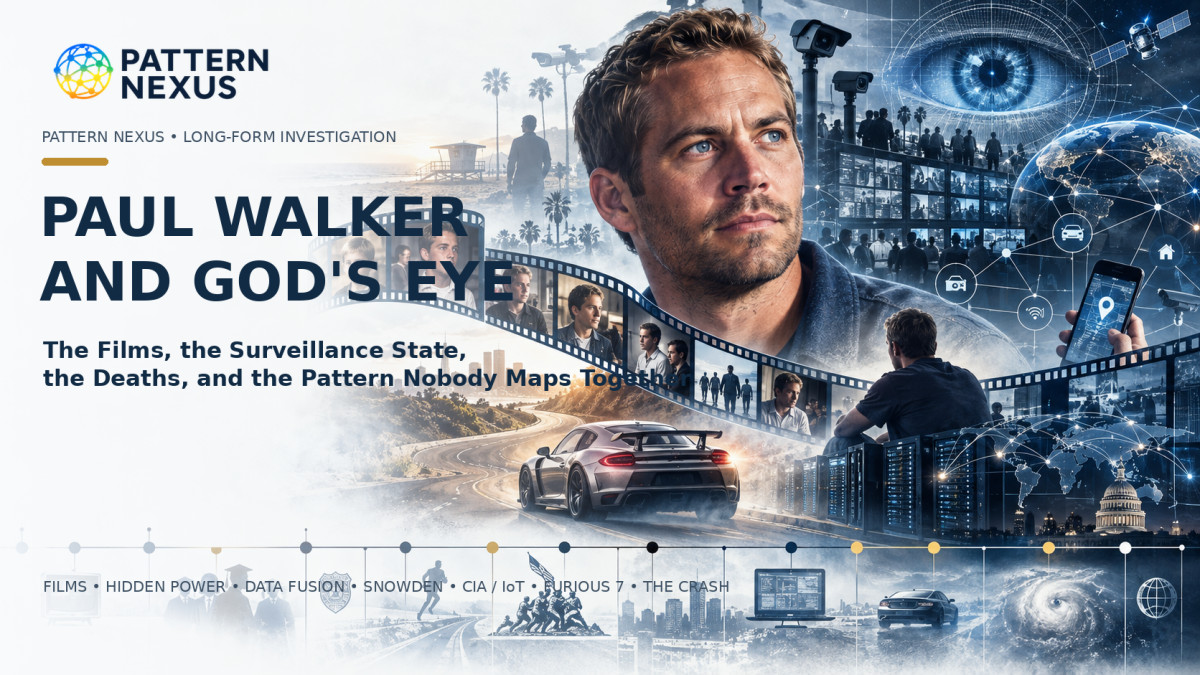
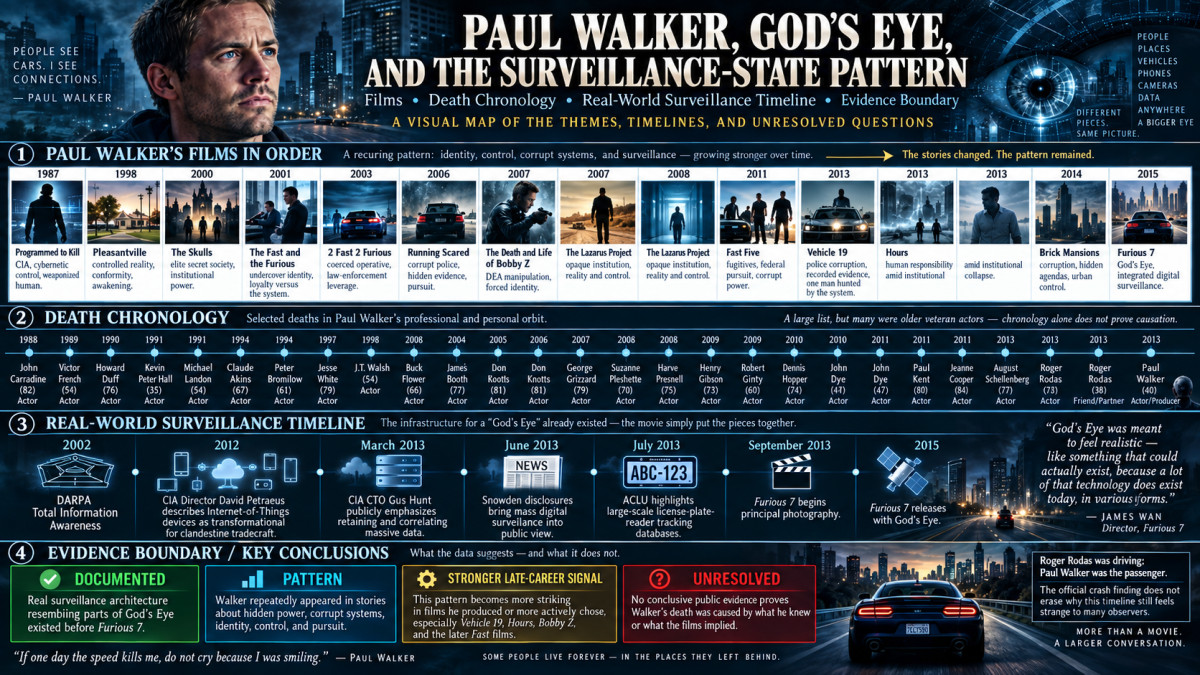
- The pattern in Paul Walker's films is real enough to investigate. Across his adult career, especially after The Skulls, he repeatedly appears in stories about hidden institutions, undercover identities, corrupt authority, coerced operatives, controlled evidence, fugitives, loyalty versus orders, and eventually integrated surveillance.
- The strongest evidence comes from the films he helped produce or executive-produce. Bobby Z, Vehicle 19 and Hours matter more than childhood credits because Walker had more agency over those projects. [1] [2]
- The real-world surveillance timeline running beside Furious 7 is not science fiction. DARPA's Total Information Awareness program, Petraeus's 2012 Internet-of-Things remarks, CIA big-data strategy, Snowden's 2013 disclosures and rapidly expanding license-plate databases all predate the release of God's Eye. [14] [18] [19] [20] [22]
- James Wan later said the realism was intentional. He said the team wanted a realistic MacGuffin, described tracking technology as already present, invoked “Big Brother,” and said connected phones, computers and social media made it difficult to stay off-grid. [24]
- The death chronology is larger than the obvious names. Once Walker's child-actor and television work is included, there are many deceased former co-stars. Most, however, were older actors and the documented causes are heterogeneous. The raw count cannot by itself establish a common cause.
- The crash deserves precision rather than mythology. Walker was the passenger, Roger Rodas was driving, and the Carrera GT belonged to Rodas/Always Evolving rather than being Walker's personal car. Both men were experienced around high-performance cars. Investigators estimated roughly 80–94 mph on a 45-mph road, found no pre-existing vehicle-system failure, and noted tires more than nine years old. [26] [28] [30]
- The unresolved question is narrower than “was he killed?” The defensible question is whether Walker deliberately gravitated toward a worldview—personal freedom, truth over institutional loyalty, distrust of corrupt systems—and whether his film choices increasingly reflected it. The evidence for that is materially stronger than a claim that the CIA, an intelligence program or a connected group caused his death.
I did not start this by trying to prove a murder. I started with God's Eye, then I asked who Paul Walker worked with, who died, what those movies were actually saying, what Walker himself believed, and what surveillance technology existed in the real world before the movie put all of it on one screen. Once you do that in order, a much more interesting structure appears.
Film pattern
Insider → discovers corruption or hidden power → chooses conscience/loyalty → becomes hunted or goes off-grid.
Technology pattern
Covert control → data fusion → location tracking → connected devices → integrated surveillance.
Evidence boundary
A recurring theme can be real without proving a secret coordinated operation.
Causation test
The missing bridge would be threats, specific classified knowledge, sabotage evidence, documentary links or a common actor connecting the deaths.
01 · STARTING POINT
God's Eye Was the Door Into a Much Larger Question
The question started with a movie device. In Furious 7, Ramsey's God's Eye can reach into connected cameras and devices, combine the feeds and geolocate a target. Cantina Creative, the studio that designed the interface, describes it as an “all-encompassing, all-seeing” system built around access to camera feeds, online devices and geotracking. [25]
That is where I started pulling on the thread. Not because a movie automatically proves anything, but because the movie arrived at a very specific moment in history. By the time Furious 7 was being made, the public had already seen Total Information Awareness, had heard the CIA director discuss connected household devices as an intelligence opportunity, had watched Snowden expose large-scale NSA collection, and had learned that license-plate cameras were quietly creating movement databases on ordinary drivers. [14] [18] [20] [22]
Then Paul Walker dies during production. So I asked a different question: what else had he been doing? What were his movies actually about? Was this one strange surveillance plot dropped into a career that had nothing to do with it, or was it sitting at the end of a much longer thematic chain?
That is the point of this article. I am not starting from the conclusion that Walker was killed. I am starting from the structure and working outward. Films. Roles. Producing choices. Interviews. Surveillance history. Deaths around the professional orbit. The crash. Then causation.
02 · METHOD
Pattern Is Not Proof, but Pattern Is Still Data
There are two bad ways to approach a story like this. One is to declare every coincidence proof of a conspiracy. The other is to see a pattern forming and immediately flatten it into “nothing to see here.” Neither method tells us much.
I use four levels instead. Documented fact is the hard record: credits, dates, interviews, government programs, crash findings. Pattern is recurrence across independent facts. Inference is what the pattern may mean. Causation requires a bridge showing that one thing actually produced another.
| Layer | What it means here | Current status |
|---|---|---|
| Documented fact | Walker produced or executive-produced Bobby Z, Vehicle 19, Pawn Shop Chronicles and Hours; TIA, Petraeus IoT remarks, Snowden disclosures and ALPR systems are documented. | High |
| Recurring pattern | Walker repeatedly appears in stories about hidden institutions, covert identities, corrupt authority and choosing conscience over orders. | Meaningful, but interpretive |
| Intent inference | Walker may have preferred these stories because they matched his own values around freedom, loyalty and authenticity. | Plausible; strongest where he had producing control |
| Causal allegation | A government/intelligence actor killed Walker because of what he knew or what the films were saying. | Not established by the evidence found |
The goal is not to kill the pattern. It is to make the pattern survive contact with evidence.
03 · COMPLETE FILM CHRONOLOGY
Every Paul Walker Film in Order — and What Each Story Was Actually Talking About
Walker’s feature-film career runs from Monster in the Closet through the posthumous Furious 7. Credits and producer roles are cross-checked against his filmography and industry listings. [1] [2]
| Year | Film | Walker role | What the story is talking about | Pattern relevance |
|---|---|---|---|---|
| 1986 | Monster in the Closet | “Professor” Bennett | A horror-comedy about unexplained killings, public panic, scientists, media and government response. Walker was a child actor; this is useful as career context, not evidence of his adult project selection. | Weak thematic relevance; strong only as a source of early cast/death connections. |
| 1987 | Programmed to Kill | Jason | A CIA-linked operation captures a terrorist and turns her into a cybernetic killing machine. Control, covert state power and weaponized technology are explicit in the premise. | Striking in retrospect, but Walker was a child and did not choose the project as an adult. |
| 1994 | Tammy and the T-Rex | Michael | A mad scientist moves a teenager’s brain into an animatronic dinosaur. Identity and technological manipulation exist, but the film is deliberately absurd exploitation comedy. | Do not overweight it. |
| 1998 | Meet the Deedles | Phil Deedle | Two outsider brothers stumble into a Yellowstone plot involving a disgruntled former ranger and institutional impersonation. | Mostly comedy/adventure; Dennis Hopper becomes a death-chronology node. |
| 1998 | Pleasantville | Skip Martin | Two teenagers enter a controlled 1950s television world where social awakening produces color, sexuality, dissent and authoritarian attempts to restore conformity. | A genuine control-versus-awakening theme, though Walker was not driving the production. |
| 1999 | Varsity Blues | Lance Harbor | High-school athletes rebel against a powerful coach who treats players as disposable inputs to preserve his own authority and legacy. | Authority versus personal agency. |
| 1999 | She’s All That | Dean Sampson Jr. | A social bet and makeover manipulate identity, status and perception. | Identity/image manipulation, but weak institutional connection. |
| 1999 | Brokedown Palace | Jason (uncredited) | Two Americans are trapped in a foreign legal system after being implicated in drug smuggling. | Individual versus an overwhelming system; Walker’s role was tiny. |
| 2000 | The Skulls | Caleb Mandrake | An elite secret society uses wealth, institutional influence, family networks and cover-up mechanisms to protect itself. Walker plays the heir inside the system. | Major pivot. Director Rob Cohen later said he wanted to portray a “secret world of power elites” and got the cast excited about that idea. |
| 2001 | The Fast and the Furious | Brian O’Conner | An undercover police officer infiltrates an outlaw street-racing group and ultimately chooses conscience and loyalty over strict institutional orders. | The central Walker archetype begins: insider → moral conflict → outsider. |
| 2001 | Joy Ride | Lewis Thomas | A prank conducted through communications technology allows an anonymous stranger to identify, locate and terrorize the protagonists. | Technology, anonymity and being found. |
| 2002 | Life Makes Sense If You’re Famous | Mikey | A small relationship/fame short. | Counterexample; not part of the control-surveillance thesis. |
| 2003 | Turbo Charged Prelude | Brian O’Conner | Brian becomes a fugitive and moves across the country while avoiding law enforcement after the first Fast film. | Going off-grid becomes literal. |
| 2003 | 2 Fast 2 Furious | Brian O’Conner | Authorities use Brian’s legal vulnerability to pull him back into undercover work in exchange for clearing his record. | The state leverages an outsider into becoming an operative. |
| 2003 | Timeline | Chris Johnston | A corporation’s experimental technology sends people into the past and strands them in a lethal environment. | Dangerous institutional technology; secondary theme. |
| 2004 | Noel | Mike Riley | An ensemble drama about grief, loneliness, love and human connection. | Important counterexample. |
| 2005 | Into the Blue | Jared Cole | Divers discover a wreck and narcotics and become trapped between greed, criminals and survival. | Crime/adventure; only modest pattern relevance. |
| 2006 | Eight Below | Jerry Shepard | A survival story about loyalty, responsibility and returning for abandoned sled dogs. | Counterexample to a single hidden-power thesis; fits Walker’s loyalty/responsibility values. |
| 2006 | Running Scared | Joey Gazelle | A mob-connected man races to recover an incriminating gun tied to corrupt police; the story ultimately reveals undercover law-enforcement identity, dirty cops and controlled evidence. | Corrupt authority, hidden evidence, identity and survival. |
| 2006 | Flags of Our Fathers | Hank Hansen | The film examines Iwo Jima, the famous flag image and the distance between lived events and the public story built around them. | Truth, image-making and institutional narrative. |
| 2007 | The Death and Life of Bobby Z | Tim Kearney | A prisoner is recruited by a DEA agent to impersonate a dead drug dealer for a covert exchange and realizes he was expendable. Walker also produced the film. | High relevance because Walker had producer-level involvement: coerced operative, manufactured identity, disposable asset. |
| 2007 | Stories USA | Mikey | Anthology release containing the earlier short. | Counterexample / minimal relevance. |
| 2008 | The Lazarus Project | Ben Garvey | After execution, a man awakens in a mysterious institution and is told his former life is gone; he is warned not to leave and begins investigating what is real. | Manipulated reality, confinement, opaque control. |
| 2009 | Fast & Furious | Brian O’Conner | Brian is now in the FBI, yet again caught between institutional authority and the outlaw family he trusts. | The inside/outside conflict becomes structural. |
| 2010 | Takers | John Rahway | A professional robbery crew uses planning, timing and surveillance avoidance while police pursue them. | Pursuit and counter-surveillance, but genre-standard. |
| 2011 | Fast Five | Brian O’Conner | Brian and Dom are fugitives hunted by a federal team while targeting the empire of a corrupt Rio businessman. | Outsiders versus both state pursuit and private oligarchic power. |
| 2012 | Air Racers 3D | Narrator | Documentary/narration centered on air racing. | Not part of the hidden-power pattern; included for completeness. |
| 2013 | Vehicle 19 | Michael Woods | A parolee accidentally becomes the carrier of a kidnapped prosecutor and recorded evidence against corrupt police; the police apparatus hunts and frames him. Walker executive-produced and performs nearly the whole film. | One of the strongest adult-choice data points: corrupt institution, evidence suppression, fugitive truth-carrier. |
| 2013 | Fast & Furious 6 | Brian O’Conner | A government agent recruits the crew to stop an advanced mercenary network pursuing a strategic technological weapon. | The franchise moves fully into covert operations and high technology. |
| 2013 | Pawn Shop Chronicles | Raw Dog | A violent, bizarre anthology of intersecting criminal stories. Walker produced it. | Important counterexample: producing authority did not always produce the same political theme. |
| 2013 | Hours | Nolan Hayes | During Hurricane Katrina, systems fail around a father trying to keep his newborn alive in an abandoned hospital. Walker executive-produced. | Not conspiracy; strong personal-responsibility/system-failure theme. Walker said the stripped-down process let him be more honest and “tell the truth.” |
| 2014 | Brick Mansions | Damien Collier | A future Detroit seals off a poor district behind walls; an undercover officer confronts corruption and a supposed enemy while authorities conceal their own agenda. | Corrupt power, containment, manipulated narratives and marginalized populations. |
| 2015 | Furious 7 | Brian O’Conner | A covert official recruits Dom’s crew around God’s Eye, a system designed to exploit connected devices and camera feeds to locate people globally. Walker died before filming was complete. | The long thematic arc ends at integrated global surveillance. |
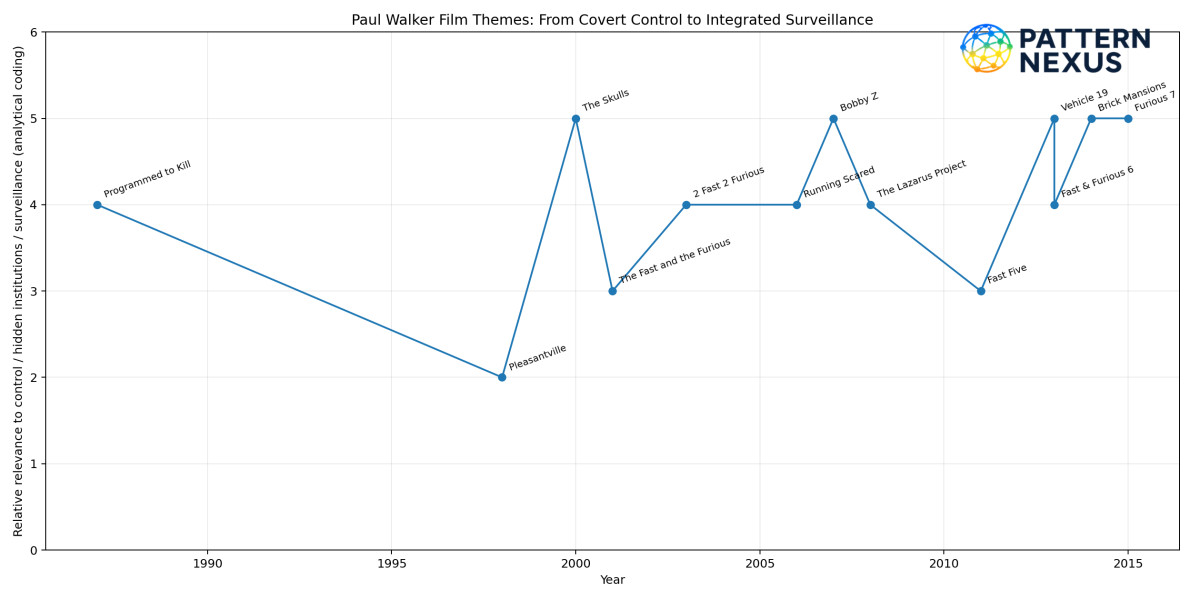
When every title is laid out instead of cherry-picking only the interesting ones, the pattern becomes more believable in one way and less believable in another. It becomes more believable because the control-versus-conscience archetype recurs many times. It becomes less believable as a “coded message in every movie” because there are obvious counterexamples: Noel, Eight Below, Pawn Shop Chronicles, Air Racers and others simply do not carry the same thesis.
That matters. A real preference does not need to explain every job an actor ever took.
04 · EARLY CAREER
The Strange Part Starts Before the Fast Films — but We Have to Weight Childhood Roles Correctly
Walker's earliest work already contains material that looks eerie in hindsight. Programmed to Kill is literally about a CIA-connected operation that captures a woman, experimentally transforms her into a cybernetic killing machine and tries to use her as a controllable covert weapon. [3]
That is an extraordinary thematic match to the later questions about technology and clandestine power. It is also weak evidence about Walker himself because he was a child. A thirteen-year-old actor does not get to treat the script as a manifesto.
The same rule applies to the large death count around Monster in the Closet. The cast included veteran performers from generations older than Walker. John Carradine died in 1988 at 82. Claude Akins died in 1994. Jesse White died in 1997. Henry Gibson died in 2009. When a child performer spends a career beside actors in their sixties, seventies and eighties, a long list of deceased former co-stars is mathematically expected decades later. [35] [37]
The television years add another layer. Walker appeared on Highway to Heaven, which connects him to Victor French and Michael Landon, both of whom died at 54. He later appeared on The Young and the Restless and Touched by an Angel, giving us additional chronological nodes such as Jeanne Cooper and John Dye. Those are legitimate connections; they are not automatically evidence of a shared cause.
So the early period belongs in the map, but I give it lower weight when asking what Walker himself was trying to say.
05 · THE PIVOT
The Skulls Is Where the Pattern Stops Being Accidental Background Noise
The Skulls matters because it is not merely a story we can reinterpret twenty-six years later. Director Rob Cohen has directly explained what he thought he was making. He said he had George H.W. Bush and George W. Bush in mind, saw secret societies as mechanisms through which elites form bonds and remain at the top of society, and wanted to create a “secret world of power elites.” He also said he got the cast excited about the idea. [4]
Walker plays Caleb Mandrake, the privileged heir inside that structure. The story is about a closed elite society that can reach into police, universities, money, careers and evidence to preserve itself.
Then Cohen says something else that matters: The Skulls is where his bond with Walker formed, and that relationship is part of why he cast Walker in The Fast and the Furious. [4]
The Skulls → Cohen/Walker relationship → Brian O'Conner → the franchise that eventually arrives at God's Eye.
That does not prove a hidden agenda. It does give us a real production-history chain rather than a symbolic coincidence.
06 · THE WALKER ARCHETYPE
Brian O'Conner Keeps Living the Same Moral Conflict
Brian begins as a cop. He infiltrates Dom's world. Then the boundary breaks. He discovers that institutional orders and personal morality are not always the same thing. He lets Dom go. He becomes a fugitive. The government later uses his vulnerability to pull him back into undercover work. He joins the FBI, but his real allegiance keeps shifting toward the people he trusts rather than whichever badge controls the mission.
That arc repeats across the franchise:
inside the system → sees the system differently → chooses loyalty or conscience → becomes an outsider → is recruited again because the system still needs him.
By Fast Five, the street racer has become an international fugitive hunted by a federal strike team. By Fast & Furious 6, the outlaws are effectively being used as a deniable operational team to stop a sophisticated mercenary organization. By Furious 7, the team works with Mr. Nobody inside a covert intelligence environment built around a global tracking system.
The franchise did not start as a surveillance saga. It evolved into one. Walker's defining character evolved with it.
07 · PROJECT SELECTION
The Strongest Evidence Is What Walker Chose When He Had More Control
This is where I weight the evidence differently. An actor can be hired into a theme. A producer helps decide which story gets made.
Bobby Z
Walker produced The Death and Life of Bobby Z. His character is a prisoner recruited by a DEA agent to impersonate a dead drug dealer. The state manufactures his identity, sends him into an exchange and treats him as expendable. He realizes the operation was not designed around his survival and runs. [10]
Vehicle 19
Vehicle 19 is even harder to wave away as a generic Walker coincidence. Walker executive-produced it and appears on screen for nearly the entire film. A parolee gets the wrong rental car and discovers a kidnapped prosecutor and evidence against corrupt police. The police apparatus that should represent law becomes the organization hunting him. The core problem is no longer simply “criminals versus cops.” It is what happens when the institution controls the official story and the outsider carries the evidence that contradicts it. [8] [9]
Walker did not say he chose the movie as a political warning. In interviews, he emphasized the freedom of making a tiny film in South Africa and the raw trust involved in shooting with fewer controls. That is important because it narrows what we can claim. We can document his attraction to freedom and the project. We cannot document that police corruption was the reason he selected it. [8] [9]
Hours
Then comes Hours. This is not a conspiracy story. It is a system-failure story. Katrina knocks out infrastructure, an abandoned hospital stops functioning as a protective institution, and one father is left with direct responsibility for his newborn.
Walker's interviews around this film are some of the clearest windows into what he valued. He called the stripped-down production more honest and said it was refreshing to step away and “tell the truth.” In one of his final interviews, he said he felt he had told the truth through the performance. [6] [7]
Pawn Shop Chronicles
Walker also produced Pawn Shop Chronicles, which is a necessary counterexample. It is violent, bizarre and not a coherent institutional-control statement. If we are testing a theory rather than advertising one, the counterexample has to stay.
That leaves a stronger, narrower conclusion: when Walker had more control, he often chose independent work about freedom, loyalty, direct responsibility and people trapped inside systems—but not exclusively.
08 · WALKER'S OWN WORDS
Freedom, Authenticity, Action: The Viewpoint Behind the Roles
There is a reason I do not think the recurring role choice should be treated as completely random. Walker repeatedly described himself in terms that match the characters he was playing.
In a 2003 interview, he discussed walking away from the possibility of a huge Superman commitment because he did not want to be obligated to a studio for seven years. His phrase was simple: he was a “free man.” [5]
Ten years later, while making smaller independent projects, he talked about freedom again—not as ideology, but as working style. Vehicle 19 appealed to him partly because the small South African production could operate outside normal studio machinery. Hours appealed because it was stripped down, honest and built around people who wanted to be there. [6] [8]
Outside movies, he created Reach Out WorldWide after deploying to Haiti following the 2010 earthquake. ROWW preserves his explanation that he wanted to turn his success into something larger because “movies aren’t enough.” [42] The pattern is not “Walker was an anti-government revolutionary.” I do not find evidence for that. The pattern is more grounded: he valued direct action, autonomy, loyalty, authenticity and freedom from institutional obligation.
That worldview maps naturally onto Brian O'Conner, Tim Kearney, Michael Woods, Damien Collier and several other characters: men forced to decide whether official authority deserves obedience when the system itself is compromised.
09 · REAL-WORLD SYSTEM
God's Eye Did Not Appear in a Vacuum
The surveillance side of this story is much stronger than the death side because the documentation is extensive and chronological.
2002: Total Information Awareness
DARPA's Information Awareness Office worked on Total Information Awareness, a research program meant to integrate data-mining and analytical technologies to detect patterns associated with terrorism. Congressional Research Service reports described the prototype architecture and the privacy controversy around large-scale access to electronic personal data. [14] [15]
The imagery could hardly have been more on-the-nose. Contemporary coverage documented the Information Awareness Office seal as an all-seeing eye over a pyramid casting its gaze toward Earth, with the motto Scientia Est Potentia—“knowledge is power.” [16]
No evidence found in this research shows that Furious 7 copied the TIA logo or took the name God's Eye from it. But the conceptual resemblance—data integration plus an all-seeing visual metaphor—is real enough to put on the timeline.
2012: Petraeus and the Internet of Things
The user-provided video points to a real underlying episode. In March 2012, CIA Director David Petraeus spoke about the emerging Internet of Things at an In-Q-Tel event. Wired reported his remarks about networked objects becoming locatable, identifiable, monitorable and remotely controllable, and described the implications for clandestine tradecraft. [18] The YouTube clip that triggered this part of the research is preserved in the sources as well. [33]
The sensational shorthand—“the CIA will spy through your dishwasher”—came from media framing, not a literal announcement of a named domestic dishwasher program. But the intelligence proposition underneath it was real: ordinary connected devices were becoming potential data sources.
March 2013: collect now, correlate later
Then CIA CTO Gus Hunt explained the logic of data retention in remarkably direct language: the future value of a datum may not be visible until it can be connected to something that arrives later, so the intelligence problem pushes toward collecting enormous amounts of information and keeping it. Nextgov also reported Hunt saying the capability to compute across essentially all human-generated information was approaching reach. [19]
June 2013: Snowden
Three months later, the Snowden disclosures began. The Guardian's timeline shows the sequence: a Verizon metadata order on June 5, PRISM on June 6, and Boundless Informant on June 8. [20] [21]
July 2013: location databases on ordinary drivers
The ACLU then documented the rapid expansion of automatic license-plate readers. These systems photographed passing plates and stored plate number, time and location, creating databases that could reconstruct where vehicles had been months or years earlier. The ACLU explicitly warned that this was evolving into mass routine location tracking. [22] [23]
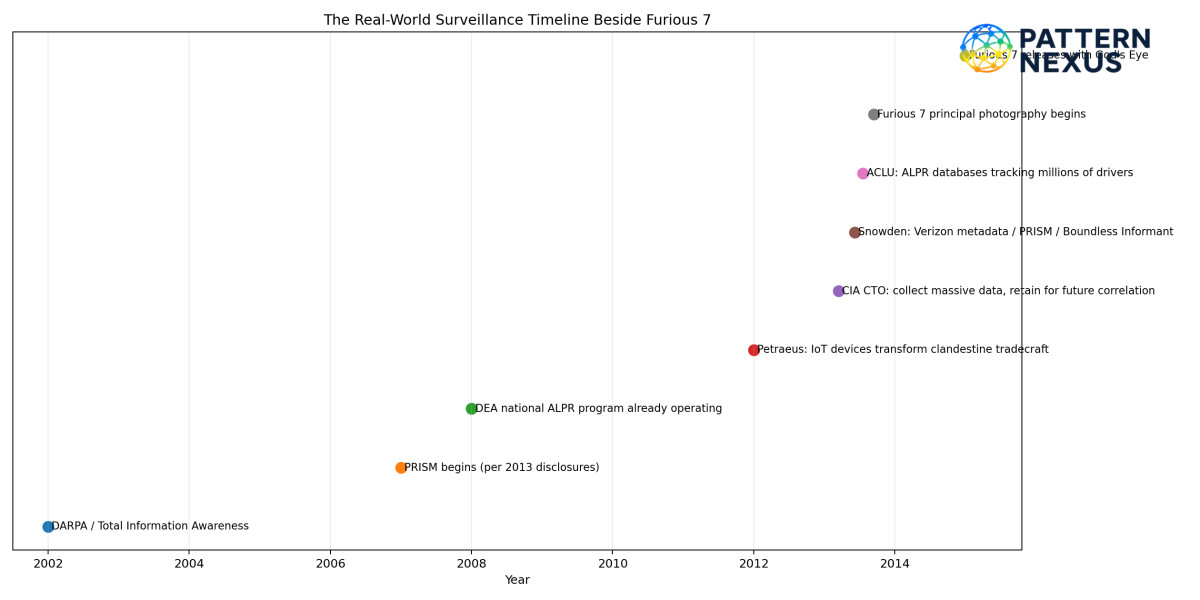
The fiction in God's Eye was not that cameras, phones, location systems, social networks and databases existed. The fiction was that one user could fuse everything, penetrate everything, identify anyone and return a target almost instantly.
10 · FURIOUS 7
James Wan Said the Surveillance Parallel Was Intentional
This is the strongest line in the entire surveillance part of the article because we do not have to infer it from the finished movie. Director James Wan was directly asked about God's Eye technology becoming real.
Wan said the team wanted to create a realistic MacGuffin. He said tracking technology of that kind was already out there, invoked Big Brother, and pointed to phones, computers, technology and social-media platforms as the reason it had become increasingly difficult to remain off-grid. He said they intentionally wanted to play with that paranoia. [24]
Cantina Creative's own project description calls God's Eye an all-seeing surveillance system built around access to camera feeds, online devices and geotracking. [25]
That lets us move one claim from interpretation into the documented column:
God's Eye was deliberately designed to feel like an extrapolation of real contemporary surveillance, not pure fantasy.
The unresolved issue is authorship and timing. We do not have evidence showing that Walker created God's Eye, supplied the idea, knew of a classified system, or pushed the script in that direction. The film's script and story were being developed around him, and Wan has spoken publicly about the intent behind the device. That is not the same as Walker being a whistleblower through fiction.
Walker died while Furious 7 was still unfinished. Production was suspended and the filmmakers reworked Brian O’Conner’s ending rather than killing the character. Walker’s brothers Caleb and Cody later served as stand-ins, with visual-effects work and existing footage used to complete the performance. [43] There is another strange technological layer here that is real without implying anything sinister: a movie about digitally locating and reconstructing people ended up relying on sophisticated digital effects to finish the performance of its deceased lead actor.
God’s Eye also did not disappear after Walker’s final film. The device remained part of the franchise and was referenced again in The Fate of the Furious in 2017. [44]
But the timing is still worth seeing in one line:
2002 TIA → 2012 Petraeus/IoT → March 2013 CIA big-data remarks → June 2013 Snowden → July 2013 ALPR revelations → September 2013 Furious 7 production → November 2013 Walker's death → 2015 God's Eye on screen.
11 · DEATH CHRONOLOGY
The Deaths Around Walker — Put in Order Instead of Thrown Into a Collage
This list is the set we identified in the research above: featured co-stars, meaningful production connections and the direct Rodas connection. It is not every deceased person who ever appeared in a Walker production; that would become statistically meaningless because the denominator would be enormous.
| Date | Person | Age | Walker connection | Documented context |
|---|---|---|---|---|
| Nov. 27, 1988 | John Carradine | 82 | Monster in the Closet | Heart/lung/kidney ailments reported in obituary. |
| June 15, 1989 | Victor French | 54 | Highway to Heaven | Lung cancer. |
| July 1990 | Howard Duff | 76 | Monster in the Closet | Veteran co-star; included as part of the early ensemble chronology. |
| Apr. 10, 1991 | Kevin Peter Hall | 35 | Monster in the Closet | Young death; played the creature. Public biographies report AIDS-related pneumonia after HIV infection from a blood transfusion. |
| July 1, 1991 | Michael Landon | 54 | Highway to Heaven | Inoperable cancer involving pancreas/liver. |
| Jan. 27, 1994 | Claude Akins | 67/75 reported contemporaneously | Monster in the Closet | Cancer; contemporary records differed on age. |
| Oct. 16, 1994 | Peter Bromilow | 61 | Programmed to Kill | Supporting cast connection. |
| Jan. 1997 | Jesse White | 79 | Monster in the Closet | Heart attack after surgery. |
| Feb. 27, 1998 | J.T. Walsh | 54 | Pleasantville | Heart attack; died before the film’s release. |
| June 18, 2004 | Buck Flower | 66 | Tammy and the T-Rex | Supporting cast connection. |
| Aug. 11, 2005 | James Booth | 77 | Programmed to Kill | Supporting cast connection. |
| Feb. 24, 2006 | Don Knotts | 81 | Pleasantville | Lung cancer. |
| Oct. 2, 2007 | George Grizzard | 79 | Flags of Our Fathers | Lung cancer. |
| Jan. 19, 2008 | Suzanne Pleshette | 70 | The Boys Are Back | Respiratory failure after lung-cancer treatment. |
| June 30, 2009 | Harve Presnell | 75 | Flags of Our Fathers | Pancreatic cancer. |
| Sept. 14, 2009 | Henry Gibson | 73 | Monster in the Closet | Supporting cast connection. |
| Sept. 21, 2009 | Robert Ginty | 60 | Programmed to Kill | Cancer. |
| May 29, 2010 | Dennis Hopper | 74 | Meet the Deedles | Prostate cancer complications. |
| Jan. 10, 2011 | John Dye | 47 | Touched by an Angel | Television co-star connection; sudden death. |
| Oct. 7, 2011 | Paul Kent | 80 | Programmed to Kill | Supporting cast connection. |
| May 8, 2013 | Jeanne Cooper | 84 | The Young and the Restless | Same production; not presented as a close personal relationship. |
| Aug. 15, 2013 | August Schellenberg | 77 | Eight Below | Co-star connection. |
| Nov. 30, 2013 | Roger Rodas | 38 | Friend, business/racing partner | Driver of the Carrera GT; died in the same crash. |
| Nov. 30, 2013 | Paul Walker | 40 | Actor / producer | Passenger in the Carrera GT; died from crash trauma and fire effects. |
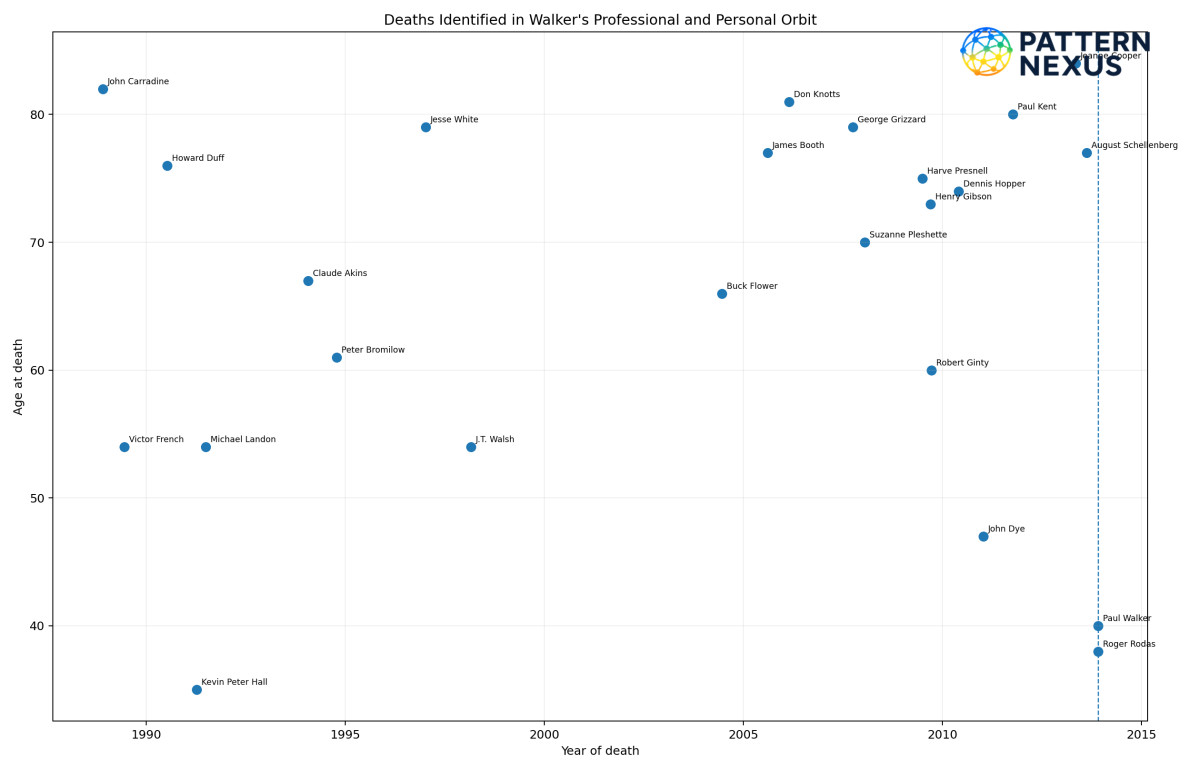
Several names are genuinely striking because of age: Kevin Peter Hall at 35, John Dye at 47, Roger Rodas at 38 and Walker at 40. Victor French, Michael Landon and J.T. Walsh all died at 54. But the documented causes do not converge on one mechanism. We have cancer, heart disease, illness, and the Walker/Rodas crash spread across twenty-five years. [34] [36] [38] [39] [40] [41]
The list therefore raises a question, but it does not yet answer one.
12 · CAUSATION
If There Is a Real Chain, This Is What We Would Need to Find
“Look long enough and you will find something” is true in two opposite ways. Real systems leave traces. But large datasets also manufacture coincidences. So the causation test has to become harder as the pattern gets more interesting.
A theory that Walker was targeted because of what he knew or what his films represented would become materially stronger if we found one or more of the following:
- a documented threat directed at Walker;
- an interview or private document where Walker says he knows about a specific surveillance/intelligence system beyond public reporting;
- a whistleblower relationship or contact with intelligence personnel tied to the same subject;
- evidence that God's Eye came from a specific classified program rather than general surveillance trends;
- a common organization connecting otherwise unrelated deaths;
- physical evidence of tampering with the Carrera GT;
- a second vehicle or unexplained external event in the crash evidence;
- contemporaneous communications showing Walker expected retaliation.
We looked for that bridge in the material available here. I have not found it.
That does not erase the thematic chain. It tells us where the chain currently stops.
13 · UNRESOLVED LEAD
The “Woman From Tokyo Drift” Connection Is Still Unresolved
One thread from this research remains open. The recollection was of a woman associated with Tokyo Drift who was outspoken about conspiracy-type ideas and later had something happen to her.
I checked the obvious candidates. The principal female lead was Nathalie Kelley, who played Neela. She is alive. Other notable women connected to the film include Nikki Griffin, Keiko Kitagawa, Lynda Boyd and Yoko Maki. I did not find a reliable match for the specific description in the current research.
That means I am not going to force a name into the article just to make the pattern look cleaner. This is an unresolved node, not a disproven memory. If the person was from another Fast installment rather than Tokyo Drift, that could explain the mismatch.
There is a deceased Tokyo Drift cast member worth keeping separate from this lead: Sonny Chiba, who played Kamata, died in 2021. Because that was eight years after Walker’s death, it cannot be part of a causal chain leading into November 2013.
The broader lesson matters: unresolved leads belong in an investigation, but they need to remain labeled unresolved until the identity is verified.
14 · NOVEMBER 30, 2013
Walker and Rodas: The Crash Is the Point Where the Story Has to Become Extremely Precise
Paul Walker was a serious car enthusiast and an experienced driver. The Los Angeles Times documented that he was deeply embedded in the tuner and racing community rather than merely playing a driver on screen. Roger Rodas was even more directly involved in competition; people around his race team described him as a highly skilled driver. [27] [30]
They were together at a charity event connected to Always Evolving in Valencia on November 30, 2013. They left in a 2005 Porsche Carrera GT for what was supposed to be a short drive. Rodas was driving. Walker was in the passenger seat. [31]
One point from the original discussion needs correction because the exact ownership matters: the Carrera GT was not Walker's personal car. Contemporary automotive reporting traced it to Roger Rodas/Always Evolving. [28] [29]
The official investigation estimated the car at roughly 80.6 to 94.0 mph before the crash on a road posted at 45 mph. Investigators reported no pre-existing failure in the car systems that caused the crash. They did, however, note that at least two tires were more than nine years old. [26]
That means two things can be true at once. Walker and Rodas were substantially more experienced around high-performance cars than the average driver. And this particular event still involved a very high speed on a public road in a notoriously demanding Carrera GT with aged tires.
The part that remains emotionally difficult is exactly what made the question arise in the first place: these were not two people unfamiliar with speed who accidentally found themselves in a supercar. This was their world. They had done more extreme things in controlled environments. The fatal event happened on a short run from their own automotive business/charity environment, in a car from that business orbit, and it ended almost immediately.
That observation is worth preserving. It is not, by itself, evidence of external intervention.
And the physical record currently cuts against a sabotage theory: no second vehicle was identified as causing the crash, investigators did not find a pre-existing mechanical failure that explained it, and speed was identified as the cause. [26]
15 · PATTERN NEXUS LENS
What Pattern Actually Survives After We Try to Break It
After laying everything out, I do not think the strongest story is “a bunch of people around Paul Walker died.” That list grows quickly, but age, career length and unrelated causes explain a lot of it.
I also do not think the strongest story is “every Walker movie was a coded warning.” The counterexamples are too obvious.
The pattern that survives is more specific and, to me, more interesting.
First: Walker repeatedly inhabited characters positioned between institutional authority and personal conscience. The badge, agency, prison system, secret society, corrupt police department or covert command structure says one thing. The human being inside it eventually decides whether the institution deserves obedience.
Second: the pattern intensifies after The Skulls, a film whose director explicitly says was built around elite power networks—and the same director then moves Walker into the role that defines his career. [4]
Third: when Walker gains more project control, he chooses several films with the same architecture: manufactured identity in Bobby Z, corrupt law enforcement and suppressed evidence in Vehicle 19, institutional collapse and direct personal responsibility in Hours. [6] [8] [10]
Fourth: Walker's own interviews support the values underneath those choices: freedom from long institutional obligation, preference for stripped-down independent work, trust, authenticity and direct action. [5] [6]
Fifth: the real world was independently moving toward exactly the surveillance environment Furious 7 dramatized. TIA, connected-device intelligence, cloud-scale retention, NSA disclosures and location databases all existed before the movie reached theaters. [14] [18] [19] [20] [22]
Sixth: James Wan confirms that God's Eye was intentionally built around real surveillance anxiety rather than fantasy technology. [24]
That is enough for a serious cultural and biographical thesis:
Paul Walker's career increasingly converged on stories about the individual confronting systems of hidden power, compromised authority and technological control, while the real world was simultaneously building the surveillance infrastructure that Furious 7 compressed into God's Eye.
That statement is strong, documented and does not require us to invent the final causal step.
16 · CONCLUSION
The Part I Cannot Prove — and the Part I Would Not Ignore
I cannot prove that anything happened to Paul Walker beyond what the official investigation says happened. I cannot prove the CIA targeted him. I cannot prove God's Eye was a classified program disguised as a movie prop. I cannot prove the earlier deaths belong to one chain.
But I also do not think the right response is to stop looking simply because the final bridge has not been found.
The movies are there. The themes are there. Rob Cohen's explanation of The Skulls is there. Walker's producing choices are there. Walker's own language about freedom and truth is there. Total Information Awareness is there. The all-seeing-eye logo is there. Petraeus's Internet-of-Things remarks are there. The CIA's 2013 big-data logic is there. Snowden is there. The license-plate databases are there. James Wan's statement that God's Eye was designed to feel realistic is there. [4] [5] [14] [18] [19] [20] [22] [24]
Then, in the middle of making that movie, Paul Walker dies.
He was not driving. Roger Rodas was. The car was not Walker's personal Carrera GT; it came from the Always Evolving/Rodas side of their shared automotive world. The measurable speed was extremely high for the road. The tires were old. Investigators did not find a pre-existing system failure that caused the crash. Those facts have to stay in the article because leaving them out would turn an investigation into a story. [26] [28]
At the same time, Walker and Rodas were not novices. This was not two ordinary people discovering horsepower for the first time. They lived around racing, tuned cars, high-performance machinery and speed. Rodas had competitive experience. Walker's identity inside the car community was real. [27] [30]
That is where I leave it.
Two experienced men. A very short drive from their own event. A difficult supercar they knew belonged to their world. A loss of control on a public road. A speed investigators measured as far beyond the limit. Old tires. No mechanical sabotage found. And one of the men was in the middle of making a movie whose central technology was an all-seeing surveillance system deliberately modeled on a world that was already becoming real.
I do not have the evidence to connect those facts causally.
I do have enough evidence to put them on the same page, in the correct order, and let the reader decide what deserves another question.
17 · FAQ
FAQ
Was God's Eye a real government program?
No public evidence found here identifies a real program formally called God's Eye matching the movie. What is documented is that many component capabilities—data fusion, internet collection, connected-device exploitation, location databases and camera networks—already existed separately.
Did James Wan say God's Eye was based on real surveillance?
He said the filmmakers wanted a realistic MacGuffin, that tracking technology like it was already out there, and that phones, computers and social media made it difficult to remain off-grid. [24]
Did Paul Walker create God's Eye?
No evidence found in this research shows Walker created the concept, supplied classified knowledge or was the source of the system.
Was Walker anti-government?
I did not find reliable evidence supporting that broad label. His public interviews more clearly support autonomy, freedom from institutional obligation, authenticity, loyalty and direct action.
Why does The Skulls matter so much?
Because director Rob Cohen later said he deliberately saw the film as a story about elite power networks and got the cast interested in that idea; he also said his bond with Walker formed on that film and led to casting him in The Fast and the Furious. [4]
Was Paul Walker driving when he died?
No. Roger Rodas was driving; Walker was the passenger. [26]
Was the Carrera GT Walker's personal car?
No. Contemporary ownership reporting places the car with Roger Rodas/Always Evolving. [28] [29]
Did investigators find evidence of sabotage?
The published investigation found unsafe speed as the cause and reported no pre-existing vehicle-system failure that caused the collision. It also noted very old tires. That does not prove every imaginable scenario impossible, but it means the public physical evidence does not establish sabotage. [26]
What about the woman from Tokyo Drift?
That lead remains unresolved. The obvious principal female cast members checked in this research did not match the remembered description, so no name is being forced into the article without verification.
18 · SOURCES
Sources
- Paul Walker filmography. Open source
- Fandango — Paul Walker film credits. Open source
- IMDb — Programmed to Kill plot. Open source
- Rob Cohen interview on The Skulls, Paul Walker, and “power elites”. Open source
- Parade/CosmoGIRL! archive — Walker on turning down Superman and remaining a “free man”. Open source
- Hollywood.com — Paul Walker on Hours, honesty, and stepping away from studio machinery. Open source
- Salon — one of Walker’s final interviews, Hours and “telling the truth”. Open source
- PASMAG — Walker interview on Vehicle 19 and “wild west” filmmaking. Open source
- Mandatory — Walker interview on Vehicle 19 and Fast 7. Open source
- Sony Pictures — Bobby Z synopsis. Open source
- IMDb — The Lazarus Project plot. Open source
- IMDb — Brick Mansions plot. Open source
- IMDb — Running Scared plot. Open source
- CRS — Total Information Awareness programs and oversight. Open source
- CRS — TIA privacy, collection and access law. Open source
- Washington Post — 2002 commentary documenting the IAO all-seeing-eye logo and “Knowledge Is Power” motto. Open source
- Wired — 2002 Total Information Awareness system. Open source
- Wired — 2012 Petraeus, the Internet of Things and clandestine tradecraft. Open source
- Nextgov/FCW — March 2013 CIA CTO Gus Hunt on retaining massive data for future correlation. Open source
- The Guardian — Snowden/NSA files timeline, June 2013. Open source
- The Guardian — PRISM reporting, June 2013. Open source
- ACLU — July 2013 license-plate-reader investigation. Open source
- ACLU — You Are Being Tracked. Open source
- Front Row Features — James Wan on God’s Eye, realism, Big Brother and staying off-grid. Open source
- Cantina Creative — Furious 7 God’s Eye interface design. Open source
- Los Angeles Times — official crash investigation: speed, no system failure, old tires. Open source
- Los Angeles Times — Walker as a serious car enthusiast and driver; Always Evolving. Open source
- Autoweek — ownership history of the Carrera GT; Rodas/Always Evolving. Open source
- Autoweek — Carrera GT difficulty and Always Evolving ownership. Open source
- CBS Los Angeles — race-team engineer on Roger Rodas as a skilled driver. Open source
- Los Angeles Times — Walker/Rodas charity event and brief drive before crash. Open source
- ABC News — Furious 7 production shutdown after Walker’s death. Open source
- User-provided video — CIA Director Warns of Spying on Americans Using Household Items. Open source
- Los Angeles Times — Victor French obituary. Open source
- Washington Post — John Carradine obituary. Open source
- Washington Post — Michael Landon obituary. Open source
- Los Angeles Times — Claude Akins obituary. Open source
- Los Angeles Times — Don Knotts obituary. Open source
- Washington Post — George Grizzard obituary. Open source
- Legacy/AP — Harve Presnell obituary. Open source
- Los Angeles Times — Robert Ginty obituary. Open source
- Reach Out WorldWide — Paul Walker, founder. Open source
- Variety — Caleb and Cody Walker served as stand-ins while visual effects helped complete Furious 7 after Paul Walker’s death. Open source
- IMDb — The Fate of the Furious references God’s Eye again. Open source
Pattern Nexus looks for structure upstream of the headline: incentives, institutions, technology, information, power, networks and the points where independent systems begin to rhyme.
This article is research and commentary. It does not accuse any named person or agency of causing Paul Walker's death. Where the documentary record ends, the article labels the question as unresolved rather than presenting inference as fact.
What's Your Reaction?
 Like
0
Like
0
 Dislike
0
Dislike
0
 Love
0
Love
0
 Funny
0
Funny
0
 Wow
0
Wow
0
 Sad
0
Sad
0
 Angry
0
Angry
0

Founder of Pattern Nexus. I research markets, macro, geopolitics, AI, history, ancient systems, and the patterns most people overlook. I’m also building Market Radar, a trading scanner designed to read pressure, risk, confirmation, and setup quality before chasing a move. Pattern Nexus is where I connect the dots between data, history, technology, and the bigger system playing out around us.



Comments (0)