
Fed Cuts Again, Tees Up the End of QT — Exactly as I Called It
The Federal Reserve just delivered its second rate cut of the year and signaled an end to Quantitative Tightening — confirming what I’ve been predicting for months. Here’s why this pivot was inevitable, what it means for liquidity, gold, crypto, and equities, and how it fits into the broader Pattern Nexus thesis on the “Everything Bubble.”

Fed Cuts Again, Tees Up the End of QT — Exactly as I Called It
Pattern Nexus
Not surprised. Not even a little. The Fed cut rates by another 25 bps and, more importantly, basically put a date-stamp on ending Quantitative Tightening (QT). If you’ve been following my liquidity threads, you know I’ve been hammering the same point for months: with Treasury issuance raging, bank reserves grinding down, and money markets flashing stress, QT was on borrowed time. The policy calendar finally caught up to the plumbing.
What changed today (and why it matters)
Headline #1: the FOMC trimmed the policy rate again to a 3.75%–4.00% target range — the second cut this year — citing softer labor trends and elevated but cooling inflation (Investing.com; AP).
Headline #2 (the real one): the Fed is moving to stop shrinking the balance sheet — effectively ending QT — as soon as December. Treasury roll-offs will cease and MBS run-off will be managed with reinvestments into T-bills to keep the system stable (Reuters). This follows weeks of telegraphing from Powell that the Committee was nearing the “ample reserves” threshold and watching money-market pressures closely (Fed speech; Reuters).
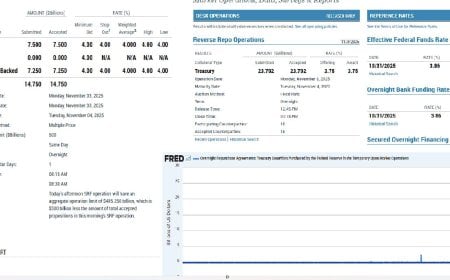
Translation: the Fed saw what I saw — rising repo firmness, Treasury bill/OIS spreads popping, SRF usage ticking up, and the growing risk of a 2019-style collateral/reserves crunch. You don’t let that spiral into year-end. You pull the brake.
Receipts: I’ve been flagging this path for months
Back in the spring I wrote that QT would slow, then stall, because the combination of heavy Treasury supply + declining reserves + sticky duration losses in banks makes the system brittle. Powell later confirmed the Committee had already discussed slowing runoff and was watching reserve scarcity (press conference transcript). The last few weeks, mainstream desks began to position for the same outcome (Reuters; FT).
Why ending QT was inevitable
- Reserves vs. collateral math. QT drains reserves from banks as Treasury supply explodes. The Treasury must refill its cash (TGA) by selling more bonds (Reuters explainer). That two-way drain tightens money markets and forces the Fed to choose: funding stress or a pivot. They chose the pivot.
- 2019 scars. The last time the Fed pushed too far, repo blew out. Powell’s team has repeated “ample” reserves like a mantra since. Once the gauges (bill spreads, SRF usage) flashed amber, the endgame wrote itself (Powell).
- Debt service reality. Higher rates + higher deficits = rapidly compounding interest costs. A slower pace of balance-sheet drain and a lower policy rate relieve pressure on the Treasury’s funding stack and the banking system’s duration hole. This is as much fiscal-financial plumbing as it is macro.
QE/QT/Rates — how the cycle actually works
I’ve said it a hundred times: what matters is liquidity — not press-conference rhetoric. QE injects reserves, compresses term premia, and floats asset multiples. QT drains reserves, raises funding premia, and exposes weak balance sheets. Rate cuts tweak the price of money; balance-sheet policy moves the availability of money across the system.
Today’s combo — cut + QT end — is the classic two-step: (1) ease the price signal, (2) stop the drain. If the data and plumbing stay fragile, step (3) is balance-sheet stabilization (flat) that later becomes stealth QE if conditions demand it. Call it whatever you want; the market reads the net change in reserves.
What this means for the trade stack
Gold & real assets
Gold likes falling real yields and abundant liquidity. Ending QT removes a constant headwind; a softer policy path reduces the hurdle rate and the opportunity cost of holding bullion. Central-bank buying has been steady; this just adds a macro tailwind. My base case: dips remain buyable while balance-sheet policy goes flat-to-expansionary. Expect “consolidation headlines” while the structural up-trend grinds on.
Crypto & speculative beta
Crypto is the purest liquidity beta in the system. Ending QT historically correlates with improving breadth and appetite for risk farther out the curve. Watch funding conditions, basis, and stablecoin aggregate supply; they’ll tell you when the engine is re-priming.
Equities
Multiples live on liquidity and positioning. With the Fed signaling a reserves floor, systematic supply from QT goes to zero. That doesn’t mean a straight line up — earnings and margins still matter — but it does mean the left-tail from a plumbing accident recedes. Breadth could finally improve beyond the usual mega-cap suspects as term premia compress.
Credit
High yield gets oxygen when financial conditions loosen. Keep an eye on primary issuance and dispersion — weak balance sheets will still pay a penalty — but the systemic stress premium should fade if repo stays calm and T-bill spreads normalize.
The mechanics: what the Fed actually said they’ll do
According to the wires, the Fed will cease Treasury runoff in December (rolling over all maturing notes/bonds) and redirect MBS pay-downs into bills to maintain control of reserves without reigniting the duration whale they’ve been trying to shrink (Reuters). Policy rate now sits at 3.75%–4.00% after today’s 25 bps cut (Investing.com; AP). This is exactly the “slow then stop” path Powell began telegraphing in mid-October (Fed speech), after months of discussions about slowing runoff (press conference transcript).
What I’m watching next (signals, not narratives)
- T-bill/OIS and GC repo prints into month-end/year-end. If spreads compress and SRF usage fades, the end-QT communication did its job.
- Bank reserve levels vs. the “ample” regime. If reserves stabilize above the floor, risk can breathe.
- Treasury refunding: maturity mix and bill share. A higher bill share plus flat Fed balance sheet is a de-facto liquidity release compared to the QT regime.
- Term premia and curve shape. QT removal + bill heavy issuance should pull term premia down, aiding mortgages and credit transmission.
- Global dollar liquidity: cross-currency basis, Eurodollar/SOFR futures term structure, and stablecoin net issuance as a real-time proxy.
How this ties back to my broader thesis
I’ve been consistent: the “Everything Bubble” isn’t one thing — it’s a liquidity regime. In a world of massive sovereign debt and AI-driven capex demands, policymakers will oscillate between “we’re tightening” and “we’re stabilizing” — but the end state keeps converging on more liquidity over time. That’s why I position into real assets, scarce cash-flowing businesses, and optionality on the innovation curve. You don’t fight the math of reserves, you surf it.
Positioning notes (not financial advice; my playbook)
- Favor assets that benefit from lower real yields and a flat/expanding Fed balance sheet — gold, high-quality miners, certain commodity plays, and secular growth with durable margins.
- In equities, look for breadth catch-up where liquidity relief can close valuation gaps without heroic earnings revisions.
- In credit, focus on quality and convexity. You want carry without land mines if the soft patch in growth lingers.
- For crypto, monitor stablecoin aggregate growth and funding markets; those will front-run price.
Bottom line
The story is simple: the Fed tried to normalize the balance sheet into a storm of issuance and a thinner reserve cushion — and the plumbing pushed back. Today’s cut plus an imminent end to QT isn’t a shock. It’s the only path that avoids breaking something important. If you’ve been reading me, you knew this was the play. Now it’s about execution: watch the pipes, not the pressers.
Sources & Further Reading
- “Fed cuts rates for second time this year, tees up end of QT,” Investing.com.
- “Federal Reserve cuts key rate as government shutdown clouds economic outlook,” Associated Press.
- “Fed to end balance sheet reduction on Dec. 1,” Reuters.
- Powell, J. (Oct 14, 2025). Speech on the economic outlook and balance-sheet policy, Federal Reserve Board.
- “End of Fed QT may offer Treasury convenient buffer,” Reuters.
- “Bond investors scale back on longer-dated Treasuries as QT lifts supply,” Reuters.
- Chair’s Press Conference (Sept 17, 2025): discussion of slowing runoff, Federal Reserve.
- “Fed nears end of QT amid signs of stress in money markets,” Financial Times.
Qual é a sua reação?
 Curtir
0
Curtir
0
 Não gostei
0
Não gostei
0
 Amor
0
Amor
0
 Engraçado
0
Engraçado
0
 Uau
0
Uau
0
 Triste
0
Triste
0
 Bravo
0
Bravo
0












Comentários (0)