
Mouse Utopia in the Age of Gen Z: When Abundance Kills Purpose
John Calhoun’s “mouse utopia” wasn’t about starvation. It was a controlled-collapse of meaning and social roles under abundance. This Pattern Nexus piece connects Universe 25 to Gen Z sexlessness, global fertility collapse, and why removing hardship without rebuilding purpose machines can push civilizations toward self-termination.



Mouse utopia didn’t fail because resources ran out. It failed because the system ran out of coherent social roles and future-oriented behavior under conditions of abundance.
Today’s civilizational risk vector is not only “running out of stuff” (Limits to Growth) but “running out of reasons” (Calhoun): a demographic and behavioral sink where people voluntarily shut down continuity.
Fixing this is not about forcing births. It’s about rebuilding “purpose machines” — roles, frontiers, and projects that make long-term continuity rational and attractive for actual humans.
Mouse Utopia: Collapse Under Abundance, Not Scarcity
In the 1960s and early 1970s, ethologist John B. Calhoun built what he called “Mortality-Inhibiting Environments” — closed “utopias” for rats and mice with unlimited food, unlimited water, controlled climate, no predators, and as much nesting material as they could use. These experiments culminated in the now infamous “Universe 25” mouse colony.
The script was eerily consistent. Each colony went through four rough phases:
Phase A — Exploration and establishment. A small founding group explored the enclosure, staked rough territories, and established early dominance hierarchies.
Phase B — Explosive growth. With no predators and abundant food, population doubled and doubled again. Territorial males defended nesting zones; females reared large litters. On paper, the system looked like a stable welfare state: needs met, violence low, infant survival high.
Phase C — Social saturation. At higher densities, something less visible than “overcrowding” started to break. Dominant males began monopolizing space. Young males failed to establish territory. Females could no longer nest in peace. Aggression, infanticide, and chaotic social behavior increased. Calhoun coined the term behavioral sink for the cascade of pathological behaviors that followed.
Phase D — Reproductive collapse. Eventually, reproduction itself failed. Even though food and water remained abundant, females abandoned their young, males stopped courting, and a final cohort emerged that Calhoun called “the beautiful ones” — physically immaculate mice that groomed obsessively, avoided conflict, refused mating, and lived in self-contained loops until the population went extinct.
Importantly, Universe 25 never hit its physical capacity. The enclosure was built to support about 4,000 mice. The population peaked around 2,200 and then collapsed. The system did not run out of calories. It ran out of coherent social roles, stable hierarchies, and future-oriented behavior.
Calhoun’s own summary was not “overpopulation causes collapse” but something much sharper: when a social species saturates the available role structure, you don’t just get more individuals; you get de-patterned behavior that ultimately breaks reproduction.
Mouse utopia didn’t fail when food was scarce; it failed when meaning was scarce. Once the system stopped giving most individuals a viable script — territory to defend, young to raise, or status to pursue — the population voluntarily turned off its own future.
From Calhoun to Gen Z: Sex, Fertility, and the New Behavioral Sink
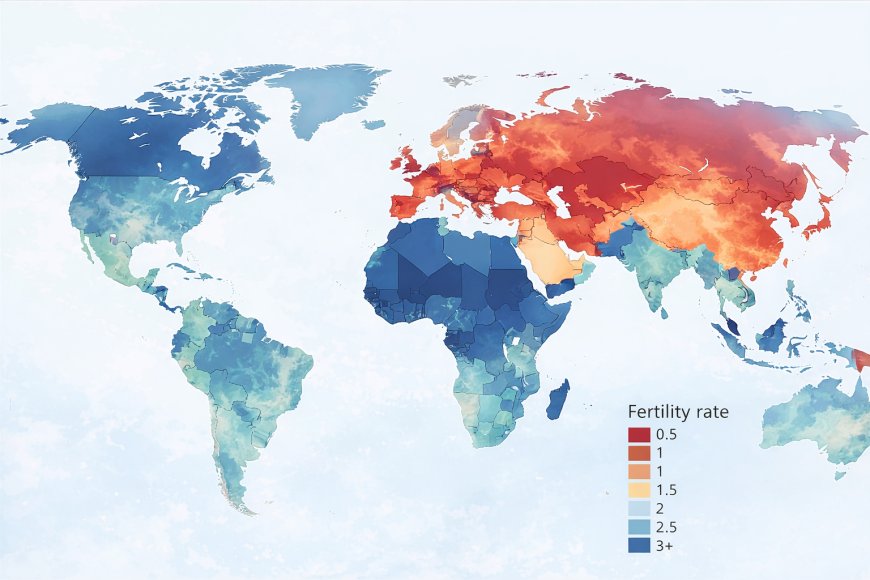
Fast-forward fifty years. The lab tank is now the late-stage developed world. We do not have a predator problem. We have:
- historically high life expectancy
- unprecedented food security and obesity rates
- urban safety (by historical standards)
- welfare systems, safety nets, and healthcare
- digital entertainment saturating every waking hour
At the same time, fertility in the core economies has fallen below replacement. The UN defines replacement-level fertility at roughly 2.1 children per woman (higher in high-mortality contexts). By 2023, the global average had already drifted down to about 2.2 and is still falling. Large parts of the world — most of Europe, East Asia, North America — are well below replacement.
Some of the steepest falls are in countries that look the most like “human utopias” on paper:
- South Korea: fertility collapsed from well above replacement in the 1980s to a record low of about 0.72 in 2023 — then “rebounded” slightly to around 0.75 in 2024, still the lowest in the OECD and far below replacement.
- Japan: long-running sub-replacement fertility, coupled with rising rates of adults reporting no sexual experience into their 30s.
- Southern Europe (Italy, Spain, Greece, Portugal): fertility in the ~1.2–1.4 range for years.
- United States: a slow grind down toward the mid-1.6–1.7 range, below replacement for over a decade, driven heavily by delayed and forgone childbearing among Millennials and Gen Z.
Parallel to fertility decline is something Calhoun would recognize immediately: a collapse in mating behavior itself. Based on recent General Social Survey data analyzed by the Institute for Family Studies, weekly sexual activity among U.S. adults aged 18–64 has dropped from around 55% in 1990 to roughly 37% in 2024, with Gen Z showing the steepest decline. Journalists are calling it a “sex recession.”
Japan has been here longer. Surveys now routinely find that large shares of young adults have never had sex, never dated, or express little to no interest in sex. In some surveys from the 2010s and early 2020s, around 40% of men in their 20s report never having had sex, and a similar share have never been on a date.
None of this is happening because people cannot physically reproduce, or because a world war has wiped out the male population, or because famine killed half the cohort. It’s happening in the most materially comfortable, medically sophisticated, digitally entertained societies in human history.
The substitution patterns look a lot like a human-scale behavioral sink:
- Digital substitution for intimacy: pornography, parasocial relationships with influencers, AI companions, and endless swipe-based dating that gamifies selection without rewarding long-term commitment.
- Substitution for status: social-media metrics, game achievements, and workplace prestige stand in for the older status packages of family, community leadership, or craftsman mastery.
- Substitution for belonging: online tribes, fandoms, and ideological micro-cultures replace local institutions like churches, guilds, and multi-generational civic organizations.
- Substitution for continuity: personal “self-branding” and short-term experience-maximization replace long-term family building or stewardship over land, companies, or institutions.
When Gen Z says “I don’t want kids, they’re too expensive,” or “I don’t want to bring children into this world,” they’re not just doing economics or climate math. They’re signaling that the system has stopped offering a convincing script where having children feels like a sane, anchored move inside a coherent future.
In Calhoun’s language, both mice and humans are reacting logically to a broken environment. When a system that once used roles like “parent,” “protector,” “builder,” “citizen,” or “patriarch/matriarch” as core identity channels stops rewarding them — or actively punishes them economically — reproduction is not just difficult. It becomes irrational.
Purpose Machines, Limits to Growth, and Civilizational Design
In 1972, another MIT-linked project was mapping collapse from a different angle. Donella Meadows and colleagues published The Limits to Growth, using the World3 system-dynamics model to simulate exponential population and industrial growth colliding with finite resources, pollution, and food constraints. Many of their scenarios ended in overshoot and collapse of population and industrial output in the mid-to-late 21st century if nothing structural changed.
Put Calhoun and Meadows side-by-side and you get two orthogonal collapse vectors:
- Limits to Growth: collapse because the physical system overshoots the carrying capacity; resources and ecological sinks become binding.
- Mouse Utopia: collapse because the behavioral system overshoots the meaning-making capacity; roles, scripts, and social coherence become binding.
Humanity now sits in a weird overlapping regime. On one axis, we are still pressuring ecological and resource systems. On another axis, many of the richest countries are already in negative demographic territory, with sub-replacement fertility, rapidly aging populations, and governments quietly panicking.
You can see the panic in the new wave of pronatalist policies:
- South Korea paying massive cash bonuses per child and ramping up childcare subsidies, while creating entire ministries dedicated to demographics.
- China pivoting from a one-child policy to alarm over too few births, adding incentives and rhetoric about family responsibility.
- European states layering tax credits, leave policies, and childcare support, trying to claw fertility back toward 2.0.
- Politicians in the U.S. and elsewhere openly calling for more births and floating policy packages framed as demographic security.
Most of these policies treat fertility as a knob you can turn with money, rhetoric, or restrictions. They rarely touch the deeper layer Calhoun’s work points at: the architecture of roles and purpose.
In pre-industrial or early-industrial societies, several “purpose machines” ran in parallel:
- Family: children as labor, old-age insurance, and lineage.
- Religion: afterlife, duty, and trans-generational meaning.
- Nation: shared narrative, war, sacrifice, and rebuilding.
- Land and craft: farms, shops, and trades handed down.
- Frontiers: literal ones (new lands) and industrial ones (new industries) to conquer.
These machines told you, very simply: there is a place for you, and building a family is part of fulfilling it.
Now, many of those machines have either:
- weakened (institutional religion, national projects),
- been outsourced to the state (old-age pensions, welfare), or
- been abstracted into hyper-specialized, fragile knowledge-economy roles that are hard to map to a concrete legacy.
For a large share of Gen Z, the world looks less like a frontier to build on and more like a completed level they’re renting time in: all the big things were built by previous generations; your job is to not get crushed by rent, tuition, and algorithmic job markets while entertaining yourself and not getting too anxious about climate or politics.
In that context, not having children is rational. Children are a massive cost center in a system that no longer promises matching gains in security, status, or continuity. The opportunity cost of kids, in terms of mobility, career, and self-exploration, is obvious; the upside is fuzzier than ever.
Calhoun would say: the environment has stopped rewarding reproductive behavior with sufficient meaning and status. So the system begins turning it off.
That is the core design problem of the 21st century: not just how to stay within physical limits, but how to rebuild purpose machines that make continuity feel sane again — without sliding into coercive, authoritarian pronatalism.
Pattern Nexus Lens
Viewed as a control system, civilization runs on feedback loops between constraints and meaning. Survival constraints used to do a lot of the heavy lifting: if you didn’t cooperate, build, and raise kids, you died. Meaning was woven tightly into those constraints — family, faith, land, and craft were all directly connected to survival.
Over the last century, we deliberately removed or softened large swaths of those constraints using technology, welfare, and global trade. That was the point. But we didn’t build an equivalent set of deliberate, high-bandwidth meaning feedbacks to replace them.
The result is a system where:
- Negative feedbacks on survival (hunger, disease, predation, local scarcity) have been suppressed in rich countries.
- Positive feedbacks on meaning (roles, narratives, paths to contribution) are weak, noisy, or captured by short-term digital loops.
Mouse utopia is what happens when you crush the survival feedbacks and ignore the meaning layer. Limits to Growth is what happens when you ignore the physical limits of the survival layer itself. We’re now juggling both.
The Pattern Nexus read is simple:
- A civilization can die by too much pressure (resource and ecological collapse) or by too little purpose (behavioral and demographic collapse).
- We have tooling to see the first one coming (climate models, energy models, material-flow analysis). We barely have language for the second.
- If we try to “fix” fertility by brute-force policies while leaving the meaning architecture broken, we will get brittle, authoritarian outcomes that don’t hold.
The real lever is neither panic about “too many people” nor panic about “too few babies.” The lever is designing environments — economic, social, and narrative — where having a future, including children, once again feels like a rational move for individuals living inside the system, not a sacrifice to keep the aggregate model stable.
FAQ
Does mouse utopia “prove” humans are doomed to go extinct under abundance?
No. Calhoun’s experiments are a model, not a prophecy. They show how one social species behaves when you remove survival constraints without redesigning social roles. Humans have cultural, technological, and institutional flexibility that mice do not. The point is not “we are mice in a tank,” but that we are approaching a similar regime where meaning, not calories, is the bottleneck.
Isn’t lower fertility good for the planet and resource limits?
A slower population trajectory can reduce pressure on ecosystems and resources, which matters in a Limits to Growth frame. The problem is how you get there. A controlled glide path to a lower, stable population is very different from an unplanned demographic collapse that implodes pension systems, labor markets, and inter-generational support structures. The current pattern — sharp collapses in core economies, combined with aging and fiscal stress — looks a lot more like a behavioral sink than a deliberately managed transition.
What would a non-dystopian fix actually look like?
The humane answer is not coercive pronatalism. It’s rebuilding purpose machines: affordable, stable paths to family formation; serious long-term projects (technological, cultural, and civilizational) that require multi-generational effort; institutional designs that reward parenting instead of punishing it; and narratives where having a future — including children — is part of a coherent life script, not an optional luxury good. That is design work, not a one-line policy tweak.
Sources
Selected references on Calhoun’s experiments, global fertility trends, Gen Z behavioral shifts, and Limits to Growth–style resource modeling.
- “Behavioral sink” and Universe 25 overviews, including Calhoun’s original 1962 Scientific American article and later commentary on the mouse utopia designs. (See Behavioral Sink entry and Cabinet Magazine’s “The Behavioral Sink”.)
- Donella H. Meadows et al., The Limits to Growth (1972), World3 model, and subsequent reassessments by the Club of Rome on overshoot and collapse scenarios in the 21st century.
- UN and demographic summaries on global sub-replacement fertility and the spread of below-2.1 fertility rates across Europe, East Asia, and North America.
- South Korea fertility statistics and policy responses, including 0.72 fertility in 2023 and a slight uptick to ~0.75 in 2024, still the lowest in the OECD, plus large-scale government incentives.
- Institute for Family Studies and related coverage on the “sex recession”: declines in weekly sexual activity among U.S. adults from ~55% in 1990 to ~37% in 2024, with Gen Z showing the steepest drops.
- Japanese surveys on sexual inexperience, dating, and “herbivore men,” including rising shares of men in their 20s and 30s reporting no sexual experience and no dating history.
- Reporting and analysis on the new wave of pronatalist policies and demographic anxiety in South Korea, China, Europe, and the United States, and associated debates over reproductive freedoms.
Qual é a sua reação?
 Curtir
0
Curtir
0
 Não gostei
0
Não gostei
0
 Amor
0
Amor
0
 Engraçado
0
Engraçado
0
 Uau
0
Uau
0
 Triste
0
Triste
0
 Bravo
0
Bravo
0

Founder of Pattern Nexus. I research markets, macro, geopolitics, AI, history, ancient systems, and the patterns most people overlook. I’m also building Market Radar, a trading scanner designed to read pressure, risk, confirmation, and setup quality before chasing a move. Pattern Nexus is where I connect the dots between data, history, technology, and the bigger system playing out around us.













Comentários (0)