
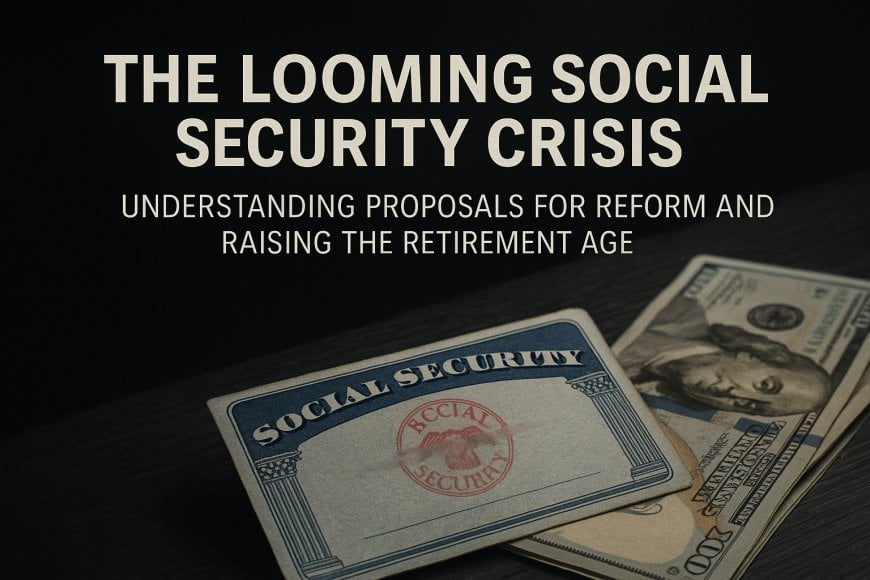
The Looming Social Security Crisis: Understanding Proposals for Reform and Raising the Retirement Age
Social Security reform is essential but often misunderstood. This comprehensive analysis explores the mechanics of the program's solvency problem, the range of policy proposals, the impacts on various age cohorts, and the likelihood of meaningful reform. We debunk political framing, emphasize structural issues, and offer a data-driven view of what needs to be done.
Published: December 15, 2025
By: Pattern Nexus
Social Security reform is not a partisan slogan, a campaign talking point, or a personality conflict. It is a delayed-feedback solvency system colliding with demographic reality, statutory limits, and decades of political deferral. The debate around raising the retirement age is not new, not ideological, and not tied to any single administration. It is the predictable outcome of a system designed to postpone adjustment until it is no longer optional.
The Core Constraint That Forces Reform
Social Security operates under a hard statutory constraint. It cannot legally pay more in benefits than it collects through payroll taxes and accumulated trust fund assets. When expenditures exceed income, reserves are drawn down. When reserves reach zero, benefits automatically adjust to match incoming revenue.
This is not a political choice. It is a mechanical outcome embedded in the program’s design.
The commonly cited depletion window of the early-to-mid 2030s is not a forecasted crisis in the abstract. It is a countdown to when discretion ends and formula takes over.
Once reserves are depleted, the program continues operating, but payable benefits fall materially below scheduled benefits. That reduction applies to all beneficiaries simultaneously unless Congress intervenes beforehand.
What the Trust Fund Actually Represents
The Social Security trust fund is not a pile of cash. It is an accounting record of excess payroll contributions invested in Treasury securities during periods when revenue exceeded benefit payments.
Those securities are claims on the federal government, not external assets. Redeeming them requires either higher taxes, more borrowing, or spending adjustments elsewhere.
As demographic trends reversed, the system moved from surplus to structural deficit. The trust fund now functions as a buffer against immediate cuts, but that buffer shrinks each year.
Once depleted, the system transitions abruptly from scheduled benefits to payable benefits. That snap-point is the real risk policymakers have been avoiding.
Why the System Was Allowed to Drift
The policy failure is not ignorance. It is incentive alignment.
Politicians are rewarded for avoiding pain today and punished for imposing it. Social Security’s design allows postponement because the trust fund absorbs the imbalance temporarily.
Every year of inaction narrows future options and increases the magnitude of eventual adjustments. Yet delay remains the dominant strategy until the cliff becomes unavoidable.
This is not unique to Social Security. It is a classic delayed-feedback failure seen in pensions, debt cycles, and infrastructure maintenance.
Raising the Retirement Age: What It Really Does
Public discussion often misrepresents what “raising the retirement age” means.
There are three distinct ages in the system:
- Earliest Eligibility Age (62)
- Full Retirement Age (currently 66–67)
- Maximum delayed benefit age (70)
Most proposals target the Full Retirement Age, not the earliest eligibility age.
Raising the Full Retirement Age does not prohibit early retirement. It changes the benefit formula so that claiming earlier produces larger permanent reductions, and full benefits require waiting longer.
This makes it politically attractive. Current retirees are protected. Near-retirees are often grandfathered. The adjustment is pushed onto younger cohorts.
Cohort Scenarios and Distributional Effects
Policy impacts depend on age, income, health, and job flexibility. Consider three stylized cohorts:
Age 55 Cohort
Most proposals largely protect this group. However, if reform is delayed until trust fund depletion, this cohort faces the highest risk of abrupt across-the-board benefit reductions.
Age 45 Cohort
This group is most exposed to phased-in changes. Higher Full Retirement Ages, modified benefit formulas, and partial revenue increases are likely to apply.
Age 35 Cohort
This cohort bears the bulk of adjustment under most designs. They face higher contribution burdens, later full eligibility, and greater uncertainty around long-term benefit formulas.
Lower-income and physically demanding workers are disproportionately harmed by retirement age increases because they have less ability to delay claiming and shorter average lifespans.
What Is Most Likely to Happen
Based on historical behavior, institutional constraints, and demographic math:
- A mixed reform package is highly likely before or near the depletion window.
- That package is likely to include both revenue increases and benefit adjustments.
- Retirement age changes are moderately likely, heavily phased in, and cohort-targeted.
- Raising the earliest eligibility age is less likely than raising the Full Retirement Age.
The longer reform is delayed, the more abrupt and politically destabilizing it becomes.
Why Framing This as “a Trump Thing” Is Wrong
No president can unilaterally change Social Security law. Congress controls the program.
The solvency problem predates every current political figure and has been documented for decades.
Framing retirement age discussions as a personal agenda obscures the structural reality: both parties have deferred action because delay was politically easier.
Pattern Nexus Lens
Social Security is a delayed-feedback system with a hard statutory snap-point.
Short-term incentives reward denial. Long-term math enforces adjustment anyway.
When reform finally arrives, it will be framed as emergency stabilization rather than strategic design.
The real risk is not reform itself, but reform under duress.
FAQ
Is Social Security going bankrupt?
No. It continues operating, but pays reduced benefits without legislative change.
Is raising the retirement age inevitable?
Some form of adjustment is inevitable. The exact mix is not.
Who is most at risk?
Younger workers and those with limited ability to delay retirement.
Sources
- Social Security Trustees Reports (OASDI projections)
- SSA Office of the Chief Actuary solvency provision catalogs
- Congressional Budget Office long-term budget outlooks
- Bipartisan Policy Center Social Security analyses
- Committee for a Responsible Federal Budget policy breakdowns
Qual é a sua reação?
 Curtir
0
Curtir
0
 Não gostei
0
Não gostei
0
 Amor
0
Amor
0
 Engraçado
0
Engraçado
0
 Uau
0
Uau
0
 Triste
0
Triste
0
 Bravo
0
Bravo
0

Founder of Pattern Nexus. I research markets, macro, geopolitics, AI, history, ancient systems, and the patterns most people overlook. I’m also building Market Radar, a trading scanner designed to read pressure, risk, confirmation, and setup quality before chasing a move. Pattern Nexus is where I connect the dots between data, history, technology, and the bigger system playing out around us.
















Comentários (0)