
SpaceX’s Booster Failure & the South Texas Industrial Surge: A Structural Look at the Week
SpaceX’s upgraded Starship booster failed in testing, but the company’s Texas industrial expansion surged—revealing the deeper structure behind America’s space future.
SpaceX Just Hit a Major Setback — And a Major Milestone — In the Same Week
A ground-test failure of SpaceX’s upgraded Starship booster sent shockwaves through the aerospace world this week. But behind the headlines is a deeper story: an expanding industrial base, billions in regional impact, and the long-term infrastructure race shaping America’s orbital future.
The Booster Failure That Defined the Week
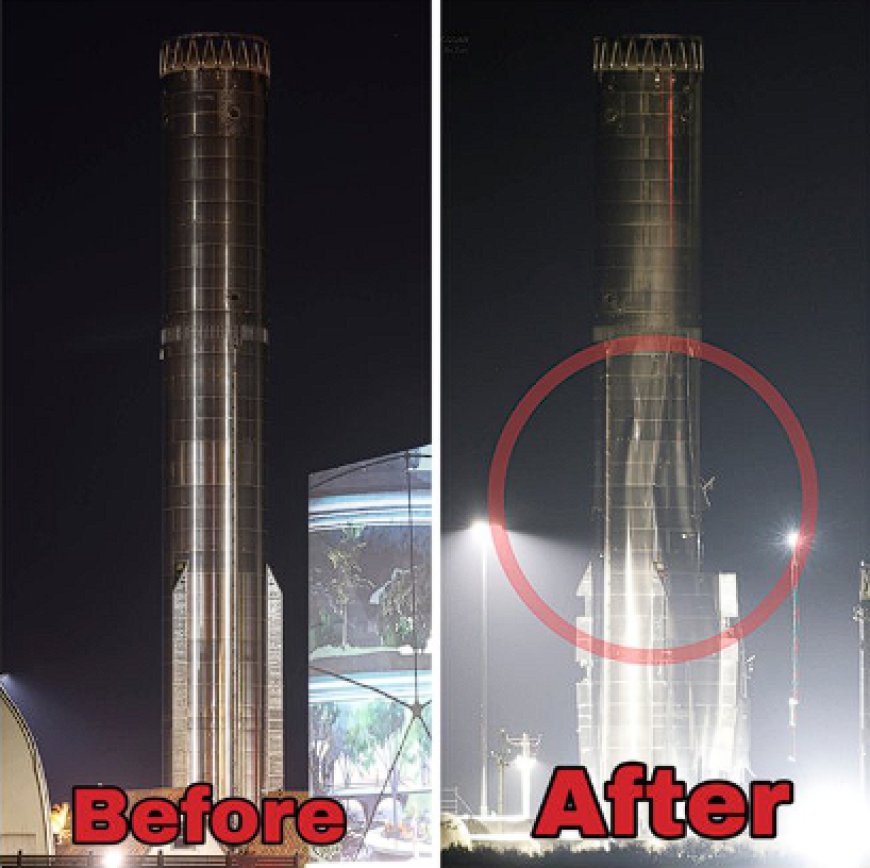
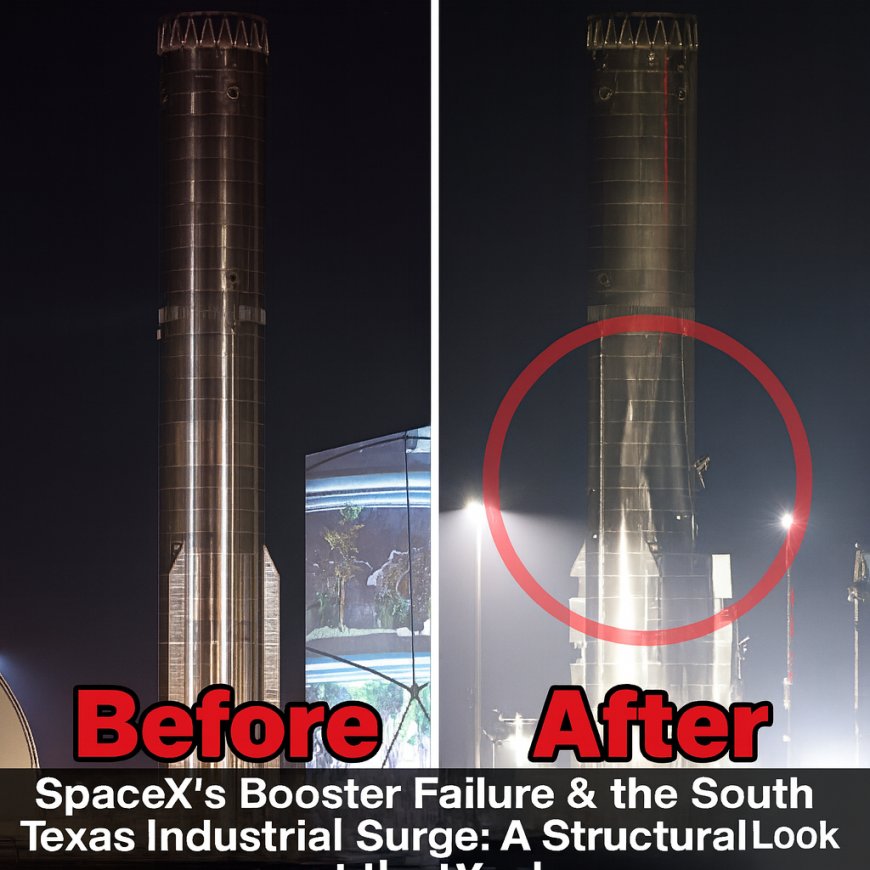
This was Booster 18 — one of the new V3-class Super Heavy variants.
SpaceX suffered a significant setback this week when its first upgraded Super Heavy booster experienced a structural failure during a cryogenic pressure test at Starbase, Texas. Reuters described the event as a buckling incident — a sudden deformation under load — rather than an explosion.
The failure comes at a crucial phase: SpaceX is transitioning Starship into a more powerful, higher-performance V3 system designed to support rapid reusability, lunar cargo delivery, and high-cadence launch operations.
These failures aren’t unusual — they’re part of SpaceX’s fast-iteration model. But the timing matters because Starship is under pressure from NASA schedules, Artemis targets, and looming commercial opportunities tied to in-space manufacturing, lunar operations, and orbital logistics.
$13 Billion: SpaceX’s Expanding Economic Footprint in South Texas
Starbase now employs over 4,300 people — with projections to nearly double.
In the same week as the booster failure, SpaceX released new economic impact data showing that Starbase has become one of the largest economic engines in Texas. The company’s footprint brings billions in direct and indirect activity to Cameron County, including construction, housing demand, subcontractor growth, and long-run industrial development.
This underscores a simple but powerful truth:
Even when hardware fails, the base supporting it continues to grow, diversify, and cement SpaceX as a foundational part of the Texas industrial landscape.
Texas Approves up to $7.5 Million in New Tax Incentives for SpaceX
These support expansions at GigaBay — the massive new Starship factory and integration facility.
As part of SpaceX’s ongoing expansion, Texas is preparing a new round of incentives tied to job creation, manufacturing capacity, and regional development.
This isn’t charity — it’s strategy. Texas understands what SpaceX is building:
- One of the largest aerospace manufacturing clusters in the U.S.
- Critical launch infrastructure for NASA’s Artemis program.
- Future economic leverage tied to commercial space stations, lunar supply chains, and in-space manufacturing.
These tax incentives are not about helping SpaceX survive — they’re about accelerating infrastructure that the U.S. needs for long-term competitiveness.
The Bigger Picture: A Structural Pattern Emerging
A booster fails. A region surges economically. A state invests even more.
This is the paradox of the modern space economy: setbacks and breakthroughs happen simultaneously, because the physical hardware is only one layer of a much larger system.
A booster can fail, but the industrial machine — the hiring, training, logistics, capital spending, tax structures, political alignment, and supply chains — continues to expand underneath it.
SpaceX is no longer just an R&D rocket company. It is:
- A regional economic anchor
- A long-run infrastructural asset
- A strategic lever in the U.S. space race
- A platform provider for the next-gen orbital economy
Pattern Nexus Implications
The real story is the capacity build-out behind it.
From a structural, macro-industrial lens, SpaceX’s week illustrates the shift from “big rocket company” to “sovereign-capability industrial platform.”
Countries don’t just want rockets — they want entire ecosystems that generate:
- Jobs
- Tax bases
- Infrastructure
- Supply chain nodes
- Strategic leverage in a multipolar world
The booster failure will be fixed. The hardware will be rebuilt. But the industrial layers SpaceX is assembling under Starship — that’s the part that cannot be ignored.
Sources
Hyperlinks are provided here only, with no in-text external linking per Pattern Nexus style.
- Reuters — First upgraded Starship booster fails during ground test https://www.reuters.com/business/aerospace-defense/first-spacex-booster-upgraded-starship-fails-during-test-texas-2025-11-21/
- Express News — SpaceX’s $13B economic impact in South Texas https://www.expressnews.com/business/article/spacex-south-texas-economy-cameron-county-21116812.php
- MySanAntonio — SpaceX eligible for $7.5M in Texas tax breaks https://www.mysanantonio.com/business/article/spacex-gigabay-starbase-tax-breaks-21196578.php
- SpaceNews — Starship development & U.S. launch infrastructure https://spacenews.com
- Ars Technica — SpaceX Starship testing updates https://arstechnica.com/space
- CNBC — Space industrialization and regional impact https://www.cnbc.com
What's Your Reaction?
 Like
0
Like
0
 Dislike
0
Dislike
0
 Love
0
Love
0
 Funny
0
Funny
0
 Wow
0
Wow
0
 Sad
0
Sad
0
 Angry
0
Angry
0

Founder of Pattern Nexus. I research markets, macro, geopolitics, AI, history, ancient systems, and the patterns most people overlook. I’m also building Market Radar, a trading scanner designed to read pressure, risk, confirmation, and setup quality before chasing a move. Pattern Nexus is where I connect the dots between data, history, technology, and the bigger system playing out around us.














Comments (0)