
AI Data Centers Are an Inflation Engine: The Race to Build a Private Grid
AI isn’t just a software story anymore. It’s a power story—capacity, interconnect queues, local resistance, and a new wave of private generation that quietly rewires inflation and industrial policy.
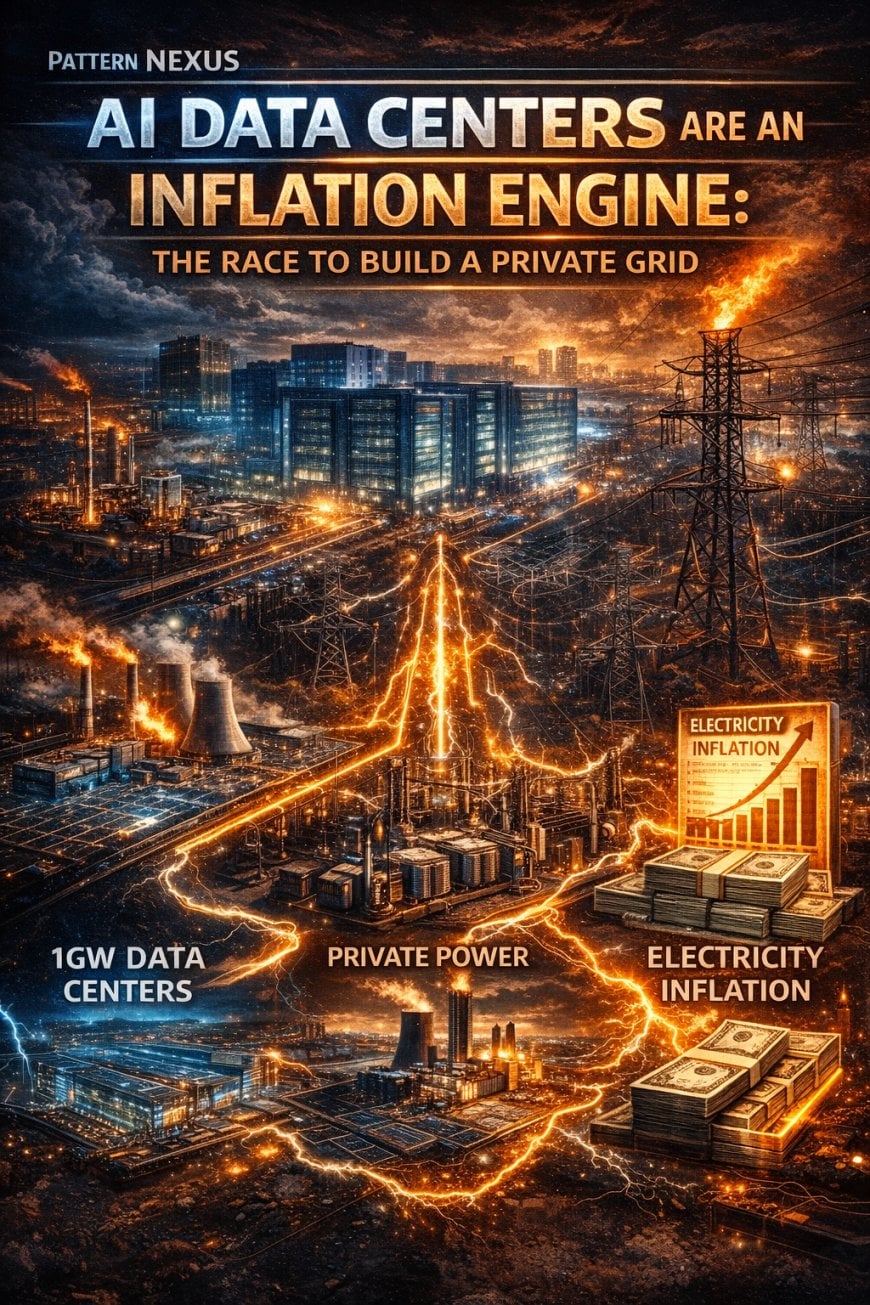


We’re watching AI shift from “software hype cycle” into “industrial load problem.” Data centers are pulling power at a scale that forces new generation, new transmission, and new political fights over water, land, taxes, and grid reliability.
Recent reporting ties AI-driven electricity demand to higher power prices and inflation pressure, with projections that data centers could drive a large share of near-term U.S. electricity demand growth and ripple into consumer spending and GDP. This isn’t abstract. It’s utility bills.
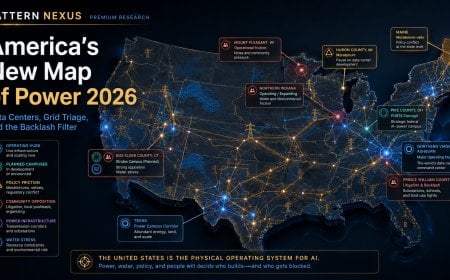
At the same time, hyperscalers are building multi-gigawatt campuses (Meta’s $10B Indiana site is one example), and local communities—especially in Texas—are pushing back because local governments often have limited tools to slow the buildout.
The outcome is obvious: a private-grid race. Companies will bypass interconnection bottlenecks with dedicated generation, long-term offtake, and on-site power. Energy becomes the new AI moat.
Compute Becomes Baseload
The story changed the moment data centers stopped behaving like “elastic demand” and started behaving like continuous industrial load. That shift is why the AI conversation is now showing up in inflation commentary and utility bill politics.
One recent analysis cited in reporting argues AI-driven electricity demand is pushing power-price inflation above broader inflation, with knock-on effects to consumer spending and GDP. Whether you agree with the exact magnitudes, the direction is the point: AI is now a physical constraint story, and power is the price of compute.
The Grid Bottleneck: Interconnect, Transmission, and Reality
The grid is not a plug. It’s a system with queues. You can pour capital into servers in months, but you can’t build transmission, generation, and interconnect approvals at AI speed. That mismatch creates a predictable outcome: projects stall, regions compete, and the winners are the ones who can secure firm power.
A Belfer Center paper notes AI-driven energy demand is outpacing available capacity in some regions and highlights projections (citing LBNL) that U.S. data center demand could rise materially by 2028. The practical read is straightforward: capacity and interconnection become strategic assets, not background utilities.
Local Backlash: Texas as the Early Signal
Texas is a preview of the national fight because it sits at the intersection of cheap land, business-friendly policy, and power constraints. Recent reporting describes communities from Waco to Harlingen raising concerns over energy and water use, while local officials often have limited authority to halt or meaningfully slow data center development.
This is what “industrial policy” looks like at the ground level: tax incentives vs quality-of-life pushback, energy reliability fears vs jobs narratives, and a growing sense that the benefits are diffuse while the costs are local and immediate.
The Private-Grid Race: Dedicated Power as a Strategic Moat
When the grid can’t deliver firm power fast enough, the rational move is to bypass it. That means direct generation deals, dedicated substations, behind-the-meter generation, and long-term offtake contracts that look less like “utility customers” and more like “sovereign industrial loads.”
The consequence is structural: firms with access to capital and power procurement sophistication will outcompete smaller players, not because their models are better, but because their electrons are guaranteed. Energy becomes the AI moat.
Macro Effects: Inflation, Politics, and the New Industrial Stack
If AI drives a large fraction of incremental demand growth, grid capex rises. In regulated markets, capex often feeds into rate bases over time. That’s how a compute boom becomes a household bill problem. This is why some coverage now frames AI power demand as an inflation input and a potential political backlash catalyst if consumer costs rise faster than visible AI productivity gains.
This is the deeper Pattern Nexus point: industrial stacks always converge on choke points. For AI, the choke points are electricity, transmission, transformers, cooling water, permitting, and local legitimacy. Those are governance problems disguised as engineering tasks.
Pattern Nexus Lens
FAQ
Sources
- Financial Times: AI electricity demand, inflation pressure, and growth impacts (Feb 2026)
- Reuters: Meta begins construction of $10B Indiana data center (~1 GW) (Feb 11, 2026)
- Texas Tribune: Local pushback and limits on stopping data centers (Feb 13, 2026)
- Belfer Center: AI, Data Centers, and the U.S. Electric Grid (Feb 2026)
- Reuters: Additional context on hyperscaler power procurement and infrastructure build cadence (same report)
Ni Nini Jibu Lako?
 Penda
0
Penda
0
 Chukia
0
Chukia
0
 Upendo
0
Upendo
0
 Picha za kuchekesha
0
Picha za kuchekesha
0
 Poa
0
Poa
0
 Huzuni
0
Huzuni
0
 Hasira
0
Hasira
0

Founder of Pattern Nexus. I research markets, macro, geopolitics, AI, history, ancient systems, and the patterns most people overlook. I’m also building Market Radar, a trading scanner designed to read pressure, risk, confirmation, and setup quality before chasing a move. Pattern Nexus is where I connect the dots between data, history, technology, and the bigger system playing out around us.














Maoni (0)