
Elon Musk’s Long-Term Vision: An Integrated Blueprint for a Multiplanetary Future
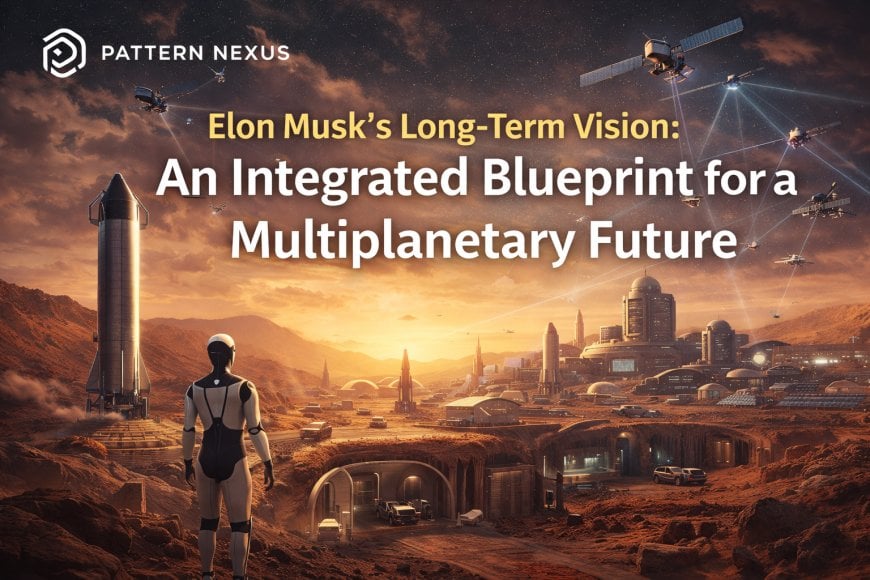
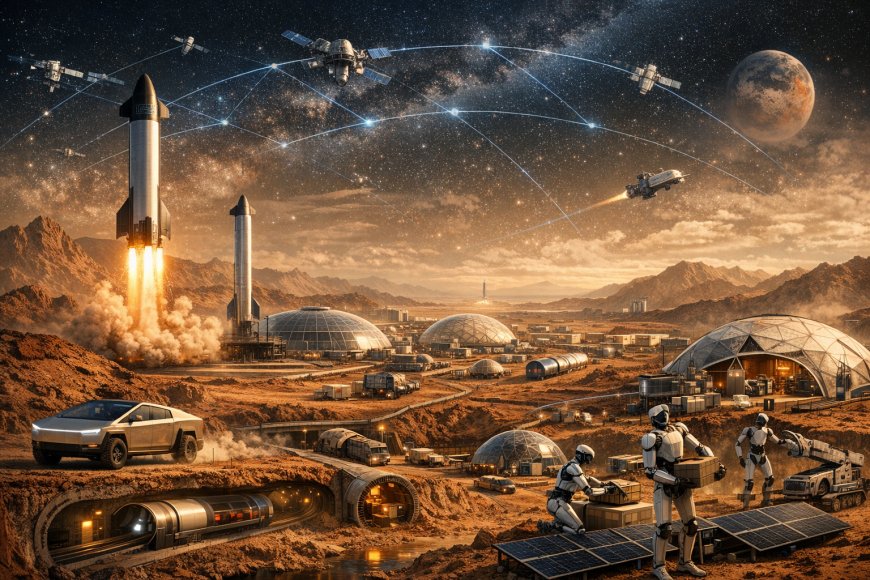
Elon Musk isn’t building disconnected companies; he’s assembling an integrated system—SpaceX, Tesla, Starlink, xAI, X, Neuralink, and The Boring Company—designed to make humanity a multiplanetary species.

The core objective
Musk’s public statements, from early SpaceX to today, are remarkably consistent: use technology, cash flow, and compounding engineering capability to push humanity beyond single-planet fragility and into a durable, multiplanetary phase. Survival, not quarterly EPS, is the primary mission.
The orchestration
Each company owns a slice of the stack—launch, energy, AI, comms, tunnels, neurotech, social—and they are deliberately wired together through shared components, shared talent, capital recycling, and data flows. They are not siloed businesses; they function as modules in one civilization-scale system.
The thesis
Short-term volatility, controversy, and missed timelines are accepted trade-offs. The actual target is a self-sustaining city on Mars and a space-based economy where SpaceX operates like a mega-corp infrastructure layer for the solar system. In that outcome, the company that sits on top of the market-cap rankings isn’t today’s biggest AI chip vendor or cloud platform—it’s the entity that every government and mega-corp must pay to move anything beyond Earth: SpaceX.
Introduction: A Unified Mission Across Ventures
Elon Musk has consistently voiced a singular overarching ambition: to make humanity a multiplanetary species. Since the early days of SpaceX (founded 2002), Musk’s stated goal has been to ensure the long-term survival of consciousness by spreading humanity to other planets. This is not a marketing tagline bolted on after the fact; it is the north star that shows up again and again in his interviews, talks, and tweets over nearly two decades.
In Musk’s framing, humanity today sits in a narrow window. Civilization is technologically capable enough to attempt a multi-planet jump, but politically and environmentally unstable enough that the window may not remain open indefinitely. He has said versions of this repeatedly: “The urgency for life to be multiplanetary is high. We have to do it while civilization is this strong.” The through-line is that failing to act is itself a high-risk decision.
Most people engage with this as philosophy or sci-fi flavor. Markets, meanwhile, stare at a different scoreboard: the current top-10 list of global megacaps. That list is dominated by cloud, chips, platforms, and consumer ecosystems. It tells a story about the last wave: the internet and smartphone era, plus the early commercial AI wave riding on top of it.
This piece is about a different question: if Musk’s blueprint works, which company not on that current list has the cleanest path to becoming the most valuable business on Earth in the next decade? The answer, in this framework, is not a web app or another cloud operator. It is the company that owns the launch lanes, satellite grids, and interplanetary logistics: SpaceX.
Crucially, SpaceX lies at the heart of this plan as the enabler of space travel and colonization, but Musk’s other companies – Tesla, Starlink (within SpaceX), Neuralink, The Boring Company, xAI, and X (formerly Twitter) – each play a strategic role. They develop technologies, generate capital, train AI systems, test robotics, or solve infrastructure and regulatory challenges that collectively pave the way for a self-sustaining city on Mars. None of these entities are “random side quests”; they are testbeds, cash engines, or capability-builders for the same long-range blueprint.
This article walks through that blueprint, shows how the pieces interlock, and then zooms out to the market-cap layer: why, in a world that prices network effects and chokepoints, a vertically integrated space infrastructure provider could realistically outrun today’s megacaps once public.
From PayPal to Starship: How the Stack Was Built
To understand Musk’s current ecosystem, it’s useful to look at the sequencing. None of this dropped out of the sky fully formed; each step created the capital, credibility, and technical capabilities to unlock the next layer.
Early capital and proof of execution: With Zip2 and then PayPal, Musk learned two crucial lessons: software scales fast, and exits can be parlayed into higher-ambition projects. The capital from PayPal’s sale became the seed for what came next. Most people would have bought an island. Musk bought rockets and factories instead, reportedly putting the bulk of his net worth into SpaceX and Tesla and borrowing for living expenses in some periods. That set the tone: personal leverage into hard tech with asymmetric upside.
Phase 1 – Prove hardware execution (Tesla + early SpaceX): The first decade of the 2000s for Musk was about proving he could ship physical products, not just code. Tesla was mocked as a niche EV maker; SpaceX was dismissed after multiple Falcon 1 failures. The fourth Falcon 1 flight, which finally reached orbit, and the NASA contracts that followed, effectively kept SpaceX alive. At the same time, Tesla showed that vertically integrated EV manufacturing could work at scale. Those two pillars established that Musk wasn’t just a dot-com lotto winner; he could run hard-tech companies under extreme pressure.
Phase 2 – Scale cash engines and capability (Falcon 9, Falcon Heavy, Model S/3/Y): As Falcon 9 reusability matured and Tesla ramped production of the Model S and then Model 3, the companies transitioned from “likely to die” to “cash-generating growth engines.” Launch costs dropped, Tesla’s market cap exploded, and Musk’s personal leverage over capital markets multiplied. This is when the blueprint shifts from survival to stacking: reuse Tesla tech inside SpaceX, reuse SpaceX engineering culture inside Tesla, share battery tech, share talent, and start quietly laying the foundations for robots, AI, and tunnels.
Phase 3 – Build the civilization stack (Starship, Starlink, Optimus, X, xAI, Neuralink, The Boring Company): Once Tesla and Falcon 9 were credible, Musk started populating the rest of the system: Starlink to turn SpaceX into a telecom and cash-flow machine, The Boring Company to tackle future habitat and transit constraints, Neuralink to start on human–AI bandwidth, X to control a communications/commercial layer, and xAI to do foundational AI work with proprietary data from Tesla and X. This is the phase we are in now. Starship is under development, Optimus is taking early steps, X is being reshaped into an “everything app,” and xAI’s models are starting to ship into production.
Across all phases, the pattern is the same: build a company that solves a near-term problem, structure it so that solving that problem also builds a piece of a larger system, and use the resulting cash, data, and engineering culture to fund and accelerate the next piece. From a markets lens, that means each “win” in automotive, energy, launch, or social doesn’t terminate at that industry’s frontier; it cascades into a bigger asset—ultimately, the SpaceX-led space infrastructure layer.
The Musk System Map: One Blueprint, Many Companies
If you sketch the system, it looks less like a list of companies and more like a stack:
Physical layer: Rockets, factories, vehicles, tunnels, robots, satellites (SpaceX, Starlink, Tesla, The Boring Company).
Energy layer: Solar, batteries, grid-scale storage, power electronics (Tesla Energy, plus integration into SpaceX and Boring machines).
Compute and AI layer: Dojo and Tesla AI stack, xAI models, onboard compute in vehicles, robots, and spacecraft.
Communications and social layer: Starlink/Marslink for physical comms, X for human social/financial comms.
Human interface layer: Neuralink for brain-computer links, plus more conventional interfaces (cars, robots, phones) acting as transitional steps.
At the center sits SpaceX as the long-term mega-corp: the entity that physically moves people, materials, and equipment between worlds and rents out that capability to governments, companies, and eventually individuals. Everything else either trains the AI that will run the system, generates the cash to fund it, or builds the tools that will be deployed on the other end.
Seen that way, SpaceX is not just “another Musk company.” It is the terminal node where all of the upstream capability converges. Tesla builds robots that Starship will ship. Starlink funds Starship and depends on Starship to upgrade itself. xAI trains on data from Tesla and X, and its models will eventually live in Optimus, rockets, and bases. Neuralink and The Boring Company help make the human side and the habitat side viable. In pure business terms, if you believe this stack gets built, SpaceX is the equity claim on the infrastructure that everyone else—governments, corporates, and even other Musk ventures—must rent.
SpaceX: Launching the Multiplanetary Frontier
SpaceX is the cornerstone of Musk’s Mars-centric ambitions. Its primary mission is to dramatically reduce the cost of space transport and ultimately ferry humans and cargo to Mars to establish a permanent colony. Musk has openly maintained that “sending humans to Mars” is his lifelong ambition, taking priority even over short-term profits or short-term investor comfort.
SpaceX pioneered reusable rockets with Falcon 9 and Falcon Heavy. The company’s relentless push for reuse—landing boosters on droneships, re-flying them many times—was not just about launch margins; it was rehearsal for a world where vehicles must launch, land, refuel, and fly again like aircraft. That maturity in reusability is the stepping stone to Starship.
Starship is a fully reusable super-heavy lift vehicle intended to carry up to 100 people per flight to the Moon and Mars. Musk has spoken of a fleet of roughly 1,000 Starships moving people and cargo during favorable Earth–Mars transfer windows to build a city of one million people. The numbers sound insane by today’s standards, but that is the point: Starship is not a “rocket program,” it is a transportation architecture. It’s designed for a world where shipping heavy equipment to Mars is as routine, conceptually, as sending containers across oceans.
Starship’s capacity—150+ tons to low Earth orbit in a reusable configuration—changes the economic calculus. It allows for new categories of payload: entire space stations in a single launch, massive next-generation Starlink satellites, on-orbit fuel depots, large telescopes, industrial equipment, and eventually bulk cargo to the Moon and Mars. It is the equivalent of going from clipper ships to steel container vessels in one jump.
SpaceX’s president, Gwynne Shotwell, has said the company will likely not take SpaceX public until its Mars mission is more mature, which is another way of saying: the company’s terminal value is tied less to today’s launch manifest and more to the future role it plays as the transport backbone of a multi-planet civilization. That is not the typical IPO story and it’s one reason the true upside is not visible in public markets yet: the key asset hasn’t listed.
Starlink, SpaceX’s satellite internet constellation, further elevates SpaceX into a comprehensive space infrastructure provider. Today, Starlink’s thousands of satellites deliver broadband to millions of customers on Earth, especially in remote or underserved areas. But the deeper strategic role of Starlink is twofold: it is a cash engine and a communications grid for Musk’s broader plan.
On the P&L, Starlink has clear, legible revenue streams—monthly subscriptions, enterprise and government contracts, aviation and maritime connectivity, and (increasingly) direct-to-cell service. That puts SpaceX in the same conversation as global telcos and cloud edge networks, with one key difference: it owns the launch stack as well. Every incremental Starlink user pushes more recurring revenue into a business that also controls the cheapest reusable heavy-lift rockets at scale.
Strategically, Starlink is the seed of an interplanetary comms network. SpaceX has publicly floated the concept of a Mars-centric constellation (“Marslink”) that would route data between Martian surface installations and Earth via optical laser links. Musk has referenced the need for petabit-per-second-class connectivity between Earth and Mars over time, even if early links are much lower bandwidth. In that configuration, SpaceX is no longer just a launch provider but the de facto telecom carrier of a multiplanet civilization.
SpaceX as the “Amazon of Space” (and the Future #1)
In equity-market terms, the core idea is simple: if Musk’s blueprint works, SpaceX is the mega-corp that sits on top of almost every meaningful transaction that crosses the edge of Earth’s gravity well. It becomes the entity that owns the infrastructure equivalent of shipping lanes, ports, satellites, clouds, and logistics hubs, but in orbit and beyond.
This is why comparisons to Amazon, Google, or Microsoft are not hyperbole. Consider the parallels:
Amazon: Built a logistics and compute empire (AWS) that other companies depend on. SpaceX is building a launch and connectivity empire (Starship + Starlink) that governments, enterprises, militaries, and colonists will depend on.
Google/Microsoft: Control foundational software and cloud stacks. SpaceX is positioning to control foundational space infrastructure—the hardware, orbital lanes, and data pipes that others will build on.
Telecom and defense majors: Global telcos and defense primes monetize connectivity and security under national constraints. SpaceX sits at the intersection: a dual-use platform that can sell bandwidth, imagery, launch, and orbital services into both commercial and national-security budgets.
Now add something the big tech companies do not have: the ability to physically move mass between planetary bodies. In a scenario where lunar mining, orbital manufacturing, space-based solar power, or Mars exports are meaningful, the entity that owns and operates the transport stack is in an extraordinary position. It can sell launch as a service, lease capacity, vertically integrate into its own off-world projects, or even gate certain capabilities for regulatory or security reasons.
From a valuation perspective, that means multiple multi-hundred-billion-dollar verticals stacking on top of each other inside one corporate shell:
• A global broadband and edge network business (Starlink/Marslink) competing with telcos, satellite operators, and cloud edges.
• A launch and logistics business with a structural cost advantage from full reuse (Falcon 9/Heavy, then Starship) and effectively no true peer at comparable cadence and capacity.
• A defense and national-security services business—ISR, secure comms, rapid reconstitution of constellations, hardened infrastructure—that can tap into massive sovereign budgets.
• Future off-world industries: in-space manufacturing, asteroid resource work, lunar infrastructure, Mars surface logistics, and whatever follows once the cost/kg to orbit and beyond collapses.
Each of those verticals could, on its own, support a large-cap public company. Combined, with high integration and shared hardware/AI stacks, they form a platform that looks less like a traditional contractor and more like a regulated monopoly-style utility for space.
That is the core of the “SpaceX becomes #1” thesis. If you believe that humanity is going to put more mass, more data, and more critical infrastructure into orbit and onto other worlds over the next 20–30 years, then the company that owns the cheapest heavy-lift rockets, the most pervasive constellation, and the operational know-how to run both at global scale is structurally positioned to sit at the top of the market-cap league table—even if it isn’t visible on today’s list yet.
Everything else Musk is building—autonomous robots, AI models, tunneling machines, high-bandwidth human interfaces—are, in that context, payloads and subsystems that ride on SpaceX infrastructure. That is why it makes sense to think of SpaceX as the future “number one” mega-corp that isn’t on today’s top-market-cap lists yet, and why the current ranking is, at best, a snapshot of the pre-space-economy world.
Tesla: AI, Energy, and Robotics Beyond Automobiles
While SpaceX builds the route to Mars, Tesla builds many of the tools needed upon arrival – and generates much of the capital and technical knowhow to get there. Musk has said repeatedly that if you think of Tesla as a car company, you will fundamentally misprice it. In his own framing, Tesla is “an AI and robotics company” that happens to sell cars as its first major product.
On paper, Tesla’s mission is to accelerate the transition to sustainable energy on Earth. This includes electric vehicles, solar energy, and stationary storage (Powerwall, Powerpack, Megapack). On Mars, sustainable energy isn’t a marketing angle; it is a survival requirement. There are no fossil fuels to burn. Everything—from life support to industry—must run on sunlight, nuclear, or imported fuels. Tesla’s entire playbook—solar generation, battery storage, power electronics, grid management—is therefore directly applicable to a Mars colony.
Energy systems: Tesla’s solar panels and large-scale battery packs are designed to be modular, robust, and remotely manageable. Musk has casually mentioned that hundreds of solar panels and enough storage would be sufficient to power early Martian bases. The durability and energy density improvements Tesla pushes on Earth show up as extra margin on Mars, where every kilogram of weight is expensive to move. The expertise in lithium extraction, battery chemistry, longevity, and thermal management all translate to solving the “keep the lights on and the air breathable” problem under Martian conditions.
Robotics and autonomy: Every Tesla vehicle is, functionally, a robot that lives in an open-world environment. It must perceive, reason, and act in dynamic, messy conditions. The billions of miles driven by Tesla vehicles feed into neural networks that learn to recognize objects, predict behavior, and plan motion. That exact skill stack—vision-based perception, path planning, control—is what you want in robots that walk around a Mars base or drive across Martian terrain.
This is why Tesla introduced the Optimus humanoid robot. Musk has called Optimus “the most important product” Tesla is developing. In his framing, cars are a special case of general-purpose robots; the real long-term value is in building an AI and hardware platform that can instantiate itself in different bodies: cars, factory bots, home assistants, and, eventually, planetary exploration robots.
Optimus is being trained first in factories—Tesla’s own factories, where the environment is semi-structured but still complex. That is a safe, high-value training ground. Once the robots are reliable in that context, they can step out into more hostile and less structured environments. Musk has already talked about loading Optimus units onto Starship flights as “explorer robots” that can land on Mars ahead of humans, set up solar arrays, deploy communications equipment, perform site surveys, and handle dangerous tasks like regolith moving or structure assembly.
Vehicles and surface mobility: Electric drivetrains and robust suspensions are not just useful on Earth. Musk has floated the idea of a pressurized Cybertruck variant for Mars. Whether or not that specific design ships, the broader point stands: Tesla’s expertise in vehicles that operate in extreme climates, with minimal maintenance and high autonomy, is the base for pressurized rovers and utility vehicles on other worlds. A Martian surface fleet is, in effect, a specialized Tesla fleet optimized for low gravity, dust, and radiation.
Manufacturing as capability: Tesla’s push for giga-casting, integrated manufacturing, and high-speed production lines is not just about margins on Earth. It is about learning to compress complex systems into fewer parts, fewer steps, and less human labor. That is exactly the kind of manufacturing you want when you are trying to build out a colony with limited manpower and hardware. The fewer parts that need to be shipped from Earth, the better.
Financially, Tesla’s role is straightforward: it is the largest, most mature cash and equity engine in Musk’s stack. Its market cap and cash flows can be tapped—via equity sales, margin loans, and reputational leverage—to fund riskier ventures like SpaceX, Neuralink, or X. When Musk bought Twitter, he did it in part on the back of Tesla equity. Tesla revenue and profits effectively underwrite the more speculative parts of the multiplanetary plan.
For our market-cap framing, Tesla itself is already a megacap and will likely remain one. But the more its AI and robotics stack succeeds, the more it quietly increases the value of SpaceX and the rest of the system, because those capabilities and learnings pipe directly into the space side of the stack. Tesla’s upside is not a rival to SpaceX’s terminal value; it is one of the engines that helps pull SpaceX up the curve.
What Tesla Really Is: An AI and Robotics Company Disguised as Auto
Most market commentary still treats Tesla as a high-multiple car company with an “option” on autonomy. That view misses how Musk himself talks about Tesla internally and externally.
AI stack: Tesla’s Dojo supercomputer, the in-house neural network architectures, the end-to-end vision training, the labeling pipelines—all of this is AGI-adjacent infrastructure. Whether or not Tesla reaches full AGI, it is baking a deep AI competency into a company that also owns factories, robots, and vehicles. That is not a standard auto OEM profile.
Robotics platform: In Musk’s framing, “cars are basically semi-sentient robots on wheels.” Once you view them that way, you realize that Tesla’s value isn’t in metal and glass; it is in the AI that allows those robots to move safely and the actuators that allow them to manipulate the physical world. Optimus is that logic ported to a different form factor.
Synthesis: When Tesla says “we are worth more as an AI and robot company than as a car company,” it is not hype for its own sake. It is a statement about the long-term business model: millions of embedded AI agents (cars, bots) operating in the real world, generating recurring revenue (robotaxi, labor-as-a-service), and creating a data moat that feeds back into the models. In the context of Musk’s Mars plan, those agents eventually step off Earth and start working in an environment where human labor is scarce and extremely valuable. Tesla’s “car phase” is the training and monetization stage of that journey.
X and xAI: Information, AI Training, and the Capital Flywheel
On first glance, buying Twitter and founding xAI might look like Musk going off-mission. In the context of a multiplanetary blueprint, they make more sense: they are about controlling data, narrative, and AI capability.
In 2022, Musk acquired Twitter and rebranded it as “X,” explicitly calling the acquisition an accelerant for his plan to build “X, the everything app.” The WeChat analogy is intentional: an app through which people communicate, pay, work, and coordinate is not just a social network; it is quasi-infrastructure for daily life.
Narrative and political leverage: Musk has used Twitter/X for years as his personal broadcast channel. Owning the platform transforms that from “a loud user” to “the person who sets many of the rules.” That matters when you are pushing policies around EVs, AI regulation, space launches, or satellite constellations that touch national security. X is a way to speak directly to tens or hundreds of millions of people without going through traditional gatekeepers.
Data for AI: X is also an enormous stream of real-time human language and behavior data. In an era where AI model quality is strongly linked to dataset scale and richness, owning the platform that generates the data is a strategic move. Musk has complained publicly about other AI companies scraping Twitter data for free. Limiting that access and sending it instead to his own AI company, xAI, keeps that leverage in-house.
xAI’s role: Musk founded xAI with the stated goal of “understanding the true nature of the universe.” In practice, this means building large-scale AI models—language, vision, multi-modal—that can match or exceed the state of the art. The company recruits researchers from top labs and is explicitly positioned to integrate with X and Tesla. That integration is crucial: models trained on X’s text and Tesla’s video can be used to improve Autopilot, Optimus, content moderation, recommendation systems, and eventually higher-level planning systems for complex operations (like managing a base or optimizing logistics).
Musk has floated the concept of TruthGPT or a truth-seeking AI as an alternative to what he sees as politically biased models from other labs. In his ecosystem, that is not just a philosophical preference; it is a way to build an AI that he trusts to help run real-world systems and to be deployed in robots and infrastructure.
Capital flywheel: If X succeeds in becoming a high-usage, payment-enabled everything app, it will generate significant recurring revenue and free cash flow, via advertising, subscriptions, transaction fees, and financial services. That cash can be recycled into xAI, into Optimus development, into Starship testing—whatever the next bottleneck is.
In market-cap terms, X and xAI are not the obvious contenders to become #1. Their role in the “SpaceX becomes #1” thesis is different: they ensure the ecosystem has proprietary data, differentiated AI, and a monetizable, global platform that can be tapped for capital and intelligence. They are the information and cognition layer that indirectly boosts the value of the physical infrastructure layer that SpaceX owns.
The Boring Company: Tunneling the Path from Earth to Mars
The Boring Company (TBC) looks like a local traffic solution on paper: dig tunnels to relieve congestion. Under Musk’s multiplanetary lens, it is a proving ground for a deeper capability: fast, cheap, electric tunneling that can be deployed almost anywhere, including other planets.
On Mars, radiation, temperature swings, and micrometeorite risks make surface living problematic. Being underground—or at least semi-buried—solves many of those issues. Tunnels and caverns provide shielding and stable environments. TBC’s Prufrock tunnel boring machines are designed to be compact, electric, and capable of launching and resurfacing with minimal disruption. Musk has explicitly noted that Prufrock fits inside a Starship payload bay. That is not an accident; it is a design constraint aimed at future Mars deployment.
Every tunnel TBC digs in Las Vegas or Texas is, in a sense, a systems rehearsal: how do you manage electric power for a TBM, how do you handle spoil removal, how do you line and reinforce tunnels efficiently, how do you navigate regulatory and engineering obstacles. Mars won’t have regulators in the Earth sense, but it will have unique engineering constraints (dust, low pressure, gravity) that will require hardened variants of the same core tech.
With TBC, Musk is quietly building what you might call the “subsurface division” of the multiplanetary project. Once Starship can haul Prufrock units to Mars, the process we see under cities could play out under Martian regolith: tunnels that house people, cargo lines, air, water, and power conduits.
From a value perspective, The Boring Company is a smaller piece of the stack. Its direct revenues on Earth may never rival Tesla or Starlink. But its option value is large: it provides SpaceX and any future Mars governance entity with the capability to build safe, underground infrastructure at scale—another strategic chokepoint that lives inside the broader Musk ecosystem.
Neuralink: Human-AI Symbiosis for Life in Space
Neuralink plays a different but equally critical role: it works on the human side of the interface. Musk has been blunt about his concerns that AI could surpass and marginalize human intelligence. Neuralink’s long-term aim is to prevent that by upgrading human bandwidth and integration with AI.
In the near term, Neuralink is focused on clear medical use cases: restoring movement and communication to paralyzed patients, treating certain neurological conditions. But the device it is building—a high-channel-count, implantable brain-computer interface—scales well beyond that. Musk has talked about eventual capabilities like memory replay, skill “downloads,” and high-speed direct communication.
In a Mars context, this has several implications:
Operational efficiency: Colonists using Neuralink-type interfaces could control tools, vehicles, and robots more directly and in parallel. One person might run multiple remote robotic systems via thought, increasing effective labor output where human bodies are scarce.
Psychological resilience: Long-duration space travel and off-world living are psychologically challenging. BCI-based monitoring and stimulation could help manage mood, sleep, and cognitive function, reducing the risk of breakdowns in isolated environments.
Human–AI merge: If xAI (or other Musk-aligned AI systems) are running complex operations, Neuralink could help keep humans in the loop by providing a high-bandwidth channel both ways: humans get more direct insight into AI outputs, and AI gets cleaner, faster human feedback signals.
Neuralink also forces Musk’s ecosystem to engage with regulators, medical ethics boards, and safety standards in a way the other companies do not. That experience with tightly regulated, safety-critical human systems will matter when building life-support systems, medical systems, and emergency protocols for off-world colonies.
From a market-cap vantage point, Neuralink is a long-duration call option on human-computer integration. Its direct valuation may stay modest for a long time, but if it works, it increases the feasible complexity of off-world projects and the resilience of the humans operating them—indirectly supporting the same endgame where SpaceX is the central hard-infrastructure asset.
Stack Dynamics: Capital, Data, and Technology Loops
When you step back, three main loops stand out in Musk’s architecture:
Capital loop: Tesla, Starlink, and eventually X generate cash and/or high-value equity. That capital is recycled into more speculative projects like Starship, Optimus, Neuralink, and xAI. Success in those projects increases the value of the whole ecosystem, unlocking more capital. It is a flywheel where each win funds the next bet. In a world where most companies run one or two big flywheels, Musk is effectively running several and cross-connecting them.
Data/AI loop: Tesla cars and Optimus robots generate real-world perception and control data. X generates human-language and preference data. Satellite constellations and future robots will generate environmental and operational data. All of that can be fed into xAI and Tesla’s AI stack to train better models. Those models, in turn, make robots, cars, content algorithms, and spacecraft smarter and more efficient, which generates even more data.
Technology reuse loop: Batteries, motors, actuators, compute modules, software stacks, and manufacturing techniques are reused across companies. Tesla motors and packs end up in SpaceX hardware. Boring Company machines use Tesla components. Starlink user terminals and network tech can be integrated into Tesla vehicles or remote robots. Each engineering dollar spent tends to create components that have multiple downstream uses.
These loops are the reason the system can compound. Instead of siloed companies competing for resources, you get a loosely coupled but coordinated set of entities that share core tech and serve a common vision.
If you overlay a market-cap lens on top of those loops, the picture gets clearer: the terminal asset is the one that benefits the most from all three loops firing at once. That is not the app where people argue, the car OEM, or the tunnel startup. It is the company whose rockets carry the robots, whose satellites handle the traffic, and whose flight manifests reflect the economic activity of the entire space-based layer of the economy. That is SpaceX.
Risks, Constraints, and Failure Modes
None of this is guaranteed. The blueprint is coherent, but execution risk is massive. Some of the obvious failure modes:
Technical risk: Starship may take longer than expected to reach fully reusable, high-cadence operations. Neuralink may hit safety or efficacy walls. Optimus may prove harder to commercialize than envisioned. AI models from xAI may lag other labs or run into unforeseen alignment issues.
Financial and market risk: Tesla’s valuation and cash flow are central to Musk’s capital stack. Major setbacks at Tesla—or regulatory decisions that constrain its margins—could starve the rest of the ecosystem. X may or may not succeed in becoming an everything app; if it doesn’t, that cash engine doesn’t materialize as envisioned. A severe downturn or regulatory shock to space, AI, or EVs could tighten capital markets right when the ecosystem needs them most.
Political and regulatory risk: Starlink already bumps up against spectrum and geopolitical tensions. Starship launch cadence, deployment of mega-constellations, and the militarization of space all invite regulatory shocks. Neuralink faces medical ethics and regulatory scrutiny. X is in constant tension with regulators over speech, moderation, and data handling. Governments could decide they are not comfortable with one private actor controlling so much of the strategic infrastructure stack.
Execution bandwidth: Musk is one person trying to steer multiple frontier efforts at once. Even with strong leadership teams, there is a coordination and attention limit. A serious crisis in one company can pull focus away from others at critical moments.
Even with those risks, it is hard to deny the trajectory so far: reusable rockets went from science fiction to industry standard, EVs went from niche to mainstream, private satellite constellations went from fringe to central, and brain–computer interfaces moved from theory to human trials—all under this same umbrella of companies. The risk is high, but so is the demonstrated execution delta versus legacy players.
Pattern Nexus Lens: A Private Apollo Program, With Equity
Viewed through a systems lens, Musk’s empire is less a loose portfolio of companies and more a private Apollo program with its own launch stack, power grid, AI layer, and human-interface R&D. Instead of a single government mission with a fixed end date, you get a rolling, multi-decade campaign where each commercial win (EV dominance, broadband subscriptions, AI models, social monetization) is immediately recycled into the next harder objective (Starship, Optimus, tunnels, implants).
That is why lines like “Tesla is just a car company” or “X is just a social network” fundamentally miss what is happening. Each node in the graph is doing double duty. It solves a near-term market problem and, at the same time, rehearses the exact capabilities a self-sustaining Mars city and a space-based economy will require: autonomous machines, robust energy, high-bandwidth comms, resilient humans, and a transport stack that treats gravity wells as a solvable logistics problem, not a permanent barrier.
From a capital-markets standpoint, the interesting twist is that this “Apollo program” is being built under private and public equity structures. Tesla and, eventually, Starlink and maybe X give public markets partial exposure. SpaceX itself, as long as it remains private, sits off the big-cap list—even as it quietly accumulates contracts, technology, and strategic leverage. At the moment it goes public (if it does so after Starship and Starlink are both mature), markets will have to reprice not just a launch company, but the core infrastructure provider of the next economic frontier.
If the pattern holds, the company that will eventually displace today’s megacaps at the very top of the rankings is not a website or an app; it is the company that owns the plumbing of the space economy. In this framework, that company is SpaceX.
Conclusion: Toward a Self-Sustaining Spacefaring Ecosystem
From the above, a picture emerges of Elon Musk’s unified strategic architecture: a tightly interwoven ecosystem of companies, each attacking a different facet of the multi-planetary challenge. It is a long-term plan where each venture is a pillar supporting an overarching vision. SpaceX provides the transportation and space infrastructure; Tesla provides sustainable energy and autonomous robotics; Starlink provides global and interplanetary communications; X provides information flow, public engagement, and a platform for commerce and feedback; xAI provides the artificial intelligence that will power robotics and data analysis; The Boring Company plans the underground habitats and high-speed transit tunnels; and Neuralink works to augment human capabilities and integration with technology.
None of these stands alone. They are strategically orchestrated so that advancements in one enable progress in others, and revenue from one can fund the next big leap. Tesla teaches factories how to build robots that later board Starship. Starlink funds Starship, which launches Starlink. X generates data that trains xAI, whose models improve Autopilot, Optimus, and eventually autonomous operations on Mars. The Boring Company refines tunneling tech that can later be dropped into a Starship payload bay. Neuralink navigates human safety constraints that will echo in life support and medical systems beyond Earth.
Musk’s vision is often compared to science fiction in scope, and indeed the synergies are reminiscent of an interplanetary enterprise out of an Isaac Asimov novel – covering rocketry, AI, energy, neurotech, and even governance. But many pieces are already tangible. SpaceX’s rockets have drastically lowered launch costs. Tesla’s electric cars and batteries are mainstream, fueling a green transition while training AI at scale. Starlink’s satellites blanket the globe in internet and are increasingly woven into military and civil communications. Optimus robots are taking their first steps. Neuralink’s implants are in human trials. X is morphing into a tightly integrated social and payment platform while feeding data into xAI’s models.
If Musk succeeds, SpaceX could become to the solar system what the East India Company once was to global sea routes—only this time the “routes” are orbital trajectories and transfer windows, and the cargo is not just spices or textiles but people, data centers, industry, and entire habitats. As a privately held entity (for now), SpaceX can pursue this without the quarter-to-quarter constraints of traditional public markets, especially while it can lean on Tesla, Starlink, and eventually X for capital support.
In conclusion, Elon Musk’s long-term vision is a holistic blueprint for a multiplanetary civilization, and each of his companies is a deliberate instrument in its construction. SpaceX is the engine taking us off-world, Tesla the toolkit for sustainable living and intelligent machines, Starlink the communication web linking planets, xAI the mind that will manage and optimize these systems, X the forum that mobilizes public will and maybe one day Martian governance, The Boring Company the builder of safe havens and high-speed links, and Neuralink the bridge that ensures humans evolve alongside our AI creations.
Musk often frames his efforts as an “insurance policy” for humanity – to safeguard our future by becoming multi-planetary. By integrating innovation across so many domains, he is essentially trying to write that insurance policy in-house. The technical and economic challenges are enormous, and timelines have already slipped on multiple fronts. Yet even skeptics concede that these companies have already reshaped their sectors: reusable rockets are now real, EVs are mainstream, private satellite internet is here, and brain–computer interfaces are no longer confined to science fiction.
Musk’s strategic architecture can thus be viewed as a 21st-century Apollo program – not run by a government, but by a network of companies under a common vision. Each company is a node in a grand plan, and together they form something far more potent than the sum of parts: an integrated ecosystem gearing up to make humans an interplanetary species. As Musk has quipped, “I want to die on Mars – just not on impact.” For someone fixated on that outcome, every startup, factory, rocket, robot, tunnel, satellite, and line of code is a step toward the same destination.
The blueprint is laid; the rockets are firing. If the loops hold—capital, data, technology, and talent compounding together—then the ghost company missing from today’s top-10 market-cap charts may not be a mystery at all. It is the one already launching most of the world’s payloads, building the next internet in orbit, and quietly rehearsing the logistics of moving civilization off-world. In this framework, that company—once public and fully valued—is SpaceX.
Sources
- Musk’s Mars vision and SpaceX strategy – assorted interviews, talks, and Q&A sessions over the past 15+ years.
- SpaceX reusable rockets, Starship architecture, and Starlink funding role – public SpaceX presentations, launch coverage, and financial commentary.
- Tesla’s positioning as an AI and robotics company – shareholder letters, AI Day presentations, and press interviews.
- Optimus robot and deployment to Mars – Musk comments and public demos.
- X (Twitter) acquisition and “everything app” ambition – Musk statements and platform updates.
- xAI launch, mission, and integration with Musk’s other companies – xAI announcements and interviews.
- Neuralink’s long-term symbiosis goal – Neuralink whitepapers, demos, and Musk’s commentary on human–AI bandwidth.
- The Boring Company’s Prufrock TBM and Mars relevance – public comments from Musk and TBC project documentation.
- Public analyses and commentary on Musk’s ecosystem as a unified strategy for Mars and a space-based economy.
Ni Nini Jibu Lako?
 Penda
0
Penda
0
 Chukia
0
Chukia
0
 Upendo
0
Upendo
0
 Picha za kuchekesha
0
Picha za kuchekesha
0
 Poa
0
Poa
0
 Huzuni
0
Huzuni
0
 Hasira
0
Hasira
0

Founder of Pattern Nexus. I research markets, macro, geopolitics, AI, history, ancient systems, and the patterns most people overlook. I’m also building Market Radar, a trading scanner designed to read pressure, risk, confirmation, and setup quality before chasing a move. Pattern Nexus is where I connect the dots between data, history, technology, and the bigger system playing out around us.









Maoni (0)