
The Fantasy of Reality: Human Constructs, Control Structures, and the World We Pretend Is Natural
A Pattern Nexus essay on how human beings mistake constructed systems for base reality, why media romanticizes worlds that never existed, and how control structures shape nearly every part of daily life.


This essay argues that much of what people accept as normal life is not base reality at all, but an accumulated stack of social, political, economic, psychological, and symbolic control structures. Media romanticizes the past and fantasizes the future, while daily systems quietly condition behavior in the present. The point is not that all structure is evil. The point is that most people never stop to notice how much of their reality has been built for them. Once you see that, everything starts looking different: time, work, school, roads, grocery stores, language, money, phones, algorithms, law, identity, architecture, and even the way you think about yourself.
The past people admire in media is often not history as lived. It is emotional mythmaking dressed up as memory, morality, and meaning.
The strongest control structures are the ones people stop recognizing as design and start experiencing as normal life, common sense, or base reality.
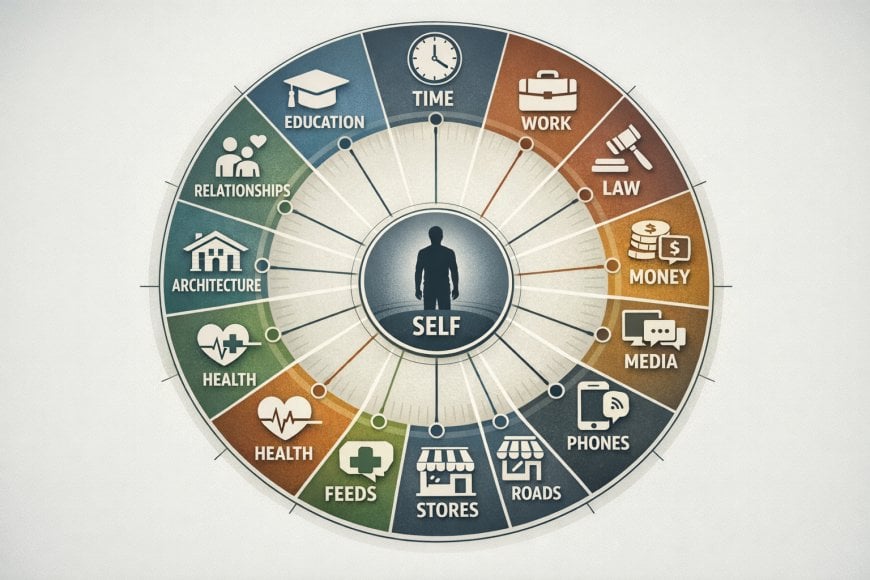
Modern life is not one system. It is a stack of interacting systems that coordinate, monetize, rank, filter, and shape human behavior continuously.
The Lie of the Past
I was sitting there watching a show on Netflix. I did not even really like the show, but that is beside the point. Somewhere in the middle of it, a thought hit me that spun off into a thousand directions at once. It was not really about the show. It was about the way the past is portrayed.
Think about fantasy worlds. Think about the broad emotional aesthetic of how older eras are presented in popular media. Not only in something like Lord of the Rings, but across entire genres. The past is framed as if it held some richer substance than the present: more honor, more glory, more camaraderie, more meaning, more human depth. Even when it is brutal, it is often romanticized. Even when it is dark, it is given a kind of moral grandeur.
But that portrayal is usually projection. It is not history as lived. It is history as desired. It is a fantasy of humanism layered onto eras that, in reality, were often defined by hierarchy, brutality, scarcity, control, disease, superstition, violence, illiteracy, coercion, and extreme power asymmetry. The same mechanism shows up in future-oriented media too. We imagine cleaner futures, nobler futures, apocalyptic futures, liberated futures, machine futures, cosmic futures. But again, what we are often seeing is not reality. We are seeing constrained ideological projection.
It is like we project onto the future and the past a different reality than what was lived. And even in the lived environment that we exist inside every day, we fantasize a reality that is not actual. There is a kind of positive bias built into the human experience. Even though the world is full of negatives, tradeoffs, pressures, manipulations, control structures, and systems of power, people still build fantasy layers over it to make it feel more meaningful, more coherent, more noble, or more survivable.
We project onto the past and the future a reality that was never truly lived, and then we use those projections to avoid seeing the present clearly.
That is where this essay starts. Not with politics. Not with economics. Not even with institutions directly. It starts with the realization that human beings seem deeply inclined to fantasize their environment instead of seeing it for what it is. We do it with the past. We do it with the future. And most dangerously, we do it with the present.
If that opening thought already irritates you, the next part will probably irritate you more.
Because once that thought landed, another one followed immediately behind it: what if these portrayals are not just entertainment? What if they function as soft control structures? What if they are constrained ideologies delivered through culture itself, teaching people to long for worlds that never existed while accepting the one in front of them without sufficient scrutiny?
That does not require some cartoonish conspiracy theory. It does not require every writer, studio, institution, or cultural gatekeeper to sit in a dark room and coordinate. Control structures do not always require conscious, centralized design. Many propagate memetically. Many are inherited. Many are repeated because they are familiar, profitable, emotionally satisfying, or stabilizing. They survive because they reduce friction, maintain narrative order, and keep populations inside legible frames.
Myths are powerful not merely because they are false, but because they are useful. They reduce complexity. They give people symbols to live inside. They compress chaotic reality into emotionally manageable stories. A noble king. A righteous war. A chosen people. A heroic age. A progress arc. A redemptive nation. A better tomorrow. A better yesterday. A moral tribe. A corrupt enemy. These are narrative containers, and people like containers because raw reality is unstable.
Fantasy creatures are one obvious example. Ogres, trolls, mythical beasts, magical races, invented cosmologies. Humanity fills its mythological imagination with symbolic beings while often dismissing material evidence sitting right in front of it. There are people that deny dinosaurs existed, yet we have plenty of evidence that they did. There are millions of people that believe with complete conviction that the earth is flat even though the evidence overwhelmingly says otherwise. That is not just random fringe behavior. It tells you something important about how humans work.
The flat-earth example matters because it exposes the larger problem: if I can find millions of people that will tell me the earth is flat, then I can find millions of people that will tell me whatever I want to hear. That is the real issue. People seek out those who will reinforce what they already want to believe instead of seeking out what would actually test them.
People do not simply believe what is true. They seek what is emotionally survivable, socially rewarded, and identity-compatible.
Perception, Bias, and the Manufactured Self
This is where the problem deepens. Human beings are not just limited. They are self-sealing. Once a person adopts a belief structure, they begin seeking emotional and social reinforcement for it. The modern information environment makes that almost effortless. Whatever you want to believe, someone is already saying it. Usually thousands of them. Often millions.
If someone wants to believe the earth is flat, they can find an entire ecosystem that will tell them exactly that. If someone wants to believe institutions are always benevolent, they can find that too. If someone wants to believe all tradition is sacred, or that all tradition is oppression, or that science is the only path, or that science is a fraud, or that history is fake, or that history is settled, or that everything is control, or that nothing is control, they can find endless affirmation.
The problem is not merely misinformation. The deeper problem is that many people are not searching for understanding at all. They are searching for emotional confirmation.
That is the trap. People seek out others who tell them what they want to hear. When, in reality, they need to hear the opposite end of the argument, the opposite belief, and they need to truly understand why the other side believes that. They do not have to agree with it, but they also do not need to get angry. That is one of the deepest human failures: projecting your beliefs onto others and deciding they should believe the same thing regardless of their circumstances, upbringing, reality, or perceived reality.
In reality, one of the most valuable things a person can do is deliberately expose themselves to the strongest version of what they do not want to hear. Not because they must agree with it. Not because all viewpoints are equal. But because if you cannot understand why another person believes what they believe, then your own position may be far weaker than you think.
The discipline people avoid most is not disagreement. It is honest comprehension of disagreement.
You do not have to get angry at the opposing view. You do not have to collapse into moral panic every time someone sees the world differently. But you do need to understand that every person is operating inside some mixture of upbringing, circumstance, emotional encoding, status incentives, trauma, socialization, and perceived reality. And perceived reality is not the same thing as reality.
That matters because once enough people reinforce one another inside the same perception loop, the loop starts to feel like truth. Social reinforcement turns preference into certainty. Certainty then hardens into identity. Identity becomes unchallengeable. From there, almost any narrative can become durable whether it is true or not.
Now go deeper.
Even before society adds its layers, the human organism is already operating inside a radically incomplete model of reality. You do not see everything that exists around you. You do not hear everything that exists around you. You do not detect all frequencies of light. You do not detect all vibrations, fields, or signals. Your sensory access is narrow, filtered, and biologically bounded.
Then your nervous system interprets those inputs. Your brain does not simply record reality like a neutral camera. It compresses. Predicts. Prioritizes. Fills gaps. Resolves uncertainty. Projects continuity. Sorts threat from non-threat. Builds models. Creates expectations. Edits overwhelming data into a usable world model.
So even your immediate lived experience is not raw reality in any absolute sense. It is processed reality. Delayed reality. Interpreted reality. Predicted reality.
What you see has already happened by the time your brain resolves it. What you think you are experiencing “now” is already filtered through sensory delay, neural processing, memory comparison, environmental prediction, and model-based expectation. That does not make experience meaningless. It makes it mediated.
Then there is the way this gets discussed in common language. People argue over exact percentages, but the broader point remains: humans only see and hear a tiny fraction of what exists. We do not see the whole spectrum. We do not hear the whole spectrum. We do not perceive all the data present in the environment. So what you are calling reality is already a narrow slice of reality before society even starts building systems on top of it.
Which means something profoundly important: even perceived reality is built on top of perception.
That matters because once social systems begin building on top of this already-limited perceptual base, humans can become extraordinarily easy to steer. Not because they are stupid, but because they are finite organisms navigating complexity through simplification.
Now move into ordinary life.
Every day you wake up and almost immediately begin interacting with control structures. Most of them are so normalized that they no longer look like control at all. They look like life. They look like base reality. But they are not the same as base reality. They are human overlays.
The first thing many people do is check the time. That alone is worth stopping on.
Time, in the way we measure it, is a constructed ordering system. Time passes, yes. Change occurs. Motion occurs. Sequence occurs. Entropy occurs. But the human packaging of time into clocks, zones, workdays, weeks, quarters, fiscal years, semesters, age brackets, schedules, deadlines, retirement windows, market hours, sleep windows, billing cycles, and productivity blocks is not reality itself. It is a local measurement architecture built for coordination.
It is useful. Sometimes extremely useful. But usefulness should not be confused with ontological absoluteness. If you were on another planet, time would be experienced and measured differently. If you lived under different gravitational conditions, time would not resolve the same way relative to another observer. Even here on Earth, relativity tells you that time is not some perfectly uniform universal slab that exists apart from context. It is relational. It is environment-dependent.
And yet the first control structure of the day for many people is submission to a clock.
Then comes food. There are endless dietary systems, supplement regimes, purity cultures, optimization protocols, food ideologies, identity markers, and moralized consumption codes. Some have merit. Some are nonsense. Some are situationally useful. Some are business models disguised as life advice. Strip it down far enough and the foundational reality is very simple: you need nutrition, hydration, movement, and enough biological support to keep the organism functioning. The surrounding symbolic architecture is where the human world begins building story on top of necessity.
I am oversimplifying that intentionally. I understand specialized diets, medical constraints, and all the exceptions. That is not the point. The point is that the human layer takes simple biological needs and turns them into identity ecosystems.
That does not mean all specialized diets are fake. It means the ecosystem around them often becomes performative, monetized, tribal, and identity-based far beyond basic biological need.
The same applies to exercise. The body needs movement. It needs load. It needs circulation. It needs walking. It needs physical demand. But then human systems repackage movement into branded fitness culture, aspirational aesthetics, expensive subscription models, influencer identity stacks, and self-optimization rituals that may obscure the far more obvious truth: a huge amount of physical health could be improved simply by changing daily habits, walking more, sitting less, parking farther away, using stairs, walking to places instead of driving whenever reasonable, and structuring ordinary movement back into life.
I park in the back of parking lots on purpose. Most people try to park as close to the doors as possible. I do the opposite. It increases the amount of time I walk. It increases the amount of movement built into ordinary life. That is a small example, but it matters, because it shows how people can either deepen or weaken certain control loops just by changing daily habits.
Then there is television and media itself. TV is another human-created reality. Nothing in it is base reality. Everything being said in there is human perception, human interpretation, human dilution, human narrative, human framing. It may contain truth. It may contain lies. Usually it contains a mixture. But it is always a constructed representation, never pure reality.
Then you go to a job, which is another human-created reality layered on top of existence. The human condition that you have been conditioned into tells you that you have to work in the way the system defines work in order to exist. But that is not the same thing as saying the biological organism needs a W-2, a timecard, a LinkedIn profile, or a weekly schedule designed by a payroll system. Remember, at the most fundamental level, I only said you had to eat, drink, move, and survive. Plenty of things on this planet do that without human money and without human labor architecture.
That does not mean jobs are fake in the practical sense. It means the human meanings built around jobs, rank, identity, status, and survival access are socially constructed layers on top of more basic reality.
- Humans do not experience objective reality directly. They experience filtered and interpreted slices of it.
- Belief often gets socially reinforced before it gets rationally tested.
- The self is not formed in a vacuum. It is shaped inside nested symbolic and institutional systems.
The Everyday Architecture of Control
This is where many people misread the argument. To call something a control structure is not necessarily to call it evil. Some control structures are necessary. Some are stabilizing. Some prevent chaos. Some allow coordination at scale. The point is not that all structure should disappear. The point is that people mistake structure for nature.
Take driving. You get into a car, itself a layered object of engineering standards, legal requirements, financing structures, licensing systems, insurance frameworks, petroleum logistics, road networks, emissions regimes, and maintenance dependencies. Then you move through roads that determine where you may and may not go. Lanes determine directional flow. Speed limits constrain velocity. Stoplights regulate sequence. Signs define permission and restriction. Parking lots encode movement, pause, storage, and exit behavior. Even the idea that you must enter one way and leave another is controlled choreography.
Again, useful. Often necessary. Still control.
The way you pump gas is a control structure. The way you enter a parking lot is a control structure. The parking lot itself is a control structure. The airport is a control structure. The amusement park is a control structure. The school is a control structure. The office is a control structure. The grocery store is a control structure. Your life is full of them.
The grocery store is the same. The layout is not neutral. Shelf placement is not neutral. Endcaps are not neutral. Price signage is not neutral. Packaging color is not neutral. Brand iconography is not neutral. Eye-level placement is not neutral. Store music is not neutral. Aisle width is not neutral. Checkout design is not neutral. Product scarcity cues are not neutral. Loyalty programs are not neutral. Data capture is not neutral.
The environment is designed to guide attention, maximize conversion, extend browsing time, increase basket size, shape choice architecture, and collect behavioral intelligence. Your psychophysical state is not merely encountered by the store. It is studied, modeled, and monetized. Boxes are colored a certain way. Products are stacked in certain locations. Paths are laid out to increase the chance you will see and buy what the system wants you to buy. Your behavior becomes data. The data gets studied. The system gets improved. Then the system comes back for you again with a better model of what works on people like you.
The same logic extends across television, streaming platforms, social media feeds, notification systems, ad auctions, recommendation engines, workplace software, app interfaces, search results, classroom structures, government forms, tax codes, dating apps, housing markets, and insurance systems. The modern human does not simply live inside a society. The modern human moves through nested optimization environments continuously.
There is also the metric layer. Likes, follows, open rates, view counts, retention curves, engagement graphs, notifications, and badges all create a behavioral mirror that trains people to perform themselves in ways the system can measure. Over time, that feedback loop changes not only what people do, but how they understand their own value.
And there is the bureaucracy layer. Forms, permissions, applications, approvals, denials, verifications, appeals, terms, and policy language do not just organize society. They shape how people think about legitimacy, access, and permission itself. People internalize the idea that the system must validate what is real before it becomes actionable.
Most environments people call normal are in fact behavioral funnels designed by institutions, businesses, governments, or inherited systems to coordinate, monetize, rank, filter, and shape human behavior.
More examples, Not as a random list, but as a map of how dense the architecture really is.
Language itself
The words available to you shape the thoughts most easily available to you. Categories compress reality. Labels decide what counts as normal, deviant, sane, irrational, successful, failing, employable, dangerous, patriotic, offensive, educated, backward, advanced, or acceptable. Vocabulary is not just descriptive. It is boundary-setting.
Schooling and credential systems
School does not merely transfer knowledge. It trains schedule compliance, authority recognition, performance under evaluation, symbolic advancement through grading, and acceptance of externally defined milestones. Credentialing systems decide who is recognized as legitimate, not merely who is competent.
Work and career ladders
A job is not only labor exchanged for income. It is a social identity machine. Titles, hierarchies, annual reviews, promotion bands, productivity metrics, office norms, meeting structures, email etiquette, and clock discipline form a total behavioral environment. People begin to confuse role-performance with selfhood.
Money and price systems
Money is one of the most powerful abstractions ever created. It allows coordination, valuation, exchange, debt, hierarchy, leverage, savings, and investment. But it also transforms survival into access management. Food exists. Shelter exists. Land exists. Water exists. Yet in the human construct layer, access to all of them is filtered through abstract symbolic accounting.
Housing norms
Even the idea of what a proper home is, where it should be, how big it should be, what type of family should occupy it, what neighborhood counts as respectable, how zoning should divide land, how ownership should work, and how people should finance shelter are all structured systems rather than natural inevitabilities.
Digital identity and login ecosystems
Passwords, accounts, terms of service, platform bans, verification badges, algorithmic trust scoring, content moderation layers, device permissions, browser tracking, authentication prompts, and biometric access gates increasingly determine who you are allowed to be in digital space and what actions are permitted.
Phones and notifications
The phone is no longer a communication device alone. It is a behavior-command surface. Buzzes, badges, pings, streaks, alerts, reminders, and algorithmically timed prompts compete for attention continuously. Your nervous system is being trained by timing architecture.
Search engines and feed ranking
People think they are exploring the internet. In reality they are usually navigating ranked pathways. The order in which information appears shapes belief formation. Visibility determines legitimacy. Suppression does not always require deletion. Sometimes it only requires strategic burial.
Navigation systems
GPS does more than help you get somewhere. It subtly standardizes route behavior, directs traffic density, influences what roads gain commercial value, changes local business exposure, and reduces human spatial autonomy by replacing self-navigation with guided dependency.
Health systems
Symptoms, risk scores, diagnostic labels, treatment pathways, insurance approvals, pharmaceutical incentives, appointment structures, public health messaging, and specialist gatekeeping all form a system that mediates your relationship with your own body. Again, not inherently malicious. Still deeply structured.
Beauty standards and self-presentation
Clothing norms, grooming standards, cosmetic expectations, body image hierarchies, age presentation, social desirability cues, and platform-enhanced visual culture all govern behavior through reward and exclusion. People call this preference. Much of it is social conditioning.
Dating and relationships
Love may be deeply real as a lived experience, but the forms through which humans organize it are structured: courtship norms, exclusivity expectations, marriage law, family roles, sexual scripts, platform-mediated matching, economic compatibility, status filters, and cultural reward systems. Emotion exists. Social packaging exists on top of it.
Law and civic order
Law is one of the clearest examples of a necessary control structure. It is a formalized permission and consequence architecture. Property, liability, contracts, taxation, compliance, zoning, criminal thresholds, licensing, civil procedure, and enforcement all define the behavioral geometry of society.
Religion, ideology, and secular moral frameworks
These systems tell people what is good, evil, sacred, sinful, permissible, redemptive, impure, dignified, heroic, or shameful. Whether institutional or secular, they encode values into repeatable structures and often turn metaphysical preference into social enforcement.
News cycles and outrage loops
What counts as urgent, what gets ignored, what is framed as a crisis, who is humanized, who is abstracted, what details are repeated, what language is used, and when coverage intensifies or disappears are all forms of narrative steering.
Consumer finance
Credit scores, APRs, underwriting models, debt-servicing norms, subscription billing, installment plans, overdraft fees, risk tiers, and approval systems decide not just what you can buy, but how much of your future is already spoken for.
Architecture and public space
Benches that prevent lying down, gated access, anti-loiter design, camera placement, lighting strategy, controlled entrances, school layouts, office badge systems, stadium queue design, and airport security choreography all tell bodies where to stand, move, stop, wait, and comply.
Rituals of success
Birthdays, graduations, promotions, weddings, retirement milestones, follower counts, homeownership, luxury signaling, and visible productivity all function as social markers that tell people whether they are “on track.” Most of these tracks were designed, not discovered.
Entertainment schedules
Release calendars, season arcs, cliffhangers, binge architecture, parasocial attachment, franchise timelines, and cultural trend cycles regulate communal attention. What people discuss, anticipate, and emotionally invest in is often synchronized by media timing itself.
Data extraction and feedback systems
Every click, pause, scroll, transaction, location ping, watch time pattern, purchase history, and device behavior increasingly becomes input into a larger optimization system that studies humans in order to better route them. This is one of the defining control structures of the current age.
Your house, your road, your parking lot, your job, your phone, your search results, your feed, your store, your school, your market, your law, your identity cues, and your social ranking signals are not isolated things. They form a single layered environment.
Smallness, Meaning, and the Human Scale of Relevance
Once you follow this line of thinking far enough, it can produce a harsh emotional effect. It can make everything feel small, even irrelevant. That is because on the cosmic scale, it is small. Humanity is not the center of the universe. It is not even close. Everything our species has ever built, from the first tool to the latest machine, is functionally negligible to the wider universe. If all of humanity vanished, the universe would continue without pause.
That realization bothers people because the ego wants centrality. The species wants significance. Civilization wants permanence. But scale does not care about desire.
And yet that is not the same thing as saying life is meaningless.
Your life is not meaningless. It is simply not cosmically central. Those are different statements. Your relevance exists in relation, not in universal dominance. The impact you have on other people, the ideas you trigger, the insight you pass forward, the compassion you show, the damage you prevent, the thought you provoke, the pattern you expose, the honesty you embody, the strength you transmit to someone else at the right moment, these things matter intensely at the human scale.
One life can alter another. That altered life can alter ten more. A useful thought can propagate. A false one can too. A person who begins to see clearly can become harder to manipulate. That alone has consequences.
Human meaning is local, relational, and transmissive. It does not need cosmic supremacy to be real.
The tragedy is that many of the largest systems surrounding people are not designed to maximize clear perception, independent thinking, or deep relational meaning. They are designed to maintain order, extract value, preserve institutional continuity, manage populations, stabilize narratives, or direct consumption. That is why media, government, commerce, and social systems often inhibit the very kinds of thinking that could alter future outcomes.
What To Do With This Awareness
So what is the point of seeing all this?
It is not to become nihilistic. It is not to reject every structure. It is not to pretend roads, laws, clocks, food systems, institutions, and social order can simply disappear. That would be childish. Complex societies require coordination. Coordination requires structure.
The point is to learn to distinguish between reality and overlay, necessity and conditioning, utility and manipulation, relationship and performance, meaning and narrative packaging.
Once you start doing that, your life changes in subtle ways.
You begin asking why a thing exists in the form it exists. You begin noticing that many “normal” behaviors are not natural but trained. You begin seeing how often your attention is being routed for someone else’s benefit. You begin realizing that your worldview may contain inherited myths dressed up as certainty. You stop treating consensus as proof. You become more careful about who is shaping your frame of reference. You become more willing to hear what challenges you instead of only what confirms you.
And maybe most importantly, you stop confusing the human system with reality itself.
That does not free you from all control structures. Nobody living in a civilization is free from all of them. But awareness changes your relationship to them. The invisible becomes visible. The naturalized becomes questionable. The inevitable becomes historical. The personal becomes systemic. The narrative becomes inspectable.
That is where genuine thought begins.
Every day you wake up and move through layers of symbols, permissions, habits, expectations, pricing systems, attention funnels, narratives, and rule sets that tell you what the world is. Most people never stop long enough to ask whether those things are reality, or merely the latest human scaffolding built on top of it.
Pattern Nexus Lens
The deeper pattern is not merely that society has rules. It is that societies build symbolic realities so immersive that people forget the difference between natural constraints, useful systems, and manufactured obedience. Once that blend becomes invisible, control no longer needs to announce itself.
What begins as coordination becomes atmosphere. What begins as utility becomes expectation. What begins as a repeated structure becomes “normal,” and once something becomes normal enough, most people stop examining it. That is when the system is strongest. It no longer has to justify itself every day because people begin defending it automatically as common sense, social order, or simply how life works.
The strongest control systems are the ones people mistake for common sense, normal life, or reality itself.
FAQ
Is this essay arguing that everything is fake?
No. It is arguing that many of the systems people treat as natural or inevitable are actually constructed overlays on top of more basic reality. Some are useful. Some are exploitative. Most are mixed.
Are control structures always bad?
No. Some control structures are necessary for coordination, safety, and civil order. The key distinction is whether people are conscious of them, whether they consent to them, and who benefits from their design.
What is the practical takeaway?
Learn to notice how environments shape behavior. Expose yourself to opposing arguments. Reduce dependency on purely inherited narratives. Rebuild your thinking from observation upward instead of ideology downward.
Sources
These sources support the essay’s discussion of confirmation bias, predictive processing, and relativity-based time effects.
- American Psychological Association — Why people are susceptible to fake news and confirmation bias
- Predictive Processing: A Canonical Cortical Computation — National Library of Medicine / PMC
- NIST — Putting Einstein to the Test: gravitational time dilation and precision clocks
Ni Nini Jibu Lako?
 Penda
0
Penda
0
 Chukia
0
Chukia
0
 Upendo
0
Upendo
0
 Picha za kuchekesha
0
Picha za kuchekesha
0
 Poa
0
Poa
0
 Huzuni
0
Huzuni
0
 Hasira
0
Hasira
0

Founder of Pattern Nexus. I research markets, macro, geopolitics, AI, history, ancient systems, and the patterns most people overlook. I’m also building Market Radar, a trading scanner designed to read pressure, risk, confirmation, and setup quality before chasing a move. Pattern Nexus is where I connect the dots between data, history, technology, and the bigger system playing out around us.















Maoni (0)