
The Systemic Realignment: Digital Sovereignty, Multipolar Liquidity & The End of Old Alliances
The world isn’t becoming multipolar — it's being rewired into competing digital, monetary, and geopolitical corridors. Alliances shift, rails define power.

The Systemic Realignment: Digital Sovereignty, Multipolar Shifts, and the Myth of Alliances
The world is not simply shifting — it is re-architecting itself in real time.
Headlines show motion.
Systems reveal architecture.
And right now, liquidity engines, digital rails, settlement standards, military posturing, and energy corridors are being redesigned — quietly, aggressively, and irreversibly.
This era isn’t defined by ideology.
It’s defined by constraints, incentives, and sovereign survival logic.
Those who only watch events will drown in noise.
Those who track plumbing, settlement, and power transmission will see what comes next.
The Systemic Realignment: Digital Sovereignty, Multipolar Shifts, and the Myth of Alliances
What once looked like isolated headlines are, on a second pass, load-bearing signals of a deeper re-platforming. From the rise of CBDCs and tokenized collateral to the slow breakup of a dollar monopoly into interoperable settlement zones, the pattern is structural. This long-form stitches together Pattern Nexus analyses and external reporting into a map of architecture — the monetary plumbing, compute stacks, corridor defense, and identity rails that actually move the world.
We’ll connect money creation to digital sovereignty, housing lock-in to demographic engineering, layoffs to AI-labor topology, and “alliances” to the only trust that matters in 2025+: settlement trust. Hyperlinks point to deeper dives; the narrative here exposes the feedback loops.

1. The New Monetary Paradigm: Money Creation, CBDCs and Digital Sovereignty
Money underpins everything — every decision, investment, deployment order, and social contract. If you misunderstand money, you misunderstand the era.
Your original frame stands: bank lending = creation, reserves = settlement foundation, QE = oxygen, QT = controlled asphyxiation. Monetary reality is software- and rule-driven — a confidence machine governed by code paths and balance sheet tolerances.
Update: QT’s endpoint wasn’t “preference” — it was constraint. As the reserve floor was approached, oxygen had to return. Markets don’t run on ideology; they run on tolerances and liquidity corridors.
CBDCs aren’t about convenience — they’re about rails and authority. As covered in Digital Sovereignty and Gold & Tokenized Sovereignty, the real contest is the wallet layer. Code becomes law; settlement becomes sovereignty; transmission becomes direct.

Wallet wars & identity stack: CBDC rails converge with identity primitives (KYC credentials, permissions, tax status) and programmable compliance. China trials expiration logic; Europe tests offline/blackout modes; the U.S. disavows “retail CBDC” while piloting wholesale/tokenized Treasuries and programmable collateral. Private mega-rails (USDC, ETF-on-chain, BlackRock/Fidelity token markets) form a shadow sovereign layer.
Settlement is sovereignty. Interfaces are power.
Money is no longer paper or ledger — it is code, clearance, and execution logic.
- Bank lending = money creation
- Reserves = settlement foundation
- QE = liquidity oxygen
- QT = controlled asphyxiation
Expansion layer — what’s actually being built:
- Tokenized Treasuries & repo-eligible programmable collateral
- Wholesale settlement chains with identity-bound wallets
- Interoperability bridges between public rails and private mega-rails
- Policy knobs: spend-by dates, sectoral throttles, direct fiscal transmission
The real battle is the wallet. Whoever governs the transaction layer governs citizen autonomy and sovereign power.
2. Liquidity Cycles: QE, QT and the Setup for QE 2026
You mapped it: QT → rising stress → pivot → re-oxygenation. That wasn’t Keynes vs. Friedman — it was tolerance physics. High-debt systems have no neutral gear; they oscillate between discipline and oxygen.
Security framing: Liquidity isn’t “stimulus”; it’s national security fuel. A liquidity-starved hegemon implodes internally before an adversary fires a shot.
Reference: Reverse Repo Trap — Liquidity as Constraint, Not Choice
3. The Fracturing World Order: From Unipolar Dominance to Economic Multipolarity
Not the end of the dollar — the end of monopoly. The map is re-drawing into settlement zones with distinct trust models: a USD clearance zone; a CN digital-commodity zone; BRICS commodity-credit corridors; a Euro survival rail; and private mega-rails bridging them all.
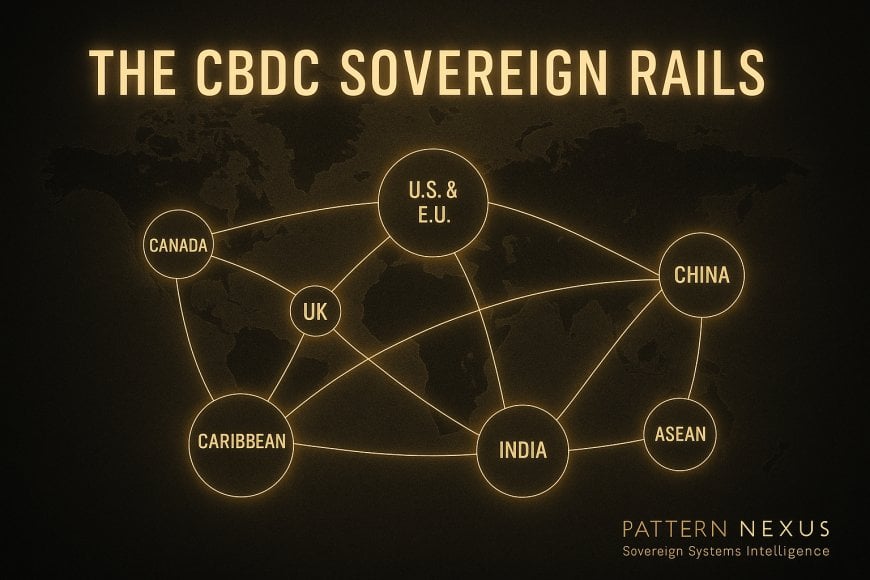
- Saudi sells in CNY, parks savings in USTs.
- India arbitrages BRICS discounts, buys U.S. defense tech.
- Europe whispers autonomy, anchors NATO clearance.
- Private rails (USDC, ETF-on-chain) route around politics.
The future isn’t USD vs BRICS; it’s stacked, competing, interoperable corridors.
4. Theatre vs. System: How Americans Misread Geopolitics
Domestically chaotic, externally consistent — that’s the operating model. Internal politics are emotional theatre; external posture is the OS. AI-amplified information sovereignty widens the gap, but the plumbing never lies.
- Domestic conflict = catharsis
- Foreign policy = corridor maintenance
Reference: Domestic Theater vs Global Projection
5. Signal in the System: Kinetic Power Meets Monetary Strategy
Carrier groups off the Caribbean weren’t “anti-narcotics”; they were corridor defense — undersea fiber, Atlantic energy flows, Latin stabilization — exactly when liquidity pivots. Military posture + monetary inflection = synchronized deterrence.

Full breakdowns: Caribbean Naval Posture & Strategic Cable Defense · Signal in the System
6. Trade, Diplomacy and Nuclear Signaling: The Xi–Trump Meeting
Tariff relief + fentanyl clampdown + rare-earth coordination, followed by a nuclear-posture signal. Markets calm, Russia takes the hint. Diplomacy is not friendship — it’s calibration of corridors and compute/energy leverage.
7. Forced Cooperation and Strategic Distrust: Sino–Russian Reality
They cooperate under pressure, not affinity. Friction lines: the Arctic, Central Asia, Pacific frontage, Far-East demography. Two imperial projects rarely share frontier space for long.
- China: capital + industry
- Russia: energy + metals + geography
Aligned by pressure; divided by incompatible destinies.
8. India and the Fragile Rapprochement with China
India won’t be absorbed. It monetizes uncertainty: ONDC/DPI at home, leverage abroad. Non-alignment 2.0 isn’t indecision — it’s pricing power across all poles.
9. The Lock-In Economy: Housing as a Feedback Loop
Housing isn’t a “market” — it’s a monetary trap system. Low-rate anchors → mobility freeze at high rates → institutional capture → generational lock-in. Mortgage engineering is demographic engineering.

Read: Lock-In Economy · The 1% Down Payment Trap · The Illusion of Ownership
10. Labor and Automation: Mass Layoffs or System Optimization?
Layoffs weren’t recession tells; they were topology redesign. Human workflows are converting into inference pipelines; payroll is becoming compute cycles. USD power now rests on military + energy + compute production.

11. The Hidden State: Rethinking Government Size
The state didn’t shrink; it outsourced into opacity. The triarchy runs the backend — Fed (liquidity), Treasury (credit/sanctions), DoD (corridors) — with hyperscale clouds governing compute. The Constitution governs citizens. The backend governs reality.
12. Conclusion: Reading the Patterns
Most watch headlines. We read feedback loops. Civilizations rarely collapse; they re-platform. Digital rails, liquidity corridors, programmable settlement, compute sovereignty — that’s the scaffolding of the next sovereign era.
Signature: We aren’t watching the world change — we’re watching the source code update.
உங்கள் பிரதியாக என்ன?
 போல்
0
போல்
0
 எதிர்ப்பு
0
எதிர்ப்பு
0
 காதல்
0
காதல்
0
 காமெடி
0
காமெடி
0
 வா
0
வா
0
 துக்கம்
0
துக்கம்
0
 கோபமாக
0
கோபமாக
0
















விமர்சனங்கள் (0)