
The Fracturing World Order: From Unipolar Dominance to Economic Multipolarity
The post–Cold War world promised stability through American dominance. Instead, it produced dependency through debt and energy control. Three decades later, that system is cracking — replaced by a network of regional powers, resource alliances, and digital financial blocs. This analysis examines how power is fragmenting, why liquidity defines modern empire, and what the next monetary architecture may look like.
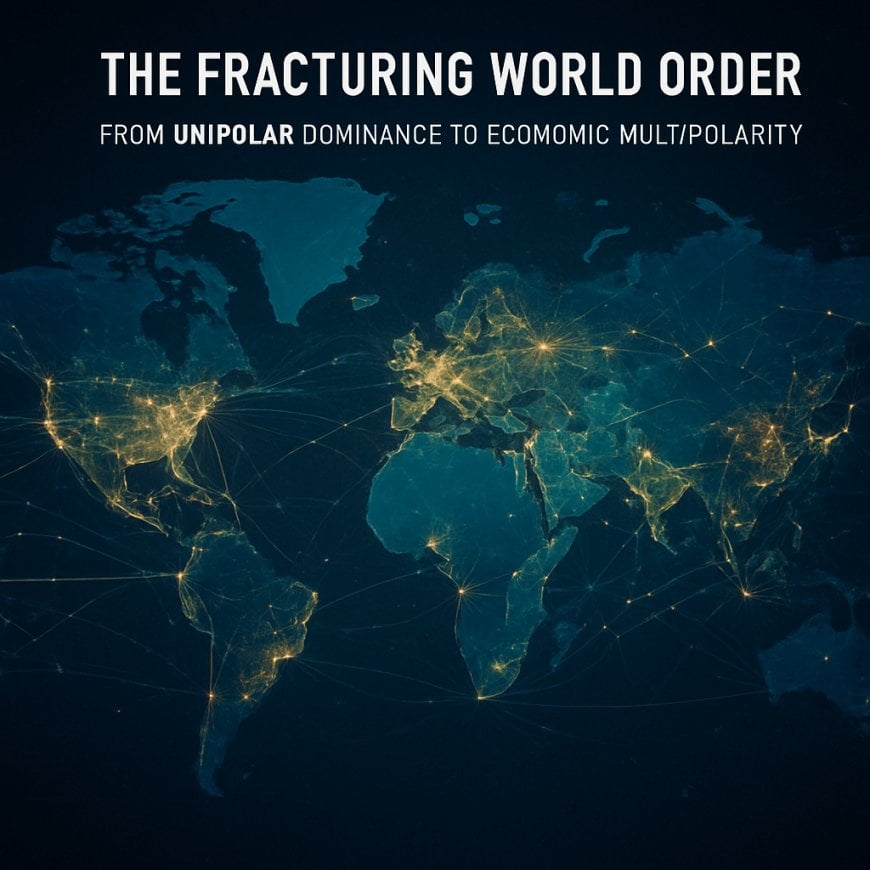
The Fracturing World Order
For most of the twentieth century, global power was simple: the United States printed the currency, controlled the oceans, and defined the rules. It was the unipolar moment — an empire of liquidity as much as military force. Every oil barrel, debt issuance, and trade transaction was priced in the same language: the U.S. dollar. That alignment wasn’t accidental; it was engineered through Bretton Woods, the petrodollar system, and decades of diplomatic and military reinforcement.
But systems built on control eventually face entropy. The post–Cold War order that promised stability through dominance is now breaking apart through its own mechanisms. What’s replacing it isn’t chaos, but *multipolar liquidity* — a decentralized structure of trade, energy, and finance built not around ideology, but access.
This is the world’s new balance of power: less about flags, more about flows. Less about armies, more about infrastructure. The empire of the future isn’t built on conquest; it’s built on networks — shipping lanes, rare earth supply chains, data cables, and settlement systems.
We are watching the global operating system reprogram itself in real time.
The Dollar’s Empire of Debt
After 1971, when Nixon severed the dollar’s convertibility to gold, the United States replaced scarcity with confidence. The dollar’s value no longer came from what backed it, but from what it *bought*: oil, credit, and safety. The petrodollar system, formalized with Saudi Arabia in the 1970s, guaranteed that every nation would need dollars to purchase energy. In return, America offered protection and access to capital markets.
That arrangement allowed the U.S. to run chronic deficits while exporting inflation abroad. For fifty years, the world recycled its surpluses into U.S. Treasuries, funding both American consumption and its military reach.
It was a brilliant structure — until technology and demographics began to erode it. As energy trade diversified, as digital settlement systems emerged, and as manufacturing shifted eastward, the world found ways to trade *around* the dollar. Liquidity stopped being exclusive.
Today, U.S. dominance still exists — but it’s maintained through inertia, not innovation.
BRICS and the Birth of Parallel Systems
The BRICS alliance (Brazil, Russia, India, China, South Africa — now joined by Saudi Arabia, Iran, Egypt, Ethiopia, and the UAE) represents the most coordinated challenge to dollar hegemony in modern history. Collectively, the bloc accounts for more than 40% of global oil output, 30% of global GDP (PPP), and a growing share of global trade settlements outside of U.S. systems.
Their strategy isn’t to destroy the dollar; it’s to *outgrow* it. Through bilateral trade, energy swaps, and new payment infrastructure, BRICS aims to replace the dollar’s network effect with a diversified web of settlements. Russia and China already conduct most of their energy trade in yuan. India buys Russian oil in rupees and dirhams.
The BRICS+ New Development Bank is laying the foundation for a parallel financial circuit — one that doesn’t rely on SWIFT or the IMF. And through projects like the BRICS alternative payment system, these nations are building rails for the next era of economic autonomy.
This is what multipolarity looks like — not an ideological split, but a diversification of dependency.
Energy as the New Currency
Every major empire in history was built around control of energy. The Romans controlled grain. The British controlled coal. The Americans controlled oil. In each case, the empire’s currency was simply the accounting layer of its resource dominance.
Now, energy itself is fracturing. The rise of renewables, nuclear expansion, and commodity-backed trade is decentralizing resource power. China dominates the solar and rare earth supply chains. Russia and Iran control vast natural gas networks across Eurasia. Saudi Arabia and the UAE are hedging between U.S. military protection and eastern financial opportunity.
In this new equation, energy becomes both a weapon and a bridge. Nations no longer choose sides — they hedge between systems. The world is dividing into overlapping zones of liquidity, not strict alliances.
This is why the next global reserve system may not be a currency at all — it will likely be a *basket of energy and commodities,* anchored by tokenized settlement infrastructure connecting multiple economies at once.
The Infrastructure of Multipolarity
While the West debates policy, the East builds pipelines, ports, and fiber. China’s Belt and Road Initiative has funded over $1 trillion in logistics and digital infrastructure, connecting Asia, Africa, and Europe through physical trade arteries. The Middle East, once fractured by ideology, is now aligning through infrastructure — from the India–Middle East–Europe Economic Corridor (IMEC) to the expanding Eurasian rail networks linking Moscow to Tehran to Beijing.
Control of logistics equals control of liquidity. Every container port and energy terminal is a node in the global settlement graph. The countries building these nodes aren’t just moving goods; they’re reprogramming global dependence.
The End of Unipolar Certainty
The unipolar era offered simplicity — one reserve currency, one dominant navy, one central narrative. Multipolarity offers something far more complex: overlapping rules, competing truths, and localized liquidity centers that shift by the decade.
This transition won’t be smooth. It means constant recalibration of alliances, currency swaps, and energy pricing. But the direction is clear. The United States will remain a central power — yet not the *singular* one.
The next system won’t have a “king currency.” It will have *zones of trust* — regional ecosystems that clear trade digitally through programmable settlement networks.
The Digital Layer of Empire
Central Bank Digital Currencies (CBDCs), blockchain settlements, and tokenized assets are the scaffolding of this new era. Projects like the BIS Project Guardian and Project Mariana are designing cross-border settlement layers that bypass traditional banking rails entirely.
This is what digital multipolarity looks like: programmable trade, instant conversion, embedded compliance. Once deployed at scale, these systems will make it possible for nations to trade value directly — asset for asset — without needing dollar intermediaries.
Liquidity will still exist, but it will flow through code instead of policy.
Liquidity as Power
Empires used to be measured in land, armies, and ideology. Today, they’re measured in *liquidity capacity* — how quickly a nation can move money, settle trade, and extend credit. That’s why the Federal Reserve, despite all its flaws, remains the most powerful institution on Earth: it controls the global flow of collateral.
But even that control has limits. Every time a new nation tokenizes a bond, issues a CBDC, or signs a trade deal outside the dollar, that control erodes incrementally. Over years, those increments form a pattern — and patterns become systems.
That’s the moment we’re living through now.
The Coming Convergence
The transition to a multipolar world won’t destroy globalization — it will *redefine* it. Trade will remain global, but trust will become local. Energy will flow east to west, data will flow north to south, and capital will circulate through digital channels that no single nation fully controls.
The world order isn’t collapsing; it’s decentralizing. The empire is not dying — it’s digitizing.
In the end, the next reserve system won’t be decided in Washington or Beijing. It’ll emerge from the logic of liquidity itself — from whoever can design the fastest, most resilient, most trusted flow of value across borders.
That’s the new map of power: networks instead of nations, flows instead of flags.
Sources & References
#Geopolitics #Macro #BRICS #Dollar #Trade #Economy #PatternNexus
What's Your Reaction?
 Like
0
Like
0
 Dislike
0
Dislike
0
 Love
0
Love
0
 Funny
0
Funny
0
 Wow
0
Wow
0
 Sad
0
Sad
0
 Angry
0
Angry
0

Founder of Pattern Nexus. I research markets, macro, geopolitics, AI, history, ancient systems, and the patterns most people overlook. I’m also building Market Radar, a trading scanner designed to read pressure, risk, confirmation, and setup quality before chasing a move. Pattern Nexus is where I connect the dots between data, history, technology, and the bigger system playing out around us.










Comments (0)