
March Ends With the System Showing Its Seams
A Pattern Nexus end-of-March 2026 master analysis on Hormuz, oil repricing, liquidity stress, inflation pressure, AI infrastructure, Moon Base acceleration, sovereignty, domestic pass-through, and why the system is showing its architecture again.
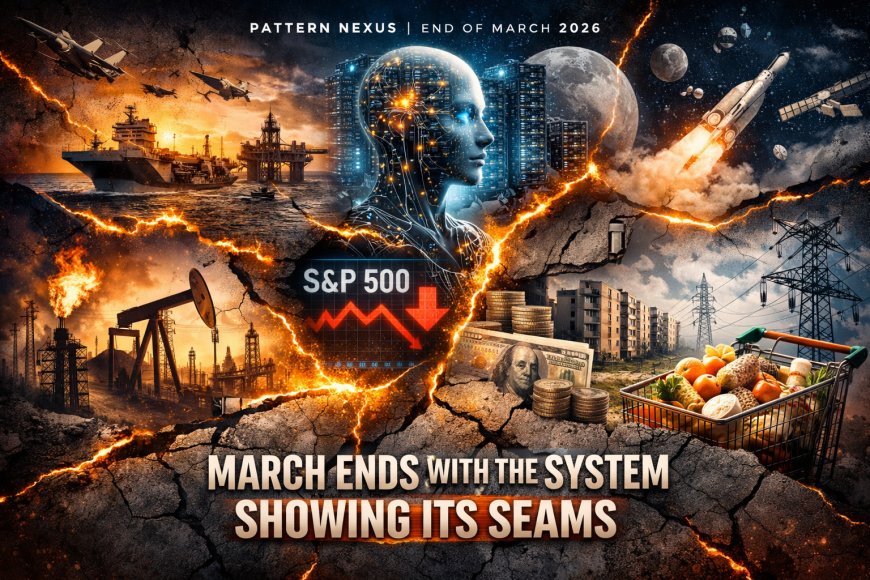
March Ends With the System Showing Its Seams
The month did not end with resolution. It ended with the real architecture showing through: war turning into energy disruption, energy disruption feeding inflation and tighter financial conditions, AI buildout running straight into power and infrastructure limits, and even the space story moving back onto an industrial and geopolitical footing.
Quick Read
March did not close with clarity. It closed with stress revealing structure. The war layer, the oil layer, the shipping layer, the inflation layer, the rates layer, the AI layer, the sovereignty layer, the domestic cost layer, and the space layer all kept feeding each other because they are increasingly expressions of the same deeper system reality. Hormuz reminded everyone that physical chokepoints still sit underneath modern financial calm. Oil repriced. Gasoline repriced. Inflation pressure moved back into focus. Financial conditions stayed tighter than many people wanted to admit. Europe started showing the energy pass-through more clearly. AI kept moving forward, but the buildout ran harder into energy, grid, hardware, capital, and political limits. NASA’s March announcements reinforced the same point from another direction: the future is increasingly about cadence, logistics, reusable hardware, nuclear power, and repeatable industrial capability, not just symbolic milestones. This was not a month of disconnected headlines. It was one architecture showing stress through multiple linked layers at the same time.
Core Signal
March was not random volatility. It was one system showing strain across multiple layers at once.
Corridor Logic
Hormuz is not just a war headline. It is a throughput problem sitting under the global pricing structure.
Liquidity Reality
Stress does not need a cinematic break. It can leak through yields, insurance, credit, capex delays, and household budgets first.
AI Reality
Compute is now tied directly to electricity, cooling, chips, land, financing, and public tolerance.
Space Shift
The future is moving away from symbolic milestones and toward cadence, logistics, nuclear continuity, and industrial permanence.
Sovereignty Layer
Control is increasingly built slowly through presence, routine, access, enforcement, and normalization.
March Was Interface vs. Substrate
March kept exposing the same problem from different angles: most people are still reading the world through the interface layer while the substrate underneath keeps forcing repricing. They are watching headlines, narratives, rumor cycles, daily closes, official statements, temporary rallies, and all the usual noise that helps people feel like they understand what is happening in real time. But the real system is not running on whatever story won the afternoon. It is still running on energy flows, corridor continuity, logistics, military positioning, refining capacity, grid load, access to capital, and industrial constraints.
That is why this month fits so cleanly into the same logic behind Time Isn’t Real, It’s a Coordination Layer. The deeper argument there was never really about clocks. It was about how human beings absorb constructed coordination systems so completely that they stop noticing they are constructed, then mistake the wrapper for the thing itself. March looked exactly like that on the macro level. Media framing was the wrapper. Daily market interpretation was the wrapper. Policy language was the wrapper. But underneath that wrapper, the physical world was still dictating terms. Oil still had to move. Insurance still had to price risk. Electricity still had to be generated. Data centers still had to draw power. The bond market still had to discount inflation pressure. The substrate did not care whether the interface was neat.
This is one of the core Pattern Nexus points overall. Human systems get mistaken for reality all the time. People treat money like it is the same as value. They treat headlines like they are the same as causality. They treat market pricing like it is neutral truth instead of a filtered signal passing through institutions, leverage, incentive structures, and narrative management. They treat borders like they are eternal rather than contingent control claims. They treat policy language like it is capacity. March was one of those months where the scaffolding got easier to see. That is what made the month feel noisy on the surface but coherent underneath.
If there is one sentence that holds the entire month together, it is this: the interface kept moving around, but the substrate kept saying the same thing. Energy still matters. Corridors still matter. Hardware still matters. Logistics still matter. Capital still has a cost. Power still has to come from somewhere. Sovereignty still has to be enforced. The future still has to be built out of real systems, not vibes. Once you frame March that way, the month stops looking like a pile of unrelated headlines and starts looking like one machine showing strain through different windows.
Hormuz, Corridor Architecture, and the Repricing of Reality
The clearest live example of all of that was still Hormuz. Not because it is dramatic, but because it is structural. That is what The Clock Starts at Hormuz got right. Hormuz is a corridor problem before it is a headline problem. The issue is not just how many barrels exist in theory. The issue is whether those barrels can reliably move through one of the narrow gates underneath the modern system. Once that gate gets stressed, the market is not pricing an abstract war narrative anymore. It is pricing the cost of physical dependence.
That is why the March oil move mattered so much. It was not just “oil went up.” It was the global system being reminded that the fake separation between finance and physical dependency never really existed. The real question underneath the move was simple: who still has continuity of access, who only had assumptions, who can absorb higher insurance and freight, who can reroute, who can pay the reliability premium, and who gets squeezed first? That is not a normal commodity story. That is corridor architecture becoming visible.
The relay layer is where shallow analysis keeps falling apart. The Gulf is not a clean source-to-buyer pipe. It connects into refining hubs, tanker fleets, port capacity, insurance decisions, relay nodes, and downstream product markets. India matters as a refining and redistribution node. Singapore matters as a relay and pricing nerve point. Southeast Asia matters because it sits in the middle of multiple flow chains. Europe matters even when it is not the first stop because it still gets hit through freight, refined products, and competition for molecules. Once you understand that, the modern habit of treating chokepoints as merely “regional tensions” starts looking almost childish.
The first damage is not always a formal closure, and this is another point too many people keep missing. Real systems degrade through friction first. The early signal can be hesitation, rerouting, tanker scarcity, insurer retreat, military uncertainty, longer voyage times, increased security costs, delayed loading, or reliability loss. That is why waiting for a perfect headline is usually a losing analytical posture. By the time the situation is clean enough for everyone to agree on what happened, the market and logistics layers are already adjusting.
This is also why The Hormuz Theory matters more than a lot of people want to admit. Once a corridor becomes important enough, military logic, political logic, and market logic start collapsing into the same field. The longer impairment persists, the more the conversation drifts away from temporary disruption and toward strategic restructuring. That is when coastal control, protected maritime corridors, mission creep, and longer pressure campaigns stop sounding like fringe speculation and start sounding like the system following its own incentives.
This is why March was not just an oil month. It was a corridor month. It reminded everyone that the global system still sits on top of a few narrow and highly consequential gates. When one of those gates gets stressed, the whole myth of frictionless globalization starts cracking fast. Money can abstract many things for a while. It cannot abstract around the need for molecules, movement, time, and safe passage forever.
Liquidity Still Needs a Cover
March also kept proving the argument in Liquidity Needs a Cover. The vulnerability was already there. The event just made it legible. Debt-heavy systems, repo-sensitive systems, rollover-dependent systems, and politically managed systems do not suddenly become fragile because oil spikes or a war intensifies. They were already fragile. What the external event does is provide a socially acceptable explanation for stress that is embedded deeper in the architecture. It gives institutions, policymakers, and markets a visible thing to point at.
That matters because people still keep talking like liquidity stress has to arrive as one giant cinematic break. That is not how it usually works. Most of the time it leaks first. It shows up as higher term premium, heavier yields, wider spreads, more expensive refinancing, shakier private-credit marks, nervous lenders, selective access to capital, reduced risk appetite, delayed investment decisions, and growing disagreement about what something is actually worth in a tighter environment. March looked a lot like that. The surface story was “geopolitical instability.” The deeper story was a brittle architecture getting another live stress test.
This is why the private-credit and hard-asset pieces still sit inside the backbone of this article. BCRED Redemptions and the Private-Credit Liquidity Mismatch mattered because it was not really about one product. It was about the mismatch between smooth redemption assumptions and slower underlying asset reality. Hard Assets Follow Liquidity mattered because the pipes never stopped mattering just because people got distracted by new narratives. If the funding layer is under strain, the valuation layer eventually has to answer to that.
And this is where mainstream analysis keeps failing. People want war in one box, oil in one box, rates in one box, credit in one box, AI in one box, and ordinary life in another. That framing is wrong. The whole system is more cross-linked than that now. Energy is a macro variable. Insurance is a macro variable. Refining is a macro variable. Military posture is a macro variable. Grid resilience is a macro variable. The fiction that these can be separated cleanly is part of why so many people keep getting blindsided by the same pass-through chains.
March was a reminder that the modern system does not merely need liquidity. It needs a story about liquidity. It needs a reason for stress that feels external, legible, and politically usable. That is what “cover” means in the Pattern Nexus sense. Not just an excuse. A narrative bridge between structural fragility and public understanding. War and energy shocks are perfect cover because they are visible enough to explain pain without requiring anyone in power to admit how brittle the architecture already was.
Once you understand that, you stop asking whether war “caused” fragility and start asking how fragility was waiting for an event large enough to expose it. That is the better question. It is also the more dangerous one for the official story, because it shifts attention away from the trigger and back toward design.
Inflation, Confidence, and the Domestic Feedback Loop
The domestic layer is where all of this stops being abstract. This is one of the places mainstream analysis still fails the hardest. People do not live inside neat macro commentary. They live inside gas bills, grocery receipts, rent, insurance, child care, borrowing costs, and the daily cost of holding life together. That is why the public often feels the system changing before the official narrative catches up.
March made that point repeatedly. The gas layer was the fastest and loudest version because it is visible, immediate, and politically toxic. But it is not the only one. Energy pressure does not stay at the pump. It moves into freight, operating costs, food, household confidence, and budget stress. That is why consumer inflation expectations and cost-of-living sentiment mattered this month. When households start talking more about prices even as headline narratives are still trying to preserve calm, that is the system speaking from the bottom up.
It also showed up internationally. Europe’s inflation pickup and Germany’s downgrade in growth expectations were not side stories. They were the same pass-through chain showing itself in another jurisdiction. Higher energy costs do not just raise one line item. They compress margins, raise transport cost, worsen business confidence, weigh on industry, and challenge central-bank easing assumptions. That is what a corridor shock looks like when it actually enters the broader economy. It does not stay in a commodity chart. It enters living standards, business planning, and policy uncertainty.
This is exactly why 2026 Food Price Outlook still fits the month-end frame so well. “Stabilizing” is not the same thing as relief. The household does not care that the rate of increase moderated if the basket is still too expensive. And the same goes for housing. 2026 Landlord Outlook mattered because it grounded the bigger macro story in actual operating conditions. Financing discipline, maintenance costs, regional demand, and property-specific economics matter more than national abstractions once money tightens and pass-through pressure stays elevated.
This also connects directly to The Day Care Scam Layer. That piece mattered because it showed what happens when billing systems, public money, institutional inertia, and weak controls detach from reality while everyone keeps pretending the interface is fine. That is not just a day-care issue. It is a system issue. The modern architecture can remain socially functional long after it has become structurally irrational. The public ends up paying for that gap one way or another.
That is one of the deeper reasons March mattered so much. It was not just a month of geopolitical tension or market repricing. It was a month where the pressure translated more visibly into the daily layer. And once the daily layer starts absorbing the shock, the politics change, the central-bank debate changes, the public mood changes, and the “maybe this is temporary” story gets much harder to sustain.
AI Is Not a Software Story Anymore
March pushed the AI story further into the same hard substrate. That matters because too many people still talk about AI like it is floating above the real world. It is not. It runs on chips, energy, cooling, copper, semiconductors, helium, fiber, concrete, transformers, construction schedules, financing, and political permission. The more aggressive the buildout becomes, the less anyone can pretend this is just a software story. It is becoming a power story, a grid story, a hardware story, an industrial story, and a governance story all at once.
The energy side of AI was one of the biggest live signals of the month. Once utilities, regulators, the White House, and local communities are all part of the AI conversation, the story has already crossed an important threshold. It is no longer just about model progress or enterprise adoption. It is about whether the physical system can support the rate of expansion without blowing back into politics through ratepayer anger, grid strain, and infrastructure bottlenecks.
That is why the buildout now has to be read through the same Pattern Nexus lens as everything else. Compute is not abstract. It is embedded. The more you scale it, the more it collides with the world underneath it. You need power. You need cooling. You need permitting. You need land. You need capital. You need transmission. You need political tolerance. And if any one of those layers gets tighter, the whole story starts looking different. That does not mean AI is fake. It means AI is real enough to have real constraints.
This is where The End of Human Primacy starts connecting more directly to the rest of the March stack. The machine handoff thesis was never just about benchmarks. It was about multiple curves compounding at once: cognition offload, enterprise dependence, infrastructure concentration, platform leverage, state interest, and the incentive to automate more and more of the high-value layer. Once that process gets large enough, it starts reshaping energy planning, labor expectations, capital allocation, and industrial geography. That is when AI stops being a sector and starts becoming a governing layer.
And that is the bigger March takeaway. AI did not stop being important because oil spiked. It became more integrated into the same system story. The future stack is being built in the middle of an energy-constrained, corridor-sensitive, politically managed environment. That means every AI narrative that ignores power, hardware, logistics, and policy is incomplete by definition.
Stablecoins, Rails, and the Emerging Financial Control Layer
One of the reasons the March article stack fits together so tightly is that the money-rail story belongs in the same frame as the energy story, the AI story, and the sovereignty story. Stablecoins Are Becoming the Dollar’s New Control Layer was not just a crypto piece. It was a control-system piece. The deeper point was that programmable, compliant, dollar-linked digital settlement becomes much more important once the system wants tighter distribution control, faster settlement rails, wider Treasury demand, and more visibility into who can transact and under what rules.
Stablecoins are not the whole future stack by themselves, but they fit perfectly inside it. They connect dollar hegemony to software, liquidity preference, Treasury collateral, platform dependence, and surveillance-friendly settlement. They are a financial coordination layer that can harden into a control layer the same way other apparently neutral systems do. Once a payment rail becomes normal enough, it stops being seen as architecture and starts being treated as reality. That is the same mistake people make everywhere else.
This is why the stablecoin story belongs near the AI story instead of far away from it. AI expands compute and automation. Stablecoins expand programmable settlement and control over the money movement layer. Compliance systems expand identity linkage and permissioning. Together they start to form a thicker operational stack. Not one giant master switch. A layered system. A machine that can think faster, route capital faster, settle faster, and potentially gate faster too.
That is also why the stablecoin angle matters from a macro point of view and not just a fintech point of view. If more savings, cash management, or transactional liquidity migrate into tokenized, Treasury-backed, or digitally compliant rails, the implications are not limited to crypto natives. They reach into bank deposits, short-duration Treasury demand, the shape of liquidity preference, and who controls access to the settlement layer in times of stress. The future of the money layer is not detached from the future of the control layer. They are converging.
The Space Story Is Turning Industrial
The space story ended up reinforcing the same broader thesis, which is why NASA’s Moon Base, MoonFall, Nuclear Missions, and Mars Helicopters belongs inside a master March macro article instead of being treated like a separate science feature. What matters here is not just rockets and symbolism. It is cadence, logistics, sustainment, procurement, rover classes, surface survivability, nuclear continuity, communications, and repeatable industrial presence.
A base is never just a building. It is the system underneath the building. That may be one of the strongest lines in the whole March PN stack because it forces people to think correctly. Moon Base language is logistics language. Cadence language is industrial language. Nuclear propulsion language is energy-density language. Mars helicopter layers are operational architecture in difficult environments. Once you look at it that way, the space story starts to look a lot less like prestige theater and a lot more like the next contested industrial frontier.
The March NASA language mattered because it pushed beyond symbolic framing. Artemis is not just an event. It is an attempt to normalize a sequence. Moon Base language is not just branding. It implies support infrastructure, repeatable landings, surface mobility, power systems, communications, and cargo cadence. Nuclear-space language is not just cool concept art. It is a statement about what type of missions become practical once energy density and propulsion architecture improve. The Mars helicopter layer is not just a one-off gimmick. It is part of a broader operational logic around robotic persistence, local exploration, and layered mission architecture.
This matters because even the “future” story is getting dragged back into the same substrate logic that governs everything else. Energy still matters. Reliability still matters. Supply chains still matter. Industrial capacity still matters. State support still matters. Whoever can sustain, repeat, and expand capability over time has the real advantage. Symbolic firsts matter for narrative. Industrial continuity matters for power.
That is the bridge back to the rest of the month. The world is not splitting into separate realities where one set of people does war and energy, another set does AI, and another set does space. The same civilization stack underpins all of it. Industrial capacity, energy abundance, financial plumbing, logistics, software control, and state backing are converging across every serious domain now.
Sovereignty Is Being Manufactured in Slow Motion
Scarborough and the Slow Manufacture of Sovereignty was one of the most important March pieces because it framed power correctly. Presence becomes enforcement. Enforcement becomes administration. Administration is meant to harden into accepted control. That is not just a South China Sea story. That is a general rule for how power now gets installed across multiple layers of the system.
It shows up at sea. It shows up in sanctions architecture. It shows up in cloud dependence. It shows up in who controls payment rails. It shows up in who defines AI rules. It shows up in who decides what is allowed to scale and what gets cut off. Sovereignty is no longer just speeches and flags. It is being manufactured through repeated operational control, access gating, enforcement capacity, and normalized routine.
This is why maritime events matter far beyond their local geography. Once patrols, naming disputes, joint exercises, or normalized enforcement cycles become repetitive enough, they start building an administrative story around themselves. Then that administrative story starts trying to harden into a political one. That is what makes sovereignty today feel slower and more procedural. It is not always declared in one dramatic act. It is often installed by making one behavior routine and then forcing everyone else to adapt around it.
This links directly back to the rest of the March article. Hormuz is a corridor sovereignty problem. Stablecoins are a monetary sovereignty problem. AI frameworks are a compute sovereignty problem. Data-center power politics are an industrial sovereignty problem. Moon Base planning is a future-domain sovereignty problem. Once you see sovereignty as the slow installation of operating control rather than just legal language, the entire month starts to look more coherent.
Constructed Reality and Why People Keep Misreading the System
This is where Fantasy of Reality and The World Is Not Normal Anymore become essential to the full March read. Human beings are very good at adapting to installed structures and then forgetting they were installed. Once a system persists long enough, people start defending it as if it were nature. That is one of the deepest Pattern Nexus points overall. The world people defend is often not reality. It is a lattice of human-made abstractions layered on top of a narrower and more fragile underlying reality.
That is why so many people keep misreading this period. They are still using the old interface assumptions. They assume media consensus means stability. They assume nominal asset prices mean resilience. They assume consumer adaptation means health. They assume AI excitement means abundance. They assume institutional continuity means competence. They assume central-bank language means control. But a lot of those things are wrappers. March was one of those months where the wrappers got thin enough for the substrate to show through.
The deeper Pattern Nexus argument is not just that reality is messy. It is that modern life is mediated through so many layers that most people no longer know where the hard floor actually is. They know the app. They know the dashboard. They know the headline. They know the monthly report. They know the official statement. They do not know the transformer bottleneck, the ship insurance clause, the refinery margin problem, the port vulnerability, the contingent liability, the mission-cadence assumption, or the hidden balance-sheet sensitivity underneath it all.
March pushed back on that ignorance. It clarified that the architecture is still there whether people see it or not. It clarified that control systems, chokepoints, money rails, infrastructure, energy density, and sovereignty mechanics are not niche side topics. They are the thing. Everything else is interpretation layered on top of them.
April Setup and Projections
My read going into April is pretty direct. Unless Hormuz meaningfully normalizes, the inflation conversation stays hotter than a lot of people want to admit because even partial impairment is enough to keep a risk premium embedded across oil, transport, shipping, and insurance. The market is more fragile than it looks because tighter financial conditions are already doing damage before any formal central-bank move. The rates layer is not detached from the energy layer anymore, and pretending otherwise is just another example of people mistaking interface for structure.
AI capex still looks like the dominant long-cycle theme, but the market is probably going to keep separating “AI demand is real” from “all AI-related multiples deserve endless expansion.” The buildout is too power-hungry, too infrastructure-intensive, and too politically exposed now to be treated like a pure software premium story. The grid layer is in it. The utility layer is in it. The ratepayer layer is in it. The permitting layer is in it. The White House is in it. Once that happens, the story changes.
The space story probably gets even more important in April because Artemis II takes the near-term spotlight while the larger Moon Base and nuclear-space agenda keeps sitting behind it. That combination matters. Public attention will lock onto the symbolic event, but the deeper signal is still the industrial one: cadence, reusable hardware, logistics, energy density, and the beginning of a more permanent architecture beyond Earth.
The sovereignty layer probably keeps getting less subtle too. Scarborough, AI governance, sanctions logic, digital rails, and corridor enforcement are all part of the same slow consolidation process. Control is increasingly being built through repeated operating behavior rather than dramatic declarations. That means a lot of the most important shifts will continue happening in plain sight while still being dismissed as isolated events.
The domestic layer probably keeps absorbing all of this through gas, food, financing, rent, insurance, and cost of living rather than through one dramatic collapse. That is how this environment works. It is not one giant movie scene. It is pass-through pressure. It is selective tightening. It is household compression. It is institutions trying to preserve the appearance of stability while the underlying machine keeps repricing the real constraints.
Pattern Nexus Lens
If there is one Pattern Nexus way to read March, it is this: people are still trying to interpret a cross-linked system through isolated headlines. That is why they keep getting blindsided. The real story was not war over here, markets over there, AI over there, space over there, and domestic stress somewhere else. The real story was one integrated architecture showing stress through corridors, capital, energy, compute, sovereignty, and household pass-through at the same time.
Hormuz showed the vulnerability of physical chokepoints. Rates and markets showed how fast financial conditions can tighten when energy stress gets real. AI showed that the future still has to pass through electricity, semiconductors, cooling, land, and political permission. Space showed that the next era is industrial. Sovereignty showed that control gets installed slowly through repetition and routine. The domestic layer showed that ordinary people absorb these shifts through gas, food, financing, rent, insurance, and cost of living long before most analysts admit what is happening.
The issue is not just that the world is unstable. The issue is that the architecture is visible again. Once you see the architecture, a lot of what looked confusing on the surface starts making much more sense.
FAQ
What is the core point of this month-end article?
That March was not a pile of disconnected stories. It was one system showing stress across multiple layers at the same time.
Why does Hormuz matter so much in this framework?
Because it is a corridor, and corridors sit upstream of pricing, logistics, inflation pressure, and economic stability. When the corridor is impaired, the consequences propagate.
Why tie AI to power and infrastructure instead of treating it as a pure tech story?
Because at this scale AI is not just code. It is electricity, cooling, chips, construction, financing, grid resilience, and political tolerance.
Why does the stablecoin story belong in a March macro wrap?
Because the future financial control layer is part of the same system stack as compute, compliance, energy, and sovereignty. Digital settlement is not detached from macro architecture.
Why connect space to macro, energy, and sovereignty?
Because once the conversation shifts from symbolic missions to cadence, bases, nuclear propulsion, and sustained surface presence, space becomes an industrial and geopolitical system question.
Why keep pulling daily life back into the article?
Because that is where system architecture becomes lived reality. Gas, food, rent, financing, insurance, and operating costs are how the public experiences what analysts are still trying to reduce to abstract categories.
What is the deepest Pattern Nexus takeaway from March?
That people keep mistaking the interface for the substrate, and March forced the substrate back into view.
Support Independent Pattern Nexus Research
Deep macro plumbing, liquidity mechanics, control systems, energy corridors, AI infrastructure, sovereignty, and system-level analysis. No sponsors. No paywalls.
Control Systems
Liquidity
QE
QT
Rates
Yields
Oil
Hormuz
Gold
Stablecoins
AI
Energy
Nuclear
Sovereignty
Real Estate
Housing
Food Prices
Space
Geopolitics
Macro
Sources
- Reuters — Iran war shock drives steepest hike yet in oil price forecasts
- Reuters — S&P 500 heads for worst quarter since 2022 as Iran war, rate worries rattle Wall Street
- Reuters — Oil and war top financial markets worry list for an uncertain Q2
- Reuters — Fed’s faith in anchored inflation expectations may be coming under stress
- Reuters — U.S. consumer confidence nudges higher in March
- Reuters — U.S. consumer sentiment slips to three-month low in March
- Reuters — German institutes cut 2026 and 2027 growth forecasts, raise inflation outlook
- Reuters — Euro zone inflation surges past ECB target on oil shock
- Reuters — Big Tech’s $635 billion AI spending faces energy shock test, S&P Global says
- Reuters — Nvidia invests $2 billion in Marvell, launches AI partnership
- Reuters — U.S. needs more energy development to power AI, Google president says
- Reuters — Stressed U.S. grid forcing data centers to get more flexible
- Reuters — Tech giants sign energy pledge at White House ahead of midterms
- Reuters — White House pushes for first big federal AI law this year
- The White House — President Donald J. Trump Unveils National AI Legislative Framework
- NASA — NASA Sets Coverage for Artemis II Moon Mission
- NASA — NASA Unveils Initiatives to Achieve America’s National Space Policy
- NASA — Ignition fact sheet
- Reuters — China conducts patrol around disputed South China Sea shoal
- Reuters — Philippines rejects Beijing’s sovereignty claim in South China Sea dispute
March did not resolve anything. It clarified the structure. The same pressure kept surfacing through war, oil, rates, liquidity, AI, sovereignty, space, and domestic cost stress because it is the same system showing itself from different angles. That is the real month-end signal. That is what Pattern Nexus has been tracking. And that is what matters going into April.
మీ ప్రతిస్పందన ఏమిటి?
 ఇష్టం
0
ఇష్టం
0
 ప్రతికూలం
0
ప్రతికూలం
0
 ప్రేమ
0
ప్రేమ
0
 కలుకలు
0
కలుకలు
0
 అబ్బా
0
అబ్బా
0
 దురద
0
దురద
0
 కోపంగా
0
కోపంగా
0

Founder of Pattern Nexus. I research markets, macro, geopolitics, AI, history, ancient systems, and the patterns most people overlook. I’m also building Market Radar, a trading scanner designed to read pressure, risk, confirmation, and setup quality before chasing a move. Pattern Nexus is where I connect the dots between data, history, technology, and the bigger system playing out around us.

















కామెంట్లు (0)