
Time Isn’t Real, It’s a Coordination Layer: Why the World Still Pretends Time Zones Are Natural
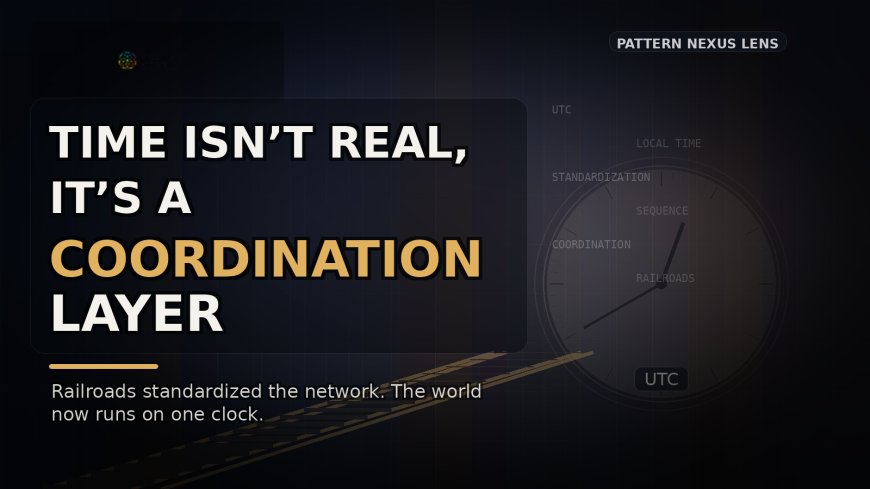

Time zones feel normal because most people were born into them, not because they are the only sane way to organize human life. Before standardization, towns kept local solar time. Railroads hated the friction, so a wider system was imposed for scheduling and coordination. That part made sense for the industrial network that existed then. The problem is that people never separated the underlying clock from the human interface built on top of it. The modern world already runs on a global time reference underneath. Finance, aviation, military operations, satellites, servers, and technical systems do not care about your local mythology of “9 a.m.” versus “2 p.m.” They care about sequence, synchronization, and precision. What we still call “local time” is a behavioral wrapper people now defend as if it were physical law. It is not. It is a human convenience layer that long ago hardened into social reality.
Time zones are not time. They are a coordination wrapper laid on top of time.
The danger is not standardization by itself. The danger is when people forget a standard is a tool and start treating it like reality.
“9 to 5” is not natural law. It is factory residue that survived into a networked world.
Time Feels Natural Because People Internalized the Interface
One of the stranger things about modern life is how quickly people start defending systems they never chose, never built, and never really examined. Time zones are one of the cleanest examples of that. Most people hear “local time” and treat it like weather, gravity, sunrise, or the movement of the Earth itself. But local clock time is not any of those things. It is an agreement. It is a format. It is a rule set.
That matters, because once a coordination layer sits in place long enough, people stop seeing it as a layer. They collapse the interface into the underlying reality. That is how something arbitrary gets mistaken for something inevitable. It is the same pattern you see in money, institutions, legal structures, media framing, and even identity. A system starts as a tool, becomes default, then gets mistaken for nature.
What most people actually mean when they say “it’s 8 in the morning” is not that 8 has cosmic meaning. What they mean is: this is the part of my local daylight cycle when I tend to begin activity. That is a behavioral statement, not a universal truth. The number itself is not sacred. The number is just a tag the culture standardized and got used to.
That is the part that interests me. Not because time zones are some huge evil by themselves, but because they show how deeply human beings will fuse themselves to systems and then defend the system as if it were the natural structure of existence. It is not. It is just an operating layer people got comfortable with.
The sun is real. Rotation is real. Sequence is real. Your clock labeling system is not. That part is negotiated.
Railroads Did Not Discover Truth, They Standardized the Network
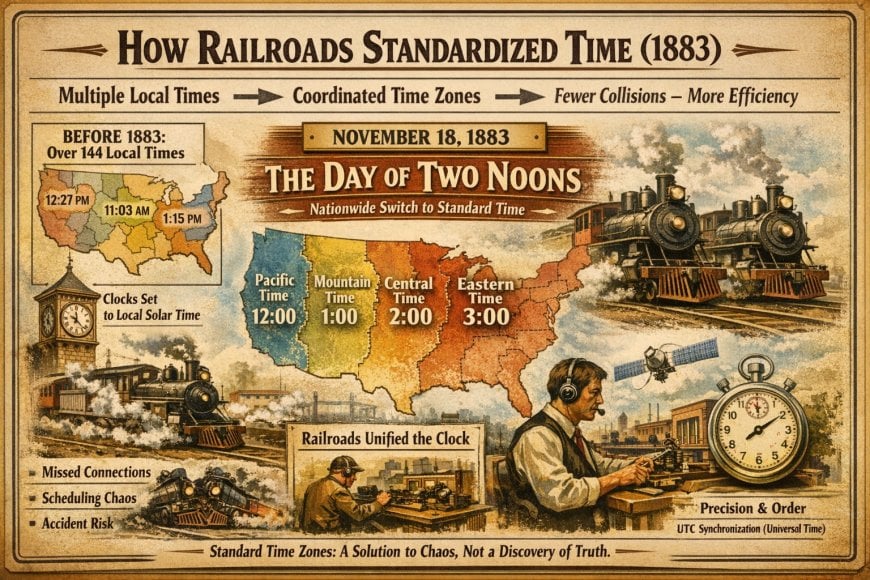
Before standardized time zones, time was local. Not “local” in the way people casually mean today, but actually local. Town by town. Clock by clock. Solar position mattered. Noon was when the sun was overhead for that place, not when some broader system told you it should be noon. That was messy, but it was also honest. It reflected physical location more directly than the system people now take for granted.
Then scale arrived. Not philosophical scale. Network scale. Railroads had no interest in preserving the poetry of each town keeping its own solar rhythm. They needed timetable discipline. They needed scheduling. They needed handoffs and routing and predictable movement across distance. Once trains, freight, passengers, and regional connections became part of the same operating network, local time turned into friction.
That is an important distinction. Railroads did not “discover” the correct way to tell time. They imposed a standard because fragmented local time was inefficient for the system they were building. In other words, they solved a coordination problem. They did not reveal some deeper truth about reality. They built a protocol and society absorbed it.
People often hear that story and stop too early, like the lesson is simply “railroads created time zones.” That is not the deeper lesson. The deeper lesson is that infrastructure reshapes human perception. Once the network became important enough, the network’s needs overrode local habit. Then, over time, the network rule got normalized into culture. That is how control structures spread. Not always through some dramatic act of domination, but through utility, repetition, dependence, and then memory loss about how the system came to be.
That is also why I do not buy the lazy response that this is all just harmless convenience. Convenience is real, but convenience is often the delivery mechanism for system adoption. The interface that makes life easier is also the interface that gets embedded deepest. Once enough institutions align to it, the cost of questioning it rises, even if the original logic has long expired.
- Local solar time worked fine when movement was slow and regional.
- Railroads required synchronized scheduling across distance.
- The standard won because the network won.
The World Already Runs on One Clock
This is the part people miss completely. The modern world already functions on a unified timing backbone. The deeper system is not confused. It is not asking whether it is noon in Chicago and 7 p.m. in London. The deeper system cares about order, precision, and reference. It already behaves as if there is one real time, because for operational purposes there is.
Aviation does not survive by treating every local clock as sacred. Military operations do not coordinate by pretending local custom is the highest layer. Financial systems, satellites, networks, and technical infrastructure all rely on standardized reference time because sequence matters more than local comfort. The machine layer of civilization has already answered this question.
So when people defend local time as though the entire world would collapse without it, they are really defending the human interface, not the underlying system. And that is fine as far as it goes, but we should at least be honest about what is happening. The clock underneath is already unified. The fragmentation is mostly for people.
That is why I think this topic matters more than it seems to. It is a small example of a much bigger pattern. The system layer modernized. The human layer kept dragging older assumptions forward. Then people started treating the human wrapper as if it were still structurally necessary. That gap between the real operating layer and the socially inherited layer is where a lot of modern confusion lives.
Civilization’s backend already moved to global synchronization. Most people are still mentally living in the frontend.
Why I Think Localized Time Is Cognitive Overhead
This is where I break with the standard defense completely. People keep saying local time reduces cognitive load. I think it often creates it. Every time you coordinate across regions, every time you convert a meeting, every time you stop to ask what the time difference is, every time some event is announced in one zone and then mentally translated into another, you are paying a friction cost for an older interface.
To me, that overhead is obvious. One global time reference would be cleaner. It would be more honest. It would force people to deal with the fact that the clock is not the same thing as daylight. If sunrise happens for your region at 17:00 on the global clock, then fine. That is your daylight rhythm. Nothing broke. The Earth did not stop rotating. Human beings would adapt faster than people think.
What most defenders of local time are actually defending is familiarity. They are used to morning being attached to certain numbers, lunch being attached to certain numbers, and work beginning at certain numbers. But that proves social conditioning, not necessity. It proves we learned a system and then internalized it. It does not prove the system is the best possible one.
The real reason this sounds strange to people is because they have fused the number with the experience. They think “7 a.m.” is somehow intrinsically morning. It is not. Morning is a human experience tied to routine, light, hormones, and habit. “7 a.m.” is just the label your local system assigns to that experience. Switch the label, keep the cycle, and life continues.
That is why I see local time as overhead. It is another translation layer. Another inherited wrapper. Another place where the interface gets mistaken for the thing itself.
The Real Problem Is Not the Clock, It Is the Social Structure Around It
I also think people make this conversation too small. The real issue is not just whether everyone should use one clock. The real issue is that industrial society welded behavior to rigid clock blocks and then sold that arrangement as normal life. “9 to 5” is the cleanest example. People talk about it like it is obvious, mature, responsible, and real. It is none of those things by default. It is just a schedule architecture inherited from a different operating environment.
Factory systems needed tightly synchronized labor. Offices copied that structure. Institutions copied it again. Schools trained people into it early. Then the entire social world started orbiting around fixed blocks that many people now treat as moral reality instead of organizational design. That is not a law of nature. It is a labor regime that got normalized.
In a world of asynchronous tools, global networks, distributed teams, machine scheduling, algorithmic routing, and digital infrastructure, a huge amount of that rigidity is increasingly artificial. Some sectors still need tight synchronization. Fine. But that does not justify pretending the whole social order should still be built around legacy clock discipline.
That is the broader Pattern Nexus point here. Time zones are not just a time story. They are a systems story. They show how infrastructure first solves a real problem, then becomes culture, then becomes ideology, then becomes invisible. Once it becomes invisible, people stop asking whether the current form still makes sense. They only defend it because it is there.
That is where I disagree with the passive “who cares” answer. I think this stuff matters precisely because it exposes how much of normal life is inherited architecture. The more clearly you see that, the harder it becomes to confuse coordination systems with reality itself.
Pattern Nexus Lens
Time zones are a small but almost perfect model of how human systems work. First there is local reality. Then scale creates friction. Then a standard gets introduced to reduce the friction. Then institutions align to the standard. Then the standard becomes culturally normal. Then the population forgets it was ever a standard at all. At that point, the interface becomes invisible and people start defending it like it is built into the structure of the universe.
That exact pattern shows up everywhere else. Money is not the thing itself. It is the accounting layer. National borders are not the land. They are the political claim layer. Media is not reality. It is the narrative compression layer. Time zones are not time. They are the human coordination layer.
Once you see that, the topic stops being quirky and starts becoming diagnostic. It tells you whether someone can separate the operating system from the user interface. Most people cannot. They get attached to the interface. They call it reality because it feels stable. But stability is not proof of truth. Often it is just proof that the system has been in place long enough to disappear into the background.
The deeper system already uses one clock. What people are defending is not time. They are defending a legacy interface wrapped around time.
FAQ
Are time zones fake?
They are real as social infrastructure, but not real in the sense people usually mean when they treat them like a natural law. They are agreements layered on top of planetary motion, not the planetary motion itself.
Would one global time actually work?
Technically, yes. Large parts of civilization already operate that way underneath. The bigger challenge would not be physics or systems. It would be social adaptation and habit. People would have to stop treating certain numbers as inherently “morning” or “night.”
So what is the real takeaway here?
The point is not just that time zones are arbitrary. The point is that human beings constantly mistake standardization for truth. That mistake shows up in far more important places than clocks.
Sources
These sources support the historical background on railroad standardization, pre-zone local time, and the modern UTC reference layer.
- U.S. Bureau of Transportation Statistics — History of Time Zones and Daylight Saving Time
- Smithsonian National Museum of American History — Time Zones
- NIST — UTC(NIST) Time Scale
- NIST — Time Realization
- Britannica — Standard Time
Яка ваша реакція?
 Подобається
0
Подобається
0
 Неподобання
0
Неподобання
0
 Любов
0
Любов
0
 Смішно
0
Смішно
0
 Ух ти
0
Ух ти
0
 Сумно
0
Сумно
0
 Злий
0
Злий
0

Founder of Pattern Nexus. I research markets, macro, geopolitics, AI, history, ancient systems, and the patterns most people overlook. I’m also building Market Radar, a trading scanner designed to read pressure, risk, confirmation, and setup quality before chasing a move. Pattern Nexus is where I connect the dots between data, history, technology, and the bigger system playing out around us.

















Коментарі (0)