
What Breaks First? A Speculative Walkthrough of System Stress Beneath 2025
A speculative deep dive into the hidden stress points of 2025—from weak holiday sales and tenant distress to global funding cracks, AI-power strain, and Treasury fragility.
What Breaks First? A Speculative Walkthrough of System Stress in 2025
Something about 2025 feels uncomfortably close to 2008—but the weak points aren’t the same. This is a speculative walkthrough of what might crack first in the global system: from dollar funding and JGBs, to AI-driven grid stress, corporate credit, and a quiet hollowing out of housing.
A Rare Speculation Warning
Most of what I publish on Pattern Nexus is grounded in hard data, primary sources, and the plumbing of the system—liquidity flows, Treasury issuance, derivatives reports, energy capacity, foreclosure data, and things I’m seeing in my own real estate portfolio.
This article is different. It’s still grounded in those inputs, but it’s more speculative than usual. I’m not saying, “This will happen.” I’m asking, “If something breaks, where does it most likely snap first based on the framework we’ve been building together here?
Treat this as a guided thought experiment. I’m going to walk through what I see as the weak points in the system, how they connect, and how they might cascade. It’s my attempt to put structure around that uncomfortable “this feels like 2008” signal a lot of us are picking up.
None of this is financial advice, trading guidance, or a precise forecast. This is structured speculation, informed by my portfolio, conversations with other landlords, and the macro-architecture we’ve been mapping on Pattern Nexus.
The “2008 Feeling” Is Real, But It’s Not 2008
There’s a specific vibe in the air right now that’s very hard to ignore. If you lived through 2008–2013 as an adult, you know what I mean:
- Things keep “functioning,” but nobody feels okay.
- People are stretched just to cover basics.
- Everyone talks about inflation, but the real story is stress.
- Markets pretend everything is fine, while daily life quietly degrades.
I remember the 2008–2013 period as a kind of economic ghost town. Building stopped. Travel stopped. People went into survival mode. The world didn’t end, but it dimmed.
Right now, I’m picking up a similar signal—but the weak organ in the system is different. In 2008, the break started in U.S. housing and subprime securitization, then got transmitted into the banking system and global dollar funding.
This time the fragility looks more distributed:
- Global sovereign debt structures (especially Japan and other heavily indebted nations).
- Dollar funding outside the U.S. via FX swaps and shadow collateral chains.
- Grid and power systems that weren’t designed for an AI-industrial load.
- Corporate credit that has to be refinanced into much higher rates.
- Housing that isn’t “crashing,” but quietly hollowing out under the surface.
So yes, something feels like 2008—but it’s not a simple replay. It’s the same kind of stress, relocated to different parts of the system.
Holiday Sales as a Stress Test: What My Tenants Are Telling Me
One of the earliest real-time indicators of economic stress isn’t CPI or the unemployment rate. It’s what I see in my tenant portfolio and what other landlords and real estate operators are reporting.
Here’s what I’m seeing on the ground:
- More late payments, even from historically reliable tenants.
- Higher abandonment rates and people just disappearing from leases.
- Tenants juggling which bills to pay and which to let slide.
- Very little slack—most people are one unexpected expense away from crisis.
- Other landlords and real estate investors reporting the same patterns.
Based on this, I personally expect holiday sales to be weaker than most people think. That’s not a number I pulled from a report—it’s a conclusion drawn from my own rental portfolio and the experiences of other operators I follow closely.
When tenants are this tight on cash, holiday consumption doesn’t disappear, but it changes shape. People:
- Trade down in quality.
- Buy fewer “big ticket” items.
- Rely more on credit cards and BNPL.
- Delay paying rent to get through the holidays.
Those behaviors don’t show up cleanly in headline retail data until after the fact—but landlords see it early. If we get a weak holiday season on top of the stress I’m seeing, it will be a major confirmation that the consumer is already broken, even if official stats still look “fine.”
Again: that’s speculation. But it’s speculation rooted in real cash flows and real people, not just charts.
What Breaks First? The Global Dominoes
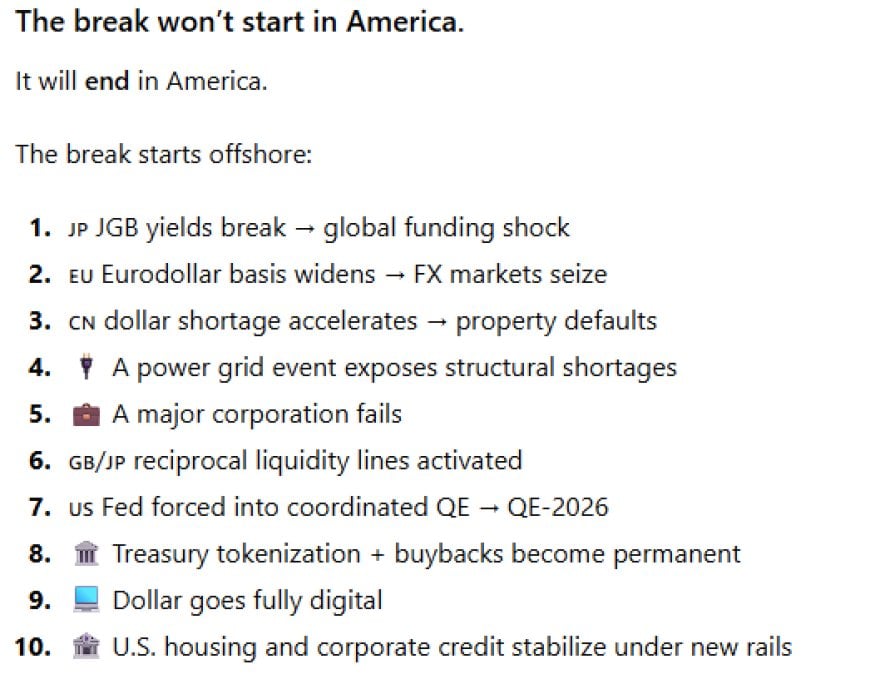
If something breaks in this system, I don’t think it starts in Main Street America. It starts offshore—in the places where dollar funding, sovereign debt, and derivatives stack up in ways most people never see.
Japan and the JGB Problem
Japan is the quiet fulcrum of a huge amount of global leverage. For decades, Japanese Government Bonds (JGBs) were pinned near zero, supporting carry trades, global risk assets, and demand for U.S. Treasuries.
As yields rise and the Bank of Japan is forced to loosen its grip, that entire structure starts to shake:
- Carry trades come under stress.
- Japanese investors may sell foreign assets, including U.S. Treasuries.
- FX swap markets start to feel the pressure as capital moves.
A disorderly move in JGB yields is one plausible “first break” point. It doesn’t look like a Hollywood crash—it looks like funding costs spiking quietly in a corner of the system most people never think about.
Eurodollards, FX Swaps, and Synthetic Collateral
The global system runs on dollar funding, and a lot of that funding happens in offshore, synthetic ways—through FX swaps and collateral chains that don’t show up cleanly on balance sheets.
When stress builds here, cross-currency basis spreads can blow out, making it more expensive and difficult for non-U.S. entities to access dollars.
If this part of the system cracks, the response is almost guaranteed:
- Central banks reopen or expand swap lines.
- The Fed becomes de facto lender to the world again.
- We get emergency dollar liquidity in some new wrapper.
China and the Slow-Motion Credit Squeeze
China’s issues are a different flavor: property sector implosion, local government financing vehicles under strain, demographics rolling over, and a system that still needs dollars in key places.
I don’t think China is the first explosive “break,” but it’s a structural drag that amplifies any global liquidity shock. When the tide goes out, you find out which parts of the Chinese system were being kept afloat purely by momentum and narrative.
A Vulnerable Sovereign
We already saw a preview of what happens when sovereign debt meets leveraged derivatives with the UK gilt crisis in 2022. That was a “mini-crash” that got papered over quickly.
It wouldn’t surprise me if the next major break involves another sovereign—Italy, the UK again, or even Japan—where a mix of:
- High debt-to-GDP,
- Rate volatility, and
- Derivatives exposure in pension and insurance systems
suddenly collide.
Housing: Not a Crash, a Hollowing-Out
Housing is where I live professionally, and what I see does not line up with the idea that “housing is fine.”
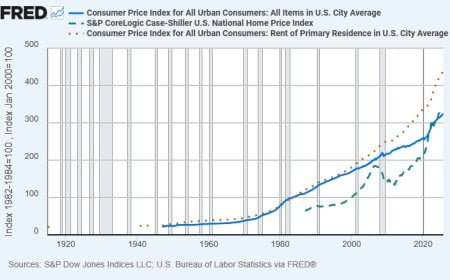
Rents and home prices don’t have to crash 30–40% to signal a problem. Instead, we’re getting something slower and more dangerous: a hollowing-out of the sector:
- Rents flatten or drift down in real terms.
- Landlord margins get squeezed by taxes, insurance, and maintenance.
- Tenants default quietly or disappear.
- Investors bleed cash flow without an obvious “event.”
- Some properties go abandoned; others just sit with stressed owners.
From the outside, that looks like “stability.” Prices may even stay flat or slightly up. But underneath, the system is losing resilience. One more shock—job loss, energy spike, a credit crunch—and you start to see more foreclosures, more fire sales, more forced exits.
This isn’t 2008’s instant cardiac arrest. It’s more like long-term organ failure.
AI Power and the Grid: The New “Bear Stearns” Moment
The other big piece of my framework is the AI–power nexus: data centers, GPU clusters, and AI infrastructure demanding more electricity than the grid was ever designed for at this speed.
Over the next few years, we’re staring at multi–tens of gigawatts of incremental demand in a grid that already struggles in places like Texas and California.
If we’re looking for a U.S.-based “first break,” I think a major power or grid event tied—directly or indirectly—to AI/data center load is a prime candidate:
- A regional blackout during a heat wave or cold snap.
- A data center losing power in a way that disrupts critical services.
- Utilities forced into emergency pricing or curtailment.
- Regulators scrambling to catch up after the fact.
That kind of event would be the modern equivalent of Bear Stearns: not the end of the crisis, but the first highly visible sign that the existing infrastructure can’t carry the new load without a systemic overhaul.
Corporate Credit: The Deferred Reckoning
Corporate America rode a decade of near-zero interest rates. A lot of companies survived not because they were productive, but because money was free.
Now all that debt has to be refinanced at much higher rates. That’s fine if your cash flow is growing. It’s a death sentence if it’s not.
The ingredients are here for a corporate credit event:
- High leverage accumulated in the ZIRP era.
- Weaker consumer demand and margin pressure.
- AI and automation putting downward pressure on certain labor and business models.
- Private credit and shadow lenders carrying risk that hasn’t been fully recognized.
If something breaks, I wouldn’t be surprised to see one or more “too-recognizable-to-fail” companies suddenly run out of runway—a big household name, or a huge private credit complex that everyone assumed was safe.
The Treasury Market: The Final Boss
Behind all of this sits the true final boss of the global system: the U.S. Treasury market.
We’re asking this market to absorb:
- Record issuance,
- Less foreign buying,
- Dealer balance sheet constraints,
- Hedge funds running basis trades,
- QT instead of QE, and
- An evolving regulatory and collateral landscape.
A serious breakdown in Treasury market liquidity—a period where bid–ask spreads blow out and normal trading seizes up even for a day or two—would be the point where all of this stops being “interesting macro theory” and becomes an emergency.
At that point, the Fed and Treasury don’t really have the option to do nothing. They have to step in with some form of permanent or semi-permanent support: buybacks, standing facilities, or de facto yield curve control by another name.
The QE-2026 Endgame and the Digital-Dollar Rails
Put all these threads together, and you don't get a single Hollywood “crash day.” You get a series of overlapping stresses:
- Weak holiday sales revealing a broken consumer.
- Housing quietly hollowing out behind the “stability” narrative.
- Global funding stress in JGBs, FX swaps, and Eurodollar plumbing.
- AI-driven power demand exposing the limits of the existing grid.
- Corporate credit finally having to pay the bill for a decade of free money.
- The Treasury market approaching the edge of what it can clear without permanent support.
The resolution, in my view, doesn’t look like a reset to 1990 or a collapse into barter. It looks like:
- Coordinated liquidity operations across central banks.
- Some new form of QE—call it QE-2026—designed as “market functioning” rather than “stimulus.”
- More aggressive Treasury buybacks and term structure management.
- Expansion of digital-dollar rails: tokenized Treasuries, regulated stablecoins, instant settlement.
- Federalized or semi-federalized support for the AI–power buildout.
In other words: we patch the current system by fusing fiscal, monetary, and digital infrastructure more tightly together. The “solution” to the break is deeper integration and less room to exit.
Again, this is speculation. I’m not saying this must happen. I’m saying: based on the framework we’ve been building, the data we’ve gone through, and the lived reality in my tenant portfolio and the landlords I follow, these are the fault lines that matter.
If holiday sales come in weak and rent stress worsens, that’s your early signal that the real economy is already breaking—quietly—long before the headline narrative admits it.
Яка ваша реакція?
 Подобається
0
Подобається
0
 Неподобання
0
Неподобання
0
 Любов
0
Любов
0
 Смішно
0
Смішно
0
 Ух ти
0
Ух ти
0
 Сумно
0
Сумно
0
 Злий
0
Злий
0

Founder of Pattern Nexus. I research markets, macro, geopolitics, AI, history, ancient systems, and the patterns most people overlook. I’m also building Market Radar, a trading scanner designed to read pressure, risk, confirmation, and setup quality before chasing a move. Pattern Nexus is where I connect the dots between data, history, technology, and the bigger system playing out around us.













Коментарі (0)