
War, Backlash and Build‑Out: The 2026 AI Data Center Report
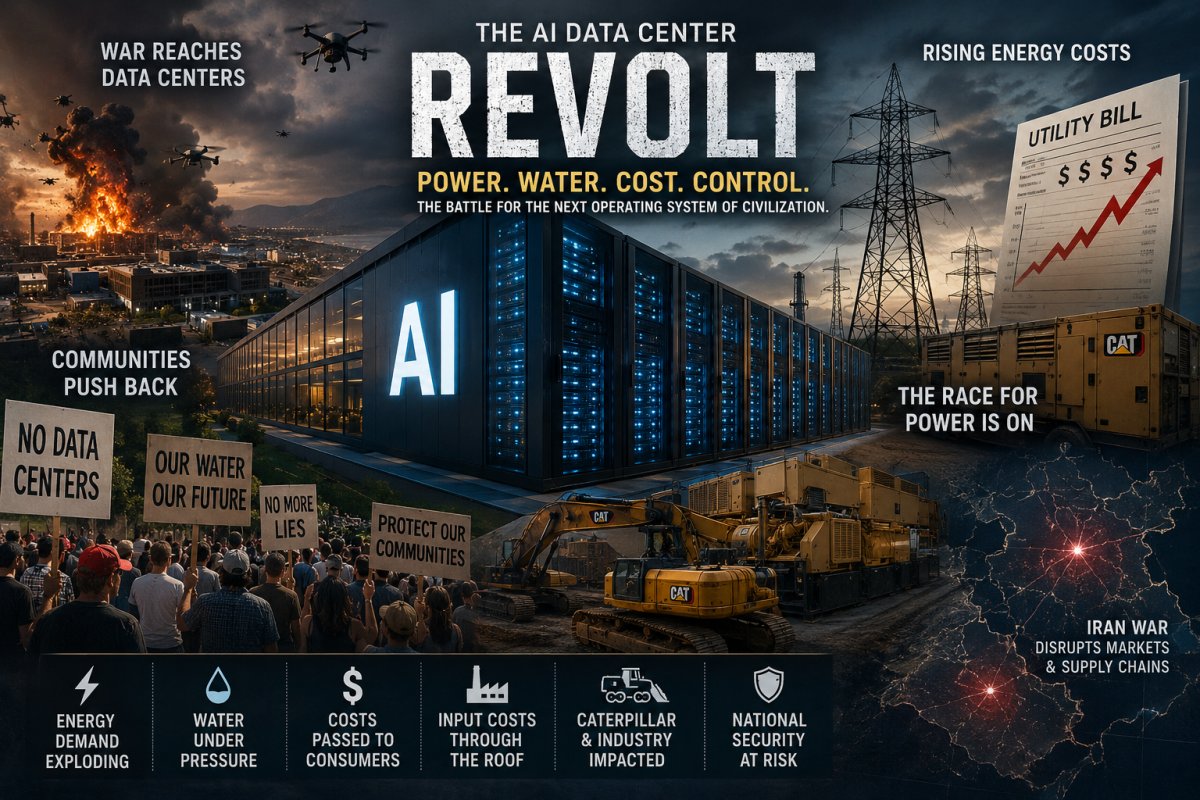
The year 2026 has been unprecedented for AI infrastructure. A global conflict disrupted supply chains and even targeted data centers; nearly 40 % of U.S. projects faced delays. Communities across America escalated their pushback with ballot measures, moratoria and protests. Tech firms responded with new power strategies, cooling innovations, community agreements and even nuclear plans. This report synthesizes the year’s events, from war‑zone drone strikes to closed‑loop cooling, large‑load tariffs, behind‑the‑meter power and the economic ripple effects on suppliers like Caterpillar.
Quick Read
The AI data center story has moved past the hype cycle. It is now about power, water, land, transformers, utility bills, construction labor, copper, generators, turbines, nuclear restarts, local moratoriums, and geopolitical vulnerability.
In 2023, U.S. data centers consumed about 176 TWh of electricity, equal to about 4.4% of total U.S. electricity use. DOE-backed analysis projects that could rise to 325–580 TWh by 2028, or roughly 6.7% to 12% of U.S. electricity consumption.[1] Globally, the IEA projects data center electricity consumption could more than double to about 945 TWh by 2030, with data centers accounting for nearly half of U.S. electricity demand growth between now and 2030.[2]
That demand is colliding with the real world. Nearly 40% of U.S. data center projects expected to open in 2026 were reported to be delayed by at least three months because of labor, power, equipment, and permitting constraints.[3] Transformer shortages have become a grid-level chokepoint, with demand for generator step-up transformers up 274% since 2019 and some large transformer lead times stretching up to four years.[4]
The buildout is also becoming political. Local opposition canceled roughly 25 data center projects in 2025, and 2026 is on pace to exceed that number only months into the year.[5] Moratoriums, ballot measures, lawsuits, recall campaigns, water fights, noise complaints, and large-load tariffs are now part of the AI infrastructure stack.
The biggest shift is that AI infrastructure is becoming war infrastructure. In March 2026, Fortune reported that Iranian drones struck three data centers operated by a major U.S. hyperscaler in the Gulf, though that specific claim should remain framed as reported unless more independent confirmation surfaces.[6] The broader point is already clear: data centers, cloud regions, ports, cables, payments, logistics, and energy corridors are now part of the strategic target map. The Iran conflict also disrupted data center supply chains through the Strait of Hormuz, contributing to reported material cost increases of up to 20% for certain building materials.[7]
The buildout is not simply being stopped. It is being rerouted. Pew found that 67% of planned U.S. data centers are in rural areas, even though 87% of currently operating data centers are urban. That means the next phase of AI infrastructure is moving into rural counties, second-tier metros, power-adjacent towns, water-access zones, and communities that may not be prepared to negotiate against hyperscale capital.[24]
Compute Is No Longer Abstract
AI runs through power plants, transformers, water systems, land deals, rate cases, and permitting fights.
The Cloud Became Heavy Industry
The AI economy now depends on concrete, copper, steel, gas turbines, substations, chillers, generators, and skilled trades.
Local Consent Is a Chokepoint
The next AI bottleneck is not only GPUs. It is city councils, zoning boards, ballot measures, lawsuits, and angry ratepayers.
Private Power Is the New Moat
Companies that control power, cooling, land, and permits control the compute runway.
AI Leaves the Screen
Artificial intelligence was sold to the public as software. It appeared inside search bars, chatbots, image generators, coding tools, office assistants, recommendation systems, and corporate demos. That made AI feel weightless, almost detached from physical reality.
But that was never true.
The cloud is not a cloud. It is a warehouse. AI is not magic. It is computation. Computation is not free. It requires chips, power, water, cooling, networking, buildings, backup systems, fiber, land, permits, and a physical supply chain large enough to support all of it.
The first phase of the AI boom was about models. The second phase is about infrastructure. The third phase is about control.
Pattern Nexus has already covered this through three connected frames: the data center map as the new map of American power, the private-grid race as an inflation and control layer, and the AI wars as a human conflict between people who adapt to acceleration and people who experience it as displacement. Those were not separate stories. They were early views of the same system.[21][22][23]
The update in 2026 is that the system is now visible. The fight is no longer theoretical. It is happening in public hearings, rural roads, township boards, water districts, utility filings, transformer orders, gas plant permits, fuel-cell deals, nuclear restarts, and drone-struck infrastructure overseas.
AI is leaving the screen and entering the land.
That is the core shift. People can argue about whether AI is good or bad in abstract terms, but once a hyperscale facility shows up next to a town, the argument changes. It becomes a local question: who gets the tax money, who pays for the grid, who loses the land, who loses the water, who lives next to the noise, who gets the jobs, and who controls the infrastructure after the deal is done?
That is why the data center revolt matters. It is the first physical mass-contact point between ordinary communities and the AI transition.
The 2026 Shock: Data Centers Become War Infrastructure
The most important shift of 2026 is that data centers are no longer just commercial infrastructure. They are strategic targets.
In March 2026, Fortune reported that Iranian drones struck three data centers operated by a major U.S. hyperscaler in the Gulf, two in the UAE and one in Bahrain. The reported disruption included banking apps going dark, payment platforms failing, and ride-hailing services crashing. Fortune framed it as the first time a U.S. data center had been hit by military action and as a signal that corporations now sit on the front lines of modern war.[6]
That matters because it destroys the old separation between national security and corporate infrastructure. In the old model, a company might be affected by war through insurance, fuel prices, shipping delays, sanctions, or cyberattacks. In the new model, the company’s physical infrastructure can be targeted directly because that infrastructure is part of the state’s economic, financial, and digital operating system.
This is where the Pattern Nexus control-system framework becomes obvious. Data centers do not just host files. They host payments, banking apps, logistics systems, ride-hailing platforms, cloud services, AI inference, identity layers, business applications, trading tools, government systems, and the digital coordination layer that modern life runs through.
When a data center goes down, the disruption is not contained inside the building. It radiates outward through dependency chains. Apps fail. Payments fail. Platforms fail. Logistics slow. Businesses lose continuity. Governments lose visibility. Public confidence takes a hit.
That is why data centers are war infrastructure now. Not because every data center is a military base, but because modern economic life runs through them. If a hostile state wants to impose economic cost without directly invading, data centers, ports, shipping lanes, energy corridors, undersea cables, satellite links, payment networks, and cloud regions are natural targets.
This is the overlooked military logic of the AI age. The more society depends on cloud infrastructure, the more that cloud infrastructure becomes part of the battlefield. The more AI becomes embedded into defense, logistics, finance, manufacturing, and public administration, the more compute capacity becomes a national asset.
In other words, the AI buildout is not only expanding the commercial cloud. It is expanding the attack surface of civilization.
Source Note: War Claims and Confirmation Standards
One important clarification belongs here. The reported Gulf data center strikes should remain framed as reported unless more independent sources confirm the full operational details. Fortune reported that Iranian drones struck three data centers operated by a major U.S. hyperscaler in the Gulf, but the broader argument does not depend entirely on treating every detail of that single report as settled fact.[6]
The stronger and more durable argument is this: data centers, cables, ports, energy corridors, payment systems, and cloud regions are now strategic infrastructure. Even if one specific event remains disputed or lightly sourced, the direction is already clear. Modern conflict targets economic operating systems, and hyperscale cloud infrastructure is now part of that operating system.
That is the correct way to frame it. Do not oversell one report. Use the report as an early warning signal. The real point is that data centers are now sitting inside the same threat map as ports, pipelines, power plants, maritime chokepoints, satellites, and undersea cables.
The Hormuz Relay: Energy, Materials, and Construction Inflation
The war layer did not stop with the direct targeting of data centers. It also hit the supply chain underneath the buildout.
The Register reported in May 2026 that the Iran conflict was disrupting data center construction supply chains, pushing up material costs, and reducing deliveries because of the closure of the Strait of Hormuz. Server hall project specialist BCS Consultancy said some construction firms were seeing increases of up to 20% in the cost of certain building materials, while available delivery volumes were reduced to a quarter of required orders in some cases.[7]
That is not just a data center problem. It is the chokepoint economy showing itself.
Data centers require energy-intensive materials: steel, aluminum, cement, copper, electrical equipment, cooling systems, switchgear, transformers, generators, backup systems, and industrial HVAC. When energy prices spike, the cost of those inputs rises. When shipping lanes are disrupted, lead times expand. When copper and transformers are already tight, geopolitical stress amplifies the shortage.
This is exactly how a corridor shock becomes a construction shock. The disruption starts in an energy chokepoint, moves into commodity prices, then into freight, then into industrial materials, then into project budgets, then into delays, then into rate cases, then into local politics.
For Pattern Nexus, this is the corridor logic in real time. The Strait of Hormuz does not have to touch a data center directly to affect the AI economy. It only has to touch the energy and material stack that data centers depend on.
This is also where AI infrastructure starts to overlap with inflation. It is not only about electricity demand. It is about the full input chain. Cement. Steel. Aluminum. Copper. Transformers. Chillers. Diesel generators. Gas turbines. Switchgear. Skilled labor. Heavy equipment. If all of those inputs are being bid up at the same time, AI becomes a pressure source inside the broader construction economy.
Once that happens, AI infrastructure becomes exposed to the same chokepoint risk as oil, shipping, fertilizer, metals, and defense production. The software layer inherits the fragility of the physical world.
The New Industrial AI Stack
The public still talks about AI as if the central question is model quality. That is already outdated.
The new AI stack has at least ten physical layers:
- chips and accelerators
- high-bandwidth memory
- server racks and networking
- cooling systems
- data halls and buildings
- fiber and connectivity
- transformers and substations
- generation capacity
- water and thermal management
- local political permission
That last layer matters as much as the first. A company can have GPUs, capital, and software talent, but if it cannot secure land, power, cooling, permits, and local consent, it cannot deploy at scale.
DOE-backed analysis found that U.S. data center electricity consumption rose from 58 TWh in 2014 to 176 TWh in 2023 and could reach 325–580 TWh by 2028.[1] The IEA projects global data center electricity consumption could reach around 945 TWh by 2030, with the United States accounting for the largest share of projected growth.[2]
That means data centers are becoming a baseload industrial category. They are not just another office complex. They are closer to aluminum smelters, refineries, fabs, and logistics hubs in terms of infrastructure pressure.
The difference is that the data center buildout is moving at software speed while the grid moves at utility speed. That mismatch is where the system starts breaking.
A model can be updated in weeks. A data center can take years. A transformer can take years. A transmission project can take longer than a political cycle. A nuclear restart can become a decade-scale project. Local permitting can turn into litigation. Water rights can become a political firestorm.
This is why the AI story is shifting from algorithms to infrastructure. The next phase is not only who has the best model. It is who can secure the physical runway to keep scaling.
Caterpillar, Transformers, Copper, and the Heavy-Machinery Layer
One of the biggest tells in 2026 is that old industrial companies are becoming AI plays.
Caterpillar is the cleanest example. Reuters reported that Caterpillar raised its 2026 and long-term revenue forecasts because the AI-focused data center boom created record order backlog for its power generation and backup equipment. Caterpillar said power generation equipment sales are expected to triple by 2030 from 2024 levels, and the company’s order backlog reached $62.7 billion at the end of the March quarter.[8]
That matters because Caterpillar is not selling language models. It is selling the machines and power systems needed to make language models physically possible.
This is the hidden industrial rotation inside the AI boom. The market talks about Nvidia, Microsoft, OpenAI, Oracle, Meta, Google, and Amazon. But the physical beneficiaries also include Caterpillar, Vertiv, Eaton, Schneider Electric, Siemens, Hitachi Energy, GE Vernova, Johnson Controls, Trane, Carrier, Bloom Energy, utilities, gas turbine suppliers, construction firms, copper producers, switchgear manufacturers, transformer manufacturers, and companies that can deliver skilled trades at scale.
The transformer shortage makes this even more important. Reuters reported that U.S. power transformer buyers are scrambling for imports and factory slots as demand surges from data centers, EVs, factories, and renewables. Demand for generator step-up transformers rose 274% since 2019, substation transformer demand rose 116%, prices rose around 80% over five years, and some high-capacity units have lead times up to four years.[4]
That is the real AI bottleneck most retail investors and the public miss. It is not only H100s, Blackwell racks, or model inference. It is the electrical hardware that lets the facility connect to the real world.
A GPU without power is inventory. A model without electricity is a demo. A data center without transformers is a building.
That is why the AI trade is bleeding into industrials. The AI economy is not replacing the old economy. It is consuming it.
The Local Revolt: Moratoriums, Ballots, Lawsuits, and Community Anger
The data center revolt is not theoretical anymore. It is organized.
Heatmap reported that roughly 25 data center projects were canceled nationwide in 2025 after facing local opposition, and that the United States was likely to break that record in 2026 only months into the year. Heatmap also reported that at least $85 billion in data center projects had been canceled over the past three years.[5]
MultiState reported that voters and local governments are increasingly targeting data centers through local and statewide ballot measures. Maine’s governor vetoed a bill that would have paused data center construction until November 2027, but even the veto message acknowledged that moratorium concerns were tied to environmental and electricity-rate impacts in other states.[9]
Route Fifty reported that voters in Port Washington, Wisconsin approved a ballot measure requiring voter approval for certain tax-increment financing districts used for data centers, and that similar ballot efforts were appearing in California, Michigan, Nevada, Wisconsin, and Ohio.[10]
The opposition is not one ideology. That is what makes it durable.
Progressives object to water use, emissions, environmental justice, corporate power, and AI acceleration. Conservatives object to land use, local control, utility bills, tax breaks, secrecy, and the sense that rural towns are being converted into corporate infrastructure zones. Farmers object to farmland loss. Homeowners object to noise, traffic, water pressure, property values, and industrialization. Ratepayers object to paying for someone else’s compute.
That is why the data center fight cuts across political tribes. It is not left versus right. It is national acceleration versus local consent.
The public is beginning to understand that AI has a physical footprint. Once people see that footprint near their home, the abstract AI debate becomes immediate. It becomes water pressure. It becomes a substation. It becomes a gas plant. It becomes a tax abatement. It becomes a closed-door county board meeting. It becomes the question: why are we sacrificing our town for someone else’s cloud?
That is the human part the industry keeps underestimating. People may not know model architecture. They may not know the difference between training and inference. They may not understand rack density, transformer capacity, or capacity markets. But they understand a massive facility being built near them, and they understand when their community is being asked to absorb the cost of a future they did not vote for.
The Next-Town-Over Pattern: How the Buildout Moves Around Resistance
The data center revolt does not stop the AI buildout by itself. It changes the routing.
That is the part people miss. If one city blocks a project, the demand does not disappear. The developer looks at the next township. If that township starts asking questions, they look at the county. If the county pushes back, they look at the next state. If a mature hub becomes too crowded, expensive, water-stressed, or politically hostile, the buildout migrates outward.
This is already visible in the data. Pew Research found that 67% of planned U.S. data centers are in rural areas, while 87% of existing operating data centers are in urban areas. Pew also found that 39% of planned data centers are in counties that currently do not have any data centers at all.[24]
That is the map shift. The old cloud was urban and suburban. The AI factory layer is moving into rural counties, cheap land corridors, power-adjacent parcels, water-access zones, and communities that may not have the legal, technical, or staffing capacity to negotiate against hyperscale capital.
This is not random sprawl. It is pressure seeking the path of least resistance. AI demand creates load. Load needs land and power. Land and power need permits. Permits need local consent. When consent fails in one place, capital searches for a softer permission layer somewhere else.
That is why the local revolt is not just about one data center. It is about the national routing logic of AI infrastructure. The buildout will keep looking for towns with cheaper land, weaker opposition, more desperate tax bases, or officials willing to trade long-term infrastructure burden for short-term investment headlines.
This is how small towns become part of a global AI race without ever asking to be. A planner in a rural county may suddenly be negotiating with hyperscale capital tied to trillion-dollar companies, private equity, utility planners, gas suppliers, and state economic-development officials. That is not a balanced table.
The next-town-over pattern means that even communities without a project today are now part of the risk map. The question is not only where data centers are. The question is where they will be forced to go next.
2026 Case Files: Where the Data Center Revolt Is Already Showing Up
The data center fight is no longer theoretical. It is showing up in specific places, with specific projects, specific water disputes, specific utility fights, and specific local political reactions.
Michigan: Stargate, Saline Township, and the Moratorium Chain Reaction
Michigan may become one of the clearest examples of the next-town-over pattern. A reported $16 billion Stargate-linked AI data center in Saline Township moved forward despite overwhelming local opposition. The project was reported to require roughly 1.4 GW of electricity. After the fight, at least 19 Michigan municipalities reportedly moved to enact moratoriums or restrictions on new data centers.[25]
That matters because it shows how one project can trigger a statewide immune response. Once residents in nearby towns see what happened, they start closing their own gates before the next developer arrives.
This is how opposition spreads. One town becomes the example. The next town becomes defensive. The third town writes the moratorium before the land option is even public. That is what happens when people conclude that the normal process is moving too fast for them to understand, influence, or stop.
Arizona: Project Baccara and the Gas-Plant Model
In Arizona, Project Baccara became a flashpoint because it was not just a data center proposal. It included a large technology campus and a 700 MW natural gas plant near Surprise. Axios reported more than 4,000 petition signatures and 225 emails opposing the project, while local residents raised concerns about water, energy, property values, public risk, and quality of life.[26]
This is the future conflict in miniature: data center plus power plant plus local opposition plus legal and lobbying pressure. The community does not just see servers. It sees industrialization.
Arizona also shows the contradiction between AI expansion and water-stressed geography. The Southwest is attractive because of land, sun, energy development, and growth corridors. But it is also where water politics are already fragile. A hyperscale campus can become a symbol of everything residents already fear about drought, sprawl, and uneven development.
Utah: Stratos, Kevin O’Leary, and the 9 GW Shock
The Utah Stratos project is another extreme case. Business Insider reported that Kevin O’Leary defended the project after intense opposition and claimed some critics were professional protesters or AI-amplified. The proposed project was reported to span 40,000 acres and consume up to 9 GW of energy, more than double Utah’s current total energy use.[27]
That number changes the conversation. A 9 GW data center complex is not a local zoning issue in the ordinary sense. It is a state-level energy-system event.
The Stratos fight also shows how the public’s understanding of scale is changing. People are beginning to understand that data centers can be as large as power systems, not merely buildings. When a project’s demand is comparable to entire regional electricity systems, the public will not treat it as a normal commercial development.
Georgia: QTS, Drought Conditions, and the Water Trust Problem
In Fayetteville, Georgia, residents were outraged after reports that a QTS data center used more than 30 million gallons of water during drought conditions, with local complaints about unbilled use, oversight failures, water pressure, and unequal treatment. QTS said the heavy use was tied to construction and that future operations would rely on closed-loop cooling, but the trust damage was already done.[13]
This is why water is politically explosive. The technical answer may be that future cooling will use less water. The human answer is that residents saw a different rule set for corporate infrastructure than the one applied to them.
In local politics, trust is hard to recover. Once residents believe a project received special treatment, future technical explanations sound like damage control. That is why transparency before the project matters more than corporate clarification after the backlash.
New Mexico: Oracle Project Jupiter and the Pivot From Gas to Fuel Cells
Oracle’s Project Jupiter shows how opposition can force design changes. Business Insider reported that Oracle canceled a planned natural gas plant after regulatory problems, lawsuits, and more than 7,000 comments on permit applications, many focused on water use and air quality. Oracle then pivoted toward Bloom Energy fuel cells.[16]
This is important because the project did not disappear. It adapted. That is the future pattern: communities may not stop every project, but they can force the architecture to change.
That is a major point. Opposition does not only function as a stop sign. It functions as a design constraint. If a gas plant becomes politically impossible, the developer looks at fuel cells. If water use becomes unacceptable, the developer looks at closed-loop cooling. If grid costs become controversial, the utility proposes a large-load tariff.
Colorado: The Failed Regulation Bill
Colorado lawmakers considered environmental and energy-use regulations for large-scale data centers, but the proposal failed in committee. Axios reported that Colorado already hosts 56 data centers, and the debate revealed a split between stricter oversight and economic-development arguments.[28]
This shows the political tension inside states. Legislators know the grid and environmental questions are real, but they also do not want to be the state that pushes AI investment somewhere else.
That is the state-level trap. If a state regulates too aggressively, developers may move. If a state regulates too weakly, residents may revolt. The states are now competing not only for AI investment, but for the political formula that allows them to host the buildout without triggering a local legitimacy crisis.
Ratepayer Politics and the Utility Bill Problem
The most politically dangerous part of the data center buildout is not the building. It is the utility bill.
When data centers require new generation, transmission, substations, transformers, and grid upgrades, somebody has to pay. If regulators do not isolate those costs to the large-load customer, they can be spread across ordinary households and small businesses.
That is how AI becomes inflationary at the household level.
Local news and national coverage have already tied community backlash to concerns over utility costs, tax incentives, water, noise, and land use.[11] The policy response is the rise of large-load tariffs.
A large-load tariff is not just a utility pricing detail. It is a political firewall. It says: if a hyperscaler wants hundreds of megawatts or gigawatts of power, it has to pay for the capacity it forces the system to build.
Pennsylvania approved a large-load framework for customers above 50 MW individually or 100 MW in aggregate, requiring them to pay for interconnection upgrades and provide financial protections against stranded costs.[12] Ohio’s AEP-related data center tariff fight centers on a similar idea: data centers should commit to paying for a large share of subscribed power so that residential customers do not absorb the risk of speculative load growth.
This is a major shift. Utilities used to celebrate load growth because more electricity demand meant more investment and more regulated returns. But AI load is different because it can arrive in concentrated blocks larger than entire towns. A single project can force infrastructure decisions that affect everyone on the grid.
The question is no longer whether data centers need power. They do.
The question is who pays for the grid they require.
The PJM Problem: When AI Load Hits the Capacity Market
Utility bills are where the AI data center fight becomes impossible to ignore.
The public may not follow interconnection queues, capacity auctions, or transmission planning. But they understand a bill that goes up. Once residents believe their monthly bill is rising because Big Tech needs more power, the data center fight moves from environmental politics into household economics.
PJM is the clearest warning sign. Reuters reported that Maryland Governor Wes Moore pushed for grid reforms as household power bills rose, with PJM capacity payments reportedly spiking around 1,000% over two years amid data center demand and limited new power generation.[29]
That is the ratepayer version of the AI buildout. Data centers do not just consume electricity. They change the planning assumptions for the entire grid. They can force transmission upgrades, new generation, capacity-market repricing, and political battles over who pays.
This is why large-load tariffs are spreading. SEPA’s DELTa database tracked 77 approved or proposed tariffs and service rules targeting large-load customers across 60 utilities, while Utility Dive reported that state regulators approved 29 large-load tariffs in 2025 alone.[30]
That is not a niche utility issue. It is the emergence of a new rate class for the AI age.
The old grid assumed load growth was broadly socialized. The AI grid cannot work that way. If one hyperscale customer creates the need for billions in grid investment, the public will demand proof that the hyperscaler pays before the cost lands on everyone else.
This is where the political fight will harden. Once the public links AI to utility bills, the issue stops being about futuristic technology and becomes about monthly survival costs.
Water, Cooling, and the Fight Over Local Resources
Water is the second flashpoint.
The public may not understand transformer queues, capacity auctions, or interconnection studies. But people understand water.
They understand being told to conserve water while a massive industrial facility gets permits. They understand wells, droughts, water pressure, irrigation rights, and municipal treatment capacity. They understand when a data center can use more water than a neighborhood or a small town.
WRI’s 2026 review of data center impacts said mid-sized facilities can use up to 300,000 gallons of water per day, while large facilities can consume up to 5 million gallons per day. WRI also noted that two-thirds of U.S. data centers built or in development since 2022 are in water-stressed areas.[31]
In May 2026, residents in Fayetteville, Georgia were reportedly outraged after discovering that QTS used more than 30 million gallons of water during drought conditions at a massive facility, with local complaints around oversight, billing, water pressure, and fairness.[13]
That is the kind of story that turns data centers into symbols of extraction. It does not matter if the company says future water use will be lower because of closed-loop cooling. The trust damage happens when residents feel one rule applies to them and another rule applies to hyperscale infrastructure.
The industry knows this. That is why cooling technology is moving fast.
Microsoft announced a new data center design using chip-level closed-loop cooling that consumes zero water for cooling and avoids the need for more than 125 million liters of water per year per data center, while still using water for ordinary administrative functions like restrooms and kitchens.[14]
Direct-to-chip cooling, rear-door heat exchangers, immersion cooling, two-phase cooling, AI-driven thermal management, heat reuse, and closed-loop systems are all becoming central to the next generation of AI facilities. This will reduce some of the tension. It will not eliminate it.
The reason is simple: efficiency lowers friction, and lower friction increases deployment.
Even if the next data center uses less water per unit of compute, total compute demand can still rise faster than efficiency gains. The same Jevons pattern applies to AI: when compute becomes cheaper and more efficient, people use more of it.
Better cooling will reduce some local water fights. It will not end the power fight, the land fight, the ratepayer fight, or the democratic legitimacy fight.
Private Power: Behind-the-Meter, Gas, Fuel Cells, and the New Moat
The grid cannot move fast enough for AI.
That is why behind-the-meter power has become one of the biggest stories in the entire data center buildout.
Behind-the-meter means power generation built on-site or directly tied to the facility rather than waiting for the public grid to provide capacity. It can include gas turbines, fuel cells, battery systems, solar, hybrid systems, and eventually small modular reactors.
The logic is simple: if the grid queue takes years, bring your own power.
Business Insider reported that the AI industry is increasingly turning to natural gas to bring data centers online quickly because the existing grid cannot support the demand fast enough and natural gas can be deployed faster than nuclear while providing firmer power than intermittent renewables.[15]
But that creates a contradiction. Tech companies spent years marketing themselves as climate-forward, renewable-powered, and sustainability-driven. Now the AI race is forcing them toward gas because speed matters more than branding.
Oracle’s Project Jupiter in New Mexico is a perfect example. Business Insider reported that Oracle canceled a planned natural gas plant for Project Jupiter after local opposition, regulatory hurdles, lawsuits, and more than 7,000 public comments, then pivoted toward Bloom Energy fuel cells.[16]
That is not the end of the power problem. Fuel cells still need fuel. If they use natural gas, the emissions and supply questions remain. But the pivot shows how local pressure is forcing technical redesign.
xAI shows the other side of the same trend. The NAACP sued xAI over allegedly operating 27 gas turbines without an air permit in Southaven, Mississippi, effectively building a power plant for the Colossus 2 data center.[17]
This is the private-grid race colliding with the public’s right to breathe clean air.
Pattern Nexus has described this as the permission stack. A company can secure capital, chips, land, and customers, but it still needs permission from the energy system, the water system, the legal system, the political system, and the local community. When one permission layer fails, the whole project can be delayed, rerouted, or redesigned.
Nuclear, SMRs, Microreactors, and the Return of Firm Power
The AI data center boom is also reviving nuclear power.
This is not because tech companies suddenly became nostalgic for old energy. It is because AI needs firm power.
Wind and solar can help, but they do not solve the full problem alone. Data centers need stable, high-capacity, round-the-clock electricity. They cannot run core AI workloads only when the sun is shining or the wind is blowing. Batteries help, but at hyperscale they do not yet solve the full duration and capacity problem.
That is why nuclear is coming back into the conversation.
The Three Mile Island restart is the symbolic case. A 20-year power purchase agreement is expected to supply Microsoft data centers with 835 MW from the restarted nuclear unit, showing how AI demand can make dormant nuclear assets financially relevant again.[18]
At the smaller end, NCSL reported that the University of Utah’s TRIGA reactor is preparing to produce electricity for a proof-of-concept experiment that will power a small AI data center node, producing 2–3 kW to run a high-performance GPU workload.[19]
That is not enough power to run a real hyperscale campus. But the point is not the wattage. The point is the direction of travel.
AI is pushing energy policy toward firm capacity. That means gas in the short run, nuclear in the long run, and hybrid systems in between.
The political question will be whether nuclear is sold as clean industrial power for society or as private compute fuel for hyperscalers. If communities think nuclear risk is being localized while AI profits are privatized, the nuclear-data-center alliance will face the same legitimacy problem as gas plants and water permits.
The Technology Shift: Higher Density, Less Water, More Total Demand
The industry is not standing still. The next generation of data centers will be more efficient, denser, more automated, and less dependent on traditional evaporative cooling.
The shift includes:
- direct-to-chip liquid cooling
- rear-door heat exchangers
- immersion cooling
- two-phase cooling
- closed-loop non-evaporative cooling
- AI-driven thermal management
- waste heat reuse
- higher-density racks
- modular power blocks
- more integrated generation and storage
This matters because old data centers were built around lower rack densities and more conventional cooling. AI clusters are different. They generate much more heat in much more concentrated physical space. That means the cooling system becomes part of the compute architecture, not just a building utility.
In the old cloud world, the metric was often power usage effectiveness. In the AI world, that is not enough. The real question is compute per watt, thermal density, water use, grid flexibility, uptime, and how fast the facility can absorb the next hardware generation.
A future AI factory will not be a simple warehouse of servers. It will look more like a tightly integrated industrial plant: compute, power, cooling, networking, storage, redundancy, and energy procurement designed together.
But the central problem remains: efficiency does not equal lower total demand.
If AI systems become more efficient, that makes it cheaper to run more inference, train more models, automate more work, generate more video, operate more agents, coordinate more robotics, and embed AI into more devices, vehicles, factories, weapons systems, and business workflows.
The industry will use efficiency gains to expand the total market. That means cooling innovation will reduce friction, but it will also enable more deployment.
Community Benefit Agreements and Corporate Damage Control
As opposition grows, companies are trying to change the local deal.
Microsoft launched a Community-First AI Infrastructure initiative in January 2026, saying it would commit to being a good neighbor in communities where it builds, owns, and operates data centers.[20] The company’s public commitments include paying its electricity costs, working to avoid shifting costs to residents, minimizing water use, replenishing water, supporting jobs, contributing to local tax bases, and investing in local training and community programs.
This is the corporate response to the revolt. It is also an admission that the revolt is real.
Community benefit agreements are becoming another tool. These agreements can require water limits, noise controls, renewable power commitments, local hiring, tax payments, education programs, workforce training, public dashboards, and community investment.
A good community benefit agreement does not make every data center acceptable. But it changes the negotiation from “trust us” to “show us the contract.”
That is where the fight is heading. Communities are learning that they need enforceable terms, not press releases. They need water disclosure, not sustainability language. They need ratepayer protection, not vague utility assurances. They need job numbers after construction, not only construction-phase headlines. They need a say before the deal is done, not after the land is already optioned and the lawyers are already in motion.
WRI’s review points to the same governance gap: data centers can bring investment and tax revenue, but they can also leave communities paying for long-lived water, electric, road, and emergency-service infrastructure if projects shrink, relocate, or fail to meet promised benefits.[31]
The next wave of data center politics will be less about whether AI exists and more about what price communities demand for hosting it.
The AI Wars Are Human Wars
Pattern Nexus has argued that the AI wars are not really machines versus humans. They are humans versus humans.
The data center revolt proves that.
On one side are the accelerationists, futurists, industrial planners, hyperscalers, utilities, state economic-development offices, private equity, construction firms, energy suppliers, and national-security voices who see AI infrastructure as unavoidable. To them, the buildout is the price of leadership. If America does not build compute, someone else will.
On the other side are local residents, farmers, ratepayers, environmental groups, homeowners, small-town officials, and people who feel the future is being imposed on them without consent. To them, the buildout feels like extraction. The benefits go to distant companies, while the costs stay local.
Both sides see part of the truth.
The acceleration side is right that compute is strategic. AI will shape defense, markets, science, medicine, logistics, manufacturing, education, media, and state power. A country without enough compute becomes dependent on countries and corporations that control it.
The resistance side is right that communities are being asked to absorb land use, water stress, power costs, noise, pollution, traffic, and infrastructure burden while receiving limited permanent jobs and uncertain long-term benefit.
That is why this conflict is going to intensify. It is not ignorance versus progress. It is a distribution fight.
Who gets the compute?
Who gets the profit?
Who pays for the grid?
Who loses the water?
Who lives next to the gas turbines?
Who gets the tax break?
Who gets the jobs?
Who gets the control?
Pattern Nexus Lens
The data center revolt is the clearest proof that AI has entered the control-system layer of civilization.
The first internet era was about connection. The social-media era was about attention. The AI era is about computation. Computation requires power. Power requires infrastructure. Infrastructure requires capital. Capital requires political cover. Political cover requires public consent or coercion.
That is the stack.
The public thinks the AI debate is about chatbots, jobs, deepfakes, bias, and automation. Those matter. But underneath them is a harder system question: who controls the physical layer that makes AI possible?
In 2026, that physical layer became visible through several shocks:
- war showed data centers are targets
- Hormuz showed AI depends on global energy corridors
- transformer shortages showed the grid is not ready
- local opposition showed communities can slow the buildout
- Caterpillar showed AI is pulling the old industrial economy into its orbit
- PJM showed compute demand can become household power-bill politics
- Pew’s rural data showed the buildout is migrating toward smaller communities
- Oracle, QTS, xAI, and Stargate-linked projects showed local fights can force redesigns, lawsuits, or moratoriums
This is why the data center map is the new map of power.
It shows where energy is being redirected. It shows where capital expects future control. It shows where land is being converted into compute. It shows where utilities are being forced to expand. It shows where communities are being asked to absorb costs. It shows where private power will appear. It shows where nuclear may return. It shows where the AI economy is becoming physically anchored.
This is the same pattern I keep coming back to. Control does not usually announce itself as control. It arrives as infrastructure. Roads. Rails. Pipelines. Ports. Fiber. Power lines. Substations. Payment systems. Time systems. Identity systems. Now compute systems.
Once the infrastructure is built, behavior routes through it. Once behavior routes through it, dependency forms. Once dependency forms, whoever controls the infrastructure controls the permission layer.
That is what the data center revolt is really about. It is not only a fight over buildings. It is a fight over the next permission stack.
AI does not replace the physical world.
AI captures it.
Watchlist: What Comes Next
More local moratoriums
Expect more towns, counties, and states to pause data center permits while they study water, noise, power, land use, and tax incentives.
More ballot measures
Direct democracy will become a major tool where residents believe local officials are moving too fast or negotiating behind closed doors.
More large-load tariffs
Utilities and regulators will increasingly force data centers to pay for the infrastructure required to serve them.
More behind-the-meter power
Gas turbines, fuel cells, batteries, and hybrid systems will expand because grid queues are too slow.
More nuclear deals
Nuclear restarts, SMRs, and microreactor pilots will gain momentum as AI demand forces a return to firm power.
More cooling redesigns
Closed-loop cooling, direct-to-chip liquid cooling, immersion cooling, and heat reuse will become central to permitting and community acceptance.
More industrial winners
The AI trade will continue spreading into power equipment, switchgear, transformers, generators, HVAC, cooling, construction, engineering, copper, gas, and utility infrastructure.
More geopolitical risk
Data centers, cables, ports, power plants, and cloud regions will be treated as strategic infrastructure in future conflicts.
More public anger over utility bills
If residents believe AI is raising their bills, the revolt moves from environmental politics into household economics.
More pressure for enforceable community deals
Communities will demand contracts, dashboards, penalties, and measurable benefits instead of vague promises.
More next-town-over routing
The buildout will keep moving around resistance. The next major AI infrastructure fight may not be in the city already known for data centers. It may be in the rural county next door.
Sources
- U.S. Department of Energy: data center electricity demand rose from 58 TWh in 2014 to 176 TWh in 2023 and may reach 325–580 TWh by 2028.
- International Energy Agency: global data center electricity consumption could more than double to around 945 TWh by 2030.
- Network World: nearly 40% of U.S. data center projects expected to open in 2026 are delayed by at least three months.
- Reuters: U.S. power transformer buyers face shortages, price increases, and lead times up to four years.
- Heatmap: local opposition canceled about 25 data center projects in 2025 and 2026 is on pace to exceed that record.
- Fortune: Iranian drones reportedly struck three hyperscale data centers in the Gulf in March 2026.
- The Register: Iran war and Hormuz disruption raised data center construction material costs and reduced deliveries.
- Reuters: Caterpillar raised forecasts as AI data center demand drove record backlog for power generation and construction equipment.
- MultiState: 2026 data center moratorium and ballot measure trends.
- Route Fifty: data centers hit the ballot in Wisconsin, Ohio, California, Michigan, and Nevada.
- TNND/KATV: AI data centers spark local backlash over utilities, noise, land use, tax incentives, and electricity costs.
- Utility Dive: large-load tariffs spread as states respond to data center power demand.
- New York Post: Georgia residents angered after QTS data center used more than 30 million gallons of water during drought conditions.
- Microsoft: next-generation data centers use chip-level cooling and zero water for cooling, avoiding more than 125 million liters per data center per year.
- Business Insider: AI data center developers are turning to natural gas to bring projects online faster.
- Business Insider: Oracle canceled its Project Jupiter gas plant plan after local opposition and regulatory hurdles, pivoting toward Bloom Energy fuel cells.
- NAACP: xAI sued over allegedly operating 27 unpermitted gas turbines for its Colossus 2 data center in Southaven, Mississippi.
- Power Magazine: Three Mile Island nuclear restart tied to Microsoft data center power demand.
- NCSL: University of Utah microreactor experiment will power a small AI data center node.
- Microsoft: Community-First AI Infrastructure initiative launched in January 2026.
- Pattern Nexus: America’s New Map of Power: Data Centers, AI, and the Grid Shortfall.
- Pattern Nexus: AI Data Centers, Inflation, and the Private Grid Race.
- Pattern Nexus: AI Wars, Futurists, Pastists, and Human Conflict.
- Pew Research Center: 67% of planned U.S. data centers are in rural areas, while 87% of operating data centers are urban; 39% of planned data centers are in counties with no current data centers.
- Tom’s Hardware: Michigan towns moved to block new AI data centers after a $16 billion Stargate-linked Saline Township project moved forward despite local opposition.
- Axios Phoenix: Arizona neighborhoods push back against data centers, including Project Baccara, a proposed 160-acre campus with two data centers and a 700 MW natural gas plant.
- Business Insider: Kevin O’Leary defended the Stratos data center project in Utah amid opposition; the project was reported to involve up to 9 GW of energy demand.
- Axios Denver: Colorado lawmakers killed a bill to regulate data center energy and environmental impacts, showing the political divide between oversight and AI investment incentives.
- Reuters: Maryland Governor Wes Moore pushed PJM reforms as household power bills rose, with capacity payments reportedly spiking around 1,000% over two years amid data center demand and limited generation growth.
- Smart Electric Power Alliance: DELTa tracked 77 approved or proposed tariffs and service rules targeting large-load customers across 60 utilities.
- World Resources Institute: 2026 review of how data centers affect communities through energy, water, air quality, noise, land use, equity, jobs, and governance gaps.
Frequently Asked Questions
What's Your Reaction?
 Like
0
Like
0
 Dislike
0
Dislike
0
 Love
0
Love
0
 Funny
0
Funny
0
 Wow
0
Wow
0
 Sad
0
Sad
0
 Angry
0
Angry
0

Founder of Pattern Nexus. I research markets, macro, geopolitics, AI, history, ancient systems, and the patterns most people overlook. I’m also building Market Radar, a trading scanner designed to read pressure, risk, confirmation, and setup quality before chasing a move. Pattern Nexus is where I connect the dots between data, history, technology, and the bigger system playing out around us.



Comments (0)