
Digital Sovereignty and the Global Race for Central‑Bank Digital Currencies
CBDCs are moving from pilot to policy as states race to defend monetary sovereignty, shape cross-border rails, and set the rules of programmable money. Here’s the systems-level picture for 2025 and what comes next.

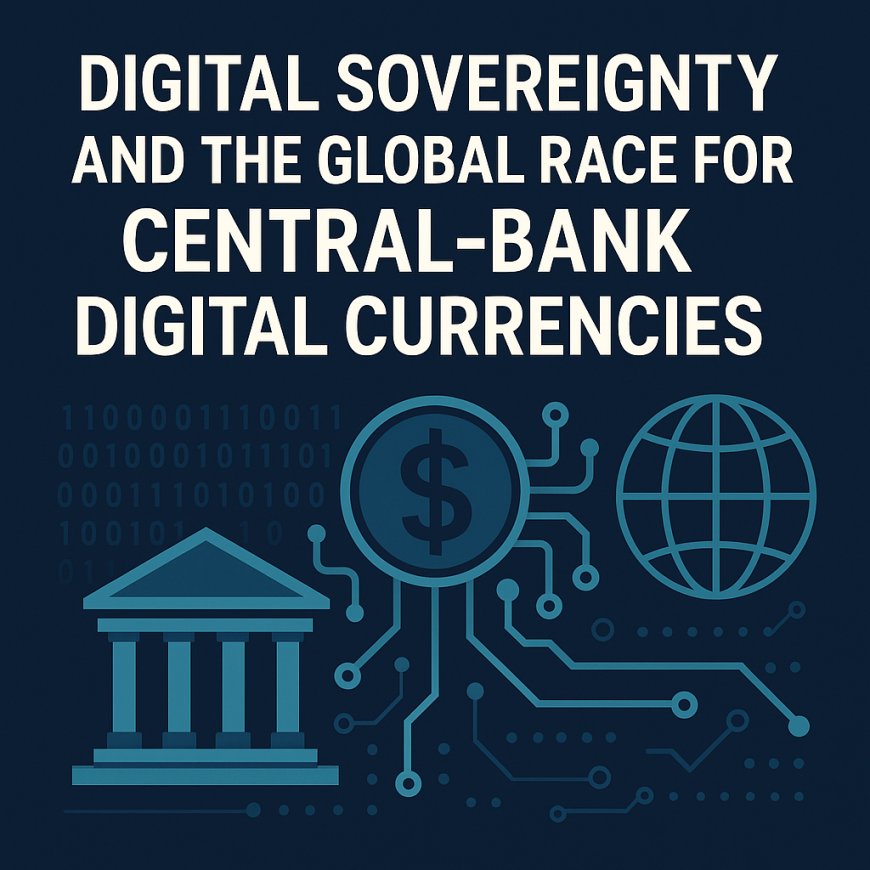
Digital Sovereignty and the Global Race for Central-Bank Digital Currencies
Money is more than a medium of exchange; it’s a lever of sovereignty, control, and geopolitical leverage. And the world’s power centers know it.
As digital platforms swallow commerce, communications, and now financial rails, governments aren’t just watching — they’re scrambling to re-assert control before private players hard-wire the future of money without them. That’s why the global race for central-bank digital currencies (CBDCs) is accelerating in 2025. This isn’t some crypto-Twitter pipe dream. It’s active statecraft.
From Fringe Concept to Global Policy Priority
A decade ago, CBDCs were whiteboard concepts inside BIS and IMF offices. Today, over 130 countries representing roughly 98% of global GDP are developing, piloting, or researching CBDCs.
Source: Atlantic Council CBDC Tracker — https://www.atlanticcouncil.org/cbdctracker/
Only a few nations have officially launched — Bahamas, Jamaica, and Nigeria — but major economies are in deep pilot phases. This is a global infrastructure shift happening in real-time.
The Big Driver: Monetary Sovereignty in a Platform World
States are terrified of two things:
- Big Tech controlling transaction rails (& user identity layers)
- Private dollar-backed stablecoins replacing sovereign currency rails
China saw the risk early and moved first with e-CNY, embedding programmability and end-to-end traceability. Europe is pushing the digital euro. The U.S. has pivoted toward regulated private stablecoins — for now — after political pushback against a “digital dollar.”
EU Digital Euro: https://www.ecb.europa.eu/paym/digital_euro/
U.S. CBDC stance shift coverage: https://www.reuters.com
China’s e-CNY info: https://www.pbc.gov.cn/en
The Cross-Border Battleground
This isn’t just about domestic digital cash — it’s about who controls the global plumbing of money.
The BIS-led mBridge project — linking China, Hong Kong, Thailand, and UAE — already processed real cross-border transactions through a shared ledger.
mBridge: https://www.bis.org/about/bisih/topics/cbdc/mcbdc_bridge.htm
What’s at stake?
- Trade settlement without SWIFT
- Instant currency conversion
- Less reliance on USD correspondent banks
That’s not just efficiency — that’s geopolitical insulation.
Programmable Money — Feature or Control System?
CBDCs are not just digital dollars — they are programmable monetary instruments.
Potential “features”:
- Funds that expire
- Limits on where money can be spent
- Automated tax deduction
- Targeted stimulus
- Precision capital controls
In authoritarian systems, these are tools. In democracies, they're constitutional landmines.
The IMF laid out its development roadmap — the “5P” model:
IMF CBDC Framework: https://www.imf.org/.../central-bank-digital-currency
The Divide: Two Monetary Futures Emerging
What’s forming is a split world:
- Public-domain sovereign digital money (state rails)
- Private tokenized money (stablecoins, tokenized treasuries, fintech rails)
The U.S. is currently leaning toward #2. China is all-in on #1. Europe is trying to build a hybrid.
We are approaching a bifurcated currency system — a digital Bretton Woods moment — where monetary networks matter as much as the currency itself.
The Next Decade: Key Flashpoints to Watch
- Digital euro roll-out + privacy guarantees
- U.S. regulated stablecoin framework & tokenized treasuries
- Scaling of BIS mBridge into production
- BRICS digital currency cooperation
- Capital-control use cases in emerging markets
- Offline CBDC payment technology for crisis readiness
Bottom Line
CBDCs aren’t about convenience. They’re about control, sovereignty, and power in the digital era.
Governments aren’t asking, “Do we need CBDCs?”
They’re asking, “Do we control the rails — or do private platforms do it for us?”
The money layer of the internet is being built right now. The rules are being written in real time. Whoever owns the rails of value will own the future of the global economy.
Sources & Further Reading
- Atlantic Council CBDC Tracker — https://www.atlanticcouncil.org/cbdctracker/
- BIS mBridge — https://www.bis.org/about/bisih/topics/cbdc/mcbdc_bridge.htm
- IMF CBDC 5-Phase Model — https://www.imf.org
আপনার প্রতিক্রিয়া কি?
 পছন্দ করুন
0
পছন্দ করুন
0
 অপছন্দ
0
অপছন্দ
0
 ভালোবাসা
0
ভালোবাসা
0
 মজার
0
মজার
0
 বাহ!
0
বাহ!
0
 দুঃখজনক
0
দুঃখজনক
0
 গোস্বামী
0
গোস্বামী
0
















মন্তব্যসমূহ (0)