Core Reading Path — This Piece Sits on Top of These
If you’re new to the Pattern Nexus worldview, this article builds on these core frameworks:
Article Navigation
When a Dollar Wasn’t a Dollar: America’s Free Banking Chaos
The World Before the Fed: Killing the Monster and Breaking the Brakes
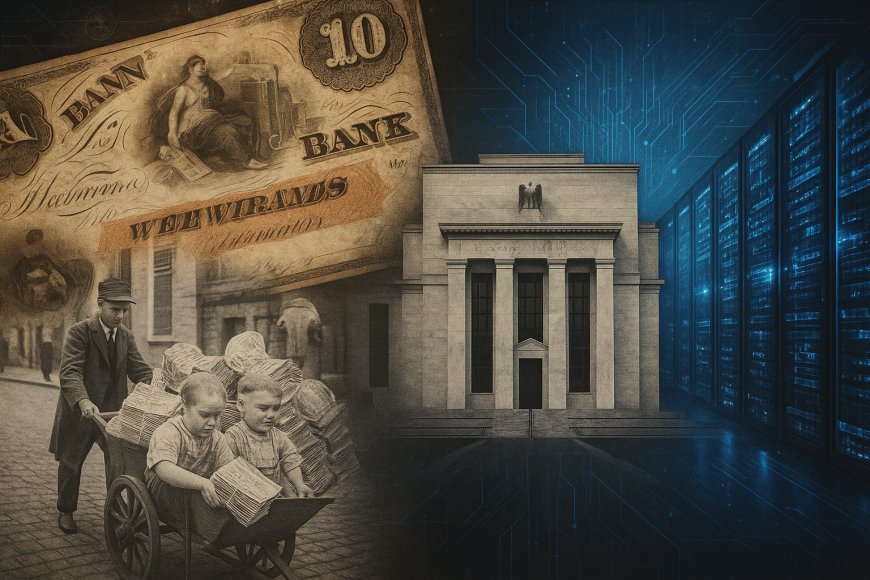
Imagine walking into a general store in 1850s Illinois with a wallet that looks less like “money” and more like a scrapbook. A $5 note from one bank in Michigan, a $2 from an Indiana “State Stock Bank,” a $10 from some Merchants & Planters outfit in Georgia. None of them look alike. None of them are guaranteed to be good. And before the shopkeeper will hand over a sack of flour, he has to pull out a little dog-eared booklet – a banknote detector – and check whether your banks are even still alive, and if so, how much of a haircut he should demand.
That wasn’t some quirky frontier edge case. For roughly three decades, that was the United States. America ran a full-scale, real-world experiment in what happens when you rip out the central brake from the banking system and then let almost anyone create their own brand of cash. That experiment – the free banking era – didn’t come out of nowhere. It was born from an earlier war: Andrew Jackson’s war against the second Bank of the United States.
The Second Bank (often shortened to “BUS” in the history books) was a strange hybrid by today’s standards. It was a private corporation with a federal charter, but it functioned as the closest thing the young republic had to a central bank. It held federal deposits. It managed the government’s payments. Most importantly, it sat on top of the hundreds of state-chartered banks as a kind of regulator by force of balance sheet. It did that with a very simple, very brutal mechanism: it collected state bank notes and regularly marched them back for redemption in gold and silver.
That one act – routinely demanding specie for paper – was the brake. If a local bank got cute and printed too many notes relative to its coin reserves, the BUS would quietly scoop those notes up and slam them back down on the counter. “Pay up.” That forced restraint onto institutions that otherwise had every incentive to lend and print until something broke.
Jackson saw something very different. In his story, the Bank was not a stabilizer – it was “the Monster”: a corrupt, unconstitutional monopoly captured by wealthy Eastern interests and used to tilt credit away from farmers and toward the urban elite. You know this script; it repeats every cycle. A real structural check on the system gets recast as a villain, and a populist coalition rallies to smash it without really knowing what will replace it.
In 1832, when the Bank’s supporters tried to recharter it early, Jackson didn’t just say no – he detonated it. His veto message reads like an early-19th century rant against financial globalization: the rich and powerful bending government to their purposes, the concentration of credit in a few hands, the betrayal of the common man. He ran for re-election on “killing the Monster,” won, and treated that victory as a mandate not just to let the charter expire but to actively pull the keystone out of the arch.
In 1833 he ordered federal deposits removed from the Bank and scattered into a constellation of smaller, politically loyal “pet banks.” The BUS withered. The one institution that had both the scale and the legal authority to yank on the brakes was dismantled. The pet banks, now stuffed with government cash, did exactly what you’d expect any set of human beings with a printing press and no adult supervision to do: they went on a lending and note-issuing spree.
Credit exploded. Land speculation in the West went vertical. Jackson, a hard-money guy who personally hated paper, watched a paper bubble inflate in his own name and panicked. In 1836 he tried to slam on a different kind of brake: the Specie Circular. From then on, federal land had to be bought with gold or silver, not paper.
In system terms, he pulled liquidity out of the one asset class that was floating the whole party. The result was predictable: the land bubble popped, banks that had lent aggressively against paper collateral were crippled, and the Panic of 1837 rolled across the country just as Jackson’s successor, Martin Van Buren, took office. Hundreds of banks failed. Businesses collapsed. A deep, grinding depression followed.
The monster was dead. So were the brakes. What was left was a vacuum.
That vacuum is where the free banking idea came from. Reformers looked at the chaos and argued that the core problem wasn’t banking itself – it was the way banks were born. Under the old “charter” model, you needed a special act from a state legislature to start a bank. That meant lobbying, favors, and outright bribery. Who got to print money was basically decided by who had the best connections.
Free banking was pitched as a clean, almost democratic solution: get the politicians out of the business of handing out charters one by one. Replace that cronyism with a general law. If you could meet a clear set of requirements – mainly posting sufficient collateral – you could start a bank. No begging in state capitals, no special favors, just rules.
On paper, that sounds almost libertarian-utopian: open access, transparent standards, market discipline. In reality, what America built was a fragmented, hyper-local, and constantly glitching monetary operating system – an early version of “anyone can issue a money-like instrument” with no central settlement layer behind it.
The Blueprint: New York’s “Safe” Free Banking and the Frontier Remix
Michigan jumped first in 1837. New York followed in 1838 with a version that became the template for everyone else. At the core of the New York Free Banking Act was a simple collateral rule: if you wanted to print notes, you had to hand the state controller high-quality assets first.
The mechanics looked like this:
You organized a bank and brought the controller a pile of approved collateral – typically New York state bonds, U.S. government bonds, or other “safe” securities.
The controller locked those bonds away and, in return, gave you an equivalent value of beautifully engraved, blank banknotes with your bank’s name on them.
You signed the notes, lent them into the community, and those pieces of paper became spendable money.
If your bank ever failed, the controller was supposed to seize your bonds, sell them, and use the proceeds to make note holders whole.
On the surface, it’s elegant. The system is “free” in entry – anyone who can post collateral can become a banker – but “safe” in theory because there is always something behind the notes. No more political gatekeeping, no more special charters. Just a standing rule: put bonds in, get money out.
New York’s version was conservative enough that, by 19th-century standards, it worked reasonably well. But America is not one state; it’s a patchwork of incentives. Once the basic design existed, every other state rebuilt it in its own image – and that’s when the Wild West really began.
Legislatures in Ohio, Indiana, Illinois, Wisconsin and others all wanted the same thing: growth. Railroads, canals, towns, “development.” They also wanted something else: a market for their own debt. If your state bonds were already trading at a discount – or the market quietly suspected you might default – you had a very strong incentive to sneak those bonds into the system as acceptable collateral anyway.
So the definition of “good collateral” started to slide. Some states allowed banks to post the bonds of any state, including ones that had already defaulted. Others, like Indiana, let banks post mortgages on unimproved land – swamps, forest, barely surveyed acreage somewhere out on the frontier. On paper, it was collateral. In reality, it was often illiquid, hard to value, and nearly impossible to sell in a crisis without taking a huge loss.
Out of that incentive soup came the legendary free-banking parasite: the wildcat bank.
A “normal” free bank at least intended to function as a bank: take deposits, make loans, manage liquidity, survive. A wildcat bank was a print shop with a charter. The business model was brutally simple:
Find the state with the loosest free banking law and the lowest standards for collateral.
Scrape together a pile of marginal bonds or paper – the kind no one else really wanted.
Turn that into a stack of officially engraved banknotes via the controller.
Set up your “bank” in the middle of nowhere – a swamp, a logging camp, a mountaintop – anywhere people were unlikely to show up in person.
Push your notes as far away as possible: lend into another state, sell them at a discount to traders, get them circulating where nobody has time to track you down.
As long as nobody actually showed up at your remote “office” demanding gold or silver, you and your partners were earning real interest on essentially fake money. By the time confidence cracked and someone followed the trail back to your shack in the woods, you were gone. The controller would seize your worthless bonds and sell them for cents on the dollar. Note holders would eat the loss.
This wasn’t a one-off scam – it became an entire genre of banking. At the peak in the 1850s, more than 1,600 banks operated under some form of free banking law, across roughly thirty different state regimes, issuing over 10,000 distinct types of banknotes. The “money supply” was not a single thing. It was a blizzard of private IOUs, each backed by a different pile of collateral, supervised by a different set of local rules, with wildly different probabilities of actually paying out.
From the perspective of a macro system, you can already see the pattern:
Entry is easy – anyone who can satisfy the letter of the law can become a money issuer.
Collateral quality drifts downward as states chase growth and markets for their own debt.
Information asymmetry explodes – nobody can keep track of all the issuers and their health.
Fraud and over-issuance are not bugs; they are natural strategies inside this rule set.
The free banking movement genuinely thought it had solved the political corruption of the old charter system. What it actually did was move the problem down a layer: from “Which friends of the legislature get the charter?” to “Which bonds and mortgages get smuggled into the collateral pool, and who gets stuck holding the bag when it all reprices?”
Living Inside the Blizzard: Discounts, Detectors, and Permanent Negotiation
For historians, the free banking era is an argument about design: were the laws well-crafted, did they work on average, were wildcat banks overblown? For the people who had to live inside it, those debates didn’t matter. What mattered was that a “dollar” was not a dollar. It was a bet.
Take that general store again. You walk up with a $10 note from some Farmers Bank of Indiana. The shopkeeper is in Ohio. To him, that slip of paper is not “ten.” It’s “ten, minus distance risk, minus collateral risk, minus rumor risk.”
Distance mattered because every note had a home bank somewhere, and if push came to shove, someone had to ship that paper back to its origin to redeem it in gold or silver. The further away you were, the higher the costs and the longer the delay. Collateral quality mattered because everyone understood, at least in a fuzzy way, that some states were sound and some were fiscal train wrecks. Rumors mattered because a bank that was fine on Monday could be gone on Tuesday if too many people tried to redeem at once.
Instead of one uniform price level, you had a constantly moving grid of discounts. A $10 note from a solid New England bank might trade at par – worth the full $10 – in Boston and still close to par a few states away. A $10 note from a shaky frontier bank might be worth $9 in its home county, $8 in the next state, and exactly zero in New York because nobody wanted to touch it.
That variability created a meta-industry: the banknote detector. These were small, dense booklets with names like McNeill’s Counterfeit Detector and Bank Note Reporter or Thompson’s Bank Note and Commercial Reporter . They were printed weekly or monthly and sold to merchants, innkeepers, and anyone else who regularly dealt with strangers’ paper.
Each issue listed hundreds of banks across the country, usually in tiny print, with a short status line – “good,” “unsteady,” “doubtful,” “worthless,” “fraudulent” – and the current discount for that bank’s notes in major cities. They also cataloged counterfeits: crude descriptions of differences in engravings, borders, vignettes, signatures. In a world with more than 10,000 note designs circulating, even honest people could barely keep track of what was real. Counterfeiters thrived in the confusion.
So every transaction turned into a negotiation on two layers:
Is this thing even real? If it’s real, what’s it worth here today ?
For consumers, this meant constant low-grade anxiety. Your wallet was not “cash,” it was a portfolio. If bad news about one bank hit town, a chunk of your spending power could vanish overnight. Traveling meant accumulating an entire new stack of local paper or accepting deep discounts on whatever you brought from home.
For merchants, it was pure operational risk layered on top of razor-thin margins. Accept too much sketchy paper and you could be wiped out when the music stopped. Refuse too much and you lost business. Raise prices to compensate and you risked driving customers away – but if you didn’t, inflation and defaults would quietly eat your profits anyway.
For the broader economy, the system was a grinding tax on coordination. Every transaction required extra time, extra information, and extra mental overhead. Capital flowed, but it flowed through a maze of frictions. You can think of it as running an entire national economy on a payment rail that constantly throws error messages – not enough to crash the system outright during good times, but enough to waste a huge amount of energy just on figuring out what money is worth at any given moment.
And yet, people tolerated it. Why? Because the 1840s and 1850s were a boom. Manifest Destiny, the Gold Rush, westward expansion, railroads. The country was exploding outward. The free banking structure – for all its scams and inefficiencies – was elastic . As long as you could post collateral and get notes, you could conjure more purchasing power to fuel land purchases, rail projects, and speculation.
That elasticity was the feature everyone loved and the bug that eventually killed the regime. In good times, it meant the money supply could balloon to meet demand. In bad times, it meant the same leverage inverted. When confidence cracked – as it did in the Panic of 1857 – the entire system’s weakness was exposed in one brutal flash: collateral that looked fine at yesterday’s prices suddenly wasn’t, bonds posted with controllers collapsed in value, and a wave of bank failures spread through the free-banking states. Note holders discovered that the collateral that was supposed to protect them didn’t clear at theoretical values; it cleared at fire-sale prices, and they ate the difference.
By the late 1850s, the intellectual case for a permanently decentralized, private note system was mortally wounded. The country was simply too big, too interconnected, and too dependent on long-distance trade to run on a patchwork of local monies. But the regime didn’t fully die until the Civil War forced the issue. It took an existential crisis to justify the next upgrade: greenbacks, national bank notes, and the quiet welding of “safe” money directly onto the back of the federal government’s bond market.
The Lived Experience of Monetary Chaos in the Free Banking Era
Historians tend to describe the Free Banking Era with sanitized language—“discount rates,” “specie shortages,” “counterparty risk,” “bond collateralization mechanics.” The reality Americans lived through was not technical. It was psychological. It was cultural. It was existential. It was a nation operating without a shared definition of money itself.
For nearly thirty years, Americans didn’t live in a unified monetary system. They lived inside a continuously shifting probabilistic landscape of value . Every transaction was a negotiation. Every payment was a form of due diligence. Every person became their own credit-rating agency.
Money as a Daily Gamble
Imagine being a small merchant in Indiana in 1850. A customer hands you a $10 note issued by the “Farmers & Merchants Bank of LaSalle.” You’ve never heard of it. The bank might exist. It might not. The note might be worth $10. It might be worth $8. Or $2. Or nothing.
You flip open your Thompson’s Bank Note Reporter , a thick reference booklet published weekly, listing every bank in America, every known counterfeit, and the probability that any given note is real. No modern American can fathom a world where “money” required a research tool.
Farmers distrusted distant notes —too risky, too hard to redeem.Travelers preferred gold or silver coins —the only universally trusted form.Urban merchants priced discounts based on mileage —distance literally equaled depreciation.Families often bartered essentials —because paper wasn’t dependable.
This didn’t merely inconvenience commerce. It psychologically conditioned the public into short-termism and opportunistic behavior. When the value of your money changes depending on where you stand, the very concept of a “stable future” collapses.
Counterfeiting and the Collapse of Trust
With over 10,000 distinct designs of banknotes in circulation, counterfeiting became a national epidemic . Many towns had more fake notes than real ones. But even the legitimate ones were dangerous. A perfectly valid note could become worthless overnight if word arrived that the issuing bank had failed, been robbed, or simply disappeared into the frontier.
The result was an economy running on suspicion. Trust—one of the most important social technologies—broke down.
The Cost on Ordinary People
We rarely think about how monetary chaos affects human beings emotionally:
Families hoarded silver coins like survival rations.Farmers distrusted “paper men” and preferred barter.Workers often demanded wages in specie or refused payment altogether.Communities developed micro-currencies —local trust networks more reliable than the banks.
The free banking era wasn’t just an economic experiment. It was a lived social crisis—a long, grinding uncertainty that rewired how Americans understood risk, money, and the future.
How the Free Banking Era Collapsed and Why It Couldn’t Scale
Monetary systems don’t collapse because of ideology. They collapse because of scale mismatches . The free banking era worked when America was a patchwork of isolated frontier communities. It failed the second the country became integrated.
The System Worked Only When America Was Small
Local currency works when economies are local. But between 1840 and 1860, the United States transformed at breakneck speed:
The telegraph connected the entire east and Midwest.
Railroads created a national goods market.
Industrial production centralized in the Northeast.
Western land speculation exploded.
The federal government’s wartime financing needs skyrocketed.
A system built for local autonomy could not survive a shift into national interdependence .
The Civil War: The Crisis That Ended the Old System
The war didn’t just demand soldiers. It demanded cash—massive, immediate, uniform cash. The Union needed:
a currency that worked everywhere,
a predictable credit mechanism,
a way to force banker participation,
a national collateral structure,
and a mechanism to suppress monetary fragmentation.
The free banking system couldn’t fund a modern war. It couldn’t even fund a railroad project without panic. So Salmon P. Chase engineered one of the most brilliant monetary transitions in American history: he replaced thousands of competing currencies with one national note .
The 10% Tax That Killed Private Money
The coup de grâce came in 1865 when Congress passed a law imposing a 10% federal tax on the issuance of any non-national banknote .
This didn’t regulate wildcat banks. It executed them .
If your business model lost 10% every time you printed a note, you stopped printing notes. That one sentence ended nearly thirty years of decentralized currency overnight.
The Aftermath: A Stable Currency with a Fatal Flaw
The new system solved the chaos of free banking but introduced its own fatal weakness: inelasticity . Because national notes had to be backed by U.S. bonds—and the federal government was reducing its debt—the money supply contracted even as the economy expanded.
This created a new pattern of crises:
Panic of 1873
Panic of 1884
Panic of 1890
Panic of 1893
Panic of 1907
Every system solves one problem and creates the next. That pattern is central to the entire article—and to Pattern Nexus itself.
What the Free Banking Era Actually Teaches Us
The Free Banking Era isn’t just a quirky historical footnote. It is a foundational case study in how societies behave when the monetary system loses coherence .
Pattern #1: Information Lag + Decentralization = Chaos
When the value of a banknote depends on news traveling by horseback, decentralization becomes synonymous with fragility. Without instant settlement and instant verification, a fragmented money system collapses.
Pattern #2: When the Economy Scales, the Currency Must Scale With It
Money is a coordination technology . Fragmented systems work only when the underlying economy is also fragmented. Once the U.S. economy became continental, a continental currency became inevitable.
Pattern #3: Every Chaos Cycle Produces a Totalizing Solution
Free banking → chaos.
Pattern #4: Monetary Breakdown Always Rewires Social Psychology
This section is crucial, because it bridges directly into the Weimar Republic—the second major section of the article. Monetary chaos forces societies to:
abandon long-term planning,
hoard real assets,
prefer immediacy over prudence,
distrust institutions,
radicalize politically.
These psychological themes will reappear—in extreme form—in Weimar Germany, and again in the modern era through digital fragmentation, hyper-financialization, and AI-driven liquidity cycles.
From Free Banking to the National Banking Regime: Taming the Chaos, Baking In a New Flaw
Context Bubble: What Actually Ended Free Banking?
Free banking didn’t end because a committee of economists proved it was inefficient. It ended because the Civil War forced the United States to pick between a thousand local monies and a single scalable war-finance machine.
By the late 1850s, the free banking experiment was already limping. The Panic of 1857 had exposed the core weakness of the system: when asset prices fell and confidence cracked, all those “safe” state bonds and land mortgages posted as collateral suddenly weren’t safe anymore. Liquidation values collapsed. Noteholders discovered the fine print the hard way: “backed by collateral” didn’t mean “you get par back in a crisis.” It meant “you get whatever the collateral fetches in a fire sale.”
Still, the system persisted. States patched their laws. Some tightened collateral rules. Others tried to standardize bank supervision. But the fundamental structure didn’t change:
Thousands of banks.
Dozens of regulatory regimes.
Tens of thousands of note designs.
No central liquidity backstop.
That architecture might have limped along for decades if the United States hadn’t torn itself apart in 1861. The Civil War converted a messy but tolerable system into an existential liability.
War Finance Snapshot
The Union suddenly needed to:
Pay hundreds of thousands of soldiers regularly.
Procure weapons, ships, rails, food, and supplies at national scale.
Borrow unimaginable sums (for that era) from domestic markets.
Project creditworthiness to foreign creditors and allies.
You can’t do that with a blizzard of wildcat notes and state currencies. You need a single, believable monetary spine.
Chase’s Design: One System to Replace Them All
Salmon P. Chase, Lincoln’s Treasury Secretary, looked at the chaos and saw an opportunity to solve three problems with one structure:
Finance the war. Create a uniform national currency. Kill the free banking model without openly declaring war on the states.
The National Banking Acts of 1863 and 1864 were his answer.
Mechanics Bubble: How a National Bank Worked
A group of investors applied for a national bank charter from Washington instead of from a state legislature.
To receive that charter, they had to buy U.S. government bonds and deposit them with the Comptroller of the Currency.
In return, they got the right to receive and issue national bank notes up to a percentage of those bond holdings.
The notes had a uniform Federal design ; the only difference was the bank’s name and charter number.
Result: every $10 note looked and functioned the same from Maine to California—and every one of them was backed by the same collateral: U.S. Treasury debt .
For ordinary people, this was a revolution. Overnight, the “is this note real?” problem got radically simpler. If it said “National Bank” and bore the proper federal marks, it cleared everywhere at par. The banknote reporters and counterfeit detectors that had once been essential suddenly looked like artifacts of a primitive world.
The 10% Tax: A Silent Execution
Chase still had a final problem: state banks that refused to join the new regime. Many liked their lax state rules. Many didn’t want federal oversight. So in 1865, Congress deployed one of the most surgical weapons in financial history: a 10% federal tax on the face value of any note issued by a state bank .
Kill Switch Bubble
This wasn’t a tax on profits. It was a tax on existence. If you issued $100,000 of state banknotes, you owed $10,000 to the federal government. Issue enough, and you died.
Faced with this, most state banks did the math and surrendered. They converted to national charters, bought federal bonds, and joined the new system. The rest were driven out of the note-issuing business. The free banking regime, born of Andrew Jackson’s hatred for a central bank, had just been quietly euthanized by bond math and tax law.
Pattern Nexus Note
File this under a recurring pattern you’ll see again in the modern era: the state rarely has to “ban” alternative monies outright . It can simply make them uneconomic while quietly steering everyone toward a new standard. Future CBDC and stablecoin conflicts will not be fought just in courtrooms, but in basis points and tax code .
The New System’s Hidden Bug: Inelasticity
The National Banking System fixed the free banking chaos, but it encoded a new structural flaw: the money supply became tightly linked to the stock of U.S. government bonds.
National banks could issue notes only up to a limit tied to their bond holdings. That meant:
If the economy grew faster than the supply of bonds, money got tight .
If the government paid down debt, the total universe of admissible collateral shrank.
Expanding the currency often required the Treasury to borrow more , even when it didn’t need the cash.
The old regime had been too elastic . The new one was too rigid . In system terms, we had replaced “many small unstable issuers” with “one large inflexible backbone.”
Pyramiding, Seasonal Strain, and the Chain Reaction of Panics
Context Bubble: Why Panics Kept Coming
After the Civil War, the United States had:
A uniform currency.
A rapidly growing industrial economy.
A banking system that stacked reserves like a Jenga tower.
The setup looked “modern” on the surface—and catastrophically fragile underneath.
The Reserve Pyramid
Under the National Banking Acts, banks didn’t have to hold all of their legal reserves in their own vaults. Country banks in rural areas could keep a large share of their reserves on deposit with bigger “reserve city” banks in regional hubs (Chicago, St. Louis, etc.).
Those reserve city banks, in turn, were allowed to hold much of their reserves on deposit with a handful of “central reserve city” banks, concentrated in New York.
Reserve Pyramid Bubble
Country banks → deposit reserves with → Reserve city banks → deposit reserves with → Central reserve banks (New York) .
One dollar of actual cash in New York might support many dollars of deposits and loans built on top of it across the country.
New York banks, sitting on this aggregated mountain of “reserves,” did what banks always do: they tried to make it earn. They lent heavily into the call money market, financing stock speculation with call loans —short-term, high-interest loans payable on demand.
As long as nobody asked for their reserves back, the machine hummed. Money seemed plentiful. Interest rates stayed relatively low. Wall Street soared. But the structure contained a ticking seasonal bomb.
The Autumn Squeeze
Every autumn, farmers needed large volumes of currency to pay for harvest labor, transport, and basic settlement. Local country banks had to meet that demand by obtaining physical cash.
Harvest Season Flow
Farmers demand cash → country banks need currency.
Country banks call reserves back from reserve city banks.
Reserve city banks call reserves back from New York.
New York banks must recall call loans from stock speculators.
Speculators sell stock en masse to repay loans → markets crash.
This predictable seasonal pattern—known for years—still repeatedly triggered full-blown financial panics because there was no institution with both the authority and the political mandate to act as a lender of last resort . Nobody could stand at the top of the pyramid and say, “We will provide emergency reserves to stop the cascade.”
System Design Flaw
The National Banking System created:
A pyramided reserve structure that concentrated risk in a few New York institutions.
An inelastic currency tied to the level of U.S. bonds outstanding.
Heavy reliance on volatile call loan markets tied to stock speculation.
All of that in an economy that was rapidly industrializing, urbanizing, and globalizing.
The Panics: 1873, 1893, 1907
This design produced a series of major crises:
Panic of 1873 – Triggered by the failure of Jay Cooke & Co., heavily exposed to railroad bonds.Panic of 1893 – Massive overbuilding of railroads, silver controversies, collapsing confidence.Panic of 1907 – A failed corner in copper stocks and a run on trust companies spiraled into a full-scale liquidity crisis.
Each panic followed a similar script:
A shock hits a leveraged segment (railroads, trusts, stocks).
Investors dump assets to raise cash; collateral values fall.
Banks and trust companies face withdrawals and can’t liquefy assets fast enough.
Rumors spread; depositors panic; runs cascade through the system.
With no central bank, clearinghouses and private financiers try to act as ad hoc stabilizers.
J.P. Morgan: The Prototype Central Banker
During the Panic of 1907, it was not a government institution that saved the banking system. It was a private syndicate led by J.P. Morgan . He literally locked top bankers in his library, forced them to open their books, and strong-armed them into backstopping weak institutions.
For a few weeks, one man functioned as an unofficial central bank. That solved the immediate crisis—and terrified the political class.
The lesson was brutal: the U.S. had become too large and too interconnected to rely on private coordination and moral suasion in moments of systemic stress. A single financier acting as “dictator of credit” was politically unacceptable. But doing nothing was economically suicidal.
From Jekyll Island to the Federal Reserve: Recreating the Monster
Context Bubble: The Question After 1907
After the Panic of 1907, the question in Washington wasn’t “Do we need a central bank?” It was: “What kind of central bank can we create that won’t look like the Monster Jackson killed?”
The Aldrich Commission and the Secret Draft
In 1908, Congress created the National Monetary Commission, chaired by Senator Nelson Aldrich, to study European central banks and design a reform for the U.S. financial system. The conclusion was inevitable: some form of central reserve institution was necessary.
In 1910, Aldrich and a small group of bankers and financiers met in secret on Jekyll Island, off the coast of Georgia, to hammer out the blueprint. The secrecy wasn’t theatrical; it was political. Any plan seen as “Wall Street’s power grab” would be dead on arrival.
Design Bubble: What the New System Needed to Do
Provide elastic currency – the ability to expand and contract the supply as needed.Rediscount commercial paper – turn banks’ short-term business loans into liquid reserves.Act as lender of last resort – supply emergency liquidity to solvent but illiquid banks.Decentralize enough to satisfy anti-“Monster” sentiment – avoid a single monolithic central bank in New York.
The Federal Reserve Act of 1913: Compromise in Institutional Form
The Federal Reserve Act, passed in 1913, was a political and structural compromise. It tried to split the difference between:
European-style centralized central banks (like the Bank of England), and
American suspicion of concentrated financial power.
The result was a federated system :
12 regional Federal Reserve Banks , each serving a district.A Board of Governors in Washington to provide national policy coordination.
The authority to issue Federal Reserve Notes , ultimately replacing national banknotes.
The power to rediscount eligible commercial paper, creating elastic reserves.
Key Transition
With the Fed in place, the U.S. financial system shifted from:
Reserves pyramided in private New York banks → reserves centralized at Federal Reserve Banks.
Currency tied directly to the stock of U.S. bonds → currency tied to Fed assets and policy.
No formal lender of last resort → an explicit institutional backstop.
In other words, after eighty years of trying to live without a “Monster,” the United States re-created one. This time, it wore a different costume: regional boards, public–private ownership, and a statutory mandate. But functionally, it restored the thing Jackson had smashed—the ability of a single coordinated institution to regulate the supply of money and credit for the entire nation.
Pattern Nexus Lens: The Full Arc of Section I
If you zoom out on everything we’ve covered so far, the pattern is stark:
Centralized brake (Second Bank) – restrains state banks via specie redemption.Populist backlash (Jackson) – kills the Monster; unleashes free banking chaos.Free Banking Era – decentralized issuance, counterfeit explosion, wildcat scams.National Banking Era – bond-backed uniform notes, reserve pyramiding, inelastic money.Serial panics – 1873, 1893, 1907 expose systemic fragility.Federal Reserve – re-centralization of liquidity and currency control.
Each regime is a reaction to the failures of the last. None of them are “final.” They’re iterations in a long-running experiment: How do you build a monetary system that can scale with an expanding economic and political order without tearing itself apart?
At this point, America has:
a central bank,
a national currency,
a growing industrial and financial system.
In Germany, at roughly the same time, a different arc is unfolding—one where the central bank itself becomes the engine of destruction. The next section dives into the Weimar Republic, not as a meme about “money printing gone wrong,” but as a lived, granular breakdown of what happens when a modern state uses its central bank to vaporize the middle class in real time.
Article Navigation
The Birth of a Doomed Republic
Context Bubble: The “Impossible Republic”
Weimar Germany was a nation born with a terminal diagnosis. It entered life in 1919 with:
No gold reserves (spent during WWI).No territorial integrity (lost industrial regions via Versailles).No political cohesion (monarchists, communists, militarists all split).132 billion gold marks in reparations — a bill engineered to be unpayable.
This wasn’t “hyperinflation waiting to happen.” It was hyperinflation built into the DNA of the state from the first day .
The Treaty of Versailles didn’t simply “end a war.” It created the economic pre-conditions for total financial collapse . Germany lost land, coal, steel, shipping, and the crucial tax base needed to rebuild. And to make matters worse, the Weimar government inherited a central bank that had already been commandeered during the war.
While the U.S. free banking system collapsed because there was no central authority to stabilize it, Germany’s collapse happened because the central authority was:
Weimar’s Structural Fatality
Legally obligated to monetize government deficits.
No independence. No restraint. No institutional “brake.”
This is the exact opposite failure mode of the American 19th century — and it sets the stage for a disastrous, textbook example of what happens when a central bank is turned into an instrument of fiscal survival rather than monetary stability.
Rudolph Havenstein: The Tragic Architect of a Monetary Collapse
Character Bubble: Rudolph Havenstein
President of the Reichsbank. Brilliant imperial-era banker. Duty-bound bureaucrat. Not an economist in the modern sense.
Havenstein is often portrayed as a villain. But that’s bad history. He wasn’t a fool, a madman, or a caricature of reckless money printing. He was a disciplined, loyal servant of the German state who believed — with religious conviction — that the central bank existed to support the government, not restrain it .
During WWI, the Reichsbank had printed marks to buy war bonds. After the war, those bonds were worthless — but the currency that had been emitted to buy them was very real. Inflation had already begun before the Weimar Republic even existed.
The Conveyor Belt of Destruction
Weimar’s Fatal Mechanism
Government issues a Treasury bill.
Reichsbank is required to buy it at face value.
Reichsbank prints new marks to pay for it.
The marks enter circulation and dilute existing currency.
No veto. No independence. No limit.
Havenstein didn’t “choose” hyperinflation. He was trapped in a machine that guaranteed it.
And when the French invaded the Ruhr in 1923 and the government launched a massive general strike — promising to pay millions of striking workers — Havenstein became the logistical heart of a national catastrophe.
The Central Bank’s Hell Mission
Pay millions of people wages for not working while industrial output falls to zero.
That is mathematically impossible… unless you print money at a speed the world has never seen.
The Human Spiral: When Money Loses Its Meaning
Human Behavior Bubble: Velocity Insanity
Weimar hyperinflation is not just “prices went up.” It is “time became the enemy.”
As the mark collapsed, ordinary Germans experienced a new kind of panic — the Flucht in die Sachwerte , the “flight into real assets.” Every rational person realized:
If you hold paper for more than an hour, you are poorer than before.
This triggered a feedback loop more powerful than the printing press itself:
Feedback Loop
You receive wages.
You spend them instantly.
The shopkeeper spends them instantly.
Prices rise faster than printing presses can keep up.
This wasn’t “inflation.” This was the collapse of the time-value of money .
Life in a Collapsing Monetary System
Wages were paid twice a day.
Wives waited outside factories to sprint to markets.
Prices doubled in an afternoon.
Shoppers weighed banknotes rather than counting them.
Farmers refused to ship food to the cities.
Children made kites out of banknotes.
Families burned money for heat — it was cheaper than firewood.
The entire concept of “saving” died. And with it died the German middle class — the very backbone of civil society.
Pattern Nexus Insight: When Monetary Trust Breaks, Society Radicalizes
This is the psychological pattern that connects:
Free Banking distrust → chaotic opportunism
Weimar distrust → political extremism
Modern distrust → populism + financial nihilism
Monetary instability doesn’t just rearrange wealth. It rewrites the social contract .
The Final Stage: When Numbers Become Meaningless
The Abyss Bubble: The Trillion-Mark Moment
By November 1923:
$1 = 4.2 trillion marks
Printing presses ran 24/7
Notes had to be printed on only one side to save time
Currency was shipped with armed guards directly to banks
Havenstein, exhausted, still believed the problem was not enough currency supply. He blamed “currency shortages” for rising prices — not realizing prices were rising because people no longer believed in the currency at all .
In this stage, the mark stopped being:
a store of value
a unit of account
even a functional medium of exchange
Barter took over:
A bag of potatoes for a piano lesson.
A lump of coal for a theater ticket.
A bushel of wheat for a winter coat.
The Reichsbank had not just failed. It had annihilated the concept of money itself.
The Bank That Died With Its Banker
On November 20th, 1923, Rudolph Havenstein died of a heart attack. His death symbolized the end of the institution he had commanded. The Reichsbank was a corpse walking — and Germany needed a miracle.
That miracle — the Rentenmark — will be Section 2.5.
The Rentenmark: The Miracle Currency That Wasn’t Actually Money
Context Bubble: Germany Hit Absolute Bottom
By late 1923, the mark was dead. Havenstein was dead. Savings were dead. The middle class was dead. Commerce was dead. But political collapse was not inevitable — because a currency can die and a society can still be saved if a new coordinating mechanism replaces it instantly.
Enter Dr. Hjalmar Schacht . A ruthless, brilliant, and politically flexible monetary surgeon. He understood something Havenstein didn’t:
Hyperinflation is not a problem of printing. It is a problem of belief.
You cannot “fix” a hyperinflated currency. You have to replace it with something people will trust instantly .
The Rentenmark Was Not Backed by Gold — and That’s the Genius
The new currency, the Rentenmark , introduced in November 1923, was backed not by gold — because Germany had none — but by a pledge on industrial and agricultural land .
Backing Structure Bubble
3.2 billion Rentenmarks were backed by:
Mortgages on factories
Mortgages on farmland
Mortgages on railroads
Mortgages on commercial buildings
This wasn’t redeemable currency — it was confidence theater .
What Schacht understood is what modern central bankers still forget:
Pattern Nexus Insight
Money works because people believe the issuing authority will maintain its scarcity. A currency’s anchor is political credibility, not metallic content.
The Real Fix: Absolute Monetary Brutality
Schacht implemented three simultaneous shocks:
Total halt of money printing. Zero monetization of government spending. Forced fiscal consolidation.
He didn’t ask permission. He didn’t seek consensus. He imposed a currency dictatorship — exactly what the moment required.
Shock Therapy Bubble
All existing marks were frozen.
Hyperinflation did not “slow down.” It didn’t “stabilize gradually.” It stopped overnight .
The Psychological Reset: How Schacht Rebuilt Belief Overnight
Human Behavior Bubble: Belief Before Mechanics
Germans did not trust the Rentenmark because it was backed by land. They trusted it because: Schacht convinced them he would rather destroy the government than print one more note.
The Rentenmark succeeded because it changed behavior instantly:
Shops reopened within days.
Farmers brought food back to the cities.
Workers demanded wages in the new unit.
Companies resumed long-term planning.
Foreign lenders treated Germany as salvageable.
This was not because of economics — it was because of collective relief . The German psyche had been battered by years of chaos, and suddenly a hard line had been drawn.
The Rentenmark Worked Because the Mark Was Buried
You cannot stabilize a currency until you destroy the old one’s memory.
Schacht engineered a symbolic break:
Old marks became “Reichsbank liabilities.”
New marks became “Rentenbank liabilities.”
The institutions were legally distinct.
The public perception was simple:
The bad bank is dead. The new one is honest.
That’s all a monetary system needs. Trust beats mechanics. Narrative beats balance sheets.
The Political Fallout: When the Middle Class Dies, Extremism Thrives
Warning Bubble: The Monetary Roots of Radicalism
Weimar hyperinflation didn’t directly create Nazism. But it did something far more dangerous: It destroyed the social class that anchors democratic stability.
The wealthy survived — they owned land, factories, foreign assets. The poor survived — they lived hand-to-mouth already. The group that evaporated was the **professional middle class**:
small business owners
civil servants
doctors, teachers, lawyers
engineers and clerks
shopkeepers and tradesmen
When these people lost everything, something inside the national psyche snapped.
Pattern Nexus Connection
Monetary disruption creates political radicalization.
By 1924, even though the Rentenmark stabilized prices, the people had not stabilized emotionally. Financial trauma lingers. A generation that watched its savings vaporize does not return to normal political behavior.
This is why extremist groups — which had been marginal in 1919–1920 — suddenly surged in membership during 1923–1924.
Trauma as Fuel
Hyperinflation taught ordinary Germans:
Institutions cannot be trusted.
The government will sacrifice you to survive.
Money is an illusion created by elites.
Only strong leaders can restore order.
These beliefs didn’t die with the Rentenmark. They metastasized — and by 1930, they exploded.
The Weimar Pattern and the Modern World: The True Lesson
Pattern Nexus Master Insight
Weimar is not a warning about “printing money.” It is a warning about destroying monetary trust .
Hyperinflation happens when a government attempts to:
fund itself outside taxation,
override its central bank’s constraints,
borrow from its own monetary base.
But the modern era (2020s–2030s) has a new set of tools:
The Modern Toolkit
QE and QT cycles
reverse repo facilities
tokenized Treasuries
AI-driven liquidity routing
stablecoin settlement layers
CBDC rails
Unlike Weimar, modern monetary systems can expand liquidity without annihilating the currency, because they do so via collateralized balance sheet operations , not fiscal monetization.
Critical Contrast Bubble
Weimar printed to fund spending. The U.S. prints to manage collateral and liquidity.
The Deeper Lesson
Society collapses when people lose faith in:
the future,
their savings,
their institutions,
their leaders.
That is why Weimar is a psychological chapter more than an economic one.
With Weimar understood — not as a meme, but as a catastrophic failure of monetary trust — we now move into the third era: the modern liquidity regime, the AI–Treasury–stablecoin nexus, and the next transformation of global money.
Article Navigation
SECTION III — The Modern Liquidity Era: How AI, QE, Digital Rails, and Treasury Mechanics Rewired Global Money
If Section I showed how too little coordination collapses a system, and Section II showed how too much political control collapses a system, Section III shows the new architecture humanity is building in real time: a computational, collateral-driven, AI-reinforced liquidity regime that is designed to avoid both historic failures — but will create entirely new ones.
Why the Modern U.S. Dollar System Cannot Replicate Weimar (and Why People Keep Getting This Wrong)
Myth-Busting Bubble
The most common error in public financial debate is comparing QE to Weimar printing. These systems are not just different — they are opposites.
Weimar’s monetary structure collapsed because:
the central bank was forced to monetize spending ,
the government had no viable tax base,
the state had no foreign reserves,
there was no independent institutional check,
production collapsed due to political strikes and war debt.
The modern U.S. system:
does not monetize spending directly
expands reserves based on collateral operations
anchors global trade and capital flows
operates the deepest debt and repo markets in human history
maintains a dominant role in global risk management
Critical Contrast Bubble
Weimar printed money to cover deficits. The Federal Reserve creates reserves against assets.
The Core Difference: Collateral vs Currency
The U.S. system is collateral-driven. Weimar was currency-driven.
Modern Liquidity Loop
Treasury issues bonds → markets absorb them → Fed manages reserves
QE shifts collateral ownership → expands bank reserves
QT reduces reserves → restores collateral to private markets
Reverse Repo Facility balances excess liquidity
Money market funds stabilize the short end
This is not printing. This is balance sheet plumbing .
Pattern Nexus Insight
The Weimar system collapsed because velocity exploded. The modern system risks collapse because velocity is dead .
Instead of hyperinflation, the modern world battles declining velocity, structural disinflationary forces, and a liquidity regime that must be continuously re-engineered to prevent stagnation — and prevent sudden deflationary shockwaves.
The Evolution of QE: From Crisis Tool to Structural Backbone
Context Bubble: QE Is Not Money Printing
QE is not “putting money into the economy.” QE is changing who holds the collateral that underwrites the money system .
After 2008, QE emerged not as an experiment, but as a structural necessity. The global financial system was too large, too interconnected, and too leveraged for the pre-2008 liquidity framework to survive.
The Mechanism
During QE:
The Fed buys Treasuries and MBS from banks.
It pays for them by marking up reserve balances digitally.
Reserves stay inside the banking system — they do not go to consumers.
QE Flow Bubble
QE → increases reserves → lowers yields → raises collateral prices → staves off crisis.
This stabilizes asset markets, preventing deflationary spirals. That is the opposite of Weimar.
Why QE Became Permanent
Modern system dependencies:
endless Treasury supply
global demand for safe dollar assets
massive repo financing chains
derivatives exposure exceeding $200T notional
These require deep collateral markets, stable yields, and a lender of last resort that can instantly liquefy the entire system.
Pattern Nexus Insight
QE is not a tool anymore. It is the monetary operating system .
The Rise of Digital Settlement: Stablecoins, Tokenized Treasuries, and the Coming Dollar Superstructure
Warning Bubble: This Is the Biggest Shift Since Bretton Woods
The world is moving toward digital dollar rails faster than any policy institution is prepared to admit.
Stablecoins started as a fringe crypto experiment. By 2023–2024 they had quietly become one of the largest payment rails on earth, settling on the order of $10–$11 trillion in value annually and already rivaling or surpassing the combined volumes of the biggest card networks on some measures. At the same time, the market for tokenized U.S. Treasuries has exploded from well under $2 billion in 2024 to more than $7 billion in 2025, growing several hundred percent year-over-year as institutions discover that “risk-free yield” can now live directly on digital rails.
Today they:
settle more value monthly than Venmo + PayPal + Stripe combined
bridge dollar liquidity into unstable economies
anchor financial stability in emerging markets
create synthetic dollar markets outside U.S. jurisdiction
The Tokenized Treasury Revolution
Tokenized Treasuries Bubble
Treasuries held as:
ERC-20 tokens
Solana SPL assets
permissioned blockchain units
wrapped collateral objects for institutional rails
These instruments allow instant settlement, 24/7 trading, and programmable collateral.
This is the foundation of the next monetary system: a programmable dollar backed by real-time collateral rails.
Why This Matters
Tokenized Treasuries + stablecoins + Fed liquidity = the digitally collateralized superstructure that will replace eurodollars, correspondent banks, and slow cross-border payment systems.
Pattern Nexus Insight
The U.S. is not losing monetary dominance — it is exporting it through the most powerful mechanism ever created: open-access dollar APIs .
From a Pattern Nexus macro-lens, this shift is not optional. It is the inevitable next stage of the global liquidity stack.
With QE established as the new operating system and digital rails forming a new monetary skeleton, we now turn to the force that will accelerate the next transformation: AI-driven liquidity systems and the coming AI–Treasury–energy nexus.
The Rise of AI-Driven Liquidity Systems: When Monetary Policy Becomes Computational
Warning Bubble: A New Monetary Operator Has Entered the Chat
For the first time in human history, the liquidity system is becoming machine-mediated .
AI is not just transforming search engines and creative tools. It is plugging itself into:
global bond markets
FX liquidity pools
collateral optimization engines
repo and reverse-repo markets
intraday settlement networks
derivative margin systems
This is not optional — the system has grown too large for humans to manage manually. Derivatives exposure alone exceeds $200 trillion notional globally. The plumbing requires computational reflexes far beyond human capability.
Pattern Nexus Insight
The modern liquidity regime is becoming reflexive . AI watches the system, interprets the system, and reacts to the system faster than any human can.
The First Stage: Algorithmic Market Stabilization
Large banks and funds already deploy AI systems for:
automated treasury trading
dynamic hedging
real-time inventory management
bond/FX cross-curve arbitrage
But the next stage is dramatically more powerful:
AI Liquidity Routing Bubble
AI systems will determine where collateral flows, how much liquidity sits in RRP vs bank reserves, and how the system reprices risk in real time.
This replaces the static, model-based worldview of 1990–2020 with a networked, continuously adaptive monetary neural net .
The AI–Power Nexus: Why Compute Demand Is Now a Monetary Force
Context Bubble: The Hidden Link Nobody in Traditional Finance Talks About
AI compute clusters are hitting power grids so hard that electricity is becoming a macroeconomic constraint for the first time since the 1970s.
In 2024–2025, estimates for AI-driven power demand went from “interesting footnote” to “macro constraint.” U.S. AI data centers are currently pulling on the order of 4–5 gigawatts of load and are projected by major utilities, research groups, and consultancies to exceed 50–120 gigawatts by the early-to-mid 2030s if current buildout trajectories hold — a 10–30× jump that forces the grid, regulators, and capital allocators to treat compute as a first-class energy consumer alongside steel, chemicals, and heavy industry.
Between 2024 and 2030, projected U.S. AI data center capacity is set to rise:
AI Buildout Bubble
10× more space than pre-2024 levels30–50 GW additional load requirementsSMR (small modular reactor) integrationdozens of hyperscaler campuses per year
This means the monetary system must adjust to a new reality:
Power Constraint Bubble
Liquidity → compute → energy → liquidity is now a feedback loop.
AI cannot scale without:
grid stability
excess generation
financing pipelines
perpetual reinvestment cycles
This makes energy not just an industrial input — but a monetary input .
Why the Federal Reserve Now Indirectly Manages Power Demand
Monetary → Energy Link
1. Lower rates → cheaper hyperscaler financing. 2. More financing → more clusters built. 3. More clusters → higher power demand. 4. Higher power demand → new grid/energy investment. 5. New investment → Treasury issuance and credit expansion.
This is the emerging **AI-Industrial Flywheel** you've described repeatedly on Pattern Nexus.
Pattern Nexus Insight
Power scarcity becomes capital scarcity. Capital scarcity becomes compute scarcity. Compute scarcity becomes AI scarcity. This is a triangular monetary constraint .
The Digital Dollar Superstructure: The U.S. is Building the Successor to Bretton Woods
Warning Bubble: The Eurodollar System Is Dying
The offshore dollar (“eurodollar”) markets that dominated the last 60 years are being replaced by something more powerful: Global digital-dollar rails .
Eurodollars were:
slow
opaque
fragmented
largely unregulated
dependent on correspondent banking chains
Digital dollars are:
instant-settling
programmable
transparent
collateral-integrated
globally accessible
Digital Dollar Stack
Stablecoins (USDC, USDT, PayPal USD)
Tokenized Treasuries (OUSG, BUIDL, USDY, HONEY)
CBDC corridors (FedNow → global integration layers)
Bank APIs + programmable settlement
Why This Is the Most Powerful Monetary Expansion in Human History
The U.S. is exporting synthetic dollars without exporting U.S. inflation.
Emerging markets are abandoning their own currencies voluntarily. They are choosing stablecoins because local governments cannot be trusted.
It is not Weimar. It is not BRICS rising. It is:
The Dollarization of the Planet
without a single treaty, shot fired, or official statement.
The AI–Industrial Flywheel: The New Monetary Engine of the United States
Context Bubble: America Is Building the Next Great Industrial Base
The AI buildout is the largest industrial expansion since WWII. It requires:
capital
energy
semiconductors
infrastructure
regulatory frameworks
And for the first time, monetary policy is a direct input into a nation’s industrial trajectory.
Why This Is a Monetary Revolution
Historically:
Money influenced credit.
Credit influenced investment.
Investment influenced production.
Now:
Liquidity → compute → intelligence → productivity → global power → liquidity.
AI is a liquidity multiplier . The more liquidity → the more clusters → the more compute → the more intelligence → the more strategic leverage → the more global capital flows into the U.S.
Pattern Nexus Master Insight
The U.S. is entering the first era where intelligence infrastructure becomes a monetary asset class.
Why This Ends All “Dollar Collapse” Narratives
Nations do not abandon reserve currencies that:
control global compute networks
control global energy grids for AI
control the Treasury collateral stack
control the digital rails for settlement
Dollar Superiority Bubble
As long as the U.S. dominates AI → compute → energy → collateral, the dollar is undefeatable.
Bridge to Section IV
With the Free Banking chaos, Weimar collapse, and modern AI–liquidity superstructure understood, we now move to the final section: What comes next — the future monetary scenarios for the U.S. and the world.
SECTION IV — The Road Ahead: Monetary Futures in the Age of AI, Energy Constraints, and Global Realignment
Pattern Nexus Meta-Frame
Every monetary era collapses for the same reason: the structure no longer fits the scale of the civilization it belongs to. money is becoming computational — backed not just by gold, credit, or policy, but by intelligence, energy, and data.
This section explores the next 25 years through the same pattern-analysis lens that defines our work: systems, cycles, energy flows, liquidity flows, and feedback loops.
The Rise of the AI Sovereign: Intelligence as Monetary Power
Warning Bubble: Nations Without AI Will Be Economically Non-Functional
By 2030, the gap between nations with supercluster-level compute and nations without it will be wider than the Industrial Revolution gap.
Historically, monetary power was determined by:
land ownership (feudal era)
gold reserves (metallic era)
industrial output (industrial era)
financial leverage + oil (20th century)
dollar collateral + global trade (1980–2020)
But from 2025 onward, something unprecedented emerges:
Compute as Sovereignty
The nation with the largest and smartest AI systems will dictate capital flows, security guarantees, technological norms, and currency usage.
The U.S. Advantage
largest capital markets in human history
globalized demand for U.S. Treasury collateral
dominance in AI models, clusters, and training data
world’s deepest commodity derivatives markets
nuclear + SMR pivot for AI energy needs
dollar-denominated stablecoin explosion worldwide
All of these reinforce one another.
Pattern Nexus Insight
AI sovereignty → monetary sovereignty → geopolitical sovereignty are collapsing into a single system.
Energy as Collateral: Powering the Next Monetary Order
Context Bubble
Energy is no longer just an industrial input. It is becoming the collateral base for the future monetary system.
The U.S. leads in:
SMR (Small Modular Reactor) development
grid expansion investment
DOE LPO mega-loans
data center–nuclear pairings
AI-driven load balancing
This restores a dynamic that humans haven’t seen since Bretton Woods:
Energy → Monetary Stability Loop
Energy abundance stabilizes compute.
The Dollar’s New Backing (2025–2040)
Unofficially, the dollar becomes backed by:
AI compute capacity
U.S. energy production
Power grid resilience
Global demand for digital dollars
U.S. Treasury collateral and tokenized debt
The Return of a “Semi-Commodity” Dollar
Not gold-backed. Not oil-backed. Energy-backed in a structural, systemic sense.
The Tokenized Reserve Era: Treasuries Become Global Money
This is arguably the most important macro-shift since 1944.
Digital Treasuries = The New World Reserve Currency
Tokenized Treasuries become the world’s savings account.
Between 2024 and 2025, tokenized U.S. debt on-chain grew by:
On-chain Treasury Explosion
1,000%+ growth in under 18 months
By 2030, this becomes:
a global reserve layer
a risk-free programmable yield asset
a settlement instrument for emerging markets
collateral for AI agents interacting autonomously
The New Bretton Woods — Without the Meeting
Pattern Nexus Insight
The U.S. is re-architecting the global monetary order through technology, not treaties.
Avoiding Collapse: Why the U.S. Won’t Go the Way of Weimar
The Mainstream Fear Narrative Is Wrong
Hyperinflation requires the destruction of productive capacity, loss of monetary sovereignty, and collapse of trust.
The U.S. has none of these conditions.
Why Weimar ≠ USA
Germany in 1923 lost half its economy.
It owed foreign-denominated debt.
It had no energy independence.
It had no military deterrence.
It had political fragmentation across regions.
It printed to fund deficits because taxes collapsed.
Contrast
The U.S. prints because the world demands its assets.
The Real Risk
Cold Liquidity Crises, Not Hyperinflation
The danger ahead is not money printing — it’s the system freezing when liquidity dries up too fast.
This is why the Fed is aggressively building a multi-layer backstop:
SRF (Standing Repo Facility)
FDIC guarantee expansions
Bank Term Funding Programs
Global swap lines
Reverse repo drainage strategies
AI-driven collateral modeling
The Civilization Trajectory: 2025–2050 and Beyond
Pattern Nexus Grand Insight
Humanity is entering its next civilizational stage — the transition from industrial → computational civilization .
Expected Trajectories
AI-labor displacement → new social contractsAI-sovereign finance → faster cycles, deeper liquidityEnergy abundance → SMR clusters everywhereCompute geopolitics → nations align by cluster networksTokenized statecraft → foreign policy runs on codeAI governance → real-time economic management
The 2050 Picture
Nations with AI + energy + collateral will thrive.
Final Conclusion: The Pattern of Patterns
Meta-Pattern
History does not repeat. But the pattern structure does:
Decentralized chaos
Over-correction
Centralized rigidity
New hybrid synthesis
America is entering a hybrid era where:
**AI is the new central bank.** **Compute is the new gold.** **Energy is the new collateral.** **Tokenized Treasuries are the new global money.** **The U.S. dollar is the new planetary operating system.**
This is the beginning of the next monetary age — not a collapse, but an evolution.
Pattern Nexus Thesis
The U.S. will not fall. It will metamorphose into the first AI-sovereign civilization with a monetary system built on energy, intelligence, and global digital rails.
How to Navigate This Regime (Personal & Portfolio)
Navigation Bubble: You’re Not a Central Bank, but You Live Inside One
You are not the Fed. You are not the Treasury. You don’t control QE, tokenized rails, or AI–power buildouts. But your entire life now runs inside that system. Navigating this era is about aligning your personal balance sheet with the direction of the macro infrastructure , instead of standing in front of it hoping it will stop.
Your Personal Balance Sheet in a Collateral World
The global system you just walked through is collateral-first. Treasuries, high-grade credit, and productive real assets are the spine everything else leverages against. Your personal balance sheet should mirror that hierarchy:
Tier 1 — Liquidity & optionality: cash, near-cash, and short-duration dollar assets you can tap in days, not weeks. This is your “don’t get liquidated by life” buffer.Tier 2 — Productive collateral: real estate that throws off cash flow, operating businesses, skill sets that convert directly into income. These are your micro-Treasuries.Tier 3 — Convex bets: exposure to the AI–power–compute buildout, selectively and with position sizes that won’t nuke you if you’re early or wrong.
Pattern Nexus Rule of Thumb
Build your life so that macro volatility is a tailwind , not an existential threat. You want to be the person who benefits from liquidity cycles and AI buildouts, not the one who gets margin-called by them.
Liquidity, Debt, and Rate Cycles: Don’t Fight the Plumbing
In a world where QE/QT, SRF taps, and tokenized collateral flows are the real heartbeat of the system, the old retail advice of “ignore macro” is suicidal. You don’t have to forecast every FOMC meeting, but you do need a simple operating playbook:
Don’t over-lever into tightening: when reserves are draining, reverse repo is falling, and funding stress is rising, you assume credit gets scarce and expensive . New leverage should be short-duration, high-cash-flow, and resilient.Lock in long when the system is forced to ease: when crises force new liquidity facilities, QE-style programs, or collateral backstops, that is when long-duration fixed-rate debt becomes valuable. You’re front-running the next liquidity wave.Separate lifestyle from leverage: debt attached to appreciating, income-producing collateral is not the same as debt attached to consumption. The former can be a weapon. The latter is a slow suicide note.
Red Flag Bubble
If a single rate hike, job loss, or rent vacancy can blow up your balance sheet, you’re not “navigating” the system — you’re a free-banking-era wildcat bank praying nobody shows up to redeem your notes.
Real Assets, AI Infrastructure, and Energy: Riding the AI–Power Flywheel
The article mapped how AI clusters, data centers, and grid expansion are becoming a new industrial base. That has direct implications for where you point real capital:
Favour assets near the buildout. Regions that attract data centers, transmission upgrades, SMRs, and AI-heavy industry are effectively sitting on top of future liquidity and jobs flows.Respect the power constraint. Markets with tight grids, anti-infrastructure politics, and hostile permitting are fighting the direction of the era. They can still work tactically, but they’re swimming upstream.Think “stacked” exposure. The ideal asset often stacks multiple themes at once: dollar income, real-estate collateral, proximity to energy investment, and indirect exposure to AI capital flows.
Pattern Nexus Lens
In Weimar, people fled into any real asset just to survive. In the modern AI–dollar regime, your edge is being early to the right real assets — the ones synced with how the system is re-wiring energy, compute, and collateral.
Narratives, Psychology, and Not Becoming Exit Liquidity
The Free Banking Era showed how confusion fragments trust. Weimar showed how collapse radicalizes societies. The modern era adds a new twist: information overload . Everyone has charts. Everyone has a narrative. Most of them are designed to harvest your attention or your capital.
Beware doom merchants. Anyone promising imminent dollar collapse while settling their subscription charges in USD is selling catharsis, not truth.Beware utopians. Anyone promising that a single asset (Bitcoin, gold, one stock, one protocol) will free you from all macro risk is just running a different flavor of wildcat bank.Anchor in structural flows. Ask: “Where is collateral actually held? Where is energy actually being built? Where is compute actually deployed? Where is regulatory power actually concentrated?” Then align with that, not with memes.
Personal Navigation Thesis
You don’t win this era by predicting the exact path of CPI or the next Fed meeting. You win by building a life that is:
collateral-backed instead of narrative-backed,
option-rich instead of over-leveraged,
aligned with AI–energy–dollar infrastructure instead of fighting it.
The pattern across Free Banking, Weimar, and the modern system is simple: people who treat money as a political outrage get wrecked. People who treat money as an operating environment survive and accumulate.
Sources & Data Notes
This article blends primary historical scholarship, central bank archives, and current market / infrastructure data. A non-exhaustive sample of references and corroborating sources:
Free Banking & Wildcat Era: Federal Reserve Bank research on the U.S. free banking period, wildcat banking behavior, and note discounting practices; historical overviews noting roughly 1,600 private issuing banks with thousands of distinct note designs before the Civil War.Weimar Hyperinflation: Exchange-rate data showing the mark’s collapse to 4.2 trillion marks per U.S. dollar by November 1923, and archival accounts of the Rentenmark reform process, currency conversion, and Reichsbank restructuring under the Dawes Plan.Stablecoin Volumes: 2023–2024 research on global stablecoin settlement, estimating $10–11 trillion+ in annual value transferred and growing, placing stablecoins alongside or beyond incumbent card networks in raw throughput.Tokenized Treasuries: 2024–2025 trackers showing tokenized U.S. Treasury products growing from under $2 billion in 2024 to more than $7 billion in 2025, with annualized growth rates far exceeding even the stablecoin base.AI Data Center Power Demand: 2024–2025 forecasts from utilities, research consortia, and global agencies projecting U.S. AI data center demand rising from roughly 4–5 GW today to 50–120 GW+ by the early-to-mid 2030s, implying a step-change in electricity investment and grid planning.Eurodollars, QE/QT & Fed Plumbing: Federal Reserve and U.S. Treasury releases on QE/QT operations, reverse repo facilities, standing repo facilities, and the evolution of collateral management in the post-2008 regime, including speeches and TBAC material on digital assets and tokenized collateral.
Sources & References
I. Free Banking Era (1830s–1860s)
Rolnick, Arthur J., and Warren E. Weber. “Free Banking, Wildcat Banking, and Shinplasters.” Federal Reserve Bank of Minneapolis Quarterly Review , 1982.
Hammond, Bray. Banks and Politics in America: From the Revolution to the Civil War . Princeton University Press, 1957.
Rockoff, Hugh. “The Free Banking Era: A Reexamination.” Journal of Money, Credit, and Banking , Vol. 6, No. 2 (1974).
Gorton, Gary. “Bank Notes and the Money Market in the U.S. Before the Civil War.” Oxford Economic Papers , 1999.
Calomiris, Charles W. “The Bank Panic of 1857.” Columbia Business School Working Paper , 2010.
U.S. Treasury Department Archives: National Banking Act of 1863 & 1864.
Federal Reserve History. “Panic of 1857.” FederalReserveHistory.org.
II. Weimar Republic & Hyperinflation (1921–1923)
Borchardt, Knut. “German Hyperinflation 1922–23.” Journal of European Economic History .
Bresciani-Turroni, Constantino. The Economics of Inflation: A Study of Currency Depreciation in Post-War Germany . 1937; reprint by Augustus M. Kelley.
Ferguson, Adam. When Money Dies: The Nightmare of the Weimar Collapse . PublicAffairs, 1975.
Holtfrerich, Carl-Ludwig. “The German Inflation 1914–1923: Causes and Effects.” De Gruyter Studies .
Reichsbank Archives & Bundesbank Historical Collection (primary documents).
International Monetary Fund. “Hyperinflation Episodes in History.” IMF Research Paper.
Weitz, Eric. Weimar Germany: Promise and Tragedy . Princeton University Press.
Peacock, Bruce. “The Ruhr Crisis and Weimar Hyperinflation.” Cambridge Economic History .
III. Modern Liquidity, QE, QT, Fed Mechanics & Global Dollar System
Federal Reserve Board. “The Federal Reserve’s Balance Sheet: An Overview.” (2020–2025 updates).
BIS (Bank for International Settlements). “Global Liquidity Indicators.” BIS Quarterly Review (2015–2025).
Greenwood, Hanson, Stein. “The Federal Reserve’s Balance Sheet as a Financial Stability Tool.” NBER Working Paper.
Federal Reserve (NY). “Standing Repo Facility: Policy Implementation.” (2021–2025).
Federal Reserve. “Money, Reserves, and the Transmission of Monetary Policy.”
IMF Working Paper: “QE and the Liquidity Channel in a Global System.”
Borio, Claudio. “The International Dollar System.” BIS Speech.
Obstfeld, Maurice. “The Future of Global Dollar Dominance.” NBER.
Stablecoins, Tokenized Treasuries & Digital Dollar Infrastructure
BIS. “Project mBridge: Multi-CBDC Platform Development.” (2021–2025).
U.S. Treasury. “Tokenized Cash and Treasury Market Innovation.” (2024–2025).
Circle Research. “USDC Transparency & Global Adoption Reports.” (2022–2025).
Chainalysis. “Global Stablecoin Usage Patterns.” (2023–2025).
IMF. “Digital Money and the Future of the International Monetary System.” (2023).
Visa & Mastercard CBDC Pilot Documentation (2023–2024).
WisdomTree. “Tokenized Assets: The Next $10 Trillion Market.”
S&P Global. “Stablecoins and the Dollarization of Emerging Markets.” (2024–2025).
Coinbase Institutional Research. “On-chain Treasuries & Global Liquidity.” (2024).
PayPal. “PYUSD Whitepaper.”
AI Compute, Data Centers, Energy Demand & Grid Stress
U.S. DOE (Department of Energy). “AI Compute Electricity Demand Outlook (2024–2035).”
TerraFlow Energy. “AI Data Center Load Profiles & Grid Stress.” UtilityDive, 2025.
IEA (International Energy Agency). “Electricity 2024: Data Center Energy Forecasts.”
NVIDIA Financial Reports & H100/H200 power-use disclosures.
McKinsey. “Data Center Build-Out: 2024–2030 Projections.”
Uptime Institute. “Global Data Center Capacity Report.”
EIA (Energy Information Administration). “U.S. Electricity Generation Capacity Additions (2023–2028).”
BloombergNEF. “AI, SMRs, and the New Nuclear Renaissance.” (2023–2025).
Goldman Sachs. “AI CapEx Cycle: The New Industrial Revolution.” (2023–2025).
Microsoft, Google, Amazon 10-K filings (capex spending on AI data centers).
MIT Technology Review. “The Energy Cost of Training Large AI Models.”
Stanford HAI. “Compute Trends Across Modern AI Systems.”
VI. Additional General Macro Sources
Ray Dalio. Principles for Navigating Big Debt Crises .
Niall Ferguson. The Ascent of Money .
Michael Bordo. “A History of Monetary Regimes.” NBER.
Bank of England. “Money in the Modern Economy: An Introduction.”
BIS. “The Future Monetary System: Programmability and Tokenization.”

 পছন্দ করুন
0
পছন্দ করুন
0
 অপছন্দ
0
অপছন্দ
0
 ভালোবাসা
0
ভালোবাসা
0
 মজার
0
মজার
0
 বাহ!
0
বাহ!
0
 দুঃখজনক
0
দুঃখজনক
0
 গোস্বামী
0
গোস্বামী
0

















মন্তব্যসমূহ (0)