
Earth’s Climate Is a Control System, Not a Thermostat
Climate risk is dominated by circulation stability, not surface averages. This analysis maps solar spectral variability, geomagnetic forcing, stratosphere–troposphere coupling, and AMOC heat transport into a single control-system model that explains why volatility and regional cold shocks can rise even in a warming mean.
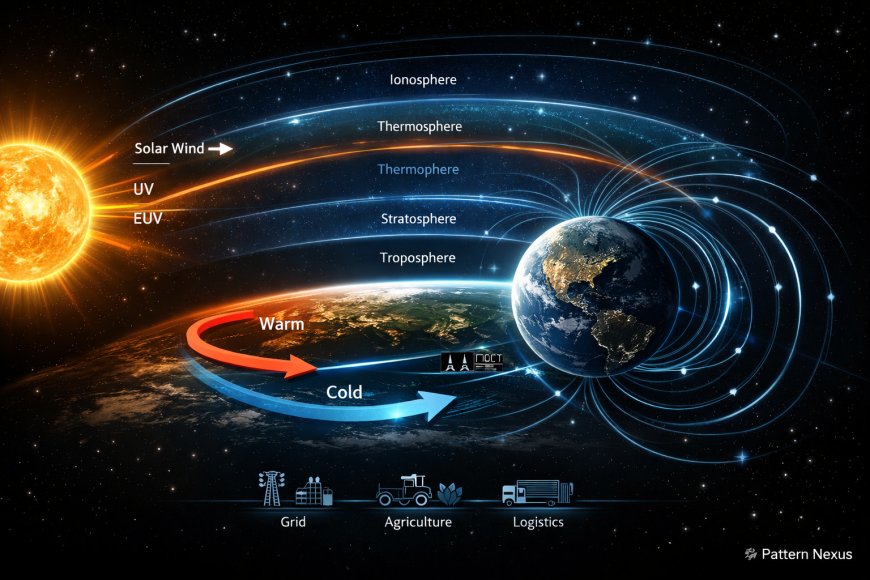
Climate Is a Circulation System
Solar spectral variability, geomagnetic shielding and space-weather forcing, stratosphere–troposphere coupling, and AMOC heat transport form a single non-linear control system. The risk is not “warming vs cooling.” The risk is instability, regime shifts, and cold shock in a warming mean—plus long-arc sensitivity changes as Earth’s magnetic field geometry evolves.
Executive Summary
The claim: Climate risk is dominated by circulation stability, not surface temperature averages.
The mechanism: Small perturbations in high-leverage layers can cascade downward through stratosphere–troposphere coupling, while ocean heat transport (AMOC) sets the baseline gradients the atmosphere must balance. Geomagnetic shielding changes add variance at the upper-atmosphere interface.
The implication: You can get “cold shock” and persistent winter extremes even while the global mean trends warmer, because non-linear flow regimes can destabilize and lock into persistence.
The actionable frame: Plan for volatility and regime shifts, not a single monotonic narrative. Build resilience for the tails, not the median.
Mainstream climate discourse collapses into a single axis: hotter or cooler. That is politically communicable and operationally incomplete. A civilization does not fail because the mean shifts by a fraction of a degree. A civilization fails when the systems that distribute energy and moisture become unstable, persistent, and asymmetric. That is a circulation problem.
This flagship paper maps interacting subsystems into one control model: (1) solar spectral variability (UV/EUV) that disproportionately influences upper-atmospheric and stratospheric structure, (2) magnetosphere–ionosphere–thermosphere energy deposition during geomagnetic storms and secular shielding change, (3) stratosphere–troposphere coupling that reorganizes jet regimes and surface persistence, (4) AMOC heat transport that governs Atlantic gradients and Northern Hemisphere stability, then extends the arc into (5) long-cycle geomagnetic secular variation since the last full reversal and (6) historical/ancient observational memory of instability.
The point is not to “replace” climate science. The point is to identify a structural blind spot: models and narratives overweight smooth averages and underweight circulation failure, regime persistence, and tail-risk outcomes that dominate real-world damage functions.
The Frame: Flow Regimes and Control Surfaces
Pattern Nexus does not treat climate as a thermostat. Thermostats behave linearly: turn the knob, the output follows. Climate behaves like a coupled flow system: rotating fluids with thresholds, feedback loops, delayed responses, and regime switches. In that world, the key variable is not “how warm is the average,” but “how stable are the transport pathways that keep the system organized.”
The public argument is often framed as an energy-balance debate: forcing in, temperature out. That framing misses the failure mode. Most societal damage is not produced by a smooth drift in mean conditions. It is produced by persistence: weeks of locked cold, months of shifted storm tracks, growing seasons that fracture at the margins, snowpack that refuses to melt on schedule, drought that becomes structural, flood that becomes recurrent. Persistence is what breaks logistics, agriculture, energy systems, and governance.
Two realities can be true at once:
Global mean temperature can rise while regional cold risk increases.
Because the system’s damage function is driven by persistence, extremes, and transport failures, not the mean.
This is not a prophecy of an imminent ice age. It is a risk analysis: a structural argument that tail risk is systematically underweighted when models, narratives, and policy obsess over averages and ignore circulation stability. In engineering terms, the system is being evaluated by average throughput while its failure mode is instability. In finance terms, the system is being priced by the median while its loss function is dominated by fat tails.
If the next era is defined by higher variance and more frequent regime persistence, then “warming vs cooling” is the wrong debate. The correct debate is “stability vs instability” and “adaptation to tails vs adaptation to averages.”
The System Map: Inputs, Transports, Outputs
We need a clean control diagram before we argue about outcomes. Not a propaganda chart. Not a single index. A system map.
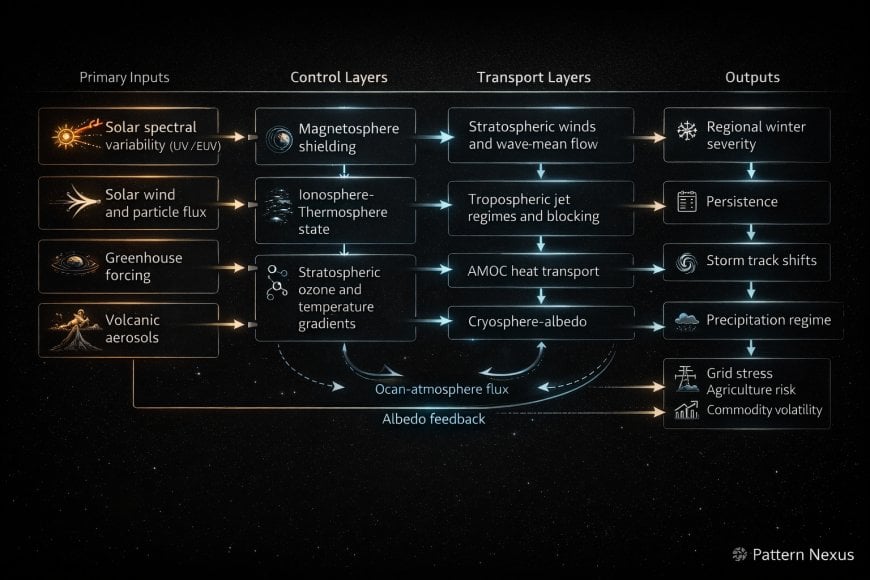
- Primary inputs: Solar spectral variability (UV/EUV), solar wind and particle flux, episodic geomagnetic energy deposition (storms), greenhouse forcing, volcanic aerosols, ocean salinity/heat changes, land-use and aerosols.
- Primary modulators: Magnetosphere shielding geometry and strength, ionospheric conductivity, stratospheric ozone and temperature gradients, waveguides and coupling windows.
- Primary transports: Stratospheric circumpolar westerlies and wave–mean flow interactions, tropospheric jets and blocking patterns, AMOC heat transport, air–sea fluxes, cryosphere albedo feedback loops.
- Primary outputs: Regional winter severity, persistence of cold anomalies, storm track shifts, precipitation regime changes, snowpack timing, agricultural risk, grid stress, commodity volatility, political stress.
The point is not to pretend one input explains everything. The point is to show how small changes in high-leverage layers (upper atmosphere, ocean conveyor, cryosphere thresholds) can produce disproportionately large changes in distribution. In other words: you can keep arguing about the mean while the system is reorganizing its pathways.
Solar Forcing Beyond “Brightness”
The Sun is typically reduced to a crude argument: “the Sun got brighter, so it warmed” or “the Sun got dimmer, so it cooled.” That framing is weak. It misses where the leverage actually is.
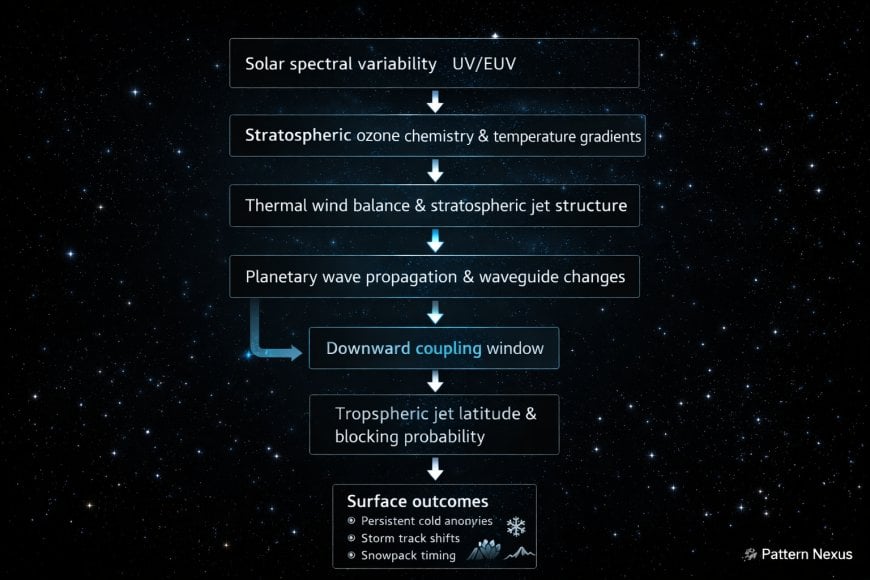
The leverage point is spectral and structural: solar UV and EUV variability disproportionately affects stratospheric ozone chemistry and upper-atmospheric temperature structure, which affects winds via thermal wind balance and modifies the wave environment that communicates changes downward. The stratosphere is not a decorative layer. It is a dynamical layer that can shape tropospheric organization.
There are multiple time scales to keep straight: the ~11-year Schwabe cycle, the ~22-year Hale magnetic cycle, multi-decadal modulation, and longer “grand” regimes where activity is suppressed or elevated. The climate relevance is not “a little more sunlight.” The relevance is that spectral changes can alter gradients and wave propagation in the layers that regulate regime behavior.
Pattern Nexus translation: Small energy changes in the control layer can re-route the distribution layer.
UV/EUV variability is not about “warming the planet.” It is about altering gradients that set wind structure and wave behavior.
Solar forcing also arrives through particles, not just photons. Solar wind variability and energetic particle events influence ionization and conductivity in the ionosphere and thermosphere, which affects coupling dynamics. Again: not a bulk heat story. A structural modulation story.
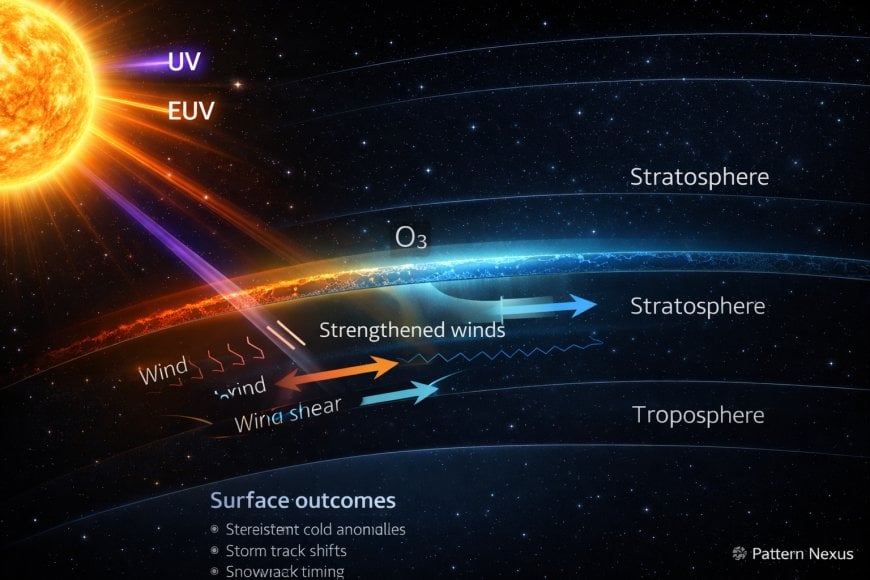
You will notice the discipline here: the claim is not that solar variability “explains everything.” The claim is that solar spectral variability is a high-leverage perturbation to the control layers that govern regime behavior—and that regime behavior is what societies actually experience.
Space Weather, Magnetosphere Shielding, and Upper-Atmosphere Coupling
Now we step into a domain that most climate discourse ignores because it is hard to narrate: Earth is embedded in a solar wind environment, and its response is mediated by a dynamic magnetic shield. During geomagnetic storms, energy is deposited into the high-latitude ionosphere–thermosphere system, producing measurable changes in neutral density, composition, winds, and currents. This is not controversial in space physics.
The open question is not whether storm-time responses exist. The open question is whether increased variability at this interface—plus long-arc shielding change—can modulate atmospheric circulation regimes at seasonal to decadal horizons via coupling pathways. If you treat the system as layered control architecture, the question is not crazy. It is mandatory.
Important constraint: This is not an argument that CMEs “cause climate change.”
This is an argument that space-weather forcing and shielding geometry add variance to high-leverage upper-atmosphere layers that are under-discussed in public-facing climate narratives.
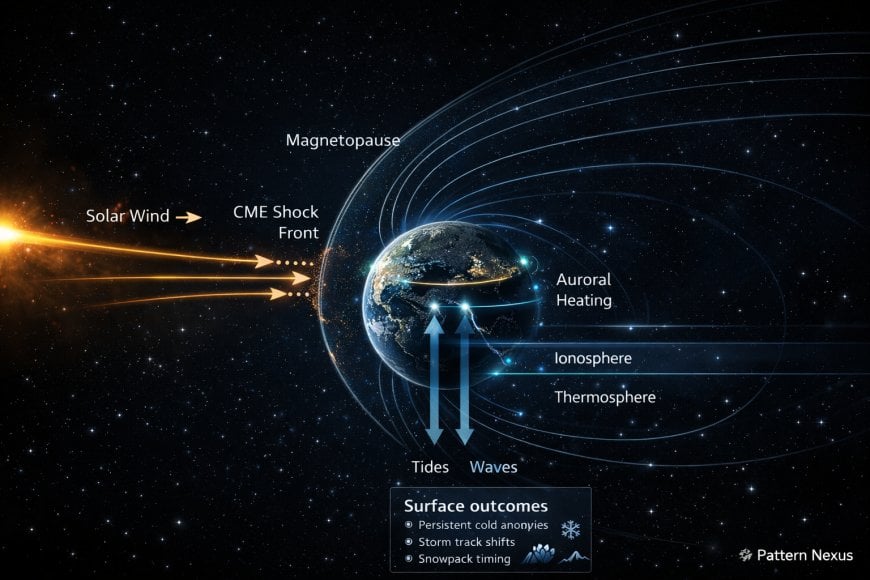
Here is the correct way to think about it: the climate system is already a chaotic, state-dependent system. If the boundary conditions at the upper-atmosphere interface become noisier, the probability of regime transitions increases. You do not need a massive energy input to change the probability of transitions. You need variance at the right leverage points.
Space-weather literature documents storm-time upper-atmosphere responses and coupled modeling of ionosphere–thermosphere dynamics. The climate question is not “does a CME warm Earth.” The climate question is “does increased upper-atmosphere variability modulate coupling windows and regime persistence probabilities downstream.”
In a world of fragile supply chains and tightly optimized infrastructure, the difference between “a rare regime event” and “a frequent regime event” is existential—even if the global mean remains on-trend.
Secular Variation, Pole Drift, and the Long Arc Since the Last Reversal
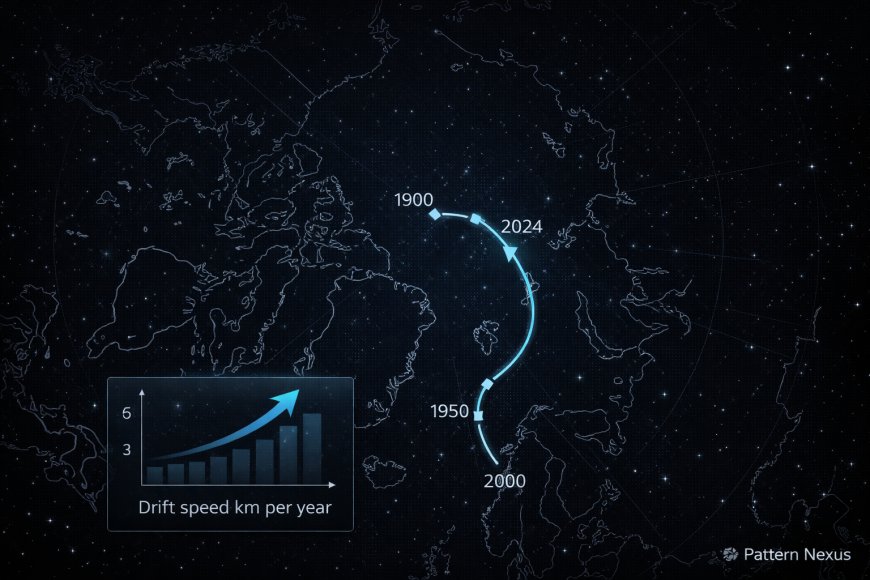
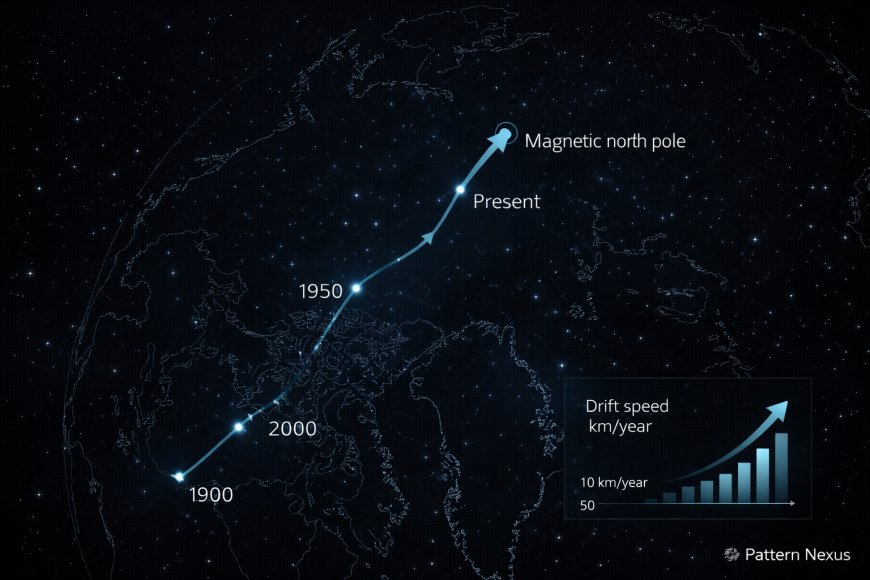
“Pole shift” is often treated as internet noise, so people either mock it or sensationalize it. Neither response is serious. The correct framing is geomagnetic secular variation: the measured, ongoing evolution of Earth’s magnetic field strength and geometry over time.
This matters because the magnetosphere is not simply “on” or “off.” Its shielding effectiveness depends on field strength and topology. Changes in topology can alter how and where energy is deposited into the upper atmosphere. The result is not a cinematic apocalypse. The result is increased variability and asymmetry.
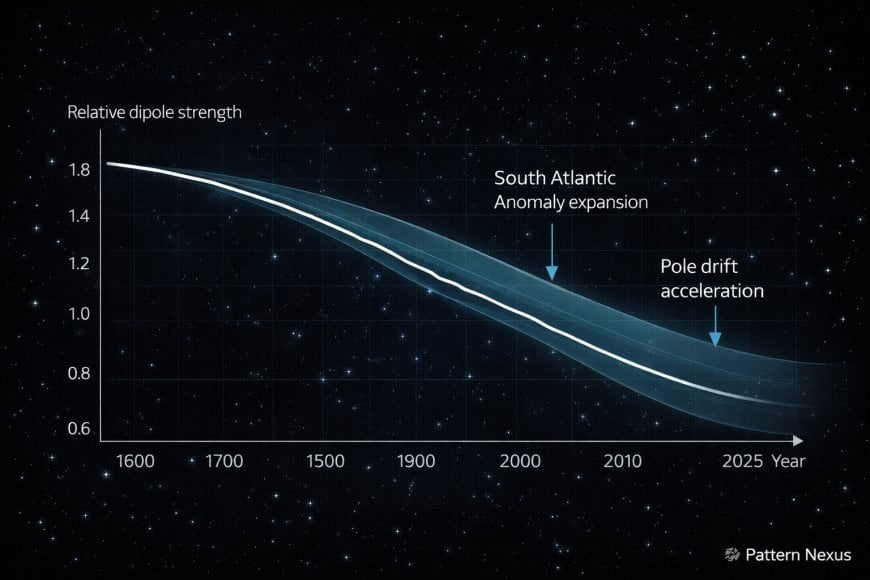
The last full polarity reversal occurred roughly 780,000 years ago. That does not mean a reversal is “due” (reversals are irregular), and it does not mean we are “about to flip.” The relevant concept is that reversals are terminal events of long instability phases. An instability phase can include prolonged dipole weakening, multipolar emergence, and shifting regional exposure long before a reversal.
Pattern Nexus does not need to claim a reversal. Pattern Nexus needs to claim something simpler and harder to dismiss: buffer capacity matters. In a coupled control system, reduced buffer capacity increases volatility transmission.
Systems translation: You can remain in the same polarity while still operating in a lower-stability regime.
Late-cycle behavior is not a date on a calendar. It is reduced tolerance for perturbation.
If you want a clean, disciplined position: the geomagnetic system is evolving measurably; the shielding geometry is changing; regional anomalies are expanding; and the upper-atmosphere interface is where small structural changes can become large regime consequences. This is a probabilistic claim. It does not require a single dramatic event to be operationally important.
Stratosphere–Troposphere Coupling
This is the core mechanism most people are gesturing at when they say “polar vortex,” and it is the proper way to state it: changes in stratospheric winds and temperatures can propagate downward and modulate tropospheric jets, storm tracks, and surface weather patterns.
The stratosphere influences the troposphere through multiple pathways: it changes the background state that planetary waves propagate through; it modifies wave–mean flow interactions; and in disruption events it can reorganize circulation geometry. The troposphere then expresses that geometry as persistent patterns—blocking highs, displaced jets, altered storm tracks, and seasonal anomalies that feel like the weather “broke.”
Sudden stratospheric warmings (SSWs) are the canonical example because they are identifiable disruptions with documented downstream impacts. Not every SSW couples downward. That nuance is not a weakness; it is the point. Intermittent coupling is itself a volatility amplifier: if the coupling window opens irregularly, prediction becomes harder, and regime transitions become more frequent.
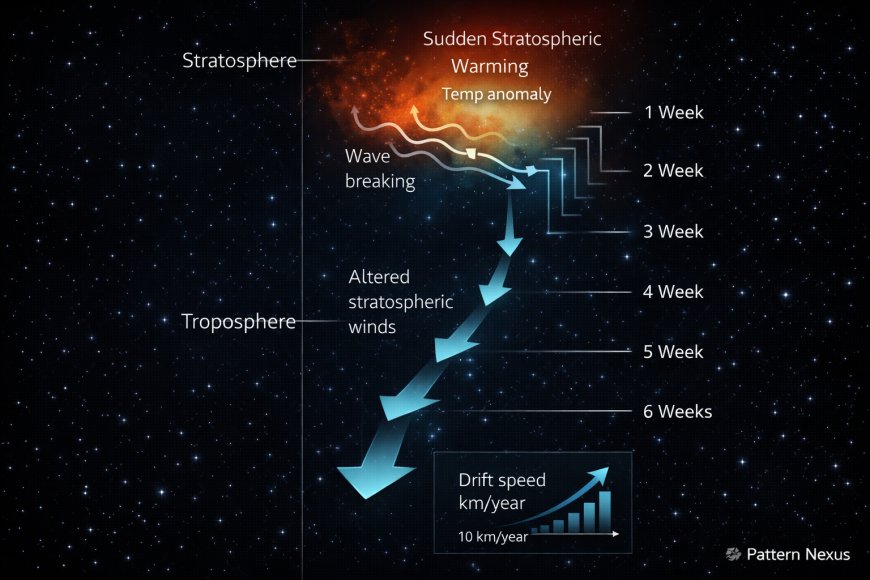
Systems insight: The atmosphere has a control layer (stratosphere) and an output layer (troposphere). When the control layer destabilizes, the output layer reorganizes.
That reorganization is what people experience as “the weather going insane,” but it is regime physics, not a moral narrative.
The framing you want is not “a vortex.” The framing you want is “a coupled dynamical system where control-layer state changes can reorganize output-layer regime geometry.” That language is accurate, defensible, and difficult to mock.
Zonal vs Meridional Regimes
Ignore the meme words. The real distinction is geometrical, and geometry determines persistence.
- Zonal-dominant flow: faster west-to-east circulation, more containment, shorter-lived anomalies, fewer locked blocks.
- Meridional exchange dominance: larger north–south waviness, greater blocking probability, persistent anomalies, bigger swings.
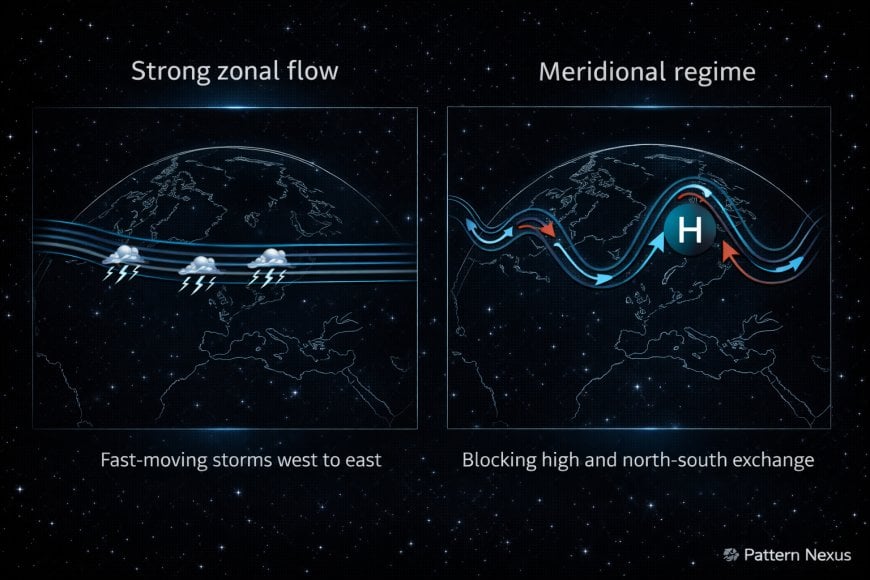
The public tends to interpret cold events as contradictions to warming. That is a category error. Cold events are not a temperature debate. They are a distribution and persistence debate. A system can have a warmer mean while expressing more frequent or more persistent regional cold if transport geometry favors exchange and blocks.
This is why “variance” is the correct variable to track: not because variance is more dramatic, but because variance is what collapses planning assumptions. A modest change in persistence probabilities can translate into a massive change in infrastructure load, agricultural risk, and commodity volatility.
Once you see the climate system as regime geometry, the narrative changes. You stop arguing “is it warming.” You start asking “is it stabilizing.”
AMOC as a Heat Conveyor
The Atlantic Meridional Overturning Circulation (AMOC) is one of the most important heat redistribution engines on Earth. It transports heat northward and stabilizes climates around the North Atlantic. If the conveyor weakens, you change gradients, storm tracks, and seasonal baselines. This is not speculative. The debate is timing, magnitude, and probability of abrupt change.
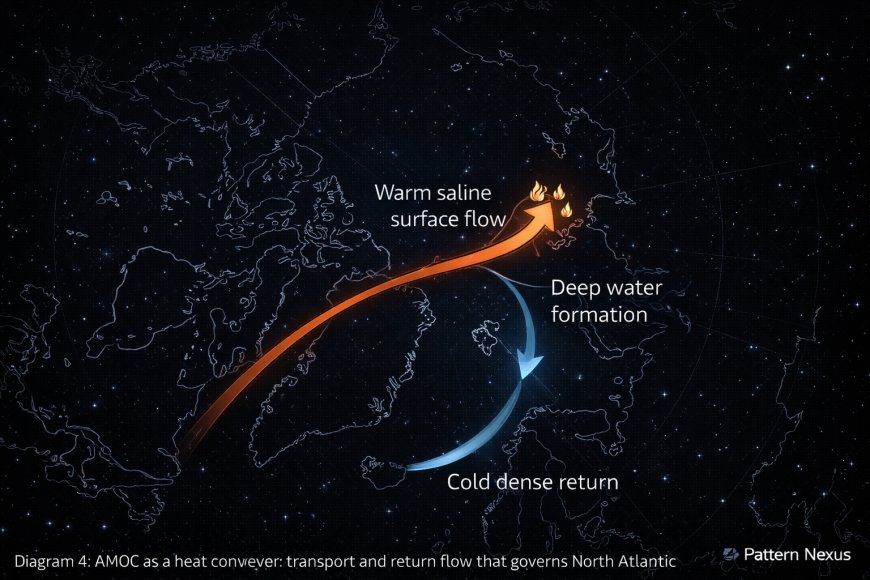
AMOC is not a knob. It is a flow regime in a saline, stratified system. Flow regimes can shift abruptly when thresholds are crossed—especially when freshwater fluxes and density gradients reconfigure. “Unlikely” in a scientific summary does not mean “non-risk” in a civilizational context.
The Pattern Nexus stance is straightforward: if AMOC is a stability anchor and the system has abrupt modes, then ignoring those modes in planning is a fragility choice. This is true even if the most likely outcome is not collapse. Tail-risk outcomes dominate the damage function.
Abrupt Change: What the Record Shows
If you want to understand tail risk, do not start with modern politics. Start with paleoclimate discontinuities: abrupt reorganizations in circulation, hydrology, and regional temperature that occur faster than societies can adapt.
The Younger Dryas is a canonical example often discussed in terms of North Atlantic circulation shifts and AMOC behavior. The details of mechanism and trigger are debated in the literature, but the existence of abrupt modes is not. The system can switch states quickly.
Pattern Nexus caution: A historical discontinuity is not a forecast.
It is proof that the system has abrupt modes, and those modes are tied to circulation and transport, not to linear surface trends.
Translate this into modern risk: any plan that assumes smooth continuity is structurally fragile in a system that has documented abrupt modes. You do not need to predict which mode triggers next to justify resilience. You only need to acknowledge that the mode exists and the exposure pathways are real.
Ancient Observational Memory and Civilizational Encoding
Most modern people assume that ancient cultures were “primitive” and therefore their records are irrelevant. That assumption is a mistake. Ancient cultures lacked modern instrumentation and formal theory, but they had something modern society has largely destroyed: multi-generational observational memory integrated into culture.
When environmental stability breaks at scales larger than a single lifetime, societies encode the experience. They encode it as myth (because myth preserves meaning), as calendars (because timing matters), as architecture (because permanence is a storage medium), and as ritual (because repetition ensures transmission). This is not “mysticism.” It is information compression under uncertainty.
The disciplined way to use ancient records is not to treat them as mechanistic proof. It is to treat them as a qualitative indicator that large, repeated disruptions were culturally salient enough to become encoded. In other words: the ancients may not explain causes, but they remembered consequences.
Category discipline:
Science explains mechanisms. History explains consequences. Ancient memory records lived exposure.
Confusing these categories is how serious work gets dismissed. Keeping them separate is how serious work survives.
If the modern era is re-entering a higher-volatility regime, one of the most dangerous errors is assuming the recent stability window is permanent. Ancient encoding is a reminder that stability is not guaranteed.
Civilization Risk: Cold, Volatility, and Fragility
Civilization is optimized for stable Holocene-like conditions: predictable planting windows, manageable winter peaks, and logistics that assume storms are episodic rather than persistent. We built a high-throughput world with tight margins and fragile buffers. That works in stable regimes. It breaks in unstable regimes.
- Agriculture: late frosts, persistent snowpack, shortened growing windows, precipitation regime changes, and timing shocks that destroy yields even when annual averages look “normal.”
- Energy: winter peak persistence stresses fuel logistics, generation, transmission, and backup planning; cold-driven demand spikes can exceed resilience margins faster than heat-driven spikes in many regions.
- Infrastructure: freeze–thaw damage, road/rail disruption, pipeline vulnerability, water system stress, brittle failure regimes, and slow recovery cycles when storms repeat without recovery time.
- Second-order effects: commodity volatility, insurance repricing, fiscal stress, migration pressure, political instability, and credibility collapse when institutions cannot explain or manage persistent disruptions.
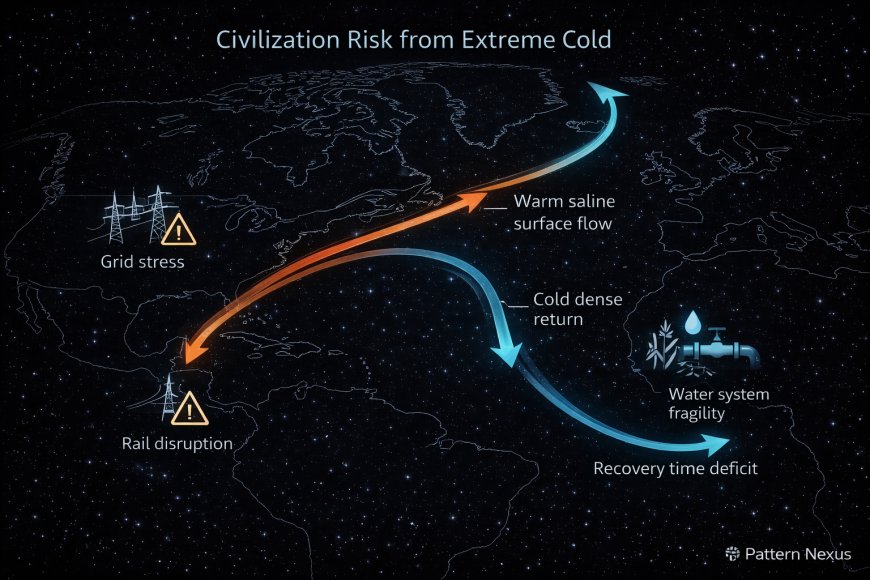
The mainstream discussion often treats cold as an inconvenience and heat as the existential threat. That framing is incomplete. Heat can be deadly. So can cold. But cold tends to break systems: heating demand, transport, supply chains, grid stability, and food logistics. In many historical contexts, cold volatility has been more directly tied to societal disruption than gradual warming.
Signals to Watch
If the world is entering a higher-volatility circulation regime, do not obsess over a single metric. Watch interfaces where regimes shift and buffers fail.
Upper-atmosphere interface: persistent stratospheric wind anomalies, increased disruption frequency, unusual wave activity patterns, extended coupling episodes, anomalous upper-atmosphere storm responses.
Geomagnetic interface: field strength trend, geometry changes, expansion of anomaly regions, acceleration of pole drift, event clustering in space-weather forcing.
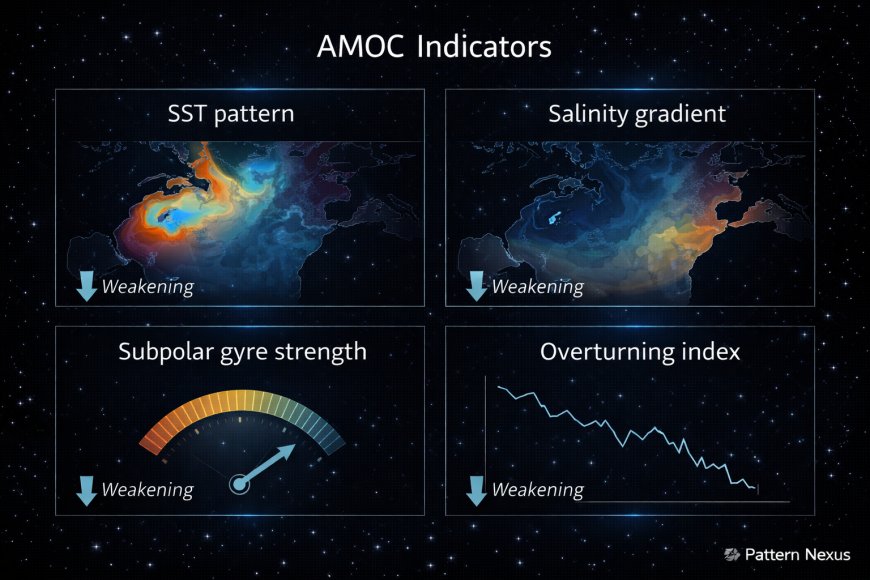
Ocean interface: AMOC proxies, subpolar gyre behavior, North Atlantic salinity/temperature patterns, freshwater flux signals, and gradient reconfiguration.
Surface regime interface: blocking persistence metrics, storm track shifts, late-season cold anomalies, snowpack persistence and albedo reinforcement.
Forecasting the exact day of a regime break is a fool’s game. The objective is to recognize that regime risk can rise even while averages drift smoothly, then build resilience to volatility rather than betting on continuity.
Scenario Stack: What “Instability” Looks Like
These scenarios are disciplined by design. They avoid certainty propaganda and focus on structurally plausible pathways. They are framed so that a reader can disagree with probabilities while still accepting the exposure logic.
Scenario A: Higher Variance, Same Mean Trend
The mean continues to drift warmer, but circulation becomes less stable. Blocking and persistence increase. Result: more frequent and more persistent winter extremes, wider swings, and higher planning error. This is the “it’s warming, but winters feel worse” world.
Scenario B: Atlantic Gradient Shock
AMOC weakens enough to materially alter North Atlantic gradients. Result: colder winters in some regions, storm track reorganization, precipitation regime shifts, and heightened volatility even where annual means appear stable. Mean trends do not save you from regional disruption.
Scenario C: Multi-System Coupled Disruption
Upper-atmosphere variability increases at the same time ocean heat transport weakens and cryosphere feedbacks amplify persistence. Result: regime persistence becomes more common, cold shock risk rises materially, and planning assumptions fail more often. This is the tail-risk scenario—the one linear narratives are built to ignore.
Pattern Nexus stance: You do not need certainty to justify resilience.
You need structural plausibility, documented abrupt modes, and clear exposure pathways.
Quantitative Uncertainty Cones and Tail-Risk Framing
Climate projections are frequently communicated as central estimates with confidence bands. That is useful for linear responses. It is incomplete for systems with regime thresholds, intermittent coupling, and state dependence.
The correct visual is not one line plus error bars. The correct visual is an uncertainty cone that widens with time and splits by regime branches—because model structural uncertainty and coupling uncertainty compound. The longer the horizon, the more “path dependent” the system becomes.
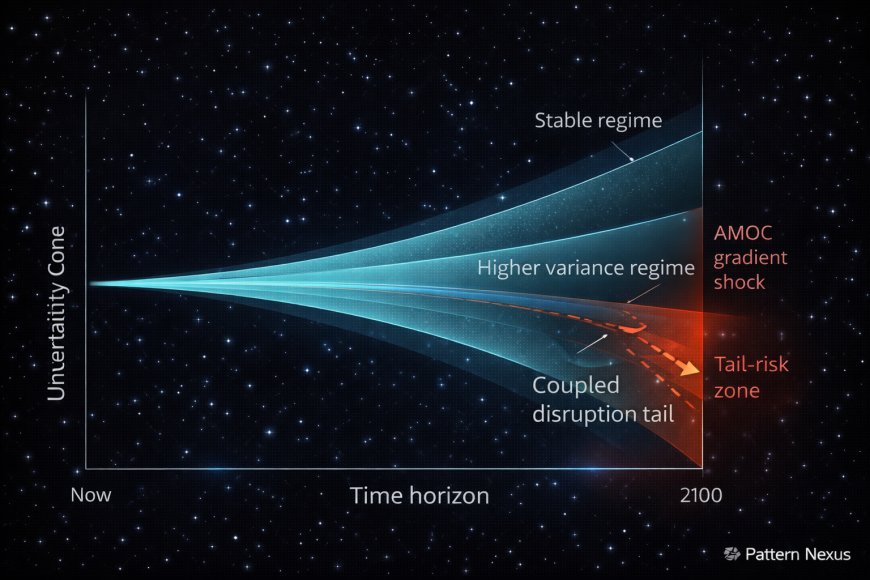
In finance, this is normal. You do not price risk by the median when ruin lives in the tails. In engineering, this is normal. You do not design a bridge for average winds when failure happens in rare gust regimes. Climate-resilience planning should be treated the same way.
Key point: “Unlikely” is not the same as “irrelevant.”
Risk is probability multiplied by impact, and regime events have high impact.
This is why the Pattern Nexus focus is stability and persistence: those are the variables that increase tail exposure. If the probability of persistent blocking doubles, the expected damage can more than double—because damage scales non-linearly with duration and recovery time.
Dedicated Rebuttal to IPCC-Style Critiques
This section exists because serious work gets attacked in predictable ways. The goal is not to “win” an argument. The goal is to keep the categories clean and prevent low-effort dismissal.
Critique 1: “There is no evidence geomagnetic variability affects climate meaningfully.”
This critique confuses dominance with relevance. The claim here is not that geomagnetism controls climate like a master dial. The claim is that geomagnetic shielding geometry modulates variance at the upper-atmosphere interface, and variance at leverage layers can change regime-transition probabilities downstream. Systems with multiple inputs do not require one input to dominate in order for it to matter to stability.
Critique 2: “Solar variability is too weak to matter.”
This is only true if solar input is treated as scalar heat. It is not true if spectral variability (UV/EUV) and coupling pathways are considered. The climate relevance is structural: gradients, winds, waveguides, and coupling windows. A small spectral shift can alter the control-layer state that governs output-layer organization.
Critique 3: “AMOC collapse is unlikely this century.”
“Unlikely” is not “zero,” and policy is not only about probability. AMOC is a stability anchor with documented abrupt modes. Even low-probability outcomes can dominate expected loss if consequences are large. Risk management for civilization is not a popularity contest for the median trajectory.
Critique 4: “Ancient records are not scientific evidence.”
Correct. They are not evidence of mechanism. They are evidence of lived exposure to disruption that exceeded normal variability. Dismissing them does not make society safer; it makes society memoryless.
Category discipline:
Science explains mechanisms. History explains consequences. Ancient memory records exposure.
Rejecting any category because it is not another is a category error.
The Core Disagreement
Institutional consensus frameworks are optimized for communicability and policy coherence. Pattern Nexus is optimized for structural risk identification and tail exposure. These goals are not aligned. A coherent narrative can still be a fragile model.
FAQ
Are you denying anthropogenic warming?
No. This analysis is not denial. It is systems framing: circulation stability, regime behavior, and tail risk. You can accept anthropogenic forcing and still conclude that volatility pathways are underweighted in public discourse.
Are you claiming CMEs control climate?
No. Space weather produces measurable upper-atmosphere responses. The argument is that upper-atmosphere variability is a leverage layer that can modulate circulation regimes through coupling pathways. Magnitude and timing are debated. Existence is not.
So are we “heading into an ice age”?
Not as a deterministic claim. The claim is that the system has abrupt circulation modes and civilization is exposed to regional cold shock and volatility even in a warming mean. Betting everything on a monotonic narrative is a fragility strategy.
Why isn’t this the mainstream narrative?
Because it is hard to message. “Warmer or cooler” is a single-axis story. “Higher variance from non-linear coupling” is not. Institutions prefer narratives that simplify action, even when the world is structurally more complex.
Pattern Nexus Lens
Model the control layers. Upper-atmospheric dynamics and ocean heat transport are control layers, not decorations.
Expect regime behavior. Non-linear flows do not degrade smoothly. They shift states.
Plan for volatility. The damage function lives in persistence, extremes, and infrastructure stress, not the mean.
Reject monotonic narratives. A politically coherent story is not a systems model.
If you want a single takeaway: climate risk is about the stability of distribution mechanisms. When distribution fails, societies break—even if the global mean is still drifting in the “expected” direction.
Appendix I: Geomagnetic Reversal Cycles and Long-Arc Instability
Geomagnetic reversals are among the most poorly contextualized phenomena in public science discourse. They are either treated as irrelevant geological trivia or sensationalized extinction triggers. Both framings are wrong.
The correct framing is systemic: reversals are terminal events of long instability phases in Earth’s geodynamo. Those instability phases matter far more than the reversal itself.
The Structure of a Reversal Cycle
Paleomagnetic evidence indicates reversals are not instantaneous flips. They unfold over thousands to tens of thousands of years and are characterized by:
- Progressive weakening of dipole field strength
- Emergence of multipolar field configurations
- Rapid pole migration and wandering
- Regional shielding asymmetry and anomaly expansion
The last full reversal (Brunhes–Matuyama) occurred roughly 780,000 years ago. Reversal timing is irregular; “overdue” is not a scientific concept here. The actionable concept is reduced stability margins during weakening and multipolar phases.
Why Weakening Matters More Than Reversal
A weakening field increases variability and asymmetry, not cinematic catastrophe. Increased penetration of galactic cosmic rays and solar energetic particles can alter:
- Ionospheric conductivity and current systems
- Upper-atmospheric chemistry, including odd nitrogen/odd hydrogen pathways in some event contexts
- Wave and tide propagation characteristics
- Coupling windows between upper-atmosphere dynamics and lower-atmosphere regimes
In non-linear systems, increased variance is equivalent to increased failure probability.
Geological archives show correlations—imperfect, debated, non-deterministic—between geomagnetic minima, climate volatility markers, and biospheric stress signals. Correlation does not imply control. But correlation invalidates dismissal and justifies deeper coupling research.
Pattern Nexus does not need the field to “cause” climate. Pattern Nexus only needs one claim to hold: if the field is a buffer and the buffer weakens, variance transmission increases, and regime risk rises.
Appendix II: Ancient Civilizational Observations of Environmental Instability
Ancient civilizations did not possess modern scientific theory, but they possessed multi-generational observational memory. Environmental instability exceeding normal seasonal variability was encoded into myth, cosmology, calendars, and architecture as an information storage system. This is not “proof of mechanism.” It is evidence of lived exposure and cultural risk encoding.
| Civilization | Encoded Observations | Storage Medium | Interpretive Frame | Modern Correlate | How to Use This Responsibly |
|---|---|---|---|---|---|
| Ancient Egypt | Disrupted seasonal order; Nile irregularity; “balance” narratives | Texts, ritual continuity, governance cosmology | Ma’at vs disorder | Hydrological instability and regime persistence | Use as consequence-memory, not mechanistic proof |
| Maya and broader Mesoamerica | Cycle resets; renewal through collapse; sky-serpent motifs | Calendrics (Long Count), iconography, monument cycles | Cosmic time as structured repetition | Abrupt regime change salience | Use as timing-sensitivity evidence, not apocalypse forecast |
| Vedic / Hindu traditions | Long cycles of decline and renewal; cosmic order degradation | Oral tradition, scripture, ritual timekeeping | Yuga cycles | Long-cycle instability framing | Use as long-horizon risk intuition, not literal chronology |
| Ancient China | Meticulous famine chronicles; “guest stars”; sky omens tied to stability | Imperial records, court chronicles, astronomical logs | Mandate of Heaven as stability contract | Solar variability proxies and societal stress coupling | Use as high-resolution consequence archive |
| Mesopotamia | Flood memory; cyclical disorder motifs; river unpredictability | Texts and myth cycles | Divine order vs chaos | Hydrologic regime shifts | Use to identify recurring vulnerability patterns |
| Indo-European flood complexes | Deluge narratives across regions | Oral transmission and myth | Reset through catastrophe | Abrupt hydrological reorganization memory | Use as signal of widespread disruption salience |
The value here is not that ancients “knew physics.” The value is that they encoded instability in durable forms because it mattered to survival. Modern systems, optimized for short horizons, are systematically hostile to that kind of memory.
Sources
Primary literature and institutional references for mechanisms discussed above.
- Butchart, N. (2022). The stratosphere: a review of the dynamics and variability. Weather and Climate Dynamics (Copernicus).
- NOAA Climate.gov. (2024). Stratosphere–troposphere coupling explainer (educational synthesis).
- AGU / GRL and AMS / JCLI literature on SSWs and downward coupling (multiple studies, 2000s–2020s).
- Journal of Geophysical Research: Space Physics and Space Weather journals on ionosphere–thermosphere storm responses and coupled modeling.
- NOAA GFDL and peer-reviewed literature on AMOC abrupt change potential, indicators, and uncertainty.
- Nature Communications and related paleoclimate literature on Younger Dryas and abrupt transition dynamics.
- Geomagnetism institutional resources (e.g., NOAA NCEI geomagnetism, IGRF/WMM model documentation) for secular variation and field geometry.
- Historical and archaeological sources for civilizational chronicles (Egyptian, Chinese, Mesopotamian) as consequence-memory archives (use cautiously, category separated from mechanism claims).
What's Your Reaction?
 Like
0
Like
0
 Dislike
0
Dislike
0
 Love
0
Love
0
 Funny
0
Funny
0
 Wow
0
Wow
0
 Sad
0
Sad
0
 Angry
0
Angry
0

Founder of Pattern Nexus. I research markets, macro, geopolitics, AI, history, ancient systems, and the patterns most people overlook. I’m also building Market Radar, a trading scanner designed to read pressure, risk, confirmation, and setup quality before chasing a move. Pattern Nexus is where I connect the dots between data, history, technology, and the bigger system playing out around us.
















Comments (0)