
WindRunner: America’s Oversized Cargo Jet That Can Move Fighter Squadrons Without Disassembly
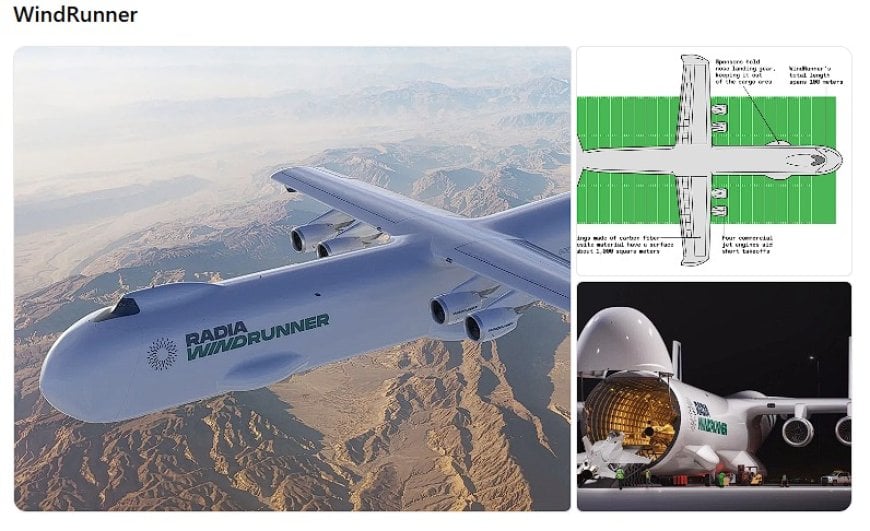
Radia’s WindRunner aircraft is designed to move entire fighter and helicopter detachments intact — bypassing disassembly delays and landing on short or unpaved runways. If successful, it rewrites U.S. force-projection logistics and creates a new strategic chassis for rapid deployment in contested environments.
WindRunner: The Ultra-Large Cargo Jet That Could Airlift Entire Fighter Squadrons
Thesis: The next big military advantage isn’t just a new weapon—it’s a new logistics chassis. Radia’s WindRunner is designed around volume over raw tonnage, promising intact movement of fighters, helicopters, and outsized systems to ~6,000-ft austere runways. If realized, that compresses time-to-combat and widens basing options.
What WindRunner Is
Built by Colorado-based startup Radia, the WindRunner began as a civilian solution to haul 100-meter wind-turbine blades to remote onshore sites. That commercial use-case—transporting extremely large but relatively light components—makes it a natural crossover for defense logistics where volume is often the constraint, not just weight.
Key Specs (as disclosed to date)
| Length | ~109 m / 356 ft |
|---|---|
| Wingspan | ~80 m / 261 ft |
| Max payload (weight) | ~160,000 lb (≈72.6 t) |
| Runway | ~1,800 m / ~6,000 ft (unpaved capable, per company) |
| Range at max load | ~2,000 km / ~1,200 mi |
| Cruise | ~Mach 0.6 |
Source: Radia’s published specs — see official page.

From Wind Farms to War Plans
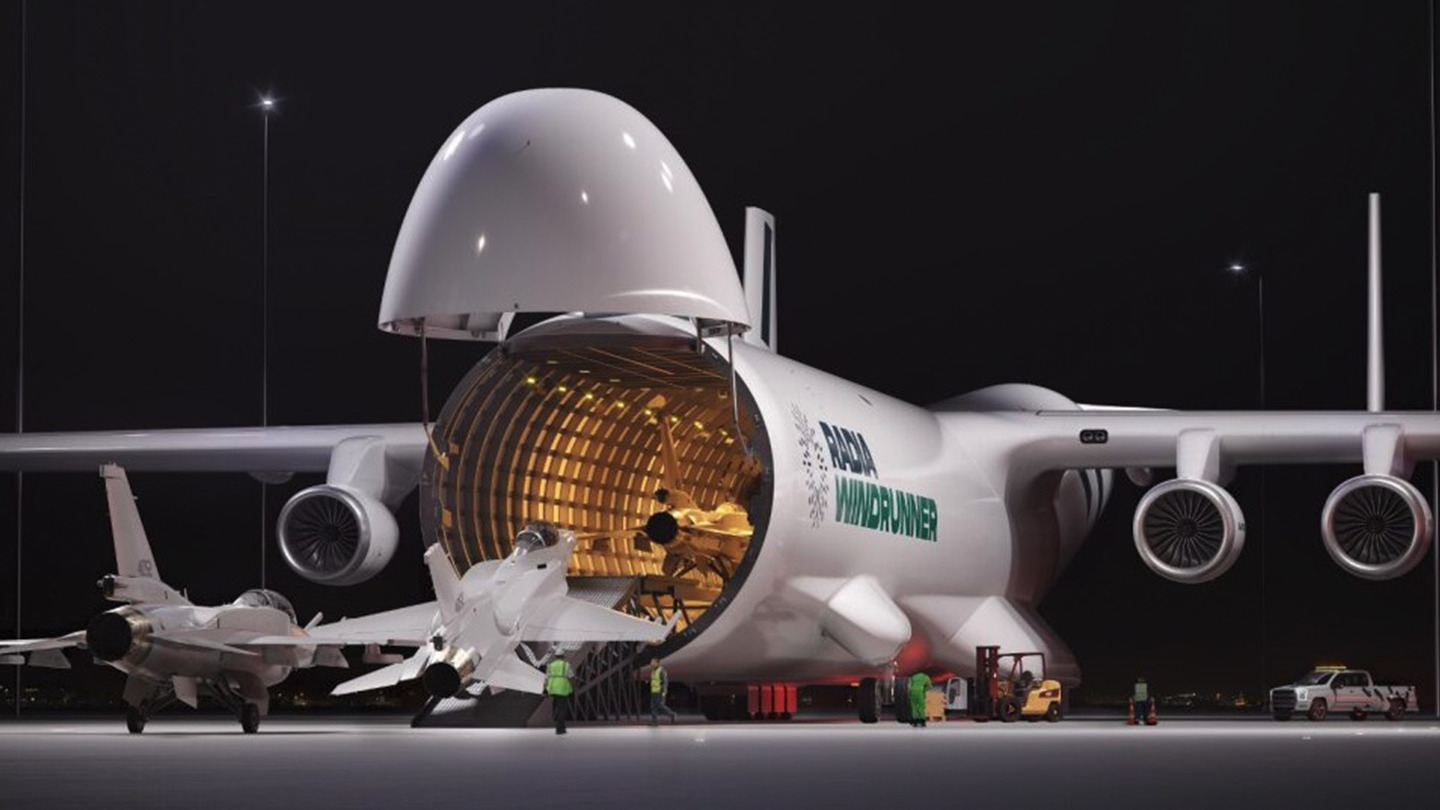
Reporting indicates the defense pitch includes transporting up to four F-35s or six CH-47s without disassembly, plus claims of operations from semi-prepared strips. That combination—intact loads + austere access—compresses timelines and sidesteps infrastructure chokepoints that slow traditional airlift.
- Business Insider coverage on the intact F-35/Chinook use-case and runway claims.
- The War Zone on USAF engagement and a ~2030 first-flight target.
- Breaking Defense on unpaved ~1,800 m runway operations.
Strategic Upside
- Time-to-combat: Intact airframes mean less wrench-time and faster sortie generation at arrival.
- Basing flexibility: Ability to use shorter, semi-prepared strips expands forward options.
- Volume-first logistics: Ideal for big but lighter systems—sensors, shelterized kits, rotorcraft, drone swarms, mobile hospitals.
Reality Check
- It’s still a concept: No public prototype yet; certification and financing risks are non-trivial.
- Weight vs. volume: Max payload weight trails some legacy heavylift; the play is cubic meters, not brute tonnage.
- Target timeline: First flight around 2030 has been floated; large-aircraft programs slip.
- High-value asset: In contested airspace, a giant lifter needs protected corridors and timing.

Bottom Line
WindRunner is a logistics swing at the real bottleneck: space and access. If Radia executes, U.S. planners get a new lever—deploying capability packages intact into places the current fleet struggles to reach. That’s a quiet—but decisive—force multiplier.
References & Credits
- Radia — WindRunner official page (specs, imagery): radia.com/windrunner
- Business Insider — defense use-case (F-35/CH-47, runway): link
- The War Zone — USAF brief, timeline to ~2030: link
- IEEE Spectrum — wind-blade logistics driver: link
- Breaking Defense — unpaved ~1,800 m runway operations: link
Jaká je vaše reakce?
 Líbí se
0
Líbí se
0
 Nesouhlasím
0
Nesouhlasím
0
 Láska
0
Láska
0
 Vtipné
0
Vtipné
0
 Wow
0
Wow
0
 Sm sad
0
Sm sad
0
 Rozčílený
0
Rozčílený
0

Founder of Pattern Nexus. I research markets, macro, geopolitics, AI, history, ancient systems, and the patterns most people overlook. I’m also building Market Radar, a trading scanner designed to read pressure, risk, confirmation, and setup quality before chasing a move. Pattern Nexus is where I connect the dots between data, history, technology, and the bigger system playing out around us.




















Komentáře (0)