
The Cycles of Power: From Regime Change to Digital Dominion – How Empires Evolve in the Age of AI
A deep investigation into the repeating patterns of American intervention—from world wars and Cold War coups to blockchain tokenization, AI warfare, and data-driven control. This piece exposes how power evolves but never disappears, urging a future built on wisdom over dominance.
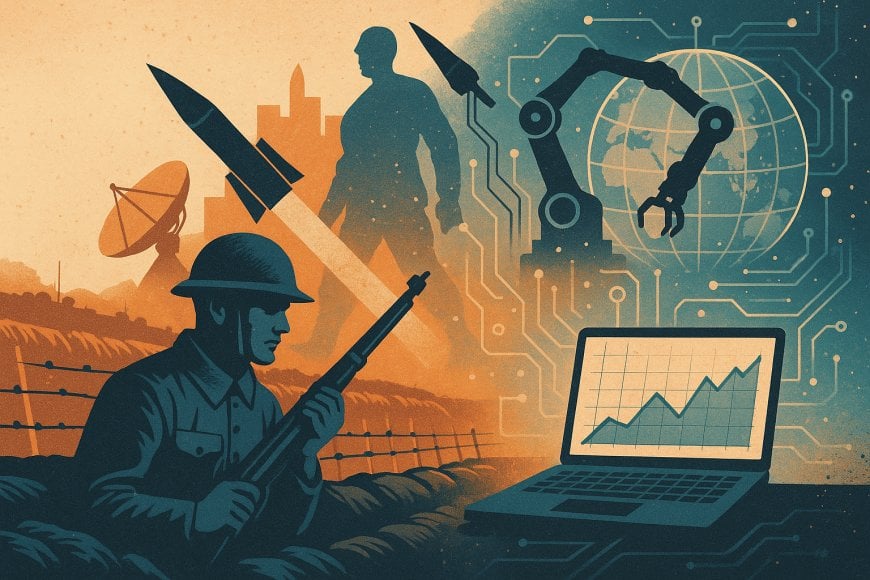
Every era, every civilization, and every empire has told itself a story about why it intervenes in the affairs of others. In the American story, the narrative oscillates between self-interest, moral crusade, and strategic necessity. The United States has been a democratic experiment that, at times, props up democracy and, at others, topples elected leaders. In the analog age, this took the form of military interventions and covert coups. In the emerging digital age, it manifests through data dominance, asset tokenization, and autonomous weapons.
This article traces the long arc of American intervention — from the world wars to Cold War coups, from Panama and Iraq to the tokenization of finance and the rise of digital authoritarianism. It examines why some interventions (particularly after World War II) are lauded as successes while most become moral and strategic quagmires. It then looks forward, asking how digitization, blockchain tokenization, AI, and robotics are creating new arenas of domination — and what it would take to break the cycle of oppression.
The aim is not to indict or exonerate but to understand the pattern: how the United States has repeatedly tried to remake the world through power rather than through wisdom, and why the same pattern risks repeating itself in cyberspace and on the battlefield of the future. Throughout, the narrative blends researched facts with a personal voice — one that is wary of militarism, skeptical of techno-utopianism, and determined to call oppression by its name.
Part 1 – The Early 20th Century: War, Idealism and Isolationism
America’s Reluctant Entry into World War I
When war erupted in Europe in 1914, most Americans wanted nothing to do with it. President Woodrow Wilson proclaimed strict neutrality, insisting that the United States must be “neutral in fact as well as in name” (theworldwar.org). Many U.S. institutions still lent enormous sums to Britain and France, but public opinion was deeply divided: pacifist songs like “I Didn’t Raise My Boy to Be a Soldier” topped the charts while the Preparedness Movement argued that the U.S. needed to build its military in case of war. The sinking of the Lusitania by a German U-boat in 1915 – killing nearly 1,200 passengers including 128 Americans – began to shift opinion, but many still favored neutrality.
What changed? Germany resumed unrestricted submarine warfare in January 1917, hoping to break Britain’s blockade. The same month, British intelligence intercepted the Zimmermann Telegram, in which Germany promised Mexico the return of U.S. territories if it joined the war. These provocations, combined with a belief that American intervention could “make the world safe for democracy,” pushed Congress to declare war in April 1917. The U.S. entry tipped the balance on the Western Front and helped secure an Allied victory.
Wilson’s Fourteen Points and the Ill-Fated League of Nations
President Wilson’s vision for the postwar order was ambitious. In 1918 he articulated Fourteen Points – principles like freedom of the seas, self-determination and a “general association of nations” to guarantee peace. This vision laid the groundwork for the League of Nations, the first attempt at a global governance body. Yet U.S. politics thwarted Wilson’s idealism. The 1920 election of Warren Harding on a platform of “normalcy” signaled a retreat into isolationism. Congress refused to join the League, focusing instead on tariffs and domestic growth. Historians later argued that the U.S. absence contributed to the League’s weakness and its failure to prevent World War II.
Lessons and Echoes
The First World War changed America. It proved that neutrality could give way quickly to intervention, that idealistic visions like the League could be undone by domestic politics, and that punitive peace treaties can plant the seeds of future conflict. The next global conflict would see the United States rise not just as a participant but as an architect of a new order, again grappling with the question: Can military victory ever lead to sustainable peace?
Part 2 – World War II and the Myth of the Good Occupation
Fighting Fascism
World War II is often invoked by those defending U.S. interventions as evidence that regime change can be good. The defeat of Nazi Germany, Fascist Italy, and Imperial Japan ended genocidal regimes and created the space for liberal democracies. Yet even here, success was not automatic. It required total war, the mobilization of millions, and postwar commitments that lasted decades.
Rebuilding Japan: Reform, Reverse Course and Treaty
After Japan’s unconditional surrender in 1945, the U.S.-led Allied occupation under General Douglas MacArthur undertook sweeping reforms. The occupation unfolded in three phases: punishment and reform, economic revival, and treaty and alliance (history.state.gov). In the early years, the Allies disbanded Japan’s army, banned former military leaders from politics, and conducted war crimes trials. They imposed land reforms to empower tenant farmers and attempted to dismantle the powerful zaibatsu conglomerates. In 1947, a new constitution downgraded the Emperor to a figurehead and renounced war, giving more power to elected institutions and women.
Economic crises and fears of communism during the Cold War triggered a “reverse course”: U.S. policymakers shifted from structural reform to economic stabilization (history.state.gov). The Korean War transformed Japan into a critical supply depot and cemented the U.S.–Japanese alliance. Ultimately, the San Francisco Treaty of 1951 ended the occupation but maintained U.S. military bases in Japan. Japan emerged as a democratic ally, though the reform process was not purely altruistic – it also secured Japan firmly within the U.S. sphere of influence.
Occupying Germany: Denazification and Decentralization
The occupation of Germany was far more challenging. The country lay in ruins; cities like Cologne had 66 percent of their housing destroyed and Düsseldorf 93 percent uninhabitable (historyandpolicy.org). Millions were homeless or displaced. British and American officials recognized that victory did not guarantee a stable peace. Field-Marshal Bernard Montgomery told his troops on VE Day: “We have won the German war. Let us now win the peace.” He emphasized combining punitive measures with positive reconstruction so the German people would have “hope for the future.”
British and U.S. zones slowly transitioned from direct military rule to devolving power to local councils (historyandpolicy.org). The British discovered that democracy cannot be imposed by force; they initially tried to transplant the first-past-the-post electoral system, only to find Germans preferred proportional representation. Over time, they realized that sustainable institutions must be built with the occupied population, not imposed on them.
Economic recovery was equally difficult. Historians note that the earliest stages of the German economic miracle actually pre-dated the Marshall Plan; they were rooted in restored transport infrastructure and basic public services that provided stability (historyandpolicy.org). Meanwhile, the U.S. provided food aid, dismantled war industries, and worked to denazify society — even forcing German civilians to walk through concentration camps to witness Nazi atrocities (nationalww2museum.org). Political renewal required balancing the removal of Nazi officials with the need for experienced administrators. The eventual Federal Republic of Germany adopted a hybrid democratic system and joined the Western alliance.
Why Reconstruction Succeeded (and Where It Didn’t)
Later analysts often cite Germany and Japan as proofs that American-led regime change can work. Yet the success conditions were unique:
- Total war and unconditional surrender: both nations were decisively defeated; there was no insurgency, no alternate power center.
- Massive U.S. presence and long-term commitment: millions of troops and administrators stayed for years, ensuring security and guiding reforms (e-ir.info).
- Extensive planning and legitimacy: reconstruction plans were developed during the war and enjoyed broad Allied and domestic support (e-ir.info).
- Cultural cooperation: reforms were negotiated with local leaders; for example, the Japanese Emperor remained as a figurehead to smooth the transition (nationalww2museum.org) and British officials learned to adapt democratic practices to German traditions (historyandpolicy.org).
A study by researchers Minxin Pei and Sara Kasper counts only 16 U.S. interventions since 1900 that meet the criteria of nation-building (deploying large numbers of troops, effecting regime change and administering a country). Only four were judged successful: Germany, Japan, Grenada, and Panama. The occupations of Germany and Japan set a standard that has rarely been matched. Later interventions lacked the decisive victory, resources, or legitimacy to replicate those outcomes.
Part 3 – The Cold War and Beyond: Coups, Quagmires and Moral Erosion
Iran 1953: Oil, Power and Lasting Resentment
In 1953 the U.S. and U.K. orchestrated a coup against Iran’s democratically elected prime minister, Mohammad Mossadegh. Mossadegh had nationalized the Anglo-Iranian Oil Company, threatening Western interests. Operation Ajax replaced him with the autocratic Shah Mohammad Reza Pahlavi. The coup ended Iran’s brief democracy and deepened nationalist resentment; it remains a defining grievance in U.S.–Iran relations.
Guatemala 1954: Ten Years of Spring Cut Short
Guatemala’s reformist President Jacobo Árbenz instituted land reforms that threatened the United Fruit Company. In 1954, a CIA-backed coup toppled Árbenz. The ouster deepened inequalities and ignited a brutal civil war (1960-1996) that killed over 200,000 people, mostly indigenous civilians (responsiblestatecraft.org). The violence included genocide against the Mayan Ixil population, and the U.S. continued to support Guatemala’s military despite knowing about human rights abuses (responsiblestatecraft.org). Today, Guatemala struggles with corruption and inequality – a direct legacy of the coup.
Chile 1973: The Pinochet Dictatorship
In Chile, socialist president Salvador Allende pursued nationalization and social reforms. The Nixon administration feared another socialist model in Latin America and covertly supported a military coup. On 11 September 1973, General Augusto Pinochet seized power. Pinochet’s 17-year dictatorship resulted in more than 3,000 people “disappeared” or killed and about 38,000 political prisoners, most tortured (npr.org). For decades, the coup was portrayed as a Cold War success; in reality, it left deep scars and fueled opposition to U.S. interventionism.
Iraq 1963 and 2003: The Baath and Beyond
The U.S. played a role in the 1963 Iraqi coup that brought the Baath Party to power, paving the way for Saddam Hussein’s rule, which later became a U.S. enemy. In 2003, citing weapons of mass destruction and links to terrorism, the U.S. invaded Iraq to overthrow Saddam. Coalition forces achieved rapid military success, but post-war planning was minimal. The occupation dissolved the Iraqi army, fueling an insurgency. A PLOS Medicine study estimates 405,000 excess deaths (violent and non-violent) by mid-2011, with an additional 56,000 uncounted due to migration. Many Iraqis attributed violent deaths to coalition forces and militias. The war destabilized the region, empowered sectarian militias, and eventually allowed the rise of ISIS.
Panama 1989: Operation “Just Cause”
In December 1989, the U.S. invaded Panama to oust military ruler Manuel Noriega. The operation achieved its objective quickly, but international bodies condemned it as a violation of international law. According to History.com, the invasion killed 23 U.S. soldiers, 3 U.S. civilians, around 150 Panamanian defense force soldiers, and about 500 Panamanian civilians. Though Noriega was removed, the intervention raised questions about proportional force and sovereignty.
Libya 2011: From Intervention to Collapse
In 2011, NATO (with strong U.S. involvement) intervened in Libya to prevent Moammar Gadhafi’s forces from attacking civilians. Airstrikes helped rebels overthrow Gadhafi, but no coherent plan existed for the aftermath. The Fund for Peace notes that between 2011 and 2021, Libya’s Fragile State Index score increased by 28.3 points, making it one of the world’s most fragile states. By 2023, more than 60 militia groups wielded heavy weaponry — about three weapons per citizen — making governance nearly impossible. Without a robust reconstruction effort, Libya descended into chaos, proving once again that removing a dictator does not guarantee stability.
Patterns of Failure
The Cold War coups and post-9/11 invasions share common failings: they prioritized short-term strategic goals over long-term stability, underestimated the complexity of nation-building, and often sowed resentment and chaos. These interventions stand in stark contrast to the post-World War II occupations. The U.S. seldom committed comparable resources or time; local institutions were dismantled rather than strengthened; and the interventions were framed as moral crusades (“spreading democracy”) but often served geopolitical or corporate interests. The cumulative result has been moral erosion — a loss of credibility and trust that continues to shape how much of the world views U.S. power.
Part 4 – Enter the Digital Age: Tokenization, Surveillance and Data Dominance
Asset Tokenization: From Tangible to Digital
The 21st century is witnessing a different kind of regime change — one that shifts control of assets, money, and data into digital forms. Asset tokenization uses distributed-ledger technology (DLT) to represent real-world assets (stocks, bonds, real estate, commodities) as digital tokens. The Financial Stability Board (FSB) defines tokenization as the process of using technologies like blockchain to issue or represent assets in digital forms known as tokens. These tokens can represent existing financial instruments or new claims; they are currently used in trading, investment, and some payment systems (fsb.org).
Proponents argue that tokenization could improve efficiency in clearing and settlement, reduce costs, increase transparency, and expand investment opportunities (fsb.org). Investors could buy fractional shares of real estate or art with minimal friction, democratizing access to high-value assets. Projects include using DLT to issue tokens representing government debt, equity stakes, or even bars of gold (fsb.org).
Risks and Challenges
Despite the promise, tokenization remains a tiny portion of the financial system. The FSB notes that adoption is still “very low,” and many benefits have yet to be proven (fsb.org). Key challenges include uncertain investor demand, lack of interoperability among blockchain platforms and legacy systems, and unclear legal and regulatory frameworks across jurisdictions (fsb.org). Tokenization may introduce vulnerabilities analogous to traditional finance — liquidity and maturity mismatches, leverage risks, asset-quality concerns, interconnectedness, and operational fragilities. Without robust oversight, a large-scale tokenized financial system could amplify crises rather than mitigate them (fsb.org).
The vision of a tokenized economy is seductive: frictionless global markets, programmable assets, and democratized finance. Yet history teaches us that new financial technologies often heighten inequalities and enable surveillance. Without careful design and public oversight, tokenization could create digital gatekeepers — corporations or governments controlling the ledger — who can freeze assets with a keystroke or exclude dissidents from economic life. The pattern of power concentrates even when the interface changes.
Digital Authoritarianism: Surveillance as Regime Change
Control over data and digital networks has become a new avenue for oppression. In its Freedom on the Net report, Freedom House warns that the internet is growing less free worldwide: disinformation and propaganda poison public discourse, unbridled data collection erodes privacy, and an increasing number of states are embracing “digital authoritarianism” (freedomhouse.org). In 2018, global internet freedom declined for the eighth consecutive year (freedomhouse.org). The report notes that China is the worst abuser of internet freedom, exporting censorship and surveillance technology to other authoritarian regimes. Governments in countries like Egypt and Iran have used “fake news” laws to jail critics and restrict social media (freedomhouse.org).
Data is the lifeblood of digital authoritarianism. The Cambridge Analytica scandal showed that private corporations could harvest the data of up to 87 million users to influence elections; Russian hackers breached voter rolls in multiple U.S. states; false rumors spread through social media have incited violence in Bangladesh, India, Sri Lanka, and Myanmar (freedomhouse.org). Meanwhile, China not only censors its own internet but runs seminars for foreign officials on how to replicate its system. Digital authoritarianism thus inverts the idea of the internet as an engine of liberation; it becomes a tool of oppression (freedomhouse.org).
From Regime Change to Platform Control
Traditional regime change required tanks and coups; digital regime change may occur through control of platforms. A country can undermine another’s democracy by manipulating social-media algorithms, hacking voter rolls, or weaponizing data leaks. Corporations, too, can become quasi-governments if they control the infrastructure of communication, finance, or digital identity. Tokenization could allow governments to link identity to economic activity, enabling them to surveil and punish dissenters. The same pattern reappears: tools created for efficiency or security become instruments of control.
Part 5 – AI, Robotics and the New Arms Race
Autonomous Weapons: A Techno-Nuclear Moment
Artificial intelligence is the latest frontier where technological progress intersects with deadly force. The Arms Control Association warns that AI promises to make tasks faster and more efficient but also poses serious risks when applied to life-and-death decisions. Experts fear a new arms race in autonomous weapons systems (AWS) — machines that, once activated, select and engage targets without further human intervention. Such systems could decide who lives or dies based on opaque algorithms, raising profound ethical and legal questions (armscontrol.org).
Early examples — from Ukraine to Gaza — show how AI-enabled drones and surveillance systems are already shaping modern warfare (armscontrol.org). The rapid development of these technologies outpaces regulatory efforts. The Arms Control Association calls the present moment a “critical juncture” that demands urgent political leadership. Without international norms, autonomous weapons could proliferate quickly, becoming cheaper and more lethal, destabilizing strategic balances and making accidental escalation more likely (armscontrol.org).
Divergent Definitions and Regulatory Paralysis
There is not even a consensus on what constitutes an autonomous weapon. The U.K. Ministry of Defence defines AWS as systems capable of understanding higher-level intent and acting with human-like situational awareness, while the U.S. Department of Defense describes them simply as systems that can select and engage targets without human input. Human Rights Watch calls for a ban on fully autonomous weapons that make lethal decisions without human intervention. These definitional debates have stalled progress in the Convention on Certain Conventional Weapons (CCW); the 2023 CCW meeting produced no substantive regulations.
Meanwhile, countries pour billions into AI and drone development. Russia views AI as a path to global dominance; China has committed $150 billion to become the world leader in AI; and Saudi Arabia plans a $40 billion fund for AI investments (gjia.georgetown.edu). With more than 14,000 U.S. drone strikes in Afghanistan between 2010 and 2020, the technology is far past the experimental stage (gjia.georgetown.edu).
Why AI Wars Escalate the Pattern
Autonomous weapons magnify the core problem of regime change: the detachment of violence from accountability. When a government can send machines to kill without risking its own soldiers, the moral and political cost of war drops. Algorithms may also replicate or intensify biases, selecting targets based on flawed data. An AI arms race not only threatens global security but extends surveillance and control to the battlefield. The same countries experimenting with digital authoritarianism domestically are now building AI-powered militaries.
If history is our guide, the rush to develop AI weapons will outpace the establishment of norms. The nuclear arms race began before the world understood its consequences; only after Hiroshima and Nagasaki did ethical debates catch up. AI may be following a similar trajectory — but with less transparency and more actors.
Part 6 – From Analog to Digital: The Persistent Logic of Oppression
Patterns Across Eras
- Moral Justification vs. Strategic Interest: World War II was fought against fascism, yet subsequent coups in Iran, Guatemala, and Chile were justified on the grounds of anti-communism or democratization while serving corporate or geopolitical interests. Tokenization is sold as democratizing finance but risks consolidating control in the hands of tech giants or surveillance states.
- Short-Term Wins, Long-Term Trauma: Removing a dictator or nationalizing an industry may yield immediate strategic gains. But Iran’s 1953 coup created lasting hostility; Guatemala’s civil war claimed hundreds of thousands of lives (responsiblestatecraft.org); Iraq’s invasion unleashed sectarian violence and helped birth ISIS (pmc.ncbi.nlm.nih.gov). Similarly, digital platforms built for connection have eroded privacy and stoked division (freedomhouse.org).
- Power Vacuum and Chaos: The overthrow of Mossadegh, Árbenz, or Gadhafi created vacuums that were filled not by democracy but by repression, warlords, or militias (fundforpeace.org). In digital spaces, dismantling net-neutrality or privacy protections can create a vacuum into which authoritarian states or predatory corporations step.
- Technology as a Tool of Control: Whether it was the CIA using radio broadcasts during the Cold War or governments deploying surveillance algorithms today, each era’s cutting-edge technology becomes a means of manipulation. Tokenized assets could be frozen with a single command, AI weapons could autonomously decide life or death, and social-media algorithms can amplify propaganda and hate speech (freedomhouse.org).
- Resistance and Adaptation: Just as local leaders in Germany and Japan shaped their own democracies (historyandpolicy.org), people today are pushing back against digital authoritarianism. Court challenges in Kenya and Malaysia have rolled back fake-news laws (freedomhouse.org); citizens demand stronger data protections, and whistleblowers continue to expose abuses. The future is not predetermined.
Analog Lessons for the Digital Future
Long-Term Commitment Matters: Post-World War II success stemmed from sustained involvement, resources, and partnership with locals. Digital platforms or AI systems built without democratic oversight and long-term accountability are likely to be hijacked by those with narrow interests.
Local Agency Is Essential: Democracy was not imposed on Germany and Japan; it emerged through collaboration and respect for local traditions (historyandpolicy.org). Similarly, digital governance should empower communities to set their own norms rather than imposing top-down surveillance models.
Beware of Techno-Solutionism: There is no algorithmic fix for social problems. AI cannot remove the moral weight of killing; blockchain cannot abolish inequality. Without ethical frameworks and public participation, new technologies will replicate old injustices.
Transparency and Regulation: The nuclear age eventually brought treaties like the Non-Proliferation Treaty because the world recognized the existential threat. AI and tokenization require similar global frameworks. The Arms Control Association calls for “urgent political leadership” to regulate autonomous weapons. The FSB urges regulators to address data gaps and legal uncertainties in tokenization. Freedom House advocates for protecting privacy and resisting digital authoritarianism.
Part 7 – The Feedback Loop: Data, Power and the Human Mind
The Psychological Battlefield
The wars of the 21st century are no longer fought only with bullets or code—they are fought in the mind. Data has become the raw material of persuasion. Every click, pause, or scroll teaches an algorithm what captures attention and what provokes emotion. Platforms then optimize for engagement, not enlightenment, feeding users more of what keeps them angry, afraid, or addicted. This is the modern psychological feedback loop—a system where data harvested from human behavior is used to engineer more of that behavior.
The logic mirrors that of propaganda during the Cold War, but the reach is planetary. Machine-learning models can now personalize persuasion at scale, predicting emotional triggers with surgical precision. Governments and corporations alike exploit this infrastructure to shape opinion, suppress dissent, or sell ideology. What was once the realm of state intelligence agencies is now embedded in social networks and recommendation engines.
Algorithmic Conditioning
The human brain is adaptable but vulnerable. Repeated exposure to outrage or fear stimuli rewires neural pathways, deepening polarization and shortening attention spans. Artificial intelligence systems reinforce these loops because they are rewarded for engagement metrics—not truth, not empathy, not collective understanding. Over time, societies become easier to manipulate, and individuals lose the ability to discern authentic experience from algorithmic manipulation.
Studies by cognitive scientists and digital-ethics researchers warn that this feedback loop erodes agency. When predictive systems anticipate desires before they are consciously formed, autonomy itself becomes a data point to be optimized. The question shifts from “What do I want?” to “What does the system want me to want?”
The Economics of Attention
Attention is the new oil—extracted, refined, and sold. Social platforms and ad networks monetize human focus, turning every interaction into behavioral surplus. The more divisive the content, the higher the engagement; the higher the engagement, the more data to feed back into the system. It is a self-reinforcing cycle of emotional exploitation disguised as connectivity.
Economists and philosophers alike note that this creates a digital class structure: those who design the algorithms hold power over those who generate the data. In this sense, surveillance capitalism is not just an economic system—it is a form of soft regime change, one that rewires behavior from within rather than through external force.
Breaking the Loop
Escaping the feedback loop requires more than privacy laws or content moderation. It demands a reassertion of human sovereignty over the systems that learn from and manipulate us. Transparency in algorithms, open-source oversight, and the recognition of data as a human right are first steps. But the deeper change must be cultural: a collective decision to value reflection over reaction, truth over virality, wisdom over power.
Just as earlier generations built treaties to contain nuclear annihilation, this generation must build norms to contain cognitive exploitation. Every click is a vote in a silent referendum on what kind of civilization the digital age will produce. The feedback loop will persist—until humanity decides to write new code for its own consciousness.
Part 7 – Conclusion / Breaking the Cycle: Wisdom Over Power
Breaking the Cycle
History rarely repeats itself in form, but it rhymes in function. From the trenches of Europe to the deserts of the Middle East, from the coups of the Cold War to the covert algorithms of the digital age, power has always sought new instruments to impose its will. The United States—like every empire before it—has oscillated between isolationism and interventionism, between the rhetoric of liberty and the reality of control. It has installed and removed governments, backed revolutions, funded resistance movements, and rebranded domination as democracy. Each generation inherits the tools of the last and reconfigures them for its own form of empire—today’s version coded in data rather than decrees.
The digital age does not erase these historical patterns—it accelerates them. The new theaters of war are virtual; the new borders are firewalls. Coups can unfold on blockchain ledgers, and social uprisings can be throttled by algorithmic censorship. Propaganda has evolved from leaflets to newsfeeds, from state radio to micro-targeted content engineered by AI. The same forces that once toppled regimes now manipulate populations through predictive analytics, biometric surveillance, and economic tokenization. Where tanks once rolled, data packets now flow. Yet the outcome is familiar: control.
Learning from the Past
Breaking the cycle begins with humility—the admission that progress in technology does not equate to progress in wisdom. The same intellect that split the atom and mapped the genome also built the tools for mass manipulation and autonomous warfare. To move forward, nations must look backward with honesty, confronting the moral and human cost of interventionism. Sustainable peace cannot be manufactured by coercion; it must be cultivated through cooperation. Real justice requires not dominance, but dialogue; not surveillance, but trust.
The lessons of the twentieth century are clear: rebuilding requires commitment, not conquest. Reconstruction in Germany and Japan succeeded not because of force, but because of partnership and patience. The same principle applies to the digital realm. If we design systems that empower communities rather than exploit them—if we prioritize transparency, privacy, and shared governance—then technology can elevate rather than enslave. The challenge is not to out-innovate our adversaries, but to outgrow our own addiction to control.
Wisdom Over Power
Wisdom, unlike intelligence, demands restraint. It requires empathy for those unseen by policy or code, and the courage to choose understanding over dominance. In every age, the defining question has been the same: will humanity use its creations to uplift or to oppress? The analog empires answered with bombs and borders; the digital ones answer with data and denial. But the cycle can be broken—if we remember that the most powerful algorithm is not one written in code, but one written in conscience.
The future need not repeat the past. By investing in ethical governance, respecting local agency, protecting privacy, and defending human dignity, we can design systems that serve people rather than power. The path forward lies not in the relentless pursuit of dominance—military, economic, or digital—but in cultivating wisdom, empathy, and balance. Only then can the story of human progress become one of liberation rather than control.
What's Your Reaction?
 Like
0
Like
0
 Dislike
0
Dislike
0
 Love
0
Love
0
 Funny
0
Funny
0
 Wow
0
Wow
0
 Sad
0
Sad
0
 Angry
0
Angry
0

Founder of Pattern Nexus. I research markets, macro, geopolitics, AI, history, ancient systems, and the patterns most people overlook. I’m also building Market Radar, a trading scanner designed to read pressure, risk, confirmation, and setup quality before chasing a move. Pattern Nexus is where I connect the dots between data, history, technology, and the bigger system playing out around us.




















Comments (0)