
McDonald’s Did Not Bring Back Value Because It Felt Nostalgic. It Did It Because the System Sees Demand Breaking.
A Pattern Nexus analysis of McDonald’s new under-$3 menu as a signal on consumer stress, franchise economics, real-estate control, fast-casual pressure, and the broader architecture of demand destruction.

People remember the old Dollar Menu as a consumer-era convenience. That is not the right way to look at this moment. McDonald’s launched its original national Dollar Menu in 2002, spent years evolving away from straight-dollar simplicity, and is now returning with a cleaner under-$3 structure because the lower end of the consumer base is cracking again. But the deeper story is not the menu board. McDonald’s corporate model is built around franchising, site control, rent, royalties, and scale. The food is the interface. The land position, lease structure, brand power, and fee streams are the machine. When a company like that leans back into blunt value, it is not just chasing nostalgia or social media approval. It is signaling that preserving frequency now matters more than preserving the illusion that the consumer is still comfortably climbing the price ladder. That matters for fast food, but it matters even more for the middle layer above it: the regional chains, fast-casual brands, and local independents trying to survive in the space between premium pricing and mass affordability. This is where demand destruction becomes visible. The giant with the best corners, the biggest ad budget, and the strongest loyalty loop can compress margins and defend traffic. Everyone else gets squeezed first.
McDonald’s corporate is not mainly a burger-margin business. It is a site-control and fee-stream business using burgers to keep the traffic alive.
When value becomes simpler and more aggressive at the very top of the scale curve, it usually means the consumer base is weaker than headline confidence data wants to admit.
The danger is not just margin compression inside fast food. It is traffic absorption across the entire dining stack, where the middle tier loses frequency first and local operators lose optionality next.
This Is Not a Burger Story. It Is a Control Story.
Most commentary on McDonald’s gets trapped at the menu board. The conversation always collapses into whether the meal is cheap, whether the fries are still worth it, whether the app deal is annoying, whether the old Dollar Menu was better, and whether inflation has pushed fast food into the same lane as casual dining. All of that is surface level. The real story begins one layer higher.
McDonald’s is one of the clearest examples in the consumer economy of how a brand can use physical presence, legal structure, financing logic, and operational standardization to become something much larger than the product it appears to sell. People think they are looking at a restaurant chain. In reality, they are looking at a global control network that routes consumer traffic through a standardized piece of real estate and extracts value through rent, royalties, supply chain discipline, brand licensing, and scale. The burger is the visible object. The invisible system is the thing that matters.
That distinction becomes critical the minute value comes back into the center of the strategy. If a normal restaurant operator cuts price, it often looks like weakness. If McDonald’s sharpens value, it can still look like strength because the company is not relying on the same revenue mix as a one-off operator trying to make payroll off plate margin alone. McDonald’s is defending throughput inside a system it largely controls. That gives it strategic room that most of the sector simply does not have.
So when the company rolls out an under-$3 menu in 2026, after spending years moving away from straightforward dollar-level simplicity, the right question is not “Are cheap burgers back?” The right question is “What is the machine seeing in the consumer, and why is the largest system player choosing simpler value now?”
Once you stop treating McDonald’s as a food company first and start treating it as a site-and-fee system, the under-$3 menu stops looking like marketing fluff and starts looking like a macro signal.
How the McDonald’s Machine Actually Makes Money
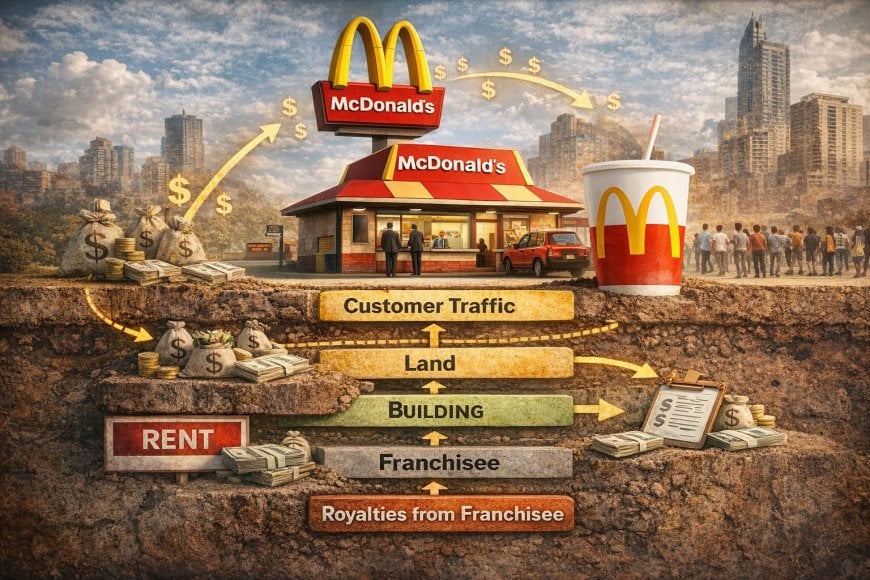
The company tells you what it is if you read the filing instead of the branding copy. At year-end 2025, roughly 95% of McDonald’s restaurants were franchised. That matters because the more heavily franchised the system becomes, the less the parent relies on direct restaurant-level operations and the more it relies on recurring fee streams tied to a global network it already controls. In conventional franchise arrangements, McDonald’s generally owns or secures a long-term lease on the land and building and then collects continuing rent and royalties from the franchisee. That is not a side feature. That is the spine of the model.
The numbers make the point even harder. In 2025, McDonald’s reported $16.548 billion in revenues from franchised restaurants. Of that, about $10.442 billion came from rent and about $6.018 billion came from royalties, before you even get into the smaller line item of initial fees. The company also reported that franchised margins represented approximately 90% of total restaurant margin dollars. That is a completely different revenue architecture from a typical restaurant operator whose economics are tied far more tightly to ingredient costs, labor costs, and same-store execution at the unit level.
There is another layer most people still do not fully appreciate: physical control of place. In consolidated markets, McDonald’s said it owned approximately 56% of the land and approximately 80% of the buildings for restaurant sites at year-end 2025. That does not mean it owns every parcel everywhere, and people overstate that point all the time. But it does mean the company sits on a massive global base of premium commercial positioning in thousands of the best traffic corridors, intersections, suburban entrances, commuter routes, and neighborhood nodes across major economies. That is strategic geography. The menu sits on top of that advantage. It does not create it.
This is why McDonald’s can never be read correctly as “just another restaurant chain.” A lot of restaurant brands sell meals. McDonald’s sells branded access to a system of location, convenience, trust, operational repeatability, and promotional reach. The physical restaurant is the portal. The economics are upstream.
- Franchise-heavy structure shifts economics toward recurring fees instead of relying only on unit-level food margins.
- Owning or controlling prime sites lowers customer-acquisition friction and reinforces brand ubiquity.
- Scale allows McDonald’s to defend traffic in a downturn more aggressively than smaller operators that need richer per-ticket economics.
Why Value Came Back Now
McDonald’s did not wake up in 2026 and suddenly rediscover affordability out of sentiment. This was a progression. The original national Dollar Menu dates back to 2002. Then the system spent years trying to modernize the idea of value without anchoring the brand to a literal one-dollar promise. That included the move toward mixed-price value boards, the “Dollar Menu & More” era, app-driven offers, bundle strategies, the 2024 $5 Meal Deal, the January 2025 McValue platform, and now the simpler under-$3 reset that begins April 21, 2026.
That sequence matters. It shows the company has been testing what kind of value language the consumer will actually respond to. The early 2025 version of McValue leaned more heavily on “buy one, add one” logic. That can work tactically, but it is not the same thing as clean price certainty. If the consumer is truly pinched, complicated savings are weaker than visible savings. You do not want a puzzle. You want a clear answer. The new under-$3 framework is closer to that answer.
The macro backdrop explains why. Food away from home prices were up 3.9% year over year in February 2026, with limited-service meals up 3.2%. At the same time, household debt hit $18.8 trillion at the end of the fourth quarter of 2025. This is the kind of environment where lower-income households become more selective, middle-income households start editing frequency, and even consumers who have not fully broken begin hunting for clearer price anchors. The issue is not just that people want deals. It is that the entire decision stack starts changing under pressure. Frequency drops. Trade-down behavior rises. Convenience still matters, but price clarity starts mattering more.
McDonald’s already saw the early version of this stress when U.S. comparable sales dropped 3.6% in the first quarter of 2025. Management said lower- and middle-income consumers had cut back and that industry traffic from consumers making $45,000 or less was down by double-digit percentages. That is not abstract theory. That is the company telling you where the consumer weakness was showing up first.
Later, 2025 improved. Full-year fourth-quarter results were stronger, global comparable sales were up, and the system regained momentum. But that rebound does not cancel the signal. It refines it. McDonald’s is not acting like a company that believes the lower-end consumer is healthy enough to ignore value. It is acting like a company that knows traffic must be protected continuously because the consumer base is still fragile and the battle for frequency is not over.
People remember the old menu as a better era of affordability. The system remembers it as a tool for traffic management. That difference is everything.
What the New Under-$3 Menu Is Really Saying
The company framed the April 2026 launch as an expansion of choice and flexibility. That is the polite corporate version. The operational version is sharper: make value easier to understand, lower the friction to entry, create more menu board clarity, and tighten the path from economic anxiety to purchase decision. This is not a luxury move. It is a throughput move.
That is also why the menu design itself matters. Ten items priced at $3 or less is psychologically cleaner than forcing a customer to combine a full-priced purchase with a conditional add-on. A simple under-$3 ladder works better for budget-conscious consumers because it reduces cognitive overhead. It also gives the system more daypart coverage, from breakfast through dinner, without making the customer feel like value is trapped behind the app or behind a bundle condition.
In other words, this is not just a price change. It is an admission that the market wants legible value again. That alone says a lot. A healthy consumer environment supports upsell, customization, premiumization, and aspirational menu migration. A strained consumer environment pulls the system back toward blunt, broadly understood price anchors. The fact that multiple major chains are leaning into value at the same time only reinforces the point. Taco Bell launched a 10-item Luxe Value Menu at $3 or less in January 2026. Wendy’s rolled out Biggie Deals at $4, $6, and $8 in the same month. This is not one company randomly bringing back cheap food. It is an entire category reworking its interface with a softer customer base.
What makes McDonald’s different is not that it noticed first. It is that when it moves, the move carries more weight because of how much ground it occupies. The company has the brand awareness, the site density, the drive-thru reach, the loyalty ecosystem, and the ad machine to turn a pricing reset into a market-wide gravity event. Smaller chains can launch value. McDonald’s can redefine the consumer expectation band.
Who Gets Squeezed When the Giant Goes Defensive
This is where the story stops being “about McDonald’s” and starts becoming a broader read on the economy. When the largest scale player in the system turns value into a primary traffic defense mechanism, it changes the competitive terrain for everybody else. The impact is not evenly distributed. The lower-frequency, higher-check, mid-tier brands get exposed first.
That does not mean every fast-casual chain is finished. That kind of overstatement weakens the analysis. What it does mean is that the middle layer becomes more fragile when household budgeting tightens. This is especially true for brands that built their growth story on a customer who still had enough disposable income to pay materially more than traditional fast food in exchange for a cleaner brand identity, fresher ingredients, or a more customized product. That customer may not disappear, but the frequency can slip fast.
We already saw versions of that pressure in 2025. Reuters reported that value-oriented chains such as McDonald’s and Chili’s were winning traffic while some fast-casual names were losing younger diners. Chipotle warned that households under $100,000 were pulling back. Noodles & Company closed 33 company-owned restaurants in 2025. Those are not identical businesses and should not be treated as if they are. But they do point in the same direction: the middle is harder to defend when the consumer weakens and the scale players on either side get more aggressive.
The local independent operator has an even harder problem. They do not have a global marketing budget. They do not have 45,000 locations. They do not have app-driven loyalty data at scale. They do not own a giant portfolio of high-visibility real estate, nor do they have leverage with suppliers that comes from national volume. When the category leaders lean harder into visible value, the independent operator does not just face price competition. They face expectation competition. The customer begins asking why a quick lunch now costs materially more at the local spot than at the chain on the corner. Once that comparison becomes habitual, brand story alone is not enough.
This is the hidden violence of demand destruction. It rarely looks dramatic at first. It looks like one less visit per month, one fewer premium add-on, a little more app dependence, a little more coupon use, a little more trading down, a little less willingness to experiment. Then the traffic base narrows, and the operators without structural advantages feel it all at once.
The Broader Economic Read
The easiest mistake here is to isolate McDonald’s from the wider system. The right read is the opposite. McDonald’s becomes useful precisely because it sits at the intersection of so many economic layers: wages, rent, commuting patterns, household debt, inflation psychology, suburban land value, logistics, franchise finance, and consumer habit. It is one of the most visible real-time sensors in the economy.
If the lower end of the consumer stack were healthy, McDonald’s would not need to keep sharpening the visibility of value. It could lean more heavily into premium mixes, bundling tricks, novelty launches, and app-mediated price discrimination without worrying as much about losing baseline traffic. The move back toward simpler price anchors says the floor still matters. It says frequency from the lower and lower-middle parts of the consumer base is important enough to defend with obvious, broad-access pricing.
That is where this becomes a broader macro piece and not just a restaurant piece. Weakening demand does not always show up first in the places the media prefers to watch. It can show up in subtle consumer routing behavior. It can show up in basket edits. It can show up in who still buys convenience at prior levels and who starts demanding value transparency again. A company like McDonald’s sees that before a lot of analysts do because it touches millions of low-friction, high-frequency transactions in real time.
And there is an even deeper read beneath that. In a softening economy, the largest systems do not wait around for weakness to become obvious. They position early. They adjust interface, pricing, promotions, and traffic capture. They turn their scale into a shock absorber. That often makes them look strong on the surface while the surrounding field deteriorates. The result is misleading if you only look at the winner. The winner can be defending successfully while the rest of the structure gets weaker.
So no, this article is not saying the entire economy collapses because McDonald’s launched an under-$3 menu. That would be lazy. The stronger point is narrower and more useful: when one of the most powerful site-controlled consumer systems on earth chooses simpler value right now, it deserves to be read as a signal of where the demand curve is under pressure and who is about to lose the most room to breathe.
Pattern Nexus Lens
This is how Pattern Nexus reads the story: McDonald’s is a control-layer business sitting on top of physical nodes. The company has brand permission, operational standardization, financial extraction rights, and geographic placement all fused into one system. That means it does not compete like a normal restaurant. It governs flow across a network of locations it heavily influences or directly controls. When it pulls the value lever, it is not just moving menu prices. It is reprogramming traffic behavior across a huge section of the consumer landscape.
That is why the real estate angle matters so much. The company’s best advantage is not just product familiarity. It is corner control. It is corridor access. It is being on the route to work, near the highway exit, at the commercial intersection, in the daily pattern of movement. In Pattern Nexus terms, McDonald’s is not merely selling food. It is harvesting convenience from position. The brand sits where people already are going.
Now layer the macro on top. If household budgets tighten, the system does not need every customer to become poor. It only needs enough customers to become selective. Once enough people start editing frequency and hunting visible value, the operator with the most physical density and the strongest promotional reach starts absorbing marginal demand from weaker players. This is what a control system does in stress. It centralizes flow.
That is the bigger lesson. The economy is full of sectors where the apparent product is not the real business. Housing is not just shelter. Tech platforms are not just apps. Shipping chokepoints are not just waterways. And McDonald’s is not just food. It is land, fee rights, route capture, and behavior management wearing a food brand on the outside. When demand weakens, those hidden layers become visible through pricing moves like this one.
The under-$3 menu is not the story. The story is that one of the world’s largest site-controlled consumer systems is signaling that demand needs to be captured more aggressively at the lower end, and that usually means the middle is about to get squeezed harder.
FAQ
Is McDonald’s really a real estate company more than a restaurant company?
It is more accurate to say McDonald’s is a heavily franchised consumer-control system with major real-estate and lease-position advantages. The food business is real, but the corporate engine is powered disproportionately by site control, rent, royalties, and scale economics.
Does the under-$3 menu prove a recession is here?
No. It is not proof of a recession by itself. It is a signal that the company believes visible value matters enough right now to simplify pricing and defend traffic more aggressively. That is consistent with a weaker, more selective consumer backdrop.
Does this mean fast-casual is dead?
No. It means the middle tier is more exposed when the largest value players get sharper and the consumer becomes more price sensitive. Some brands will adapt, some will stall, and some will lose frequency faster than investors expect.
Why does Pattern Nexus treat this as a macro story?
Because McDonald’s sits at the junction of land use, commuting patterns, inflation psychology, household stress, franchise economics, and consumer behavior. A pricing move at that scale is not just a food story. It is a read on how the system is reallocating demand.
Sources
These sources support the company structure, the current menu move, the consumer-stress backdrop, and the broader competitive context discussed in this article.
- McDonald’s 2025 Annual Report (SEC)
- McDonald’s USA introduces new under-$3 menu and $4 breakfast meal deal
- McDonald’s launches the McValue platform in 2025
- McDonald’s first-quarter 2025 results
- McDonald’s fourth-quarter and full-year 2025 results
- Reuters: McDonald’s launches under-$3 menu items and $4 breakfast deals in the U.S.
- Reuters: McDonald’s popular Dollar Menu debuted nationally in 2002
- AP: McDonald’s store traffic fell unexpectedly as diners grew uneasy about the economy
- BLS Consumer Price Index, February 2026
- New York Fed Household Debt and Credit Report, Q4 2025
- Reuters: McDonald’s and Chili’s win on value as fast-casual chains lose younger diners
- Reuters: Chipotle flags pressure among households under $100,000
- Noodles & Company fourth-quarter and full-year 2025 results
- Taco Bell launches the Luxe Value Menu
- Wendy’s introduces the Biggie Deals menu
Ποια είναι η αντίδρασή σας;
 Μου αρέσει
0
Μου αρέσει
0
 Μη Αγαπημένο
0
Μη Αγαπημένο
0
 Αγάπη
0
Αγάπη
0
 Αστείο
0
Αστείο
0
 Ουάου
0
Ουάου
0
 Λυπημένος
0
Λυπημένος
0
 Θυμωμένος
0
Θυμωμένος
0

Founder of Pattern Nexus. I research markets, macro, geopolitics, AI, history, ancient systems, and the patterns most people overlook. I’m also building Market Radar, a trading scanner designed to read pressure, risk, confirmation, and setup quality before chasing a move. Pattern Nexus is where I connect the dots between data, history, technology, and the bigger system playing out around us.

















Σχόλια (0)