
Stone Money on Yap: When the Ledger Is the Island
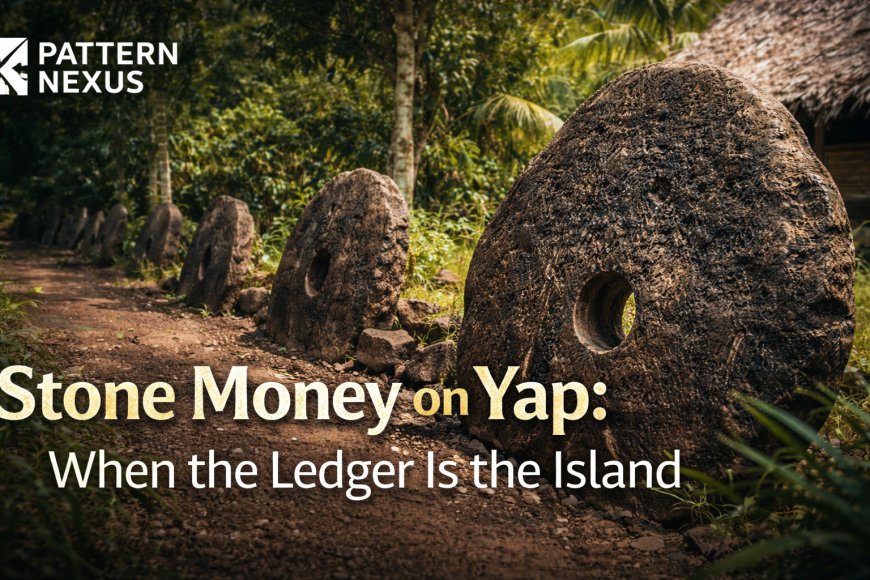
On Yap, massive stone disks called rai functioned as money even when they never moved. Ownership moved through public consensus, proving money is a control system: a ledger, validators, and enforcement.

Money is not “the thing.” Money is the agreement around the thing, enforced by a validation layer.
Settlement is a state change in a ledger. Movement of objects is optional. Finality is what matters.
Warning: If the ledger becomes private, centralized, or manipulable, the “money” becomes a control lever, not a neutral unit.
“Value” is often just legibility plus enforceability. If the network can audit the claim, the claim can carry weight.
“Hard” money is not just scarcity. It’s also the cost to issue, the cost to counterfeit, and the credibility of the ledger that tracks it.
The Yap Model: Legibility, Not Utility
On Yap, the rai isn’t valuable because it’s useful. It’s valuable because it’s legible.
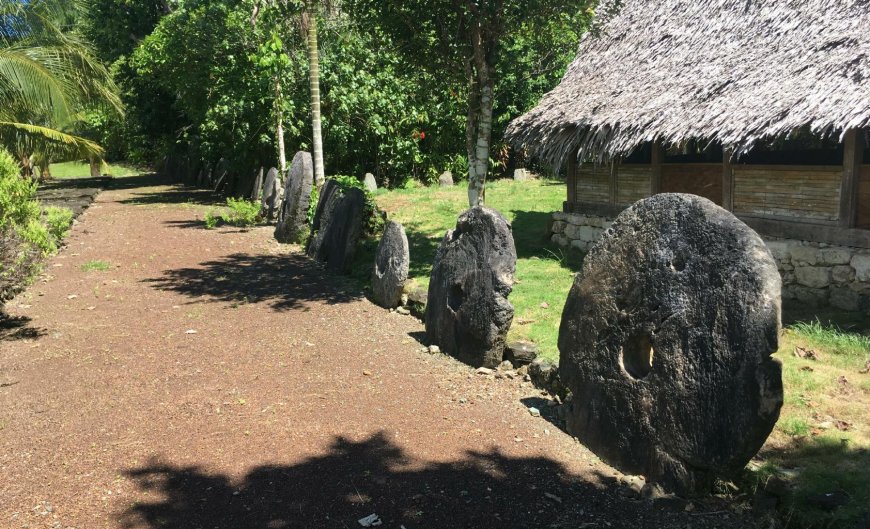
A big rai sitting by a path isn’t “spent” the way a coin is spent. It’s referenced. It’s pointed to. It’s invoked. The rock is just the physical anchor for the real asset: the island’s collective agreement about who controls it.
If the “money” never moves but the economy still clears transactions, you are forced to see the real mechanism: a ledger plus validators plus enforcement. The stone is a physical pointer that makes the record hard to fake.
This is what we're explaining: money can be anything. It can be shells, metal, paper, digits, or a rock that never moves. What matters is whether the system can define ownership, transfer ownership, validate the transfer, and enforce the record.
“The wealthiest person doesn’t carry their wealth. The biggest stone sits in public view. Everybody knows who owns it. And nobody moves it. If you don’t understand that, you don’t understand money.”
Issuance and Scarcity: Why Palau Matters
The system works because the supply is hard.
The best stones were quarried far away, in Palau — a multi-day open-sea run, then brutal extraction and carving, then hauling it back. That difficulty mattered because it made “new issuance” expensive and slow. Scarcity wasn’t a slogan. It was logistics.
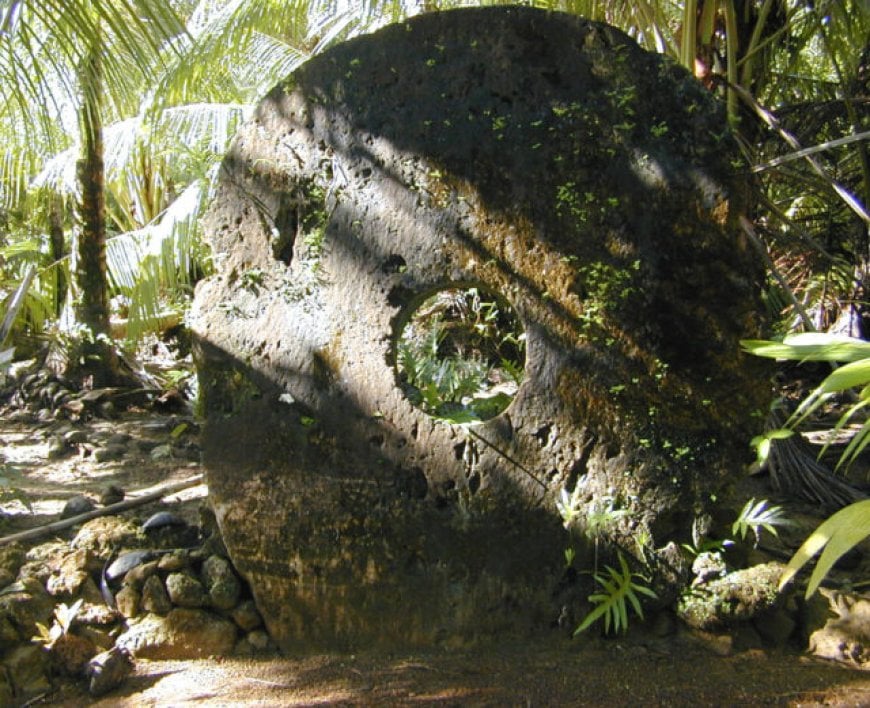
Rai are not just random rocks. High-value stones were historically produced from limestone-like material (often described as aragonite or calcite-rich stone) sourced outside Yap. That distance is a built-in issuance constraint: new “money” requires authorization, labor, risk, logistics, and time.
The system embeds scarcity through friction. Even if a stone is “just stone,” it is not “just stone” when it requires a dangerous voyage, specialized carving, and communal coordination to bring it home. That effort becomes embedded value, and the story of acquisition becomes part of the stone’s pricing.
- Issuance is costly because production and transport are non-trivial.
- Value includes provenance because the stone’s “story” functions like a credibility premium.
- Counterfeiting is constrained because the network audits what “real issuance” looks like.
Scarcity isn’t just “limited supply.” Scarcity is “issuance is gated.” The gate can be distance, danger, tooling, social permission, or all of the above. This is a control layer.
Settlement Without Movement: How Ownership Transfers
The ledger is social and public.
Big stones were generally left in place. Transfers could be handled by announcement and shared recognition, sometimes with marks, because everybody knows everybody. Ownership moves — not the object — and the record is carried by communal knowledge.
No trucks. No guards. No vaults. The enforcement mechanism is communal memory, status, and consequence.
If the community recognizes the transfer, it is final. If the community disputes it, it is not. The settlement layer is the people plus the authority structure that resolves disputes.
The clean model is:
- Asset: the stone disk, as a physical anchor for a claim
- Ledger: public knowledge of ownership and provenance
- Validators: witnesses, elders, chiefs, and community consensus
- Enforcement: social consequence, authority, and reputational constraints

This is why our line lands: money can be anything. The thing is not the system. The system is what turns “thing” into “claim,” and “claim” into “permission.”
A young man asks why the largest stone isn’t guarded. The elder answers: “Because you can’t steal what you can’t validate. Touching the rock isn’t the transaction. Changing the record is.”
Provenance: “History” as a Collateral Premium
“History” is collateral premium.
Not all rai are equal. Age, size, craftsmanship, and the risk story attached to acquisition affect value. A stone’s story is not decoration; it’s pricing input. It’s how the network decides what the anchor is worth.
In modern terms, provenance is credit. It’s the difference between a claim the system trusts and a claim the system discounts. On Yap, that trust is encoded in narrative memory and public witness. In modern finance, it’s encoded in documentation, custody chains, audits, legal frameworks, ratings, and institutional credibility. Different implementation. Same function.
The stone is “backed” by the story, and the story is “backed” by the network’s ability to enforce the record.
The Lost Stone Principle: Ledger Over Physical Custody
And here’s the part that’s pure control-system poetry: there’s a frequently cited anecdote (recorded in early anthropology accounts) where a family’s wealth is partly anchored to a great stone that never even successfully arrived the normal way — the stone’s “reality” is upheld by the ledger, not by physical custody.
That is the point in its most violent form: custody is not the asset. The ledger is the asset.
Once a society accepts that “the record” is what matters, money becomes a protocol. The object becomes optional. All you need is (1) an anchor, (2) a ledger, and (3) a governance layer that can declare finality and punish fraud.
If a “lost” stone can still hold value because the network agrees it does, you’ve proven that money is not material. It’s a coordinated belief system with enforcement.
Governance and Attack Surfaces: What Breaks the System
Every monetary system has attack surfaces. Yap is just transparent enough that you can see them without modern complexity hiding the mechanics.
- Ledger capture: If a small group can rewrite “who owns what,” the system becomes a control tool.
- Validation failure: If trust collapses, transfers stop being final and disputes spike.
- Issuance shock: If new stones can be produced too easily (tools, ships, external support), the scarcity model changes and the claim map destabilizes.
- External enforcement mismatch: When an outside authority imposes new rules, you can get parallel ledgers competing for legitimacy.

This is where our “control system forever” framing becomes unavoidable: money is governance. It always was. The only question is whether the governance is obvious (Yap) or hidden behind institutions and interfaces (modern finance).
Modern Mapping: Banks, Markets, Token Rails
If you strip away the exotic framing, Yap is just a clean demonstration of what money always is: money is a control system for coordinating claims.
- Who owns what
- Who can transfer what
- What counts as “final”
- Who validates the transfer
- What happens if there’s a dispute
- How new units enter the system
- How status/power shapes access
On Yap, the “validators” are the community and the chiefs’ authority structure (because the system doesn’t run without governance). On modern rails, it’s banks, courts, regulators, payment networks, central banks, custodians, and the compliance layer. Different costume. Same machine.
A rai stone is a physical placeholder for a social database. Most modern money is a digital placeholder for an institutional database. In both cases, the asset is the ledger’s credibility.
And once you understand that, you stop getting hypnotized by “what it’s made of.” You start tracking the control stack: issuance, validation, settlement, enforcement, and the ability to gate access.
This is also where our broader Pattern Nexus framing slots in cleanly:
- Base layer: “real” anchors (reserves, collateral, Treasuries, commodities, energy, hard assets)
- Ledger layer: balance sheets, custody, clearing, payment networks, market plumbing
- Governance layer: law, regulators, compliance, sanctions, standards, permissioning
- Leverage layer: claims built on claims (rehypothecation, derivatives, collateral reuse, synthetic liquidity)
Same structure, higher resolution, more layers, more leverage. The only “new” thing is speed and scale.
Story Draft: Kaleu and the Stone
The rock sat there like it had always been there.
Not hidden. Not guarded. Not locked away in a vault. Just parked by the path near the meeting house, half sunk into the dirt, the center hole dark like an eye.
A man could walk up to it, put his hand on it, and pretend — for a second — that he could take it.
But you couldn’t take it. Not in the way that mattered.
Everybody on the island knew whose stone it was. They knew the story of it. They knew how far it came, what it cost to bring it here, and which families had held it before. If you tried to roll it away at night, you’d just be dragging a rock through the jungle.
The ownership wouldn’t move.
Kaleu stood with his son at the edge of the path while the elders spoke.
His son was at that age where he could feel power but didn’t understand it. He kept staring at the big stone, like it was a prize you could win by force.
“Why don’t we put it somewhere safer?” the boy asked.
Kaleu didn’t answer right away.
Because the question itself was the lesson.
“Safer from who?” Kaleu finally said. “From you?”
The boy’s face tightened.
Kaleu crouched and ran his fingers along the stone’s rough edge. The surface was pitted, old, weathered like bone. He could feel the years in it. He could feel the weight of men who had died on the sea trying to bring stones like this back from Palau — days across open water, navigating by skill and memory, gambling against weather that didn’t care about your plans.
“This stone isn’t money because it’s stone,” Kaleu said. “It’s money because it’s remembered.”
The elders had finished their exchange and now the talk had shifted. A land boundary. A marriage. Compensation for a wrong that had to be balanced. The kind of transaction that wasn’t about buying fish. It was about resetting the map of who owed who, and who stood where.
The old chief lifted his chin toward the rai and spoke one sentence, calm as a man naming the tide.
That was it.
No one dragged the stone. No one rolled it. No one chipped off a piece like a coin. Nothing physical changed at all.
But everyone heard it.
Everyone saw it.
And because everyone saw it, it became real.
The boy blinked. “That’s it?”
“That’s settlement,” Kaleu said.
The boy didn’t like the word.
“What if somebody lies?” he asked.
Kaleu stood up slowly.
Now they were finally inside the machine.
“Then they’re not stealing stone,” Kaleu said. “They’re attacking the ledger.”
He nodded toward the circle of men.
“And the ledger isn’t the rock. The ledger is us.”
The boy looked at the elders again, and for the first time, he didn’t see them as old men talking. He saw them as the enforcement layer.
Kaleu leaned closer, lowering his voice.
“You want to understand what money is?” he said. “Stop looking at what it’s made of. Look at what it controls.”
The boy frowned. “What does it control?”
Kaleu pointed at the meeting house, at the path, at the village, at the whole island that ran on invisible agreements.
“It controls permission,” he said. “It controls access. It controls status. It controls who can say ‘this is mine’ and have the world accept it.”
He let that sit for a moment.
“People think money is a thing,” Kaleu continued. “It’s not. Money is a protocol.”
The boy’s eyes narrowed. “A protocol?”
“A set of rules that tells everybody what counts,” Kaleu said. “Who gets to create claims. Who gets to transfer claims. What counts as proof. What happens if you challenge the record.”
He tapped the stone once, like knocking on a door.
“This is proof,” he said. “Not because it’s impossible to move. It’s proof because the story is harder to move than the rock.”
The boy looked down at the center hole. “So if I owned that stone… I could just… tell people?”
Kaleu almost smiled.
Now the kid was thinking like a banker.
He nodded toward the elders again. “Not you alone. You need witnesses. You need recognition. That’s why the biggest stones don’t need to move. They’re too visible to fake.”
They walked home as the sun slid down, and the stone stayed exactly where it was.
But the island had changed. The map of claims had shifted. The future would bend around that one sentence the chief spoke, because everyone agreed that sentence meant something.
That night, the boy couldn’t sleep.
He kept thinking about the stone sitting out there unguarded, and how it still couldn’t be stolen.
He kept thinking about how the real value wasn’t in possession. It was in consensus.
And somewhere in the dark, without realizing it, he finally understood the uncomfortable truth:
Money can be anything, as long as the system can enforce the belief.
Pattern Nexus Lens
Yap is the primitive, uncluttered version: a visible anchor asset + a public ledger + governance. The reason it hits so hard is because nothing is hidden. You can see the system.
Modern systems do the same thing with more abstraction:
- Modern base assets: reserves, collateral, Treasuries, commodities
- Modern ledgers: bank balance sheets, custodians, clearing houses, payment networks
- Modern governance: law, regulators, compliance, sanctions, standards
Same structure, higher resolution, more layers, more leverage. And the deeper continuity is the same question we keep circling in our broader work: who controls the ledger and who controls finality?
The stone is a prop. The island is the database. The elders are the validators. The social order is the enforcement. That is the machine. Everything else is implementation detail.
When people argue about whether something “counts” as money, they’re debating the prop. The real debate is always about control: issuance gates, validation authority, settlement finality, and enforcement jurisdiction.
FAQ
Did people use giant stones to buy everyday items?
The biggest rai were typically reserved for high-value transfers tied to status, land, alliances, compensation, and ceremonial exchanges. Smaller valuables and other local exchange items handled routine trade. The key is that the high-value layer proves the ledger principle in the clearest form.
If the stone doesn’t move, what does “spending” mean?
Spending is a recognized change of ownership in the public record. The transaction is the ledger update, witnessed and validated by the community’s governance structure.
What’s the modern equivalent of “everyone knows whose stone it is”?
It’s the credibility of institutional ledgers: bank records, custody chains, clearing houses, legal enforcement, and the policy layer that defines finality. Modern systems replace communal memory with formal infrastructure, but they do not escape the control stack.
What’s the biggest lesson to take from Yap?
Money is a protocol for claims. The “thing” is secondary. If the network can validate and enforce the record, the claims can move even when the object doesn’t.
Sources
Background on Yapese rai (fei) stone money, production, and how ownership functioned as a public ledger.
- Smithsonian (Gillilland): The Stone Money of Yap (PDF)
- Smithsonian NMAH: Rai Stone object record
- Smithsonian Re:Collections: Yap Island’s stone-cold cash
- Bank of Canada Museum: Rai: big money
- Rai stones overview and references
Ποια είναι η αντίδρασή σας;
 Μου αρέσει
0
Μου αρέσει
0
 Μη Αγαπημένο
0
Μη Αγαπημένο
0
 Αγάπη
0
Αγάπη
0
 Αστείο
0
Αστείο
0
 Ουάου
0
Ουάου
0
 Λυπημένος
0
Λυπημένος
0
 Θυμωμένος
0
Θυμωμένος
0

Founder of Pattern Nexus. I research markets, macro, geopolitics, AI, history, ancient systems, and the patterns most people overlook. I’m also building Market Radar, a trading scanner designed to read pressure, risk, confirmation, and setup quality before chasing a move. Pattern Nexus is where I connect the dots between data, history, technology, and the bigger system playing out around us.
















Σχόλια (0)