

Half-Century Mortgages and Fantasy Car Loans: How Ultra-Long Debt Turns Households Into Cashflow Collateral
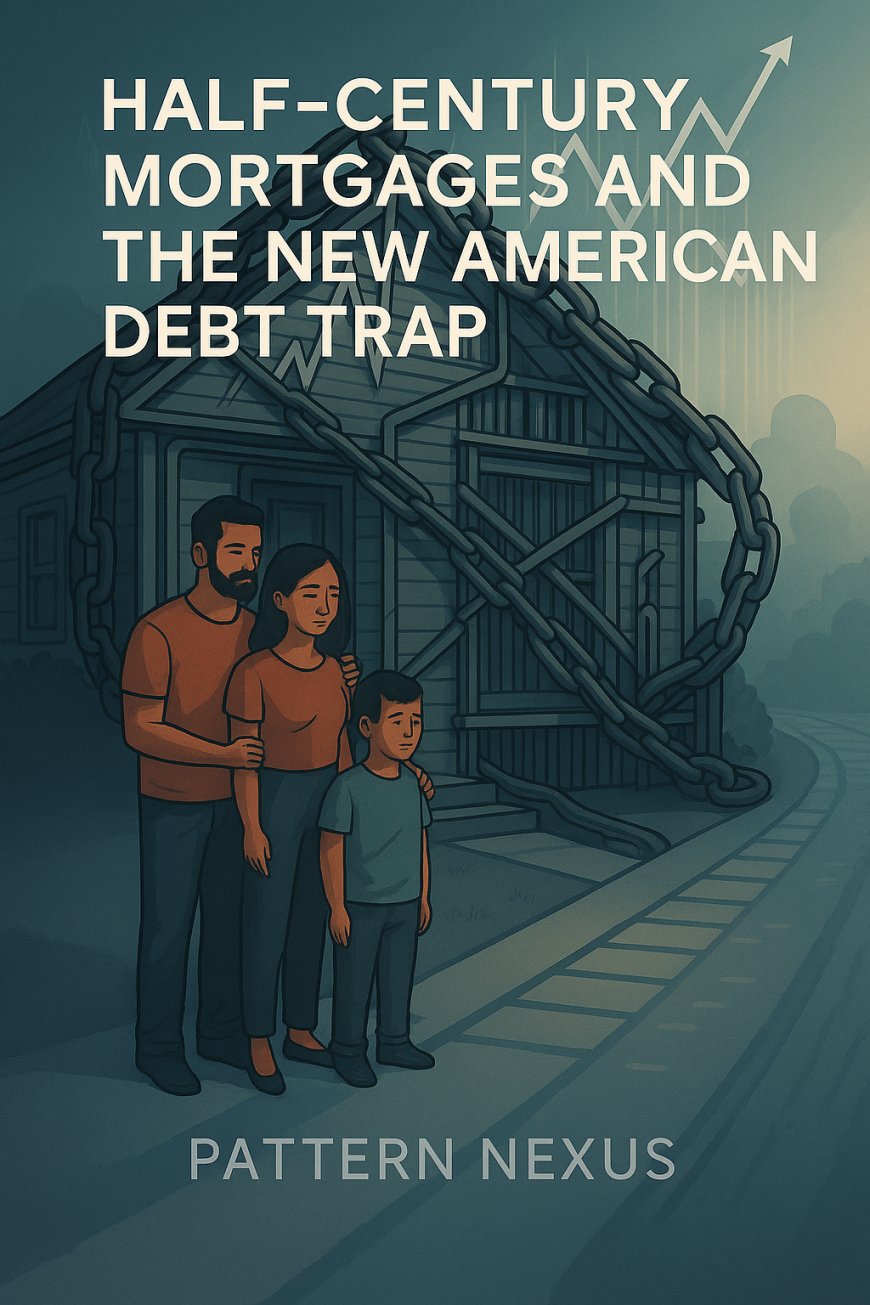
The Trump administration’s 50-year mortgage proposal, paired with viral rumors of 15-year car loans, is being sold as “affordability.” In reality, ultra-long debt structures double the interest burden, trap low-income households in lifetime payments, and weaponize credit against an already fragile workforce.
The Trump administration’s 50-year mortgage proposal, paired with viral rumors of 15-year car loans, is being sold as “affordability.” In reality, ultra-long debt structures double the interest burden, trap low-income households in lifetime payments, and weaponize credit against an already fragile workforce.
Jump to a section
- What the Administration Is Actually Proposing
- How a 50-Year Mortgage Really Works
- The 15-Year Car Loan Hoax and the Real Trend Behind It
- Why This Is a Debt Trap for Low-Income Households
- Pattern Nexus Lens: Credit Engineering in a Broken System
- What a Real Affordability Strategy Would Look Like
- FAQ: Key Questions About Ultra-Long Debt
- Conclusion: Affordability Theater in a Fragile Job Market
- Sources
What the Administration Is Actually Proposing
As of December 5, 2025, the Trump administration is openly exploring a 50-year, government-backed mortgage product. The concept is being pitched as a new tool to fight the housing affordability crisis. The story is simple and emotionally loaded: take a 30-year mortgage, stretch it to 50, lower the monthly payment, and suddenly homeownership is “within reach” for people who have been locked out.
The rhetoric leans on the most powerful symbols in U.S. economic mythology: the starter home, the yard, the family finally getting “out of renting.” It speaks in the language of rescue and inclusion: helping ordinary Americans, unlocking the American Dream, using “innovative” finance to bridge the gap. In soundbites and headlines, it scans as benevolent policy.
Inside the policy and housing world, the mood is very different. Early reporting has already hinted that parts of the administration and some housing officials were blindsided by how fast the idea was floated. That matters. When your own people quietly panic, it’s usually because the internal math and risk profile do not remotely match the public messaging.
Layered on top of this, social media produced a viral graphic claiming that the administration was also working on 15-year car loans, supposedly at presidential direction. Official channels, press releases, and feeds show no such initiative. The “announcement” was a fake.
But the hoax landed because it fit the trajectory people already live inside. We already normalize 72- and 84-month car loans. We already have consumers stretched to the edge of their income just to roll off the lot. When you juxtapose that reality with a 50-year mortgage proposal, a 15-year auto loan doesn’t feel like satire. It feels like the next patch in a broken system.
So the starting point is this: the 50-year mortgage is real policy exploration. The 15-year car loan is a fake headline that exposes a real direction of travel. Both orbit the same gravitational center: long-duration claims on household cashflow packaged as “solutions.”
How a 50-Year Mortgage Really Works
Strip away the talking points and the 50-year mortgage is mechanically blunt. It’s the same house, roughly the same price, similar or slightly higher interest rate, but stretched across almost two working lifetimes instead of one.
What the numbers actually look like
Take a middle-of-the-road example. Consider a $450,000 home financed with a conventional 30-year fixed-rate mortgage around 6.25%. The monthly principal and interest payment lands in the high $2,700s. Over 30 years, the total interest bill ends up a little over half a million dollars. You pay more in interest than the original note value, but in exchange you own the home outright by the time you hit retirement age, if life cooperates.
Now stretch that same basic loan out to 50 years.
- The monthly payment comes down into the mid-$2,400s. On paper, you “save” a few hundred dollars a month.
- The total interest bill balloons toward the vicinity of $1 million or more over the life of the loan.
- You end up paying roughly two times the original note value in interest alone.
Other modeled scenarios show the same pattern. A $360,000 loan with 10% down might shave off something like $200–$300 per month going from 30 to 50 years. But the total interest paid nearly doubles. A $500,000 loan can show a 50-year borrower saving only tens of dollars a month relative to the 30-year option, yet after three decades of payments they still owe close to the original balance.
The phrase “game changer” makes it sound like we discovered a new efficiency in the system. We didn’t. You are trading a small monthly discount for an enormous expansion in total interest. That is not innovation; that is leverage and time doing exactly what they always do.
Amortization as a wealth-transfer machine
Mortgage amortization already front-loads interest. In a standard 30-year mortgage, the first 10–15 years are dominated by interest payments. Only a small fraction of each payment goes to principal. The structure is tolerable because it roughly matches a working lifetime: if you buy somewhere in your 30s, you can realistically own the house free and clear by your 60s.
A 50-year mortgage shatters that alignment. It stretches that front-loaded regime over half a century. The early years of a 50-year loan are almost pure interest. Principal barely moves. Even after decades of steady payments, the remaining balance can look disturbingly close to what you started with.
From the household perspective, this converts homeownership into a long-term lease on money. You are renting capital for most of your adult life. From the lender and securitization perspective, you’ve manufactured a long-duration cashflow stream that can be sliced, tranched, and pledged into capital markets. One family’s paycheck becomes a steady coupon stream flowing into bond portfolios, mortgage-backed securities, and structured products.
And that’s before pricing in the risk premium. Longer terms equal higher risk for lenders. Over fifty years, the odds of something going wrong — job loss, illness, divorce, regional decline, technological disruption — are far higher than over fifteen or thirty. That risk does not evaporate. It shows up as higher interest rates or stricter underwriting for those very borrowers the product is supposedly “helping.”
Why the optics and the economics diverge
The power of this product is entirely in the optics. The selling point fits on one line of a campaign brochure: “We lowered your payment.” The cost does not. The cost lives in amortization tables, compounding curves, and theoretical totals that most people will never calculate and many will never reach because real life will interrupt the loan.
That gap between visible benefit (smaller payment today) and invisible cost (much larger total interest over decades) is where the system harvests value. It exports a little short-term relief to the borrower and imports a huge extended cashflow obligation to the financial sector. The slogan is “affordability.” The mechanism is lifetime rent on capital.
The 15-Year Car Loan Hoax and the Real Trend Behind It
The 15-year car loan meme is fake as a policy proposal, but painfully real as a directional signal. It didn’t gain traction because people are gullible. It gained traction because people are already living inside a stretched timeline of automotive debt.
The average new-car loan has crept toward six years. Loans of 72 and 84 months are increasingly normal for trucks, SUVs, and high-priced vehicles. For buyers with weaker credit, double-digit interest rates are common. The culture trains people to fixate on one number: the monthly payment. Everything else gets buried in the fine print.
Run a rough hypothetical. Take an average new car price around $49,000, assume a 7% interest rate, and extend it to fifteen years. The total interest bill lands somewhere near the cost of another entry-level car. You are paying interest that approaches the original sticker price of the vehicle.
That’s not mobility. That’s an extraction pipeline.
Cars are built on guaranteed decay. Every year, the asset loses value. Yet the loan balance declines at a slower pace. For much of the loan, you are “upside down” — you owe more than the car is worth. Any shock — job loss, accident, forced sale — locks in losses you cannot absorb. You are effectively trapped, paying down a rotting asset on an extended schedule.
So when people see a meme about a 15-year car loan alongside headlines about 50-year mortgages, they don’t ask, “Is this real legislation?” They ask, “Is this where we’re heading?” Because culturally and financially, we are already behaving like 15-year loans would just be one more notch on the timeline, not a structural break.
The meme is fake. The direction is not. The reflex is the same as housing: don’t challenge prices, don’t challenge wages, don’t challenge dealer margins or manufacturer pricing power. If people can’t afford the payment, just stretch the term until the screen shows a number they can barely manage.
Why This Is a Debt Trap for Low-Income Households
Interest that overwhelms the note value
From a real estate operator’s perspective, a 50-year mortgage is not an affordability tool. It is a cashflow-harvesting tool. It is a long-duration annuity carved out of a household’s future earnings.
On a $450,000 loan, paying near or above $1 million in interest over fifty years is not a rounding error. It is the design. You aren’t just buying shelter; you are buying a lifetime subscription to your lender’s income stream.
For low-income and working-class borrowers, that subscription competes directly with the cashflow they need to build any kind of base: emergency savings, retirement contributions, education for their kids, seed money for a small business, paying down other debts. Instead of accumulating capital, they continually service someone else’s asset — their loan — for decades.
At a certain point, the line between principal and interest loses meaning. The house is no longer a vehicle for storing your effort. It becomes a conduit for moving your effort into a financial pipeline whose primary beneficiaries you will never meet.
Decades of vulnerability in an uncertain job market
A 50-year mortgage assumes a life path that no longer exists: stable employment, predictable wages, slow career progression, and modest technological change. The real world is the opposite. The labor market is being shredded and reordered by automation, AI, offshoring, demographic shifts, and corporate restructuring.
For working-class borrowers especially, employment is increasingly contingent. Gig work, contract work, and just-in-time hours are common. Benefits are fragile. Wage growth is uneven. Volatility is normal. Now drop a half-century payment obligation on top of that volatility and call it “help.”
Lose your job, the payment is still there. Your industry gets eroded by AI, the payment is still there. You get sick, your spouse needs care, your region falls into decline — the payment is still there. Default risk doesn’t just live in the math; it lives in the gap between fantasy stability and real-world instability.
The harsh part is what happens when something breaks. Because you spend so long feeding interest, you don’t build protective equity. You can’t easily sell the house to cure the problem. You can’t tap the asset as collateral without taking on even more debt. The product that was supposed to stabilize your life becomes the lever that magnifies the damage.
The auto side: paying interest on a decaying asset
On the car side, the math is even more ruthless. A long auto loan on a rapidly depreciating asset is wealth extraction almost by design. Subprime borrowers — the ones with the least cushion — face the highest rates and the most aggressive term structures. They are steered into loans where the interest portion dominates and the collateral is evaporating every year.
For many of these buyers, the vehicle is necessary to earn income at all. You need it to get to work, to cobble together gigs, to access basic services. That dependency gives lenders and dealers enormous leverage. The longer the term, the more completely they can drain your future earnings for the privilege of keeping your job.
When “choice” hides the absence of options
Politically, ultra-long loans are marketed as “options.” No one is forcing you to take a 50-year mortgage or an 84-month car loan. But in a world where wages, rents, and asset prices are badly misaligned, the practical choice set is narrow. For many households, the “option” is between an unsustainable conventional loan, an even worse ultra-long loan, or no access to housing and mobility at all.
This is how predatory structures hide inside voluntary contracts. The system produces conditions where the bad choice is the only realistic choice, and then congratulates itself for offering “flexibility.”
Pattern Nexus Lens: Credit Engineering in a Broken System
Pattern Nexus is not interested in the surface story of policy. It is interested in the machinery under the floorboards: the plumbing, the incentives, the feedback loops. Viewed through that lens, ultra-long consumer debt is not about helping households. It is about stabilizing an aging financial architecture that cannot run on organic wage growth and sane prices.
The real product is the payment stream
In a modern financial system, the loan is not the final product. It is raw material. A 50-year mortgage is not just a deal between a family and a bank. It is a half-century river of payments that can be modeled, rated, securitized, and traded.
On the back end, that payment river feeds a chain:
- Mortgage originators that earn fees and offload risk
- Servicers that skim a slice of each payment for decades
- Structured products that repackage those cashflows into different tranches of risk and yield
- Pension funds, insurers, asset managers, and foreign investors hunting for long-dated, predictable income streams
From this perspective, the key design variable is not “Does this help the borrower?” It’s “Does this create a stable, modelable, long-duration cashflow that can be plugged into portfolios?” The humanity of the debtor is not central to the algorithm. Their predictability is.
Duration extension as macro patch
Ultra-long loans also serve a macro function. When real wages lag and asset prices levitate, the system faces a choice: let prices correct, or extend credit to keep demand afloat. Over the last few decades, the default choice has been to extend and pretend — stretch credit terms, lower underwriting standards at cycle peaks, and rely on policy backstops when things break.
A 50-year mortgage pushes that logic to the edge. It doesn’t fix the mismatch between incomes and home prices. It just stretches the mismatch across time. Instead of admitting that houses cost too much relative to the median paycheck, the system declares that the median paycheck will now be pledged for half a century.
Households as shock absorbers for systemic risk
From a Pattern Nexus vantage point, the most important thing about ultra-long loans is not the monthly payment. It is where the risk goes when something cracks.
Mortgage-backed securities, auto loan ABS, and related instruments sit across the balance sheets of banks, insurers, pensions, and funds. Their stability is a political and regulatory priority. When a downturn hits, policymakers have demonstrated again and again that they will mobilize to protect the system: emergency facilities, liquidity lines, guarantees, rate cuts, special programs.
Individual households get nothing like that treatment. When things go wrong, the first line of defense is their savings, their fragile equity, and their credit. They are the shock absorbers. Ultra-long loans ensure that they remain in that position for a much longer stretch of time. They turn episodic vulnerability into a persistent operating condition.
AI, labor bifurcation, and a half-century bet
Overlay the AI-industrial transition on top of this. We are not in a stable labor regime. We are moving into a world where entire categories of work are being automated or restructured. Productivity will rise, but the distribution of that productivity is already skewed. High-skill, capital-aligned workers capture outsized gains. Routine and mid-skill workers face compression, displacement, or churn.
Now ask what it means to lock a working-class household into a 50-year bet on that future. You are asking people with the least bargaining power, the least savings, and the most exposure to automation risk to commit to a debt horizon that stretches beyond their career horizon. That is not just financially aggressive. It is structurally reckless.
Policy theater as narrative cover
Finally, there is the narrative layer. The 50-year mortgage is not being sold as a way to extend the life of an over-levered system. It is being sold as a compassionate response to a housing crisis. That is how policy theater works. The theater provides emotional cover while the machinery under the stage does what it was always going to do: protect asset prices, sustain portfolio income, and keep the credit engine spinning.
From a Pattern Nexus lens, this is the real role of ultra-long loans: they are narrative instruments. They translate systemic necessity (“We need more duration and more collateralized cashflow”) into political virtue (“We are helping you afford a home”). The human being trapped inside the amortization schedule becomes a character in someone else’s story.
What a Real Affordability Strategy Would Look Like
If you truly wanted to address affordability instead of staging it, you would not start by asking, “How far can we stretch the loan?” You would start with much harder questions: “Why are prices this high? Why are wages this fragile? Why is the system depending on leveraged households to keep functioning?”
Housing: more supply, less gimmick
On the housing side, a serious affordability agenda would focus on fundamentals instead of term gymnastics:
- Expanding supply where people actually work: build more units near employment centers, infrastructure, and transit, rather than pushing families deeper into exurbs and lengthening their commute and fuel exposure.
- Attacking local bottlenecks: rework zoning and permitting regimes that make it almost impossible to build multifamily housing, accessory dwelling units, or missing-middle options in high-demand regions.
- Compressing cost structures: encourage streamlined codes and inspection processes that preserve safety without layering redundant delay and expense. Support modular and industrialized construction that actually lowers unit costs instead of treating every project as bespoke.
- Designing finance around equity-building: promote shorter-term, smaller-balance starter loans that households can realistically pay off or roll forward without swallowing half a lifetime in interest.
Autos: honest pricing and transparent risk
For vehicles, a real strategy would attack the game at the dealership and lender level, not by stretching terms:
- Crack down on fee stacking and junk add-ons that inflate the financed amount.
- Force clear disclosure of total cost over the life of the loan, not just the monthly payment.
- Clamp down on the steering of subprime borrowers into the worst possible rate and term combinations.
- Encourage product designs and transit investments that reduce the necessity of taking on massive debt just to access work.
The common denominator in real reform is simple: help households own their assets sooner, with less leverage and less interest, and leave more of their income available to build resilience.
Macro: stop outsourcing stability to household debt
At the macro level, an honest affordability agenda would admit that the system relies too heavily on household leverage for stability. It would focus on:
- Strengthening wage floors relative to housing and transport costs.
- Expanding social insurance and shock absorbers so that a single disruption does not trigger a spiral into default.
- Rebalancing tax and regulatory structures that privilege debt-fueled asset price growth over broad-based income security.
None of that is as easy as announcing a 50-year mortgage. All of it is more real than promising relief through a longer leash.
FAQ: Key Questions About Ultra-Long Debt
Does a 50-year mortgage really help me if my income is low?
It may lower your monthly payment compared to a 30-year loan, but that “help” comes at the cost of dramatically higher total interest. You are not getting a cheaper house. You are getting a more expensive loan. For many low-income borrowers, that means paying interest that can exceed the original note value by a factor of two, in a life where their job, health, and region are anything but guaranteed.
Isn’t some equity better than renting forever?
In principle, owning can be better than renting. But with a 50-year mortgage, equity builds so slowly that for many years the difference between owning and renting is mostly psychological. If home prices flatten or fall, or if you have to sell or move sooner than expected, you may find that the equity you thought you were building exists mostly on paper. Meanwhile, the interest dollars you burned are very real.
Couldn’t I just refinance later into a shorter term?
Refinancing later assumes a perfect chain of conditions: your income holds up, your credit score stays strong, interest rates cooperate, and your home’s value doesn’t collapse. That is a fragile bet across half a century. Often, the moment you most need a better loan is the moment you are least able to qualify for it.
Are 15-year car loans really coming?
Right now there is no official policy setting up 15-year car loans. The viral “announcement” was fabricated. But the drift toward longer terms is already real: the average auto loan term has been stretching, and loans of seven years or more are common. The meme felt believable because the credit culture is already moving in that direction, not because someone signed a bill.
Why do lenders and investors like ultra-long loans?
Because ultra-long loans manufacture long-duration cashflows. A 50-year mortgage creates a stream of payments that can span multiple market cycles and feed a wide range of portfolios. The longer the term, the more total interest is paid, and the longer that income can be modeled and sold. Your “affordability tool” is someone else’s yield engine.
Is this only a problem for low-income borrowers?
The structure is warped for almost everyone, but low-income and subprime borrowers are hit hardest. They face higher rates, thinner buffers, and more exposure to job and health shocks. For them, a half-century mortgage or extreme car loan is not just inefficient. It is a trap that can cost them decades of potential mobility. Higher-income borrowers may survive the structure; lower-income borrowers are much more likely to be broken by it.
Conclusion: Affordability Theater in a Fragile Job Market
The 50-year mortgage proposal and the viral 15-year car loan meme come from different places, but they rhyme. They are both expressions of the same instinct: when the system is under strain, don’t change prices, don’t change wages, don’t change power. Change the length of the leash.
From the vantage point of someone who actually deals with housing on the ground, the pattern is obvious. You are not empowering low-income or working-class families when you place them into structures where they pay interest two times over the note value and carry debt toward old age. You are converting them into a long-term cashflow instrument in a system that treats income streams as collateral and human beings as inputs.
We could choose a different path. We could confront why home prices and wages drifted so far apart. We could invest in building more units where they are actually needed instead of papering over scarcity with creative amortization. We could normalize shorter debt horizons and faster equity-building instead of designing products that assume people will be tethered to payments for life.
Instead, we are flirting with a half-century mortgage and sharing jokes about 15-year car loans in a world where those jokes feel uncomfortably plausible. That is not progress. That is a quiet conversion of human time into collateral streams, wrapped in a language of compassion.
Call it what it is: not affordability, but affordability theater. Not liberation, but long-term servitude dressed up as “options.” In a fragile job market, on the edge of an AI-driven restructuring of labor, choosing ultra-long debt as the policy answer is not innovation. It is a decision to secure the system by extending claims on the very people the system has already failed.
Sources
- WTTW / CNN – Trump Floated a 50-Year Mortgage. Is That a Good Idea?
- CBS News – What the Trump administration’s 50-year mortgage plan could mean for homebuyers
- Axios – Trump administration’s 50-year mortgage idea ditches a key advantage
- Forbes – A 50-Year Mortgage Is A Terrible Idea; But So Is The 30-Year Mortgage
- Cars.com – 15-Year Car Loans Aren’t a Thing, But Americans Are Getting More Comfortable With Long Loan Terms
- Newsweek – Fact Check: Is Donald Trump Planning 15-Year Car Loans?
- Politico – ‘Band-aid,’ ‘distraction’: Experts slam Pulte, Trump 50-year mortgage idea
Mikä on reaktiosi?
 Tykkää
0
Tykkää
0
 Epätäydellinen
0
Epätäydellinen
0
 Rakkaus
0
Rakkaus
0
 Hauska
0
Hauska
0
 Vau
0
Vau
0
 Surullinen
0
Surullinen
0
 Vihaisa
0
Vihaisa
0

Nexus (Christopher)
Founder of Pattern Nexus. I research markets, macro, geopolitics, AI, history, ancient systems, and the patterns most people overlook. I’m also building Market Radar, a trading scanner designed to read pressure, risk, confirmation, and setup quality before ch…
Related research

The Wall Street Single-Family Ban: The Action, the Housing Math, and Where the Ownership Actually Sits
Trump says he will ban large institutional investors from buying single-family homes. Here’s the real housing inventory math, what share in…
5 shared topics, same research avenue.
The Coastal Housing Repricing Map: Where the U.S. Housing Plateau Is Starting to Crack
The U.S. housing market is not crashing everywhere. It is repricing where the affordability stack broke first: coastal price towers, insura…
3 shared topics, same research avenue.
Housing QE by Proxy: How Weaponizing Fannie and Freddie’s Buffers Turns the GSEs into Political Liquidity Machines
Floating the idea of using Fannie Mae and Freddie Mac’s capital buffers to buy mortgages is more than a housing tweak. It’s an attempt to r…
3 shared topics, same research avenue.
Debt Is Not Income: How Asset-Based Living Legally Escapes the Tax Trap
The tax system taxes transactions, not wealth. Learn how borrowing against appreciated assets allows individuals to legally fund their live…
3 shared topics, same research avenue.
The K-Shaped Recovery: Why the Bottom Half Can’t Survive Without Subsidies
The K-shaped recovery has split America into two economies: a subsidized bottom that mathematically cannot survive on wages alone, and an a…
3 shared topics, same research avenue.
The Lock-In Economy: Why America’s Housing Market Remains Frozen
The Lock-In Economy: Why America’s Housing Market Remains Frozen (2025) Meta Description: Rates above 7 percent created a lock-in freeze a…
3 shared topics, same research avenue.
🏠 The Great Housing Plateau: Why the American Dream Is No Longer a Ladder
The housing market was once a ladder — a path from one stage of life to the next. Now, for most people, it’s a plateau. The combination of …
3 shared topics, same research avenue.
The New Fed Chair Does Not Inherit an Economy. He Inherits the Permission Stack.
Kevin Warsh is not simply inheriting the Federal Reserve. He is inheriting the control layer where inflation, debt service, Treasury fundin…
3 shared topics.
Kommentit (0)
Security Check
Please complete the captcha to verify you are human.