

ADP Just Printed a Split Labor Market: Small Firms Cut, Mid/Large Firms Hire
The latest ADP data shows a bifurcated labor market: small employers are shedding jobs while mid-sized and large firms add. ADP’s NER Pulse also signals a late-November rebound after several weeks of losses.
The latest ADP data shows a bifurcated labor market: small employers are shedding jobs while mid-sized and large firms add. ADP’s NER Pulse also signals a late-November rebound after several weeks of losses.
Jump to a section
Published: December 2025
By: Pattern Nexus
This isn’t a clean “jobs up / jobs down” headline. The internals show a bifurcated market: small employers are contracting while mid-sized and large employers add. ADP’s NER Pulse (weekly 4-week moving average) also suggests hiring firmed in late November after several weeks of losses.
Snapshot
Bottom line: ADP is showing two realities at once. The weekly pulse suggests late-November hiring improved, but the firm-size breakdown shows where the stress is concentrated: small firms cut while mid-sized and large firms hire. That is not a uniform labor market. It is a labor market that is redistributing toward scale.
- Weekly signal: NER Pulse turned positive in late November on a 4-week moving average basis.
- Structural signal: Small employers (1–49) are net negative while mid-sized and large employers remain net positive.
- Core interpretation: “Jobs” is not one thing. The system is selecting winners by balance-sheet endurance and pricing power.
When you combine high-frequency stabilization (Pulse) with size-tier bifurcation (firm-size), you get a very specific picture: the labor market can look stable in aggregate while the bottom layer of the private economy is actively de-risking.
NER Pulse Weekly Signal
ADP’s Media Center release on December 16, 2025 reports that for the four weeks ending November 29, 2025, U.S. private employers added an average of 16,250 jobs per week on the NER Pulse’s four-week moving average (seasonally adjusted). ADP describes this as “continued strengthening during the second half of November” and notes it may signal a rebound after four weeks of losses, with values preliminary and subject to revision.
NER Pulse (Four-week moving average, seasonally adjusted)
- Week ending 11/29/25: 16,250
- Week ending 11/22/25: 2,750
- Week ending 11/15/25: -9,250
- Week ending 11/8/25: -12,000
- Week ending 11/1/25: -7,250
- Week ending 10/25/25: -4,750
- Week ending 10/18/25: 11,500
- Week ending 10/11/25: 10,250
- Week ending 10/4/25: 4,250
- Week ending 9/27/25: 11,750
- Week ending 9/20/25: -7,750
- Week ending 9/13/25: -9,500
Important: This weekly pulse is a high-frequency estimate using a four-week moving average with a two-week lag. It can rebound even while the firm-size internals remain bifurcated. The weekly signal tells you “direction.” The size breakdown tells you “distribution.”
Think of the Pulse as the “surface current.” Useful, fast, and noisy. Then think of the firm-size table as the “pressure map.” Slower, more structural, and directly tied to survivability. Both can be true at the same time: the surface can calm while the pressure keeps shifting underneath.
Chart: NER Pulse Trend
Firm-Size Breakdown
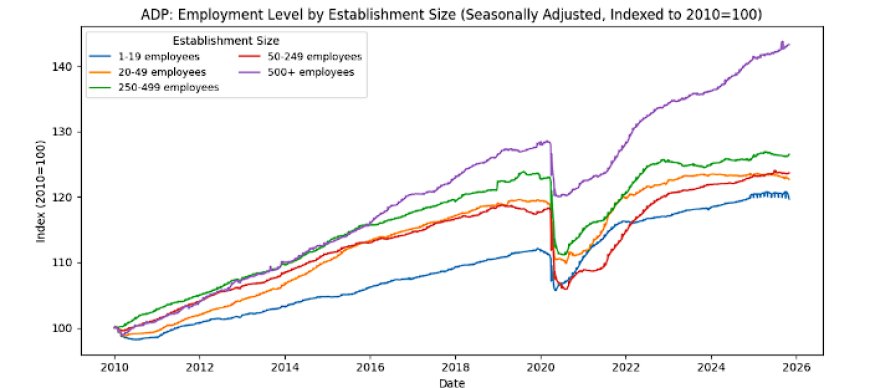
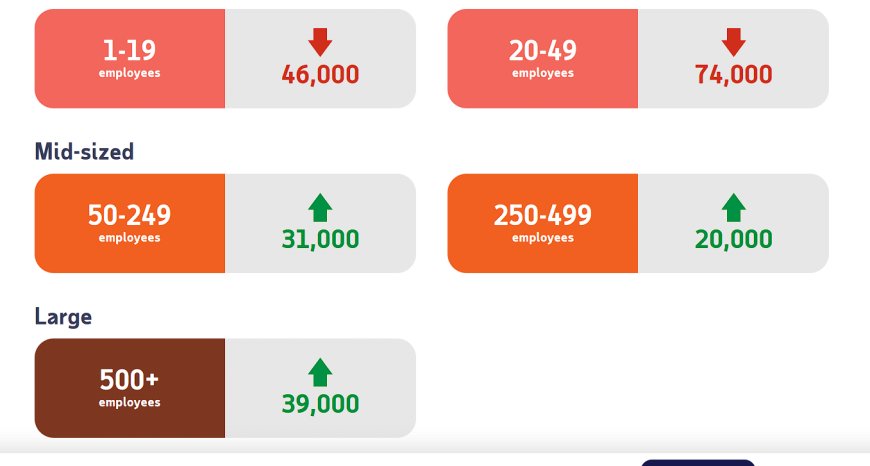
The employer-size breakdown is where the story becomes structural. Small firms are trimming payrolls while mid-sized and large firms keep adding. That isn’t “uniform strength.” It is a concentration pattern consistent with tighter financial conditions, higher fixed costs, and regressive overhead that punishes the bottom of the business stack.
Latest firm-size moves (net jobs)
- 1–19 employees: -46,000
- 20–49 employees: -74,000
- 50–249 employees: +31,000
- 250–499 employees: +20,000
- 500+ employees: +39,000
Interpretation: The weekly pulse can stabilize while the economy continues consolidating underneath. The split tells you where power and survivability are shifting. Small business is the first layer to de-risk when the system is tight.
Notice what this is not. It’s not a “labor shortage solved” story. It’s not “the economy is great” because one segment is hiring. It’s a sorting mechanism. The labor market is being reallocated toward entities with access to cheaper capital, better procurement, more pricing power, and more operating slack.
Chart: Net Change by Firm Size
Long-Run View
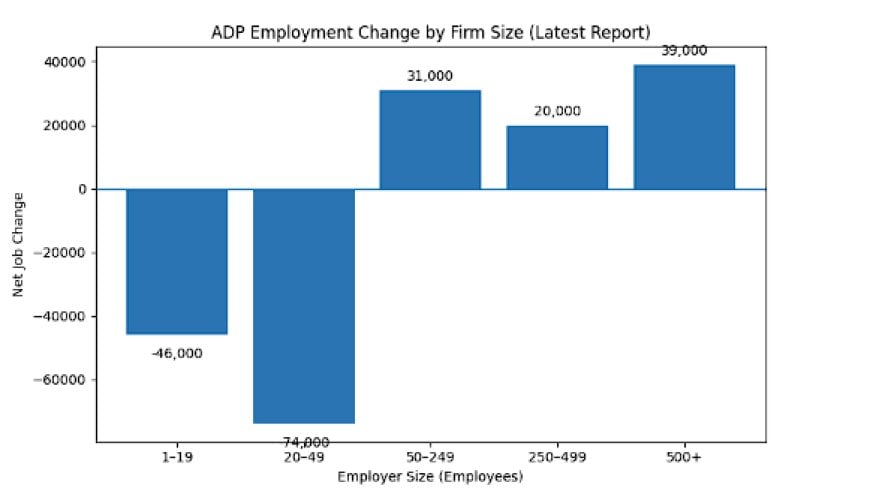
Short-term prints get headlines. The long-run drift tells you what kind of system you’re living in. When you index ADP’s establishment-size employment levels to a common baseline (2010 = 100), the concentration trend becomes visible: employment growth shifts toward larger firms over time, and that concentration tends to accelerate after shocks.
This is the part most people miss. The labor market doesn’t just fluctuate. It evolves. It becomes more centralized, more balance-sheet-driven, and more dominated by firms that can withstand tight regimes. When you see that in the indexed chart, you’re not looking at a “cycle.” You’re looking at a structural selection process.
Chart: Indexed Employment by Size
Mechanics: What This Report Is Really Measuring
To go deeper, you have to separate what ADP is measuring from what people think it measures.
- Pulse is speed, not structure: The NER Pulse is a smoothed, lagged read on near-term payroll momentum. It can turn positive while the internal distribution remains fractured.
- Firm-size is structure, not mood: The firm-size breakout is a direct signal of who is expanding payroll capacity and who is shedding it. That’s survivability, not sentiment.
- Seasonal adjustment hides and reveals: SA helps trend clarity, but it also compresses volatility into “surprise” when the regime changes. That’s why the distribution table is so valuable.
- The labor market is a transmission channel: It reflects credit, overhead, pricing power, and demand. It is not an isolated economy widget.
Key idea: The ADP story is not “jobs.” It is the system’s risk allocation decision expressed through hiring. The question is always: who can afford labor right now, and who can’t?
Why This Split Happens
- Cost of capital: small firms are rate-sensitive and often refinance at worse terms or not at all; large firms can borrow and refinance on better terms, for longer durations.
- Pricing power: large firms pass costs through; small firms absorb margin compression until labor becomes the adjustment valve.
- Regressive overhead: compliance, insurance, payroll administration, benefits, and liability costs punish small employers disproportionately.
- Operating slack: smaller payrolls adjust faster because they have less buffer. A 12-person operation cannot carry “excess labor” the way a 12,000-person operation can.
- Procurement and scale advantages: input costs and supply reliability increasingly favor large buyers. Small firms lose twice: higher costs and lower demand tolerance.
- Technology as leverage: automation, software, and AI adoption are easier to deploy at scale, turning productivity tooling into a size amplifier.
In plain language: the system is not “anti-small-business” as a moral stance. It is structurally hostile to low-margin operators when rates are high, overhead is sticky, and volatility is elevated. The report is simply showing that hostility in payroll form.
Distribution Matters More Than Direction
This is the part that should be stapled to every jobs headline: an improving aggregate can be built on a deteriorating base.
- Direction: Pulse turns positive, headlines say “rebound.”
- Distribution: small business cuts, large business hires, the economy centralizes.
Pattern Nexus framing: If the labor market “recovers” by concentrating into fewer, larger employers, the system becomes more brittle even while it appears stable. Centralization increases sensitivity to shocks, policy errors, and sector-specific disruptions.
That is why a “soft landing” can still produce social and political stress. The aggregate may hold. The lived economy can still degrade if opportunity and bargaining power compress into fewer nodes.
Implications
For Main Street
- Small business becomes the shock absorber: layoffs happen first at the bottom of the size stack, often before aggregates weaken.
- Local demand fragility: communities dominated by small employers can soften faster and recover slower.
- Entrepreneurial churn: formation slows, survival rates drop, and the economy becomes less distributed over time.
For workers
- Bargaining power changes shape: if employment concentrates, wage-setting and career mobility become more centralized.
- Benefits bifurcate: large firms can sustain benefits structures that small firms cannot, widening job-quality divergence.
- “Good jobs” cluster: opportunity becomes more geographically and institutionally concentrated.
For the macro regime
- Concentration compounds concentration: jobs, pricing power, and policy influence increasingly concentrate together.
- Stability can be deceptive: a centralized system can look stable until it isn’t, then breaks harder.
Markets: How This Shows Up in Risk, Rates, and Narratives
Market narratives often treat labor data as a one-dimensional toggle: strong jobs means hawkish rates, weak jobs means dovish rates. That is too flat for the regime we’re in. The distribution layer is where the market signal hides.
- Equities: concentration tends to support index-level resilience (because large firms dominate indexes) while the underlying economy weakens at the bottom.
- Credit: small business stress is a credit story before it is a jobs story. Tight credit, higher spreads, and lower risk tolerance show up in payroll cuts among small employers first.
- Rates and policy: policymakers can point to “stable jobs” while small business is already in contraction. That lag is where policy errors are born.
- Inflation optics: if pricing power concentrates, inflation can persist in pockets even as demand weakens elsewhere, which complicates the “inflation is dead” narrative.
If you’re trying to read where the regime is going, don’t just ask “are jobs up.” Ask “who is hiring.” That tells you whether the system is broadening or consolidating.
Forward Scenarios
Scenario 1: Soft landing with consolidation
Pulse stays positive or near zero, the headline stays “fine,” but small firms remain negative while large firms absorb labor. Index-level markets can remain buoyant even as Main Street continues to de-risk.
Scenario 2: Broad slowdown
Mid-sized hiring rolls over next, then large firms pause. That’s when the aggregate catches up to what small business showed first. Watch for the 50–249 cohort to flatten and then print negative as an early tell.
Scenario 3: Re-acceleration
If financial conditions genuinely ease, the first real confirmation is not a one-week Pulse bump. It’s small cohorts (1–49) turning consistently positive. That is how you know the base is healing instead of the system merely centralizing.
Monitoring tells: 1–49 stabilization, mid-sized rollover risk, and whether large-firm hiring remains the marginal support beam for aggregate employment.
Pattern Nexus Lens
This report fits the Pattern Nexus control-system view: tightening regimes don’t just slow growth, they alter the topology of the economy. Capital access and pricing power become the selectors, and the labor market becomes the visible output of that selection.
Labor as a control surface
Employment is one of the fastest adjustable levers in the real economy. When margins compress, demand becomes uncertain, and credit becomes expensive, firms don’t philosophize. They adjust labor. That is why small business prints go negative early. They have the least slack.
The concentration machine
High overhead plus expensive capital creates a consolidation gradient. Larger firms can carry fixed costs, refinance liabilities, and absorb volatility. Smaller firms cannot. Over time, the system migrates toward the entities that can hold risk. That is exactly what the indexed chart is showing.
The headline trap
The aggregate jobs number is an average. Averages are famous for hiding structural damage. A stable headline can coexist with a rotting base if the growth is being centralized upward. That is how you get a “strong economy” in headlines and a stressed economy in lived experience.
PN conclusion: The ADP split is not an anomaly. It is the signature of the current regime. The labor market is consolidating, and the economy is becoming more balance-sheet-driven, less distributed, and more sensitive to the decisions of fewer, larger nodes.
Tie-Ins to Other Pattern Nexus Frameworks
This is not a standalone datapoint. It nests directly into several themes you’ve already been laying out.
K-shaped reality, but through employment concentration
When small employers cut and large employers hire, the “K-shape” isn’t just households. It’s the employer base itself. Opportunity, wages, and stability concentrate where the balance sheet is thickest. That’s why aggregate stability can coexist with rising stress in the bottom layers.
Liquidity cycle translation: tightening selects for scale
In a tight liquidity regime, survivability is not evenly distributed. The cost of money rises, risk tolerance falls, and the economy shifts toward large, funded entities. This is the labor-market printout of that liquidity selection process.
Control systems: centralization increases brittleness
As jobs concentrate into fewer employers, the system becomes more “single-point-of-failure” sensitive. That’s not ideology. That’s network topology. Fewer nodes matter more. Shocks become sharper. Policy mistakes become more expensive.
AI-industrial flywheel: tooling amplifies size advantage
Automation and AI tend to reward scale. Larger firms deploy productivity tech faster and more broadly. That doesn’t always reduce headcount immediately, but it does change hiring behavior: fewer marginal hires at small firms, more controlled expansion at large firms, and more capability per worker where investment is affordable.
Real economy optics: why headlines feel disconnected
Large firms dominate major indexes and major narratives. If large firms are still hiring, the “economy is fine” storyline persists. Meanwhile, small business can be in contraction for months. That disconnect is exactly where social tension builds, because people live in the distribution, not the average.
Practical integration: If you want this article to chain into our broader series, link it to our pieces on liquidity regimes, K-shaped stress, and control-system centralization. This ADP print is a clean supporting exhibit for all three.
FAQ
What is the NER Pulse?
ADP’s NER Pulse is a weekly estimate using a four-week moving average (seasonally adjusted) with a two-week lag, designed to track high-frequency employment trends.
Why can the pulse rebound while small firms still cut?
Because the pulse measures overall directional movement, while the firm-size split reveals distribution. You can have stabilization that still concentrates employment upward.
Does this mean recession is guaranteed?
No. But it does mean the base layer of the economy is de-risking. If mid-sized cohorts roll over next, recession odds rise. If small cohorts stabilize and turn positive consistently, the base is healing.
What should I watch next?
Watch whether 1–49 turns sustainably positive, watch whether 50–249 flattens, and watch whether 500+ remains the marginal support beam for headline employment.
Sources
- ADP Media Center: ADP National Employment Report Preliminary Estimate November 29, 2025 (Dec 16, 2025): https://mediacenter.adp.com/2025-12-16-ADP-National-Employment-Report-Preliminary-Estimate-November-29,-2025
- ADP National Employment Report portal: https://adpemploymentreport.com/
Mikä on reaktiosi?
 Tykkää
0
Tykkää
0
 Epätäydellinen
0
Epätäydellinen
0
 Rakkaus
0
Rakkaus
0
 Hauska
0
Hauska
0
 Vau
0
Vau
0
 Surullinen
0
Surullinen
0
 Vihaisa
0
Vihaisa
0

Nexus (Christopher)
Founder of Pattern Nexus. I research markets, macro, geopolitics, AI, history, ancient systems, and the patterns most people overlook. I’m also building Market Radar, a trading scanner designed to read pressure, risk, confirmation, and setup quality before ch…
Related research
Market Wrap – December 16, 2025: Delayed Jobs Print, Energy Weakness, AI Leadership Holds as the Curve Reprices Quietly
Markets finished mixed after a delayed jobs report and softening activity data. Energy weakened, gold firmed, AI leadership held, and the c…
5 shared topics, same research avenue.
Jobs on Pause: September 2025’s Delayed Report and the Great Employment Plateau
The delayed September 2025 jobs report shows 119k new jobs, 4.4% unemployment, and a labor market stuck in neutral—revealing the start of A…
5 shared topics.
Market Wrap 01.05.26: The Duration Bid Turns On Everything
Stocks ripped, metals ripped, and the 10-year backed off to ~4.16% as weak ISM data and Venezuela geopolitics pushed investors into duratio…
4 shared topics, same research avenue.
Market Wrap – January 14, 2026: Volatility Up, Commodities Hit, Crypto Holds
U.S. equities drifted lower with Nasdaq leading losses, VIX jumped, crude and metals pulled back, yields stayed steady, and Bitcoin remaine…
3 shared topics, same research avenue.
Energy Isn’t Spiking, Utilities Are: AI Baseload, Gas Turbines, and the Reprice of Energy Services
CPI “energy” is splitting into two stories: gasoline is deflating while electricity and utility gas inflate. This is a structural load + gr…
3 shared topics, same research avenue.
January 12, 2026: Metals Break Out, AI Leaders Grind Higher
A deep market wrap for January 12, 2026: equity indices edge higher, gold and silver rip to new highs, crypto and AI leaders stay bid, and …
3 shared topics, same research avenue.
January 7, 2026 — Rates Lead, Metals Diverge, Geopolitics Pressures the Tape
Equities faded, volatility rose, yields fell, and commodities cracked on January 7, 2026. Gold slipped while silver broke harder. Geopoliti…
3 shared topics, same research avenue.
Market Wrap-Up 01/02/2026: Equity Drift, Yield Reprice, Metals Hold, Dollar Soft Start
Stocks edged higher with mixed internals, yields moved, the dollar opened soft, and metals held firm as markets kicked off 2026. Full Patte…
3 shared topics, same research avenue.
Kommentit (0)
Security Check
Please complete the captcha to verify you are human.