

GW Ranch: Texas Builds Private Grids for the AI Flywheel
Pacifico Energy’s 7.65 GW permitted GW Ranch marks the shift to off-grid hyperscale power islands in West Texas. In the Pattern Nexus framework, this is permission-stack infrastructure: fuel optionality → electrons → compute → governance leverage. A deep dive into ERCOT’s large-load queue, emissions politics, and what…
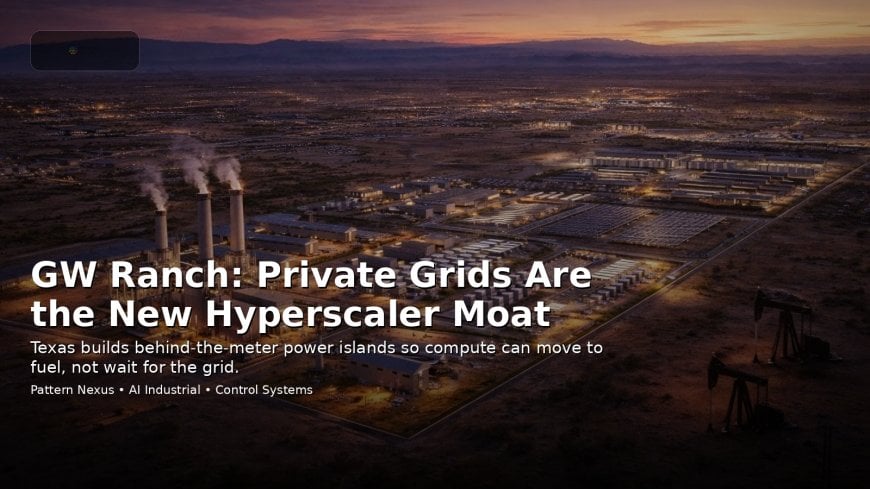
Pacifico Energy’s 7.65 GW permitted GW Ranch marks the shift to off-grid hyperscale power islands in West Texas. In the Pattern Nexus framework, this is permission-stack infrastructure: fuel optionality → electrons → compute → governance leverage. A deep dive into ERCOT’s large-load queue, emissions politics, and what…
Jump to a section
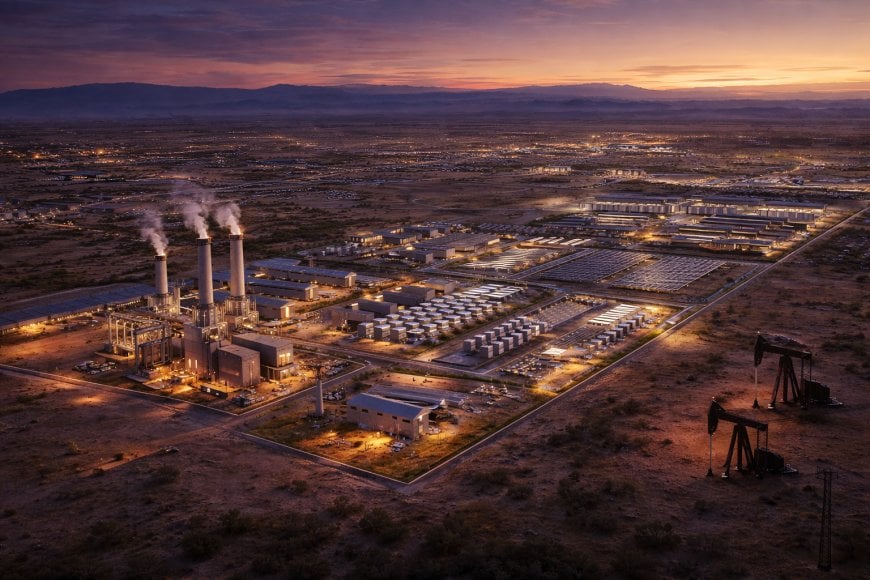

The product is not “electricity.” The product is time-to-power with contractual uptime. In 2026, that’s more valuable than marginal $/MWh.
Permitted capacity is a ceiling, not a forecast. But even partial build at this scale reshapes gas flows, transformer queues, emissions politics, and local water fights.
Behind-the-meter power is a governance hack: it reroutes “grid permission” into “private permission,” moving choke points from utilities/regulators to infrastructure operators.
Texas is becoming a compute basin for the same reason it became an energy basin: abundance + permissive build environment + fast siting + industrial culture.
The backlash vector isn’t abstract climate discourse. It’s local externalities: air permits, water use, noise, traffic, and “why did my power bill go up?”
The AI flywheel becomes physical here: turbines, transformers, copper, gas pipelines, cooling. This is “software” colliding with thermodynamics.
The $7T–$10T capex wave (why this is the real story)
GW Ranch isn’t important because it’s “big.” It’s important because it’s a financing wrapper for a cycle that is now being described in trillions. Once the capex number gets that large, the market stops treating power like a utility input and starts treating it like a strategic bottleneck.
In other words: the debate is not “gas vs renewables” or “Texas vs California.” The debate is who controls the gates in a buildout where compute, power, and land are being pulled into the same industrial gravity well. Private-grid campuses are a way to turn that gate into a product.
This is where GW Ranch fits: it’s an attempt to convert a public bottleneck (interconnection + transmission + process) into a private execution chain. And once that chain exists, it becomes bankable — not because it’s “green” or “dirty,” but because it sells the scarce commodity in this cycle: schedule certainty.
When capex is measured in trillions, the fight shifts from “who has the cheapest electrons” to “who controls the gates that turn electrons into uptime.” That’s what private grids monetize: permission → throughput → SLA → revenue.
GW Ranch spec sheet (verified)
Before the narrative war starts, lock the baseline facts. This is what the developer has publicly stated, plus the regulatory/market context that’s now on-record in Texas. Everything else is commentary.
1.8 GW battery energy storage
750 MWac solar
Phase 1 first power targeted H1 2027
Developer claims turbines are secured and site delineations complete
8,000+ acres build-ready with room to expand
Multi-customer campus design (not a single-tenant bet)
A 15-mile direct pipeline described at 1 Bcf/d to Waha
“Compute follows molecules” is not a metaphor here
The most important part of the spec sheet is what it implies: the “grid” is no longer the default container for compute. When interconnection becomes the bottleneck, the market does what it always does: it routes around the bottleneck and sells certainty. That’s the business model. That’s the moat. That’s also why this becomes political.
What got permitted and why it matters
Texas issued an air permit tied to a project framed as the largest permitted “power-for-AI” campus in the U.S. The headline number is 7.65 GW of gas generation, but the deeper signal is the platform design: build a private grid big enough to host hyperscale tenants without waiting for ERCOT to bless your timeline.
There’s a common mistake people make when they see a number like 7.65 GW: they treat it like a prediction. It’s not. It’s a regulatory envelope. It’s the maximum authorized wrapper that makes everything else possible: financing, turbine procurement, EPC sequencing, interconnect optionality, and customer contracting. In control-systems terms, the air permit is not “paperwork.” It is a gate key.
“Permitted capacity” defines what you’re allowed to do under state/federal air-quality rules. “Built capacity” depends on contracts, turbine delivery windows, transformer lead times, EPC throughput, and the political friction that appears the moment locals realize you’re not building a shed. The trap is arguing about 7.65 GW as if it’s a certainty. The correct lens is: the permit proves direction, and direction is enough to move supply chains and policy.
The “why now” is not subtle. Texas is staring at a step-function in large-load demand, and the policy system is trying to avoid the nightmare scenario where residential ratepayers feel like they’re subsidizing hyperscalers. The private-grid pitch is the cleanest firewall: ringfence the load, ringfence the economics, and sell certainty as the product.
This is also why the developer’s language matters. “Protect ratepayers” is not a vibe. It’s a political positioning statement that anticipates the next phase: hearings, press, county pressure, and the inevitable “why did my bill go up?” narrative during the next heat wave.
The Texas constraint: time-to-power beats cheap power
When people argue about electricity in 2026, they still talk like the primary variable is cost. That framework is outdated. The bottleneck is permissioned throughput: can you deliver firm power on a timeline that matches compute deployment, or do you sit in queue purgatory while the AI cycle moves on without you?
Texas is the cleanest laboratory because the demand is obvious, the industrial build culture is strong, and the grid operator is now publicly redesigning process to deal with large-load shock. That combination produces a predictable outcome: if the grid path is slow, capital builds an off-grid path and sells speed.
Translation: the system can still “absorb” data centers today, but the forward curve is the problem.
That is not “incremental growth.” That is a planning regime change.
The system is now forced to plan against a much fatter right tail.
Translation: even ERCOT is saying “the queue overstates near-term reality,” and still the numbers are huge.
Notice what this does to strategy. If you’re a hyperscaler or AI infrastructure builder, the existential risk is not paying 10% more for power. The existential risk is missing the window: you can’t monetize compute you can’t energize. That turns “interconnection latency” into a tax, and it turns private-grid developers into toll collectors.
Markets reveal scarcity through behavior. When you see private power campuses proliferate, it means the grid path is too slow, too uncertain, or too politically exposed. That latency becomes a de facto constraint on AI deployment, and constraints are where profit concentrates.
- Grid risk: queue delays, restudies, transmission upgrade cost allocation, political exposure, curtailment/reliability constraints.
- Off-grid risk: air permits, fuel logistics, cooling/water design, onsite reliability engineering, community backlash.
- Strategic answer: move compute to fuel and build an island with contractual uptime.
If you want the Pattern Nexus translation in one line: cheap power is not the moat. Guaranteed energization is the moat.
Inside GW Ranch: the private-grid design
GW Ranch is not being framed as a single power plant. It’s framed as a campus: a multi-source private grid pairing gas turbines with batteries and solar, deployed in phases, designed to serve hyperscale tenants with different ramp schedules. That matters because it aligns with how compute actually deploys: in blocks, in waves, with constant revision.
The site selection is the thesis in physical form. West Texas is not “near the Permian.” It is inside the molecules of the Permian economy, with proximity to Waha and the industrial logistics that already exist to move steel, pipe, crews, and compressors. When you can pull fuel from the basin, the compute campus becomes a new kind of refinery: molecules in, electrons out, revenue up-stack.
A direct 15-mile pipeline described at 1 Bcf/d to the Waha hub
That’s the difference between a “site” and a system-level flow event.
The battery and solar components are not “green garnish.” They are operational tools: smoothing ramps, absorbing transient spikes, improving stability, and creating a buffer layer so the gas fleet can operate in a more controlled regime. For AI loads, stability is not optional. Model training can tolerate some scheduling, but uptime at scale is revenue.
Behind-the-meter designs can ringfence load, stabilize pricing for customers, and reduce direct reliance on ERCOT for firm capacity. Some projects later interconnect, but the strategic objective is to prevent interconnection from being the gating item for first power delivery. In other words: “optional connection” instead of “required permission.”
The water angle matters more than most people realize, because it’s where the project leaves macro discourse and enters local reality. West Texas is arid. Data centers are heat engines. If you don’t solve cooling in a way that locals view as non-threatening, you inherit a political war you didn’t price into your capex model.
Water recycling and minimized make-up water
Thermal management that prioritizes heat rejection efficiency over traditional “water-heavy” assumptions
Bottom line: GW Ranch is not just an energy asset. It’s a packaged, bankable product: power + timeline + reliability + site scale. That’s the thing hyperscalers actually buy.
ERCOT’s Batch Study pivot: the queue is the signal
When a system operator redesigns interconnection under pressure, it’s telling you the truth without arguing on social media. ERCOT has been running a Large Load process aimed at a Batch Study framework: group projects, reserve capacity, and reduce the “whack-a-mole” restudy cycle. The subtext is simple: the existing workflow is not built for the scale and velocity of large-load requests being filed.
ERCOT stated it plans to file a proposed framework for discussion at the February 20, 2026 PUC Open Meeting.
Translation: this is now in the formal governance pipe, not just “industry chatter.”
Here’s the deeper mechanism: large loads don’t just add megawatts. They add coordination stress. A single “surprise” 500 MW energization can flip constraint behavior in a region. That forces ERCOT to demand better sequencing, better milestones, and better visibility. And as soon as that happens, your timeline becomes conditional on governance.
- Grid reality: large loads want certainty, not vibes.
- Operator reality: reliability requires visibility and planning, not surprise megawatts.
- Market reality: whoever can deliver firm power fastest wins the compute contract.
This is why “private grid” is more than an engineering choice. It’s a way to move the timeline out of the public queue and into a private execution chain.
Externalities: emissions, water, politics
This is where the narrative war concentrates. Not because emissions are irrelevant, but because scale makes the numbers weaponizable. A large permitted envelope becomes a headline even if the facility never runs at the theoretical ceiling. That’s how politics works: people fight the symbol, then negotiate the reality.
This is the “local air-quality” wedge issue.
This is the “national climate” wedge issue.
The backlash vector won’t be purely ideological. It will be operational: air quality, water draw, noise, traffic, land impacts, and “ratepayer fairness.” National opposition frames it as climate. Local opposition frames it as quality-of-life and resource competition. Both converge into hearings, lawsuits, and political leverage.
In most jurisdictions, the fastest way to slow a hyperscale project is not a macro argument. It’s a local coalition with a concrete complaint. That’s why community benefit agreements (CBAs) are becoming a standard tool: they convert “resistance risk” into a negotiated package of measurable concessions.
Also note the second-order reliability effect: “private islands” change how stress propagates through the broader system. If large loads can self-supply during extreme weather, they reduce their draw on the public grid, but they also introduce a parallel fleet of generation with its own operational incentives. That fleet doesn’t disappear. It becomes a new layer in the power stack, and regulators eventually have to decide how it is coordinated, monitored, and constrained.
AI Flywheel: how power islands accelerate the loop
The AI flywheel is usually described in software terms: models get better, demand grows, revenue rises, capex accelerates. That description misses the binding layer. The flywheel becomes real when it hits physical constraints: power, cooling, land, transformers, turbines, and permitting. GW Ranch is the market acknowledging that the constraint is now binding enough to justify building a bypass.
The strategic inversion is the whole story: instead of “site data center → request interconnection → wait,” the pattern becomes: secure permit → secure fuel optionality → secure turbines → build pad-ready power → sell compute-ready capacity. That’s the reordering of the stack. And when the stack reorders, the value chain reorders with it.
Without this, nothing is financeable.
Pipelines, laterals, hub proximity.
Steel-in-ground scheduling is the real bottleneck.
Where local politics bites.
The asset is “guaranteed throughput.” Power becomes a competitive weapon, not a utility function.
This is why the buildout is not just “more gas plants.” It’s an industrial reconfiguration: compute becomes a heavy industry anchored to fuel basins, and energy infrastructure becomes a strategic input to AI dominance. That pulls the whole ecosystem with it: transformers, copper, switchgear, pipelines, cooling gear, land, and eventually governance.
- Winners: firms that can package permits + generation + pad-ready sites into a bankable product.
- Losers: projects dependent on long interconnection timelines, unclear cost allocation, or political exposure.
- Key market signal: how fast the “private island” model proliferates beyond Texas.
Scenarios + what to watch (2026–2031)
You don’t need a perfect forecast to track this theme. You need a clean scenario map and a watchlist that updates as reality prints. The biggest mistakes happen when people treat this as a single-variable story (“AI demand” or “emissions”) instead of a multi-gate permission stack.
Axis A: AI/data-center demand realized vs under-delivers. Axis B: permitting/policy stays permissive vs tightens (air, water, local zoning, ratepayer rules). The regime determines whether private campuses become moats or political liabilities.
Offtake structure and phase commitments
Contract MW and ramp schedule
Turbine delivery milestones
Commissioning milestones and energization dates
New lateral/pipeline announcements tied to campuses
Any evidence of regional supply competition
Water disputes and county-level pushback
CBAs or community concession packages
In 2026, the most realistic path is not “everything builds” or “nothing builds.” It’s phased buildouts, multi-tenant ramps, and a continuous tug-of-war between execution speed and public friction. The market won’t need 7.65 GW online for this to matter. It only needs enough projects to prove the pattern, and the pattern is already visible.
Pattern Nexus Lens
GW Ranch is a control-systems event wearing an energy costume. The system is rerouting around the grid because the grid is becoming a bottlenecked permission layer. When that happens, the market manufactures a new permission layer: private power islands.
This is the deeper structural shift: “power generation” stops being a utility function and becomes a competitive weapon in compute deployment. Whoever can lock the chain (permit → fuel → turbines → electrons → cooling → uptime) sells guaranteed throughput on a timeline the grid can’t match. That is a moat. It’s also a political target because moats concentrate leverage.
Private power is permission. Permission becomes leverage. Leverage attracts capital. Capital accelerates the AI flywheel. That’s the loop.
FAQ
Is 7.65 GW “real,” or is it marketing?
It’s a permitted envelope and a stated plan. The correct frame is: permitting is the hard gate, buildout is phased and customer-driven, and even partial utilization at this scale matters. Treat the permit as a directional signal and watch contract announcements, EPC awards, turbine delivery schedules, and Phase 1 energization milestones.
Does “private grid” mean it never connects to ERCOT?
Not necessarily. Behind-the-meter projects can operate independently and later interconnect if desired. The strategic objective is to avoid making interconnection the gating item for first power delivery.
Why gas instead of nuclear?
Speed, siting, and fuel availability. Gas projects can be permitted and built faster than nuclear, and West Texas offers proximity to abundant gas supply and industrial build infrastructure. Nuclear may show up later as the cycle matures, but the current flywheel is selecting for time-to-power.
What breaks first: permits, pipelines, water, transformers, or turbines?
It varies by region, but recurring bottlenecks are permitting friction (air + local), transformer/substation lead times, water/cooling constraints in arid zones, turbine delivery windows, and pipeline constraints when projects cluster at once. The tell is where timelines start slipping in public filings and construction sequencing.
What’s the single best indicator this is “real build” and not just headlines?
A sequence: named customer commitments → EPC awards → turbine delivery/commissioning milestones → Phase 1 first power. The market will tell you when it shifts from PR to steel-in-ground.
Why is ERCOT changing process if “not all requests are real”?
Because the system has to plan against the right tail. Even if only a fraction of large-load requests materialize, the scale is large enough to change transmission planning, resource adequacy assumptions, and outage coordination. ERCOT adjusting methodology is itself an admission that the old process can’t handle the current request velocity cleanly.
Sources
Reporting, regulator notices, and developer materials supporting the permitting milestone, ERCOT interconnection redesign, and the broader Texas gas-for-AI buildout context.
- Pacifico Energy: GW Ranch permit highlights, capacity mix, phasing, availability target, Waha optionality
- DataCenterDynamics: project mix, Phase 1 timing, Waha pipeline mention, Permian context
- Midland Reporter-Telegram: local reporting on timeline, phasing, water strategy
- Inside Climate News: emissions-envelope context and Texas gas-for-AI buildout narrative
- Texas Observer: emissions envelope, scale comparison, additional Texas megaproject context
- ERCOT Market Notice: Large Load interconnection redesign and Batch Study framework timeline
- ERCOT: Long-Term Load Forecast update (data-center growth and methodology adjustments)
- Texas Tribune: Texas data-center demand framing and grid planning stress
- WIRED: Global Energy Monitor findings on data-center-driven gas project growth
- Brookings: community benefit agreements as a response to local resistance
- McKinsey: “The cost of compute” — ~$6.7T global data-center capex by 2030; ~$5.2T AI-focused
- Reuters (Jan 28, 2026): AI infrastructure investment expected to exceed $7T over the next decade
- Morgan Stanley (Jan 2, 2026): AI investment cycle framed as ~ $10T in corporate spending
- Morgan Stanley IM: “Bull/Bear AI funding cases” — $10T investment-base framing; hyperscaler capex scale discussion
- Brookfield (PDF): “Building the Backbone of AI” — cites $0.5T+ power generation & transmission buildout estimate (next decade)
Mikä on reaktiosi?
 Tykkää
0
Tykkää
0
 Epätäydellinen
0
Epätäydellinen
0
 Rakkaus
0
Rakkaus
0
 Hauska
0
Hauska
0
 Vau
0
Vau
0
 Surullinen
0
Surullinen
0
 Vihaisa
0
Vihaisa
0

Nexus (Christopher)
Founder of Pattern Nexus. I research markets, macro, geopolitics, AI, history, ancient systems, and the patterns most people overlook. I’m also building Market Radar, a trading scanner designed to read pressure, risk, confirmation, and setup quality before ch…
Related research
Nvidia Turns Powered Land Into a Grid-Responsive AI Factory Pipeline
Lancium announced a strategic collaboration with Nvidia on August 24, 2026, including an undisclosed Nvidia investment and planned deployme…
5 shared topics, same research avenue.
Amazon Turns AI Compute Into a Private Gas-Grid Emissions Test
Amazon has confirmed that its planned Pecos County, Texas data center will use new on-site generation, while reporting and project document…
6 shared topics, same research avenue.
AI Loads Fail the Texas Grid’s Ride-Through Test
Reuters reported on June 5, 2026 that several large data centers and crypto facilities seeking to connect to the Texas grid failed key volt…
5 shared topics, same research avenue.
The Nuclear Renaissance: 2026’s Drive for a 400 GW Grid and the Control Layers of Energy
In 2026 the United States announced plans to quadruple its nuclear power capacity to 400 GW by 2050, investing billions in domestic enrichm…
5 shared topics.
The AI Wars Are Human Wars
The coming AI wars will not be machines versus humans. They will be humans versus humans—futurists who adapt and integrate AI versus pastis…
5 shared topics, same research avenue.
Energy Control- Grid Interdependence, Fuel Corridors, and Blackout Leverage
Energy is the original control system. Grid synchronization, fuel corridors, dispatch priority, and failure modes now function as continuou…
6 shared topics.
Standards as Weapons
Standards are not neutral. ISO frameworks, accounting rules, settlement norms, and governance protocols act as invisible weapons—embedding …
5 shared topics.
NextEra’s 30-Gigawatt Bet: AI Data Centers Just Forced a Utility Supercycle
NextEra Energy just committed to 15–30 GW of new power generation for U.S. data-center hubs by 2035—spanning gas, nuclear restarts, renewab…
5 shared topics, same research avenue.
Kommentit (0)
Security Check
Please complete the captcha to verify you are human.