
Fragmented Society: The Elites Don’t Think Like You, and the Elites of the Elites Don’t Think Like Them
Society is not one shared reality. It is a stack of disconnected mindsets layered by survival, class, power, wealth, ideology, and future access. The average person thinks about kids, bills, work, retirement, and survival. The elite think in systems, leverage, insulation, manipulation, and continuity of power. The…
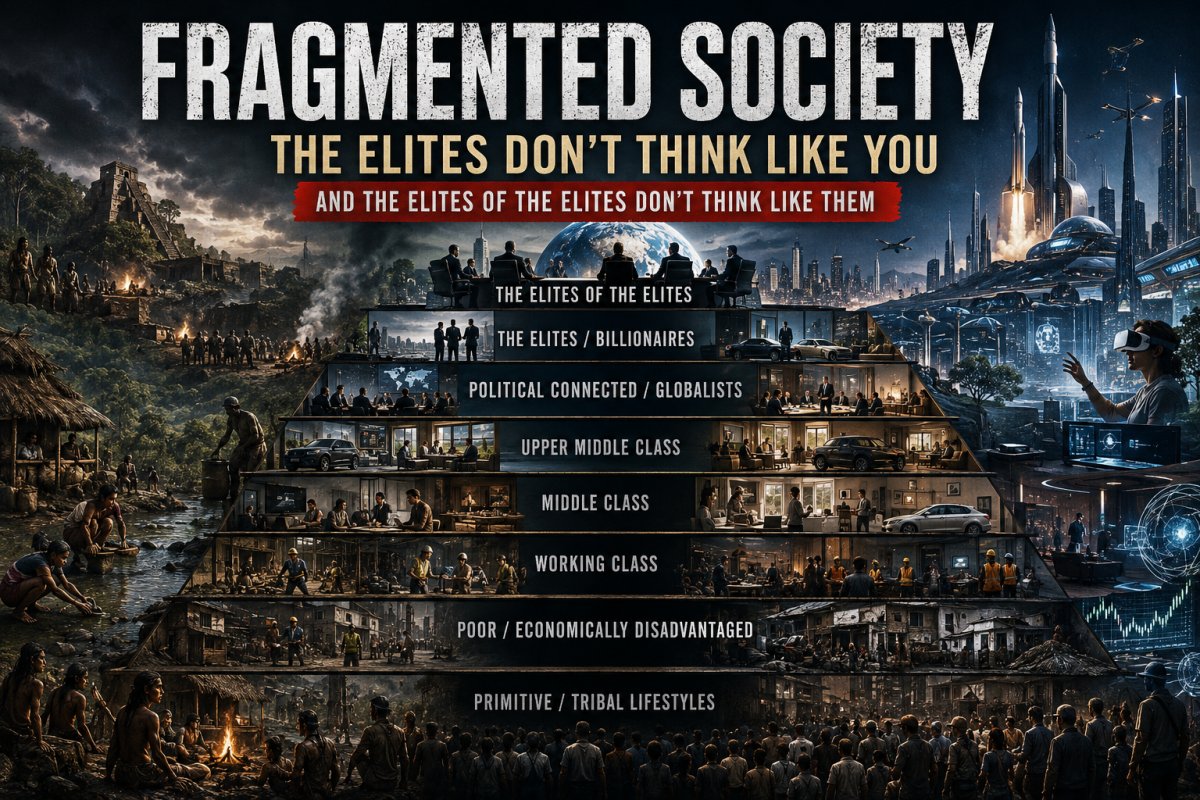
Society is not one shared reality. It is a stack of disconnected mindsets layered by survival, class, power, wealth, ideology, and future access. The average person thinks about kids, bills, work, retirement, and survival. The elite think in systems, leverage, insulation, manipulation, and continuity of power. The…
Jump to a section
 Pattern Nexus Research
Fragmented Society: The Elites Don’t Think Like You, and the Elites of the Elites Don’t Think Like Them
Society is not one shared reality. It is a stack of disconnected mindsets. The further up the stack you go, the less human-centered the thinking becomes.
The mistake most people make is assuming the world is being run by people who think like them. It is not. The average person thinks about family, work, bills, rent, kids, food, retirement, and staying comfortable enough to keep going. The elite think about leverage, continuity, insulation, influence, risk management, and how to keep the machine running because the machine is what gives them power.
Then there is another layer above that: the elites of the elites. The post-human expansionists. The billionaires and near-trillionaire class building rockets, AI, robotics, private infrastructure, virtual worlds, brain-machine interfaces, automated labor, space systems, bunkers, and parallel societies. They are not just trying to win inside the current system. Some of them are trying to outgrow the system completely.
That is the fracture. The average person is still arguing from human values. The higher system class is increasingly operating from non-human system logic.
Fragmented Society Is Not Just Economic. It Is Mental.
The basis of this article is simple: society is fragmented, the elites do not think like you, and the elites of the elites do not think like them.
Most people think class is just income. Poor, middle class, upper middle class, rich, wealthy, billionaire. That is the surface model. The deeper model is mindset. Each class is not just living with a different amount of money. Each class is living inside a different operating system.
The person without reliable water does not think like the person worried about a mortgage rate. The person living in an informal settlement does not think like the person planning a Roth IRA. The person running a regional business does not think like the person moving capital through foundations, political networks, private equity, and multinational structures. The billionaire does not think like the millionaire. The ultra-billionaire does not think like the normal billionaire. And the post-human expansionist does not think like any of them.
That is what most people miss. They keep trying to interpret elite behavior through normal human assumptions. They assume the people above them want comfort, stability, family, community, a good life, and maybe a little more money. Some do. But the further up the hierarchy you go, the more those ordinary motivations fall away and get replaced by abstraction.
Power turns people into system thinkers. Extreme power turns people into system owners. The next level above that is people who no longer want to be bound by the human system at all.
The mistake is assuming everyone is trying to live a better version of your life. They are not. Some of them are trying to exit your reality completely.
Start With the Person Still Living Outside the Modern Assumption
Before we even talk about elites, we have to start with the part of the world most modern people barely conceptualize.
There are still people in 2026 living tribal, subsistence, off-grid, isolated, or semi-isolated lifestyles. I know people get sensitive about the word primitive, but I am not using it as a moral ranking. I am talking about infrastructure, survival structure, and daily reality. There are still uncontacted peoples. There are still Indigenous groups living outside normal state systems. There are still people whose lives are organized around land, water, weather, animals, clan structure, oral memory, and daily survival instead of banks, credit scores, digital identities, and power bills.
The exact number depends on how you define it. If you mean truly uncontacted groups, the number is small but real. If you mean Indigenous peoples, subsistence communities, informal rural populations, off-grid communities, or populations living outside modern service access, the number expands massively. The point is not one clean statistic. The point is that the modern person’s default assumption — that everyone is basically living inside a digital, electrified, wage-based, state-administered world — is false.
There are billions of people still missing pieces of what the average first-world person assumes is normal life. More than two billion people lack safely managed drinking water. More than two billion lack clean cooking access. Hundreds of millions still lack basic electricity access. If you raise the standard from “does a light turn on somewhere” to “does this person have reliable, affordable, modern electricity capable of supporting refrigeration, clean cooking, internet, education, medical access, productive work, and climate resilience,” the meaningful energy-poverty number grows far beyond the official no-electricity number.
That matters because each of those realities produces a different brain. A person whose day starts with water insecurity is not thinking about the future the way a suburban worker is. A person who has to think about predators, shelter, disease, distance, physical safety, or whether a river source is clean is not living in the same mental world as somebody arguing online about which phone upgrade to buy.
This is not some romanticized “noble savage” nonsense either. Survival is hard. Go backpacking. Go find a remote place. Go off into the woods and live for a week without the modern system catching you. Suddenly water becomes the issue. Shelter becomes the issue. Weather becomes the issue. Food becomes the issue. Injury becomes the issue. Predators become the issue. The little conveniences you never think about become the entire day.
That is the first point: even before class, humanity is already fractured by infrastructure.
Then You Move Into the Emerging-Market Layer
Then you move into what people call emerging markets or emerging economies. Even that term is loaded because it assumes the Western economic model is the destination. But inside those countries you have the same fragmentation stacked again.
You have poor people. You have working-class people. You have informal workers. You have the middle class. You have the upper middle class. You have the economically wealthy. You have political insiders. You have elite families. You have people connected to the state. You have people connected to foreign capital. You have people connected to resource extraction, shipping routes, ports, commodities, banking, real estate, media, and security networks.
And inside the same country you can still have people living tribal, rural, subsistence, water-insecure, or off-grid lives. That means one political border can contain multiple centuries of human development at the same time.
One family is still collecting water. Another family is sending a kid to a private English-language school. Another person is driving for an app without labor protection. Another is importing goods through a cousin in government. Another is structuring wealth through offshore entities. Another is trying to leave the country. Another is trying to buy land before the infrastructure corridor gets announced. All of that is happening inside the same national map.
So when somebody says “the people,” which people? The water-insecure person? The informal worker? The new middle class? The urban poor? The political-connected business family? The resource elite? The foreign-aligned NGO class? The military-linked contractor? The billionaire family office?
There is no one public. There are publics stacked on top of publics, all looking at the same country through completely different survival maps.
In the First World, the Class Stack Expands Again
Then you move into what is considered a first-world society. People assume this simplifies the model. It does not. It expands it.
In a first-world society you still have the poor. You still have the working class. You still have the middle class. You still have the upper middle class. You still have people one medical bill, one rent hike, one layoff, one divorce, one lawsuit, or one market shock away from being wiped out. You still have rural people, urban poor, immigrants, homeless populations, informal labor, cash workers, and people living outside the polished statistical model.
But then the upper stack gets wider.
You have the wealthy. You have the locally connected. You have the political class. You have the donor class. You have the institutional class. You have media elites. You have legal elites. You have academic elites. You have intelligence-linked elites. You have foundation elites. You have billionaires. You have ultra-billionaires. And now you have the emerging trillionaire class — whether literal, temporary, on-paper, or structurally inevitable through AI, space, defense, data, and monopoly-scale platforms.
These people are not just richer versions of the same citizen. They are structurally different actors.
The average person has a job. The elite has influence. The billionaire has leverage. The ultra-billionaire has infrastructure. The post-human expansionist has a civilization plan.
Pattern Nexus point: class is not just income. Class is a relationship to time, risk, institutions, and the future.
The Higher You Go, the More Single-Minded They Become
Each individual mindset has a different way it perceives the world. I am not going to cover every class here. That would be a separate book. This article is focused on the elite class, the elitists, the globalists, the post-human expansionists, the billionaires, and the trillionaire class forming above them.
The further up you go inside these social classes, the more single-minded people become. That does not mean they cannot dabble in a lot of subjects. It means their identity starts orbiting one core mission.
Jeff Bezos is Amazon and rockets. That is the visible lane. Commerce infrastructure, logistics, cloud infrastructure, and then Blue Origin’s road to space. Elon Musk is every single one of his endeavors tied into a broader civilizational frame: EVs, batteries, rockets, Starlink, AI, robotics, tunnels, brain-machine interfaces, Mars, and the preservation or expansion of consciousness. Mark Zuckerberg is Facebook, social graph control, virtual reality, augmented reality, AI glasses, and the attempt to mediate human interaction through digital layers.
They each have a lane. They each have a mission. They are competing for a futuristic ideology that is not human-centric in the normal sense. It is individual-centric, mission-centric, and system-centric.
That is the part people miss. The public sees a product. The elite sees a platform. The billionaire sees an ecosystem. The post-human expansionist sees a species transition.
The average person says, “Why would anyone need that much money?” Wrong question. At that level, money is not the object. Money is the tool. It is the lever that buys engineers, lobbyists, land, launch capacity, compute, private security, media influence, political access, legal insulation, research pathways, and time.
Kevin O’Leary is a clean example of a wealthy business-centric mind. Mr. Wonderful is obsessed with the deal. He is great at that. Build the company, structure the deal, create wealth growth for everybody involved, cut the emotion, respect the numbers, get paid. That is his eccentric ideology: the deal as the engine.
Elon Musk’s centric ideology is broader. It is not just wealth growth. It is preservation and expansion of consciousness, or at least that is the stated and visible frame. Jeff Bezos’ centric ideology, in my read, is preservation of himself through systems: Amazon, AWS, logistics, capital, media, space access, and the long road to moving industry and human activity beyond Earth. Zuckerberg’s centric ideology is mediation of human attention and identity through digital worlds.
The average person thinks about kids, the future, and what their grandkids might eventually do one day. These people think about continuity of mission beyond normal human timelines.
From a System Standpoint, Humans Become Interchangeable
This may seem cold, and people will misconstrue it, but from a system standpoint a human is no different than an ant, and an ant is no different than any other ant.
Now, before people get emotional, understand what I am saying. I am not saying your life does not matter to you. Of course it does. Every individual life matters to the person living it. It matters to their family, to their kids, to their friends, to the people who love them, to the people who interact with them. That is the human scale.
But the system scale is different.
From a system standpoint, one worker is replaceable. One voter is replaceable. One customer is replaceable. One soldier is replaceable. One renter is replaceable. One user is replaceable. One account is replaceable. One data point is replaceable. You would have to wipe out the entire colony before the system recognizes the loss as structurally relevant.
That is how elitists view the world. Not all wealthy people. Not all successful people. Not every person with money. I am talking about the elitist system mind. The one that sees people as populations, labor pools, voting blocs, markets, demographics, behavior clusters, consumers, risk groups, compliance groups, and controllable inputs.
That is why the average person cannot understand elite behavior. They keep expecting human-centered logic from people operating from system-centered logic.
C. Wright Mills understood part of this when he described the power elite as people whose positions allow them to rise above the ordinary environments of ordinary people. That matters because once you live above ordinary reality long enough, ordinary reality stops feeling real. It becomes something to model, manage, message, and manipulate.
Power does not just give people options. It changes the perception of other people.
Psychology research on power and wealth keeps circling the same uncomfortable idea: power can reduce empathy, increase abstraction, and make people more likely to rationalize self-serving behavior. Again, this does not mean every rich person is evil. It means power changes the operating environment of the mind. When consequences no longer reach you normally, reality no longer disciplines you normally.
The average person sees another human. The system mind sees a unit. That is the fracture.
The Thing They Fear Most Is Not Collapse. It Is Losing the Tools.
The elitist does not fear collapse the same way you do.
The average person fears collapse because food, safety, shelter, medicine, money, and family security disappear. The elitist fears collapse because the tools of elitism stop working.
Money only works if the system recognizes it. Contracts only work if courts function. Ownership only works if enforcement exists. Influence only works if institutions still obey the signal. Wealth only works if the social operating system still converts wealth into obedience.
That is the real fear.
The elite view money as a tool to manipulate the system. They do not fear society collapsing merely because society will suffer. They fear that if society collapses, their money, wealth, credentials, ownership claims, legal structures, political access, media access, and institutional levers may stop producing obedience.
That is why they are all preparing for collapse in multiple different ways.
Some want to leave Earth and humanity behind. Some want to build space infrastructure. Some want to automate labor. Some want AI-managed societies. Some want private cities. Some want sovereign enclaves. Some want bunkers. Some want robot security. Some want bodyguards who will stay loyal when payroll stops. Some want digital realities where identity, money, social life, status, and work can be mediated through platforms they control.
They are not all coordinating as one cartoon villain group. That is too simple. They are competing. They disagree. The elites do not all think the same. The elites of the elites do not even think like the normal elites. But they are all responding to the same underlying recognition: the current system is fragile, and whoever controls the next system will control the future.
The Bodyguard Problem Explains the Whole Mindset
One of the most revealing stories about elite collapse psychology is the bodyguard problem.
At the top, some of these people are worried that if society collapses their own guards will not protect them. Think about what that means. They have enough money to hire protection, but they do not understand loyalty. They can buy labor, but they do not understand human reciprocity. They can pay a security team, but they are afraid that once the payment system dies, the human beings around them may stop obeying.
So their instinct is not, “Maybe I should treat these people like family. Maybe I should help them. Maybe I should build real loyalty. Maybe I should pay for the bodyguard’s kid’s birthday party, help his family, show respect, and build a human bond.”
Their instinct is, “How do I design a control system that survives payroll failure?”
That is the elite mind in one sentence.
They have to be instructed that basic humanity creates loyalty. They have to be taught that treating people below them with respect may benefit them later. They have to be told that favors, kindness, dignity, and personal loyalty matter. Because their default model is transactional. To them, the way you get something from somebody is by paying for it, contracting it, owning it, litigating it, automating it, or coercing it.
They preach humanity. They preach donations. They preach philanthropy. They preach inclusion. They preach saving the world. But when the collapse scenario becomes personal, the question becomes: will the guards still obey?
That is not a human-centered question. That is a control-centered question.
This is why robots are so attractive to the upper class. A robot does not have a sick kid. A robot does not resent you. A robot does not ask whether your wealth is moral. A robot does not unionize. A robot does not remember how you treated it. A robot does not turn around in the bunker and say, “Actually, why are we protecting you?”
The robot is the fantasy of obedience without reciprocity.
PN read: elite collapse preparation is not just about fear. It is about preserving command after normal social trust fails.
Philanthropy Is Often System Benefit, Not Individual Benefit
The average person hears donation and thinks help.
The elite hears donation and often thinks leverage.
That does not mean every donation is fake. It does not mean every foundation is evil. It means the elite version of charity is usually routed through systems. Foundations, NGOs, universities, policy shops, medical institutions, education programs, climate initiatives, social-impact funds, cultural institutions, media organizations, research grants, and international development structures.
Those can do real good. They can also shape ideology. They can define acceptable opinion. They can fund one discipline and starve another. They can create credential pipelines. They can set language rules. They can decide what counts as respectable. They can create the appearance of moral authority while consolidating influence.
That is the difference between helping an individual and funding a system that controls individuals.
The average person says, “Why not just help the person directly?” The elite says, “Because direct help does not scale influence.”
That is why this whole topic feels foreign to normal people. Normal people understand helping a cousin, covering somebody’s rent, buying groceries, fixing a car, helping a neighbor, paying for a kid’s birthday party, showing up when somebody is hurt. The elite system mind understands institutions, tax structures, reputational capital, board seats, access networks, policy influence, and ideology laundering.
They talk about humanity, but they often act through abstractions.
And abstraction is where the human disappears.
The Modern Life Script Was Built, Taught, and Repeated
You are not meant to work and enslave yourself for money, debts, institutions, and credential systems your whole life. You are not meant to follow a plan where you feed money into the system for decades in the hope that one day the system rewards you with retirement, maybe a beach, maybe a Mai Tai, and then a comfortable death.
That is not the objective of conscious life anywhere else we can observe. It is not even the dominant pattern through most of our own past. It is a modern construction created by industrial society, debt society, institutional education, and productivity systems.
The average person has been taught to see life as a pipeline: school, job, debt, house, kids, retirement, death. That is the approved track. It is presented as freedom, but it is really system participation with delayed reward.
This is where education enters the picture.
The modern education system did not appear from nowhere. It was shaped by state-building, industrial labor needs, philanthropic foundations, credentialing systems, universities, standardized time, standardized age cohorts, standardized testing, and a belief that populations could be improved, managed, trained, sorted, and made productive.
This is where the Rothschild-Carnegie-Rockefeller type of framework matters. Not as a cartoon where one family sits in a room and writes every school lesson. That is too stupid and too easy to dismiss. The real version is deeper: financial houses, industrial fortunes, philanthropic foundations, university systems, and state institutions all understood that education is not neutral. Education forms the citizen. Education forms the worker. Education forms the managerial class. Education forms the acceptable imagination.
Carnegie’s education philanthropy, Rockefeller’s General Education Board, industrial-era vocationalism, teacher credentialing, university reform, testing, and foundation-directed research all belong inside that larger story. The public sales pitch was uplift, opportunity, professionalism, and national improvement. Some of that was real. But the system function was also obvious: create a population compatible with industrial modernity.
Show up on time. Sit down. Follow instructions. Respect bells. Accept grading. Compete for approval. Internalize credentials. Wait for permission. Move through levels. Borrow money for status. Take a job. Pay debt. Save into financial products. Retire if the system allows it.
That is not natural life. That is designed life.
The elitist belief underneath it is that society must be conditioned. The population must be trained into useful forms. The chaos of human life must be made legible to institutions. The child must become the worker. The worker must become the taxpayer. The taxpayer must become the debtor. The debtor must become the retirement account. The retirement account must become system liquidity.
That is the life script. And people defend it because they were trained inside it.
The Elites Above the Elites Are Not Trying to Fix Your World
Now we get to the highest layer: the post-human expansionists.
These are the people and networks building toward a future that is no longer human-centered in the normal sense. Space expansion. AI civilization. Robotics. Synthetic biology. Brain-machine interfaces. Longevity. Virtual worlds. Augmented reality. Private currencies. Private cities. Private security. Private infrastructure. Automated production. Orbital networks. Moon resources. Mars settlements. Digital identity. Social graph control. Behavior prediction. Algorithmic governance.
Again, they do not all agree. They are not one group. They compete. They sue each other. They hate each other. They copy each other. They use different language. Some frame it as saving humanity. Some frame it as expanding consciousness. Some frame it as preserving Earth. Some frame it as abundance. Some frame it as efficiency. Some frame it as safety. Some frame it as freedom.
But the common pattern is this: the future they are building is not centered on the average human being living a meaningful life in a real community.
It is centered on platforms, infrastructure, escape routes, scaled systems, machine mediation, and continuity of mission.
The normal elite wants status inside society. The billionaire wants control over parts of society. The post-human expansionist wants to build the next society.
That is why you see rockets, AI, robots, digital worlds, neural interfaces, energy systems, compute infrastructure, private security, and data empires all converging. They are not random tech verticals. They are civilization primitives.
If you control compute, you control intelligence. If you control energy, you control compute. If you control rockets, you control orbital infrastructure. If you control satellites, you control communication. If you control platforms, you control speech and identity. If you control payments, you control economic permission. If you control robotics, you control labor replacement. If you control education, you control imagination. If you control media, you control interpretation.
This is the post-human expansionist stack.
The average person sees products. Pattern Nexus sees rails.
Why the Average Person Cannot Conceptualize This
The average person cannot conceptualize beyond their own life because their life is already full.
They have work. Bills. Kids. Rent. Mortgage. Food. Insurance. School. Car repairs. Aging parents. Health issues. Taxes. Debt. Groceries. Social pressure. Entertainment. Exhaustion. They complain for a short amount of time, then they go back to maintaining the illusion of happiness they built inside this false reality.
That sounds harsh, but it is true.
Most people do not take action because they are too busy surviving the life script. And the life script is designed to keep them busy enough that they never step outside it.
They do not understand the water-insecure person because they have a faucet. They do not understand the off-grid person because the grid is invisible until it fails. They do not understand the billionaire because they think money is the end goal. They do not understand the post-human expansionist because they assume everyone still wants a normal human future.
They also cannot believe people at the top lack normal human-centered values. That is why elite scandals shock the public over and over again. Epstein-type networks, sealed files, private islands, blackmail structures, hidden circles, institutional protection, and sick behavior around power are not hard to understand once you stop assuming elite circles operate from normal moral psychology.
That does not mean every rumor is true. It means the pattern is not surprising.
When people live above consequence long enough, consequence becomes something for other people. When people become insulated from normal life long enough, normal morality becomes optional, performative, or useful only as public language.
The average person says, “How could they do that?”
The system answer is: because they do not see the world the way you do.
The average person is thinking about family. The elite is thinking about leverage. The post-human expansionist is thinking about continuity beyond the current human order.
Try to Think From Each Reality Without Lying to Yourself
This is the thing I can do that most people either cannot do or refuse to do.
I can think like them. I can think like you. I can think about how the person in an unconnected tribe perceives life. I can move through those frameworks in my mind and attach them to some lived experience, some hardship, some worksite, some class layer, some survival pressure, some business problem, some system pattern, or some reality I have actually touched.
That does not mean I am them. It means I can build a bridge into the mindset.
Go live outside for a week and you will understand water differently. Run a business and you will understand payroll differently. Manage property and you will understand human behavior differently. Trade markets and you will understand liquidity differently. Build a website by yourself and you will understand infrastructure differently. Watch institutions lie and you will understand narrative control differently.
Every lived experience opens a mental model. Most people only defend the one they are currently trapped inside.
The billionaire’s problem is not your problem. His problem might literally be: where am I eating in the world today, is the jet ready, is the pilot available, what government is hostile, what asset is exposed, what lawsuit is coming, what security risk exists, what platform rule changed, what regulator is circling, what technology threatens my moat, what happens if the dollar breaks, what happens if the grid fails, what happens if the guards stop obeying?
Different problems. Different realities. Different minds.
The Pattern Exists
The pattern exists.
Fragmented society is not just rich versus poor. It is not just left versus right. It is not just capitalism versus socialism. It is not just globalists versus nationalists. Those are surface fights.
The deeper fracture is reality access.
Some people live at the water layer. Some live at the wage layer. Some live at the debt layer. Some live at the asset layer. Some live at the institution layer. Some live at the state layer. Some live at the platform layer. Some live at the space and AI layer. Some are already trying to exit the human layer.
That is why modern society feels insane. People from completely different layers are arguing as if they share the same reality.
The working person asks for fairness. The elite hears labor cost.
The parent asks for safety. The platform hears engagement risk.
The citizen asks for truth. The institution hears narrative threat.
The renter asks for affordability. The asset owner hears yield compression.
The population asks for stability. The billionaire asks whether the system will still convert ownership into obedience.
The post-human expansionist asks whether humanity itself is the bottleneck.
That is the article. That is the whole point.
The elites do not think like you. The elites of the elites do not think like them. And the people building the next layer may not be thinking in human terms at all.
That is not conspiracy. That is class, power, psychology, infrastructure, and future access stacked into one pattern.
Sources Used for This Framework
- World Bank / Tracking SDG7: Energy Progress Report 2025 — electricity access, clean cooking access, and energy-poverty framing.
- UNICEF / WHO Joint Monitoring Programme — safely managed drinking water, sanitation, and global water access data.
- International Energy Agency — clean cooking access and the distinction between basic electricity access and modern energy life.
- International Labour Organization — informal employment and the scale of workers outside formal labor protections.
- Survival International — uncontacted Indigenous groups and Indigenous peoples still living outside normal state-modern assumptions.
- C. Wright Mills, The Power Elite — elite position, institutional power, and the separation of elite decision-making from ordinary life.
- Paul K. Piff et al., Higher Social Class Predicts Increased Unethical Behavior, Proceedings of the National Academy of Sciences — social class, wealth, entitlement, and unethical behavior research.
- Dacher Keltner, The Power Paradox and related UC Berkeley work — power, empathy, and social behavior.
- Douglas Rushkoff, Survival of the Richest / elite bunker discussions — wealthy collapse preparation and the bodyguard-loyalty problem.
- Rockefeller Archive Center — General Education Board history and early twentieth-century education philanthropy.
- Carnegie Foundation for the Advancement of Teaching — Carnegie education philanthropy and institutional education reform.
- Blue Origin official mission statements — millions of people living and working in space for the benefit of Earth.
- Tesla / SpaceX official biographical and mission material — Musk’s companies, multi-planetary species framing, Neuralink, Starlink, and Mars continuity logic.
Do not read the modern world as one society. Read it as stacked realities. The person collecting water, the worker chasing overtime, the middle-class family trying to retire, the business owner trying to survive payroll, the elite trying to preserve leverage, and the billionaire trying to build a future off-world are not living inside the same mental universe.
The public argument is human. The system argument is not.
That is the fracture.
Frequently Asked Questions
What's Your Reaction?
 Like
0
Like
0
 Dislike
0
Dislike
0
 Love
0
Love
0
 Funny
0
Funny
0
 Wow
1
Wow
1
 Sad
0
Sad
0
 Angry
0
Angry
0

Nexus (Christopher)
Founder of Pattern Nexus. I research markets, macro, geopolitics, AI, history, ancient systems, and the patterns most people overlook. I’m also building Market Radar, a trading scanner designed to read pressure, risk, confirmation, and setup quality before ch…
Related research

The Capital Ladder: Where $100 to $1 Trillion Places You in the Global and American Wealth System
A deep Pattern Nexus regression and data analysis mapping where net worth levels from $100 to $1 trillion place an individual within the gl…
4 shared topics, same research avenue.
The Sun, Liquidity, and Financial Turning Points: The Regression Missed the Regime
A corrected Pattern Nexus analysis of solar cycles, liquidity, recessions, and financial tops from January 1987 through July 2026. The firs…
3 shared topics, same research avenue.
Pattern Nexus Worldview — Full Digital Edition
Read the complete 10-chapter digital edition of Pattern Nexus Worldview by Christopher Grenke. A systems-level examination of money, liquid…
3 shared topics, same research avenue.
The Fertilizer Strait: Why the 2027 Food Shock May Already Be Forming
Fertilizer prices, Persian Gulf disruption, a potentially historic El Niño, expanding drought risks, weak currencies, and fragile food-impo…
3 shared topics, same research avenue.
The Command Line — Audio-Video Edition
Episode 3 of the weekly Pattern Nexus audio-video series turns Part 3 of Cycles of Power into a shorter story about how Dartmouth, integrat…
2 shared topics, same research avenue.
United Wholesale Mortgage: The Dividend Cut, the Ishbia Structure, Oaktree, and the Real Risk in UWMC
I rebuilt the UWM panic from the ownership structure outward: who actually received the distributions, what the dividend suspension retains…
2 shared topics, same research avenue.
Are Auto Sales Predicting a Recession? A 50-Year Regression and the 2026 Signal
Vehicle sales normally weaken before recession becomes obvious elsewhere. Pattern Nexus reconstructs every U.S. recession since 1976, build…
2 shared topics, same research avenue.
The Yen Line Broke: The Intervention That Changed the Global Liquidity Map
yen-line-broke-us-japan-intervention-global-liquidity-map Meta description: Pattern Nexus reconstructs the yen’s plunge to a 40-year low, …
2 shared topics, same research avenue.
Comments (0)
Security Check
Please complete the captcha to verify you are human.