
Moon Base Alpha: Why the Moon Is Becoming Infrastructure
Moon Base Alpha isn’t sci-fi anymore. Starship, Artemis, power constraints, and south-pole logistics are converging into real lunar infrastructure. Pattern Nexus breaks down what actually matters.

Where Moon Base Alpha Actually Came From
“Moon Base Alpha” did not originate as a formal NASA architecture. It emerged from a far more pragmatic SpaceX realization: early Starships landing on the Moon may never fly again — and that’s not a failure mode.
If you’ve already expended the propellant, tanker cadence, orbital refueling, and landing risk to put a fully pressurized, structurally robust, stainless-steel vessel on the lunar surface, scrapping it is economically irrational.
Starship flips the traditional space architecture stack. Historically, we designed habitats first and transportation second. Starship reverses that: the vehicle arrives first, already pressure-rated, micrometeoroid-resistant, and volumetrically massive.
Moon Base Alpha is the emergent result of that inversion.
This is not about “living on the Moon.” It’s about reducing the activation energy required to stay.
The Build Order: Turning Starship into a Buried Habitat
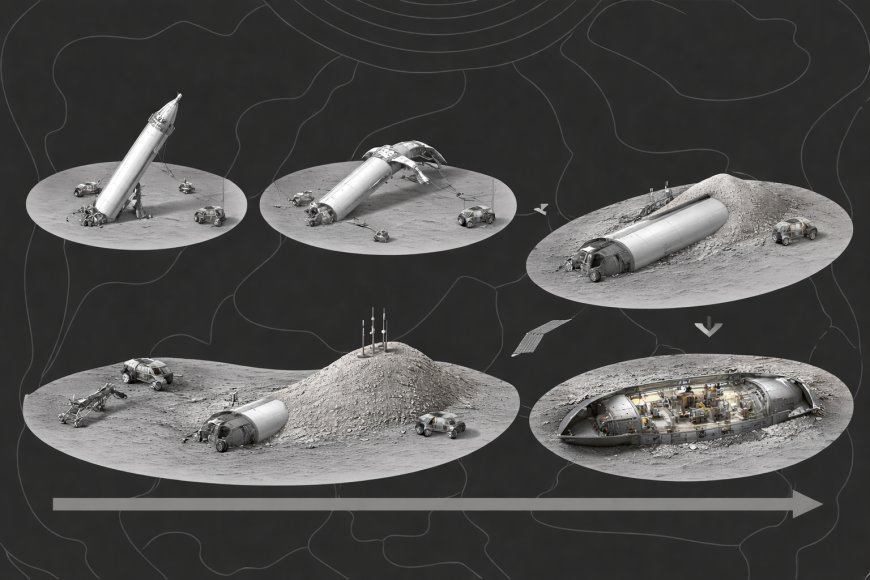
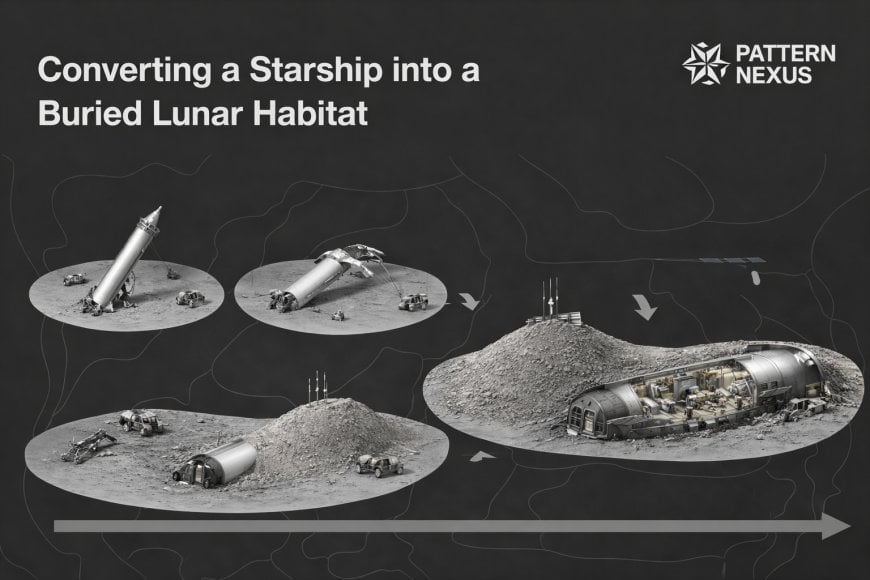
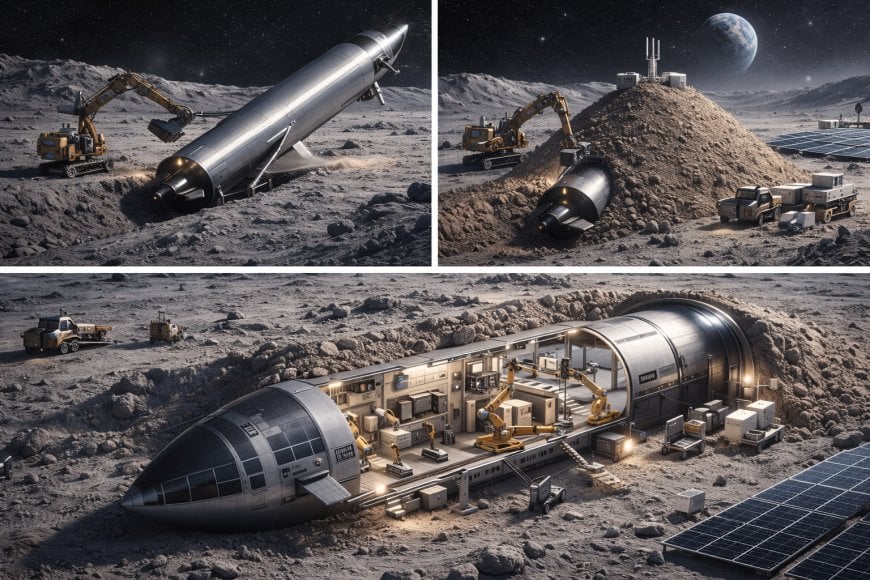
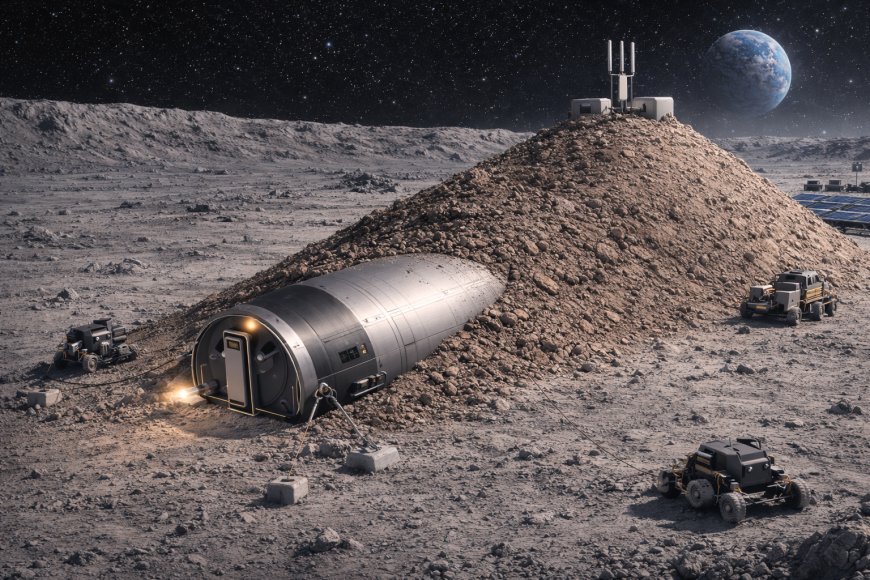
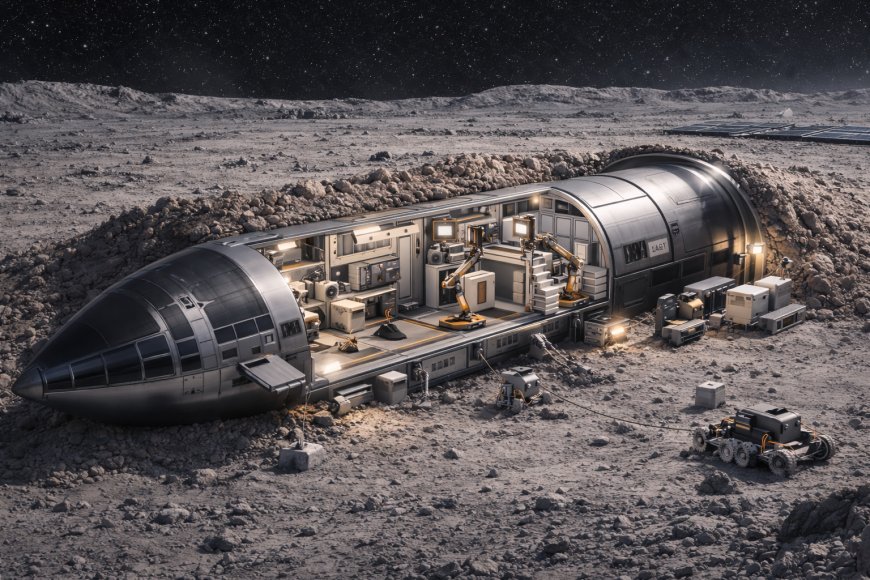
The images above are not aesthetic renders. They depict the only sequence that actually makes sense under lunar physics.
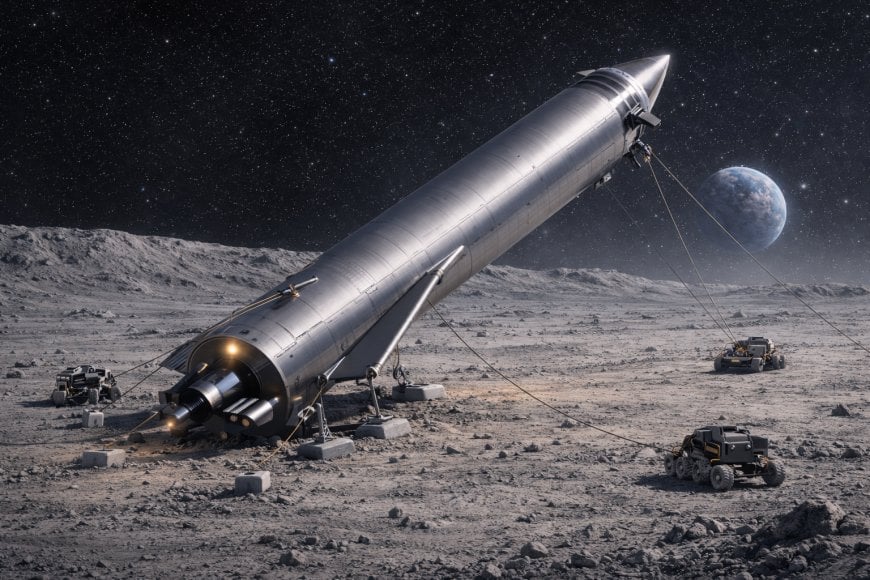
Step one: Starship lands vertically using minimal plume interaction zones, anchored with surface restraints to prevent tip-over during unloading.
Step two: The vehicle is deliberately laid down or partially trenched. This reduces vertical exposure, simplifies access, and prepares the hull for regolith shielding.
Step three: Autonomous excavation units push regolith over the hull, creating a multi-meter radiation and thermal shield. No concrete. No domes. Just mass.
Regolith burial is not optional. Without it, long-duration crews absorb unacceptable radiation doses and experience extreme thermal cycling.
The stainless steel hull provides pressure integrity. The Moon provides shielding.
This is civil engineering, not habitat design.
Once buried, internal reconfiguration begins: life support racks, power distribution, storage bays, and robotic work cells. The ship transitions from spacecraft to static asset.
Why Starship Changes Lunar Economics
Starship collapses the marginal cost of lunar mass delivery by roughly an order of magnitude compared to legacy architectures.
One Starship delivers more pressurized volume than the entire International Space Station — in a single launch sequence.
- 600+ cubic meters of pressurized volume
- Over 100 tons of surface payload capacity
- Integrated airlocks and cargo handling
- Refueled in orbit, not launched fully loaded
This breaks every historical lunar bottleneck: crew size, redundancy, construction pace, and spares availability.
Artemis plugs into this whether NASA acknowledges it explicitly or not. Starship HLS is functionally the first permanent surface structure — not a lander.
Once landed, it becomes inventory.
The Real Constraints: Power, Dust, and Continuity
The Moon’s limiting factor is not mass delivery. It is operational continuity.
Even the so-called peaks of eternal light experience multi-day darkness. Solar alone does not close the loop. Batteries scale poorly at lunar base loads.
That is why nuclear fission sits quietly at the center of every serious Artemis power plan.
Dust is the second killer constraint. Starship plume interactions eject regolith at ballistic velocities, threatening optics, seals, radiators, and nearby ice deposits.
Landing zone separation, terrain berming, and sacrificial shielding are not optional details — they determine whether a base survives its own logistics chain.
This is why south-pole site selection matters more than aesthetics or symbolism.
Pattern Nexus Lens
Moon Base Alpha is not about exploration.
It is about control layers.
Whoever controls lunar power generation, landing corridors, refueling cadence, and surface logistics controls access to cislunar space.
The Moon becomes a gate — not a destination.
Starship made the Moon cheap enough to matter. Everything else cascades from that.
FAQ
Is Moon Base Alpha officially approved?
No. But Artemis plus Starship make it structurally inevitable.
Why the lunar south pole?
Power continuity, thermal stability, and access to water ice.
Is this really about Mars?
Yes. The Moon is the rehearsal environment for off-world permanence.
Sources
- NASA Artemis Program
- SpaceX Starship
- NASA Fission Surface Power
- Casey Handmer – Lunar Engineering Analysis
Mi a reakciód?
 Tetszik
0
Tetszik
0
 Nem tetszik
0
Nem tetszik
0
 Szeretet
0
Szeretet
0
 Vicces
0
Vicces
0
 Hűha
0
Hűha
0
 Szomorú
0
Szomorú
0
 Mérges
0
Mérges
0

Founder of Pattern Nexus. I research markets, macro, geopolitics, AI, history, ancient systems, and the patterns most people overlook. I’m also building Market Radar, a trading scanner designed to read pressure, risk, confirmation, and setup quality before chasing a move. Pattern Nexus is where I connect the dots between data, history, technology, and the bigger system playing out around us.














Hozzászólások (0)