
Markets Drop as Bank CEOs Warn of Pullback, Gold Slips, and Shutdown Risks Grow — Nov 4, 2025
U.S. stocks sold off on Nov 4 2025 as top Wall Street CEOs warned of a market pullback, bonds rallied, gold struggled, and investors braced for a U.S. government shutdown that may cut food aid in December. Japan's rally drew fresh 1980s bubble comparisons; tech leadership narrowed as volatility ticked up.
Markets Slide as Bank CEOs Warn of Pullback; Gold Slips; Shutdown Drags On – Nov 4, 2025
A day after last week’s Fed cut dominated the narrative, financial markets spent Tuesday under a shadow of caution. U.S. stocks sold off sharply as Wall Street heavyweights warned of a looming correction, the dollar surged to multi‑month highs, and safe‑haven demand drove Treasury yields lower. Meanwhile, gold struggled, Japan’s historic rally rekindled bubble memories, and Washington’s shutdown threatened to keep vital economic data and food benefits off the table.
U.S. Market Recap: Bank Warnings Send Stocks Tumbling
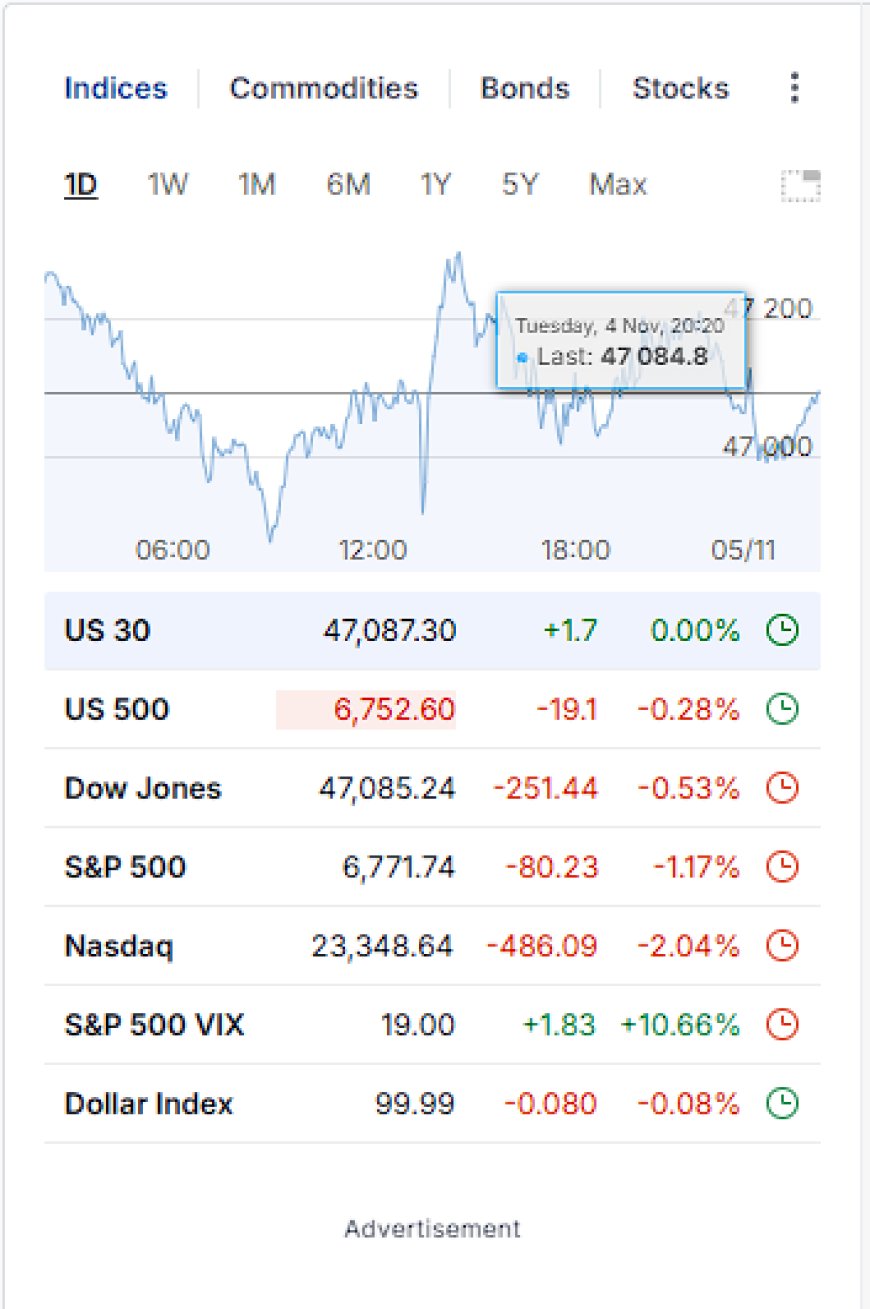
Major equity benchmarks retreated decisively. The Dow Jones Industrial Average fell 0.53%, the S&P 500 slid 1.17% and the tech‑heavy Nasdaq Composite dropped 2.04%, its biggest one‑day decline since early October. Semiconductor shares were hit hard: the Philadelphia semiconductor index slid 4%, with Nvidia and other AI names retreating after months of relentless gains. Palantir tumbled 8% despite upbeat guidance, while Uber fell 5% on a profit miss.
The sell‑off came after CEOs of Goldman Sachs and Morgan Stanley sounded alarms about stretched valuations and the risk of a market bubble. Their warnings stoked fears that the artificial‑intelligence‑led rally could unwind. Big Tech weakness dragged on the Nasdaq, while financials were the only bright spot, reflecting a shift out of growth into more defensive positioning.
Bonds Rally, Dollar Jumps, Gold Slips
Risk‑off sentiment sent investors into U.S. Treasuries, pushing yields lower; the benchmark 10‑year note yield dipped to around 4.09%.. The flight to safety also boosted the U.S. dollar, which climbed to a four‑month high against the euro. The dollar’s strength knocked spot gold down 1.7%, to roughly $3,934 per ounce, highlighting how the metal struggles when interest‑rate expectations are in flux.
The energy complex weakened as well: U.S. crude settled at $60.56 and Brent at $64.44, each down about 0.7%. Oil’s slide, combined with renewed dollar strength and fading rate‑cut bets, kept pressure on commodity‑linked currencies. The euro fell for a fifth straight session and sterling stumbled after the UK finance minister warned of budget “hard choices”.
Connecting Back to Our Recent Posts
Tuesday’s action reinforced themes we’ve been highlighting. Our Oct. 29 wrap pointed out that the Fed’s quarter‑point cut created as many questions as answers, with bonds quietly signalling that more easing is likely. On Oct. 30 we noted that bonds were “not playing ball” as yields climbed back above 4.10% amid doubts about the Fed’s commitment to further cuts. Now, risk aversion has sent yields lower again, underscoring just how jittery the fixed‑income market remains.
We also warned that narrow breadth — with AI megacaps masking weakness under the hood — left stocks vulnerable. Tuesday’s sell‑off shows what happens when investors decide to take profits in over‑loved names. The high‑profile caution from bank chiefs served as the catalyst.
Japan: Bubble Memories and BOJ Warnings
Japanese equities have been on a tear all year, breaking above the 1989 bubble‑era peak and stirring memories of the country’s wild 1980s boom. A February Reuters feature recalled that during that bubble “everyone in the country seemed to be a stock market millionaire,” Tokyo car parks were worth more than New York’s Central Park and the Nikkei rocketed from around 6,867 in 1980 to 38,915 by decade’s end. Land prices in Tokyo’s Ginza district surged 58% in 1987 to roughly $230,000 per square metre, and capital gains from stocks and real estate that year equalled 40% of GDP. When the bubble burst, bad loans and deflationary pressures ushered in decades of stagnation.
Today’s rally looks healthier but still warrants caution. The Nikkei 225 is up about 24% this year, buoyed by corporate reforms and foreign inflows. However, the Bank of Japan’s semi‑annual report in October flagged early signs of overheating and warned that foreign hedge funds’ rapid position adjustments could amplify volatility. Memories of the late‑1980s euphoria — when a golf club membership cost ¥500 million and property values eclipsed those of whole U.S. states — remain a cautionary tale.
Government Shutdown: December Looms, Food Assistance on the Brink
The ongoing U.S. government shutdown is now in its fifth week, making it the second‑longest on record, and could soon set a new benchmark. One worrying consequence: the Department of Agriculture has said that, without a funding resolution, the Supplemental Nutrition Assistance Program (SNAP) — which provides monthly benefits to more than 41 million Americans — cannot be paid for December. The agency already warned In late October, USDA officials warned that “the well has run dry,” signaling that November SNAP benefits would not be funded due to the shutdown. While some disbursements still went out in certain states, the process was chaotic and uneven. Governors in Louisiana and Virginia declared emergencies to support food banks as families braced for missed payments. A federal judge has since ruled the suspension illegal, but the ruling created more confusion than clarity — beneficiaries remain unsure whether payments will continue in November or be interrupted again.
Senate Majority Leader Chuck Schumer has already warned that the shutdown could extend deep into November and potentially into December, leaving SNAP funding for December completely unfunded. Economists say the direct macro impact is modest, but the compounding stress on 40+ million low-income households, plus delayed government data and broader uncertainty, arrives at the worst time possible — right as holiday-season consumer spending becomes critical to economic momentum.
Looking Ahead
After Tuesday’s jolt, investors face a landscape where valuations remain rich, policy signals are ambiguous and geopolitical tensions simmer. AI enthusiasm and corporate reforms continue to buoy select markets — but as Japan’s history reminds us, exuberance can turn on a dime. Meanwhile, U.S. political dysfunction threatens both economic data flow and critical social safety nets. As we head deeper into November, bond markets and safe‑haven flows may serve as the best barometer of whether another leg lower or higher awaits.
Sources
- Reuters – Stocks fall after recent rally; dollar hits four-month high vs euro
- Reuters – Wall Street ends lower as bank CEOs warn of possible pullback
- Reuters – US Department of Agriculture says no food aid benefits will be issued on Nov. 1
- Reuters – US economy at risk of wobble as lower-income consumers get squeezed
- Reuters – Food aid for 42 million imperiled by shutdown politics
- Reuters – Senator Schumer sees US shutdown stretching into November
- Reuters – Japan's crazy 1980s bubble a dim memory as Nikkei hits record high
- Reuters – BOJ sees signs of overheating in Japan's stock market
Apa Reaksi Anda?
 Suka
0
Suka
0
 Tidak Suka
0
Tidak Suka
0
 Cinta
0
Cinta
0
 Lucu
0
Lucu
0
 Wow
0
Wow
0
 Sedih
0
Sedih
0
 Marah
0
Marah
0

Founder of Pattern Nexus. I research markets, macro, geopolitics, AI, history, ancient systems, and the patterns most people overlook. I’m also building Market Radar, a trading scanner designed to read pressure, risk, confirmation, and setup quality before chasing a move. Pattern Nexus is where I connect the dots between data, history, technology, and the bigger system playing out around us.










Komentar (0)