
The Dollar’s Last Stand: Why the System Squeezes Before It Breaks
The dollar doesn’t collapse when it’s weak — it spikes under maximum strain. This is the final squeeze phase of the global monetary system before transition. When reserve systems end, they don’t fade — they compress, surge, and then reset. Inside: charts, cycle mechanics, and how this ties into gold, housing, QE, sovereign debt, and de-globalization.
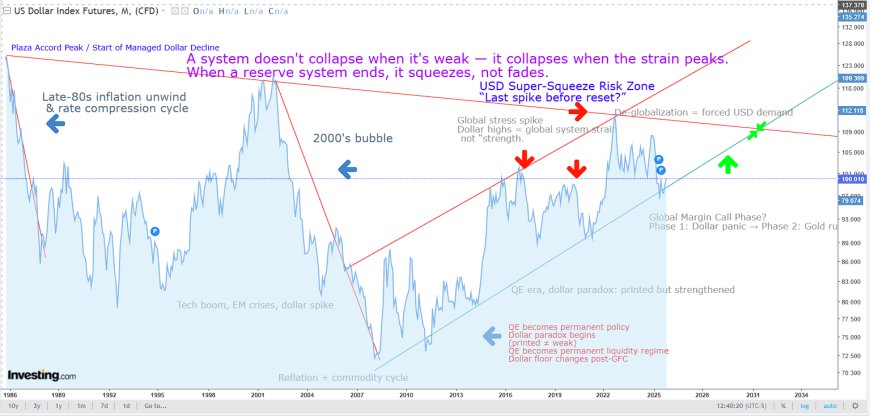
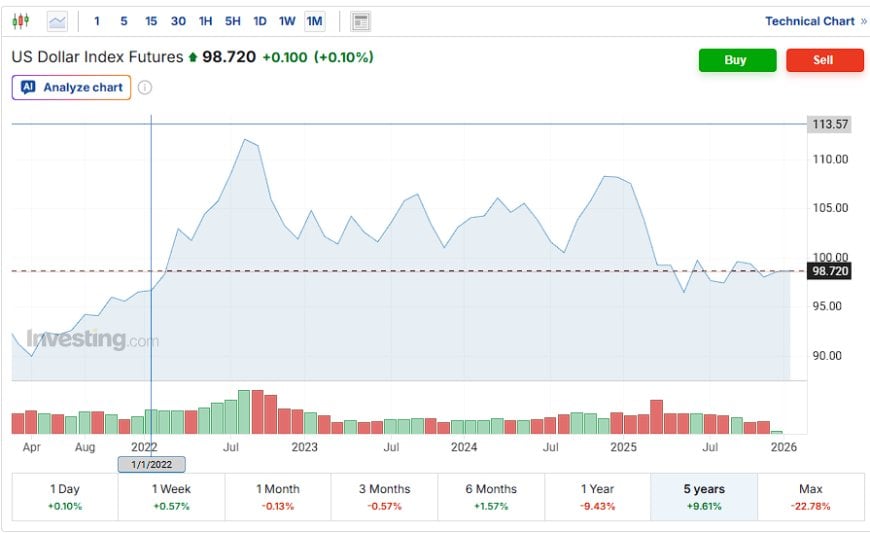

The key change is not a “breakout” in the dollar—it’s confirmation that the system is still operating inside the compression regime. DXY futures have been grinding higher short-term while sitting well below the post-2022 extremes. Recent print on the tape is roughly 98.7–98.8, with a mild weekly lift (~+0.6%) and modest 6-month firmness (~+1.6%), while the 1-year window remains notably lower (~-9%).
Translation: this is not yet the “super-squeeze” phase. It is the pre-squeeze posture—range behavior and intermittent USD bids that show up whenever risk, funding, or policy uncertainty rises. That posture matters because it keeps the scenario map intact: the next dollar spike, if it comes, is most likely to arrive as a funding/settlement event—not as a clean macro “strong economy” story.
“Strong dollar” narratives are usually wrong. The dollar tends to firm when global balance sheets are tightening—because settlement and collateral preference is rising.
The real risk is not a gradual dollar fade. The real risk is a spike that forces emergency plumbing: facilities, swap lines, collateral interventions, and a political rewrite.
The transition won’t arrive by consensus. It arrives by necessity—when legacy rails fail to clear flows without repeated crisis responses.
Thesis: The Dollar Doesn’t Die in Weakness
The popular story says the dollar collapses when America looks weak, overextended, or politically unstable. That story is emotionally satisfying—and historically unreliable.
Reserve systems don’t dissolve because they are disliked. They end when the burden of global settlement and collateral demand breaks the plumbing itself. The final phase looks like strength because the system is forcing capital into the core currency as the periphery loses funding elasticity.
A system doesn’t collapse when it’s weak. It collapses when the strain peaks. Reserve regimes typically end with a squeeze phase—then a reset.
The regime sequence tends to rhyme:
- Global capital rushes into the core settlement currency (liquidity preference)
- Funding stress rises across the periphery (basis, FX pressure, reserve drawdowns)
- Policy is forced into structural interventions (facilities, swaps, targeted backstops)
- Confidence breaks in the legacy rails and the alternative rails scale under crisis pressure
The Chart: Structural Compression
This report is not a USD “bull case.” It’s a stress map: what reserve systems do when they approach a constraint.
The “compression” concept is simple: a long-run structural ceiling (decades of managed and geopolitical pushback) meets a post-crisis structural floor (the world’s dependence on USD settlement and collateral). As those bands converge, the system becomes more prone to disorderly spikes.
A dollar high is often misread as “US strength.” In practice, it more often reflects global strain: forced deleveraging, collateral demand, and the scramble for the settlement asset that clears obligations.
With DXY still below the post-2022 peak regime and recently behaving as a mild grind rather than a spike, the system is signaling “compression continues,” not “breakout now.” That preserves the core framework: the squeeze tends to arrive as an event.
Cycle Mechanics: Why Spikes Mean Stress
Complex systems rarely transition smoothly. They compress, become brittle, then break along a constraint—after which the system reorganizes around a new set of rails.
In reserve regimes, the “brittleness” comes from the mismatch between:
- Global demand for USD settlement and collateral
- Finite dealer balance sheets and constrained intermediation
- Political objectives that conflict with purely financial clearing
- New security corridors that fragment liquidity and increase friction costs
The squeeze phase is not a victory lap. It’s the moment the system reveals its dependence on the core currency—by forcing everyone to bid for it at once.
QE & the Dollar Paradox
The most common error is: QE equals “money printing,” therefore the dollar must weaken. That assumes QE is primarily a spendable cash flood.
In the modern system, QE often reinforces USD centrality by stabilizing the collateral chain and keeping the settlement asset dominant—especially when the rest of the world is structurally short dollars during stress.
A policy that looks like “abundance” in headlines can behave like “scarcity” in plumbing if it concentrates settlement rails, collateral preference, and balance sheet dependence.
This is why the next spike, if it comes, is likely to trigger targeted interventions (repo operations, standing facilities, swap lines, collateral substitutions) rather than clean, broad easing.
The Global Margin Call Pathway
The margin call narrative is not metaphorical. It describes a mechanical process: liabilities that clear in dollars meet tightening funding conditions, widening hedging costs, and reduced risk capacity.
The pathway typically looks like this:
- USD bid rises as risk capacity tightens
- Cross-currency basis and funding premia widen
- Reserve drawdowns accelerate in stressed regions
- Treasury market depth deteriorates at the worst moments
- Policy steps in with targeted plumbing tools
- The system resets—often by accelerating alternative rails
The update section matters here: when the dollar is quietly firming inside a range, it often signals that the stress is not “resolved,” only deferred. The big move tends to arrive when an external shock collides with thin intermediation.
Signals to Watch
These are the real-time tells that the system is transitioning from “compression” into “squeeze.”
- DXY behavior: persistent upside with rising volatility (grind becomes lurch)
- Cross-currency basis: widening funding stress (dollar premium)
- EM FX + reserves: drawdowns paired with reserve decay
- UST liquidity: weak depth, sloppy auctions, larger tails
- Repo specials: collateral scarcity showing up in rates and availability
- Facility signals: sudden operational changes, expanded terms, or unusual usage
- Gold paradox: gold holding firm alongside a firm dollar (stress signature)
The squeeze phase is not “strong USD, weak everything.” It’s “strong USD plus broken market microstructure.” Watch plumbing indicators, not headlines.
Scenario Map
Base case (compression persists): DXY remains range-bound with intermittent upside shocks. Volatility clusters around auctions, funding windows, and geopolitical stress pulses.
Squeeze case (event-driven spike): a funding shock or market-depth break produces a fast move higher, followed by emergency plumbing and a political settlement response. This is the classic “spike before reset” behavior.
Soft case (delayed transition): relief in growth and energy plus coordinated policy keeps the dollar contained. Compression continues, but the break window stretches rather than disappears.
The Next Monetary Architecture
The post-squeeze world is not one new currency replacing the dollar overnight. It’s a layered architecture: alternative settlement paths, regional liquidity pools, commodity-linked invoicing in corridors, tokenized rails, and more explicit security-driven financial alignment.
The key point is timing: the alternative rails scale fastest during stress, not during calm. The squeeze creates the mandate for adoption—because the legacy rails become politically and financially costly to depend on.
The “last stand” is not the dollar winning forever. It’s the dollar forcing one more consolidation of dependence—before the rewrite accelerates.
Pattern Nexus Lens
Think of the dollar as a control layer: settlement authority, collateral preference, and enforcement capacity embedded in rails. As geopolitical fragmentation rises, the rails become more valuable and more contested at the same time. That produces the paradox: the system pulls toward the dollar under stress even as long-run incentives push away from it.
The next dollar spike should be read as a system signal, not a trade signal. It’s the fingerprint of a settlement architecture hitting a constraint.
FAQ
Does a rising dollar always mean risk-off?
Not always. But when the dollar firms alongside visible plumbing stress (basis widening, weak UST depth, facility adjustments), it is often a risk-off or funding signal rather than a growth celebration.
Why can the dollar rise even if the US looks unstable?
Because the mechanism is settlement and collateral demand. In stress, the system prioritizes what clears obligations, not what looks politically clean.
What would invalidate the “squeeze then reset” framework?
A long period of stable, deep market functioning with declining funding premia, improving UST liquidity, and falling geopolitical fragmentation—without recurring emergency interventions. In other words: the plumbing would have to heal structurally, not just temporarily.
Sources
Links below support the plumbing concepts referenced: dollar index basics, funding stress indicators, Treasury market function, and related Pattern Nexus frameworks.
- ICE: U.S. Dollar Index Futures (DXY) product overview
- New York Fed: SOFR reference rate
- New York Fed: Repo operations and policy implementation
- Federal Reserve: H.4.1 balance sheet (factors affecting reserve balances)
- BIS Quarterly Review: Global dollar funding and FX swap markets (background)
- Pattern Nexus: Reverse Repo Trap
- Pattern Nexus: QT Is Over — Reserve Floor
- Pattern Nexus: End of the Bond Supercycle (2020 Regime Shift)
Apa Reaksi Anda?
 Suka
0
Suka
0
 Tidak Suka
0
Tidak Suka
0
 Cinta
0
Cinta
0
 Lucu
0
Lucu
0
 Wow
0
Wow
0
 Sedih
0
Sedih
0
 Marah
0
Marah
0

Founder of Pattern Nexus. I research markets, macro, geopolitics, AI, history, ancient systems, and the patterns most people overlook. I’m also building Market Radar, a trading scanner designed to read pressure, risk, confirmation, and setup quality before chasing a move. Pattern Nexus is where I connect the dots between data, history, technology, and the bigger system playing out around us.














Komentar (0)